
By Roselyn Fauth

Gates of the timaru cemetery. A newspaper article states that iron gates were gifted by Mr Richard Turnbull. His grave and monument are in the center of these gates on the lawn. - Photo Roselyn Fauth 2025. paperspast/THD18691204.2.9
Timaru never had graveyards, (churches with burial plots onsite). From the early years of European chapter our dead were laid to rest in public cemeteries shaped by surveyors, local boards, government acts and, later, the council. Our story is written into the land itself. Here is how it unfolded.
From the 1860s onward, every province in New Zealand had some version of “Free Ground,” “Public Grave,” “Government Burials,” or “Charity Burials” for those who could not afford fees. These areas were not only for the destitute. They also became the resting place of stillborn children, new immigrants far from kin, sailors and labourers, people who died in hospitals, gaols or asylums, and many women with limited means — unmarried mothers, widows and orphans. Some who were buried in Row 0 received help; some could not afford it; others had no friends or family to bury them. Whatever the circumstance, the rules were the same for everyone.
In 1876 the Abolition of the Provinces Act became operative and in 1877 the Cemeteries Management Act was passed. This was New Zealand’s first piece of national burial legislation. It gave the Governor power to make appointments to Boards of Trustees to administer cemeteries. It specified the exclusive right of burial, the erection of tombstones, and the burial of poor persons. The administrative oversight for the cemetery was by the Levels Road Board and the Canterbury Provinical Government.
While the spiritual and cultural practices would have been recognised, I guess the priority would have been mostly influenced by public health concerns at the time.
In the 1860s the Timaru cemetery burials were recorded by St Mary's Anglican Church. Then the first council cemetery managers would have come in around 1871-1881 to enforce regulations. In the Canterbury Provincial Gazette of 13 December 1870, the first Managers of the Timaru Cemetery Reserve were formally appointed: Samuel Hewlings, Henry John Le Cren, Edward Glaves Stericker, Herbert Belfield, and George Healy. On 6 April 1871 the Regulations for the Management of the Timaru Cemetery were published in the Gazette, setting out how the reserve was to be run. These regulations allowed burial costs to be waived if the Managers were satisfied that neither the deceased nor any responsible person had the means to pay. At the same time, they made clear that no monument could be erected unless an “exclusive right” to a plot had first been purchased, establishing the principle that memorialisation required payment even when burial itself did not.
This put a line between those who could pay and those who could not. From 1871 a person buried in the Free Ground had no legal claim to the soil above them, even if their relatives were loving and attentive. They could not fence the grave, could not set a permanent marker, and even a modest headstone was forbidden unless the burial fees were later repaid.
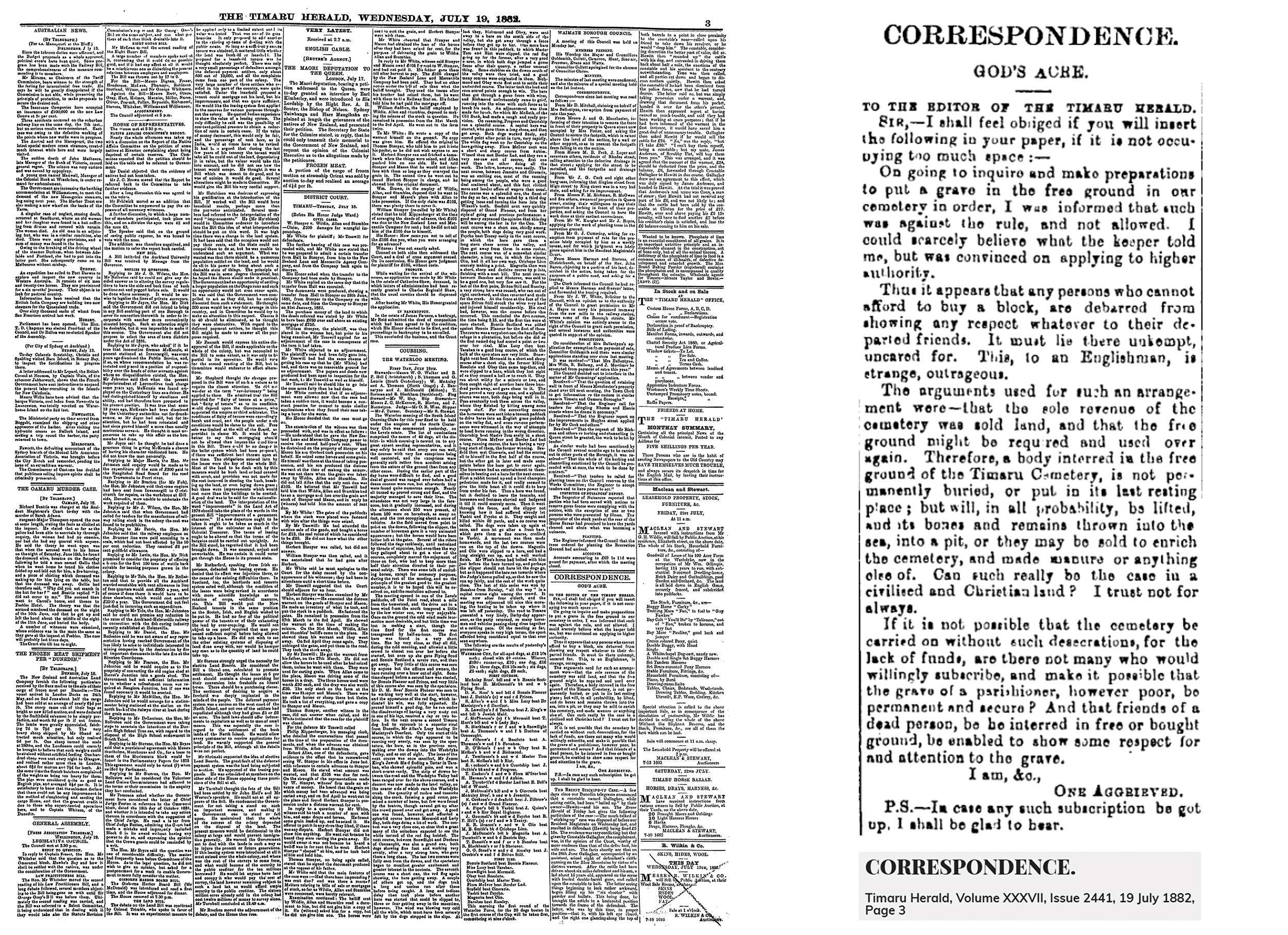
By 1882, this was causing so much distress that a grieving Timaru resident wrote to the newspaper as “One Aggrieved”, protesting that friends of the poor were “debarred from showing any respect whatever to their departed friends” in the Free Ground. They feared that the bodies might later be lifted and their bones thrown into a pit when the land was needed again. The Timaru Herald confirmed that, because no money had been paid, the Cemetery Board kept “all rights over the graves in the free ground”, and the plots could indeed be reused. At the same time, the editor seems to have sympathetically sided with the families, asking why the friends of the poor could not at least keep the graves neat or plant flowers “as a labour of love” without that being taken as a legal claim. paperspast/THD18820719.2.26
This is the hard truth at the heart of the Free Ground. The poorest or most isolated people in Timaru were buried by charity and by law, but the system denied their families any lasting way to mark their loss. So the wide lawns and “empty” corners of the cemetery that you see in Timaru are not empty at all. They are the resting place of those whose grief and love simply did not come with a receipt.
The first recorded burial according to the Timaru Cemetery Database online in the Free Ground "row 0" was for George Miller, aged 30. He was buried on the 27th February 1863. Since the first burials at the Timaru Cemetery over 160 years ago, this area has had no general area signage or monument. So in 2025 the community fundraised to create a monument which to be unveiled 10am Sunday 14th December 2025.
Nothing survives above ground of George's grave... no headstone, obituary or newspaper notice, which seems to be typical of early Free Ground burials in a small, port town of about a thousand people. His name appears just ahead of other early burials such as William Peters in April 1863 and Cornelius O’Connor in July 1863. George stands as an early example of how people were laid to rest under rules that allowed burial but not memorial...
Here is my deep dive into the history of the cemetery and the legislation for those in row 0, and why I was motivated to create a monument - it wasn't about correcting family neglect. It was about correcting structural erasure built into NZ law.
You can look up those who were buried in row 0, under the advanced tab of the Timaru Cemetery database online: timaru.govt.nz/cemetery-search
There were two Cemetery Reserves, but only one was ever used
According to the original 1859 survey, Timaru began with two cemetery reserves, laid out just a month before the Strathallan arrived.
John Henry Whitcombe (Provincial Surveyor), created the 1859 survey that laid out Timaru township. Under his authority, Reserve 165 and Reserve 166 were designated as cemetery reserves. This is the earliest official action relating to burial land in Timaru.
1. Reserve 165 – the Southern Cemetery (the one still used today) Located on the town belt near today’s Domain Avenue, across from the Botanic Gardens. Early records show it was originally marked for Anglicans, although burials here were never strictly limited by denomination.
2. Reserve 166 – the Northern Cemetery (never used) On the corner of Wai-iti Road and Selwyn Street, on what later became the Beverley Estate. According to Levels Road Board records, it was divided on paper into Wesleyan, Presbyterian, and Catholic sections. Despite its careful planning, no one was ever buried there. Timaru District Council later confirmed it was never opened. By the early 1880s the Cemetery Commissioners were already proposing to sell it. Both reserves still appear on Canterbury Maps and Recollect, ghost-shadows of a plan that never came to life. I wonder why.
Timaru had been burying its dead for two decades by the time Reserve 166 was formally recognised. A Timaru Herald report (20 September 1881) noted that Superintendent William Rolleston officially proclaimed Reserve 166 as a cemetery in 1879, calling it the Timaru North Cemetery. This confirmed:
- Reserve 165 as the original cemetery in use since the 1860s
- Reserve 166 as the “new” cemetery for future expansion
- That 1879 decision formalised what had already been happening informally: Timaru needed more space, and the older ground had been filling for two decades.
Before Timaru had a council, cemetery responsibility was shared:
Levels Road Board (1860s–1870s)
- The earliest local body with administrative roles in the district.
- Their minutes refer to Reserve 166 being divided into denominational sections on paper.
- They were part of the administrative chain that oversaw reserves before formal cemetery boards existed.
Canterbury Provincial Government (1853–1876)
- Held legal control of all cemetery reserves.
- Approved regulations, fees, and rights of burial.
- Published the 1871 Timaru Cemetery Regulations (your blog cites them accurately).
- Gave managers authority to remove unauthorised headstones and set rules for pauper burials.
These groups provided policy, not day-to-day management.
The Burial and Cremation Act 1964 moved responsibility to Timaru District Council who took over management, records, maintenance, and new burials, which still continues today.
The First Recorded Burials: Deal Boatmen Lost at Sea
According to local maritime histories, the cemetery’s first recorded burials were two surf-boat men from Deal, Kent — brought to Timaru in 1859 to run the dangerous landing service in the days before the breakwater.
On 6 October 1860, Morris Clayson Cory and Robert Boubius (Bowbyes) drowned during a rescue attempt off the open beach. Their burials are the earliest known for the Timaru Cemetery. Cory received a headstone. Bowbyes did not. Our cemetery began with working men who lost their lives in the service of the port.
Before the Cemeteries Act 1882
Prior to 1882, New Zealand had no national system for managing burials. Each province (and later each local board) made its own rules, and these rules shaped the cemetery landscape far more than people realise today. Timaru, like most towns, never had church graveyards; burials went straight into public cemeteries laid out by surveyors and run by local committees. This meant that from the 1850s to the early 1880s, burial practices were uneven, lightly regulated, and strongly influenced by ideas imported from Victorian Britain about class, property, and respectability.
In Canterbury, the key law was the Cemetery Reserves Management Ordinance 1870, which allowed cemetery managers to use cemetery funds to bury poor people but required families to purchase an exclusive right if they wished to mark a grave. Managers could even remove any monument erected without payment. These ideas created the system known as the Free Ground, where people who could not pay were buried without any permanent right to the land. Their graves could not be fenced, planted, or marked unless the family later raised the money to buy the plot. Timaru followed these rules closely: the 1871 regulations required payment for any monument, formalising the divide between the dead whose families could afford memorials and those who would be laid to rest in grassed-over anonymity.
When provincial government was abolished in 1876, the system became even more fragmented. The stop-gap Cemeteries Management Act 1877 recognised free burials and exclusive rights but did not create national standards or guarantees of dignity. Local trustees continued to run cemeteries according to their finances and priorities. This is why conditions varied so widely — Timaru’s cemetery was famously described in 1873 as “a disgraceful piece of public property,” with pauper graves disappearing almost instantly into weeds and tussock. Everywhere in New Zealand, people buried in the Free Ground were legally buried, yet socially and visually forgotten.
By the early 1880s, this inequality was provoking public anger. In 1882 a Timaru mourner, writing as “One Aggrieved,” complained that families were forbidden from tending Free Ground graves and feared that bodies might later be disinterred and the bones thrown into pits. The Timaru Herald confirmed that cemetery boards held all rights over pauper graves because no money had been paid. It was this growing discontent — expressed not just in Timaru but across the country — that finally pushed Parliament to pass the Cemeteries Act 1882, the first true national burial law. Yet even that Act would retain the core structure created earlier: free burials for the poor, and lasting memorial rights only for those who could afford to buy them.
After 1876: There was no national cemetery law.
When provinces were abolished in 1876, control shifted to local boards and trustees. The government passed a stop-gap law, Cemeteries Management Act 1877. This Act: Formalised exclusive burial rights, allowed monuments only on paid plots, required trustees to allow free burials but did not require dignity or permanence and it did not create national standards. The 1877 Act did not solve the problem. In fact, I think it entrenched the inequalities that Free Ground families complained about.
Free Ground and Government-Paid Burials
One of the earliest documented government-paid burials was Cornelius O’Connor, interred in Row 0, Free Ground, on 14 July 1863. Free Ground was designated for those unable to pay burial fees.
According to the 1871 regulations published in the Canterbury Provincial Gazette (Parliamentary Library report, p. 2):
- Burial costs could be waived if the deceased or their family had no means.
- Headstones were not permitted unless an exclusive right to the plot was later purchased.
This rule shaped Timaru for generations. As the Parliamentary Library summary states, managers were empowered to “expend cemetery finances on the burial of poor persons,” but monuments could only be erected upon payment of fees (report p. 2). This is why wide areas of the cemetery appear empty today — they are not. They hold hundreds of unmarked burials: labourers, infants, immigrants, the poor, the voiceless. Buried with dignity but not memorialised.
Essentially... Poor people could be buried, but they could not be remembered.
By the early 1880s, newspapers across NZ, including rural towns like Timaru were filled with complaints.
- Families forbidden from tending Free Ground graves
- Fear that bodies could be disinterred
- No right to fence, plant, or mark
- Poor and working families denied basic dignity
The 1882 Act was the first attempt to fix this. Though, as you now know, even that Act did not give pauper graves lasting rights.
By the early 1880s, trustees were replaced by a formally constituted board under national legislation.

Cemeteries Act 1882. This was the foundational cemetery statute for New Zealand. This Act: Applied to all cemeteries except Māori urupā. Required trustees to bury poor persons free of charge by order of a Justice. Created the system of exclusive rights (purchasable). Regulated monuments, vaults, and cemetery layout. Became the legal basis of cemetery management for the next 80 years. This is the Act that directly explains why pauper graves went unmarked in NZ. https://www.nzlii.org/nz//legis/hist_act/ca188246v1882n39190.pdf
The Cemeteries Act 1882
This consolidated and updated New Zealand’s laws relating to public cemeteries and burial grounds. It defined cemeteries as places set aside for the interment of the dead, regardless of denomination, and confirmed that all existing public cemeteries and burial grounds were to be treated as though established under the Act. The law set out how cemeteries were to be governed, managed, and regulated, and who held legal authority over them. Trustees, appointed by the Governor or by virtue of local authority control, were given responsibility for cemetery land, funds, and administration. They were required to maintain the cemetery, regulate burials, approve monuments, set fees, keep accounts, and ensure that the grounds remained in good order. All burials were required to be registered, and disinterment was prohibited without a licence from the Colonial Secretary.
The Act allowed trustees to sell exclusive burial rights and to set aside portions of cemeteries for religious denominations, which could then consecrate and manage their own sections through appointed guardians. Local authorities were required to provide a suitable public cemetery if no adequate provision existed or if an existing cemetery was closed. They were empowered to purchase or acquire land, borrow money, dedicate land as a cemetery, and, if appointed as trustees, hold all property and revenues relating to the cemetery. Burial grounds not classified as public cemeteries were granted similar powers through their managers.
To protect public health and order, the Act required cemeteries to be fenced, drained, and properly maintained, and it prohibited burials beneath or close to chapels. It set penalties for vandalism, indecency, pollution of waterways, trespassing animals, and breaches of cemetery regulations. The Governor in Council was empowered to close cemeteries once a new one had been provided, and closed cemeteries were to be maintained as public reserves. Existing plot owners retained certain rights, including the ability to claim an equivalent plot in a new cemetery or to continue family burials under limited conditions. The Act also permitted cremation if directed by will, restricted private burials where a cemetery was available, and required official sanction or notification for burials on private land. It concluded by repealing earlier cemetery-related laws while preserving existing rights and obligations.
The Free Ground Controversy of 1882
In July 1882, public frustration reached the newspapers. A correspondent, signing as “One Aggrieved,” wrote to the Timaru Herald protesting that families were not allowed to tend or mark Free Ground graves (report p. 4). They feared that remains might later be lifted, reused or worse — a real possibility under nineteenth-century burial law.
The paper responded the next day, stating that because families had not purchased the exclusive right, the Board retained “the sole right over the graves there” (report p. 5). Yet the editor also questioned why grieving families could not at least tidy graves “as a labour of love.”
This tension between compassion and regulation has shaped Free Ground from the very beginning.
What the Cemetery Looked Like in 1873
When Thomas Bottomley was buried in April 1873, The Timaru Herald called the cemetery “a disgraceful piece of public property.”
According to reports from that time, rank weeds covered the site, tussock grew waist-high, only a few fenced family plots were visible, the rest looked more like an unfarmed paddock. Free Ground burials disappeared almost instantly into the landscape.
But 1873 was a turning point. A newly active Cemetery Managing Board began real improvements: 2½ acres cleared and levelled, grass sown, gravel paths formed, burial mounds flattened, wheels banned from the grounds, and for the first time, a caretaker appointed. It took over a decade before the cemetery began to look like a place of respect.
Were Early Burials Divided by Religion?
According to local histories, Timaru’s cemetery eventually developed recognisable denominational pockets — Anglican, Catholic, Presbyterian, Jewish and veterans’ areas.
However:
- No early maps from the 1860s survive showing formal denominational divisions in the very first years.
- Religious influence seems to have been informal at first, then gradually strengthened as the cemetery developed.
- By the early twentieth century, the layout was clearly patterned:
- Jewish burials in the south-west corner
- Roman Catholic burials concentrated along the southern boundary
- Anglican areas clustered near the chapel and early paths.
Even after the cemetery became officially undenominational, the old patterns remain visible in its oldest sections.
The Chapel That Never Quite Found Its Purpose
The little cemetery chapel has a story of its own. It was designed by Maurice de Harven Duval, a Timaru architect active in the late nineteenth century. It hosted very few funeral services. By the mid-1900s it was being used to store the cemetery’s tractor. A post-WWI restoration proposal went nowhere. A 1935 plan to convert it into a crematorium was rejected. A Timaru Herald article from 20 April 1968 records its demolition due to structural damage and borer.
How the Cemetery Was Managed
New Zealand’s first real burial law was the Cemeteries Management Act 1877, followed by the Cemeteries Act 1882, described by the Law Commission as “New Zealand’s foundational burial statute” (report p. 5).
Key points from the 1882 Act:
- Section 16: cemeteries must be open to all, regardless of ceremony.
- Section 22: trustees must bury poor persons free of charge on order of a Justice (report p. 5).
- Sections 24–27: exclusive burial rights, monuments and vaults regulated.
This formalised Free Ground nationwide.
Trustees — later the Timaru Cemetery Board — were responsible for layout, maintenance and fees. Early twentieth-century members included John Jackson, James Mee, T. L. Harney, J. Levien and Captain G. H. Smith.
In 1897, the Board commissioned James S. Turnbull to design the cemetery’s elegant stone wall and entrance piers — landmarks still greeting visitors today.
Management transferred to Timaru District Council under the Burial and Cremation Act 1964, which largely preserved the structure of the 1882 Act (report p. 7).
Why Cemetery Records Can Be Confusing
A few things history hunters will discover:
- Cemetery rows and plot numbers were renumbered over time
- The original sexton’s books don’t perfectly match the current online database
- Headstone transcriptions from the 1970s use another system again
- So discrepancies aren’t mistakes — they’re simply layers of record-keeping over 160 years.
Some locals also recall an infant section overplanted with roses in the early twentieth century, though no formal record has yet verified this.
Today, Timaru Cemetery is home to more than 17,000 recorded burials, plus many more unmarked graves in the Free Ground. Walking through it, you can see:
- the early sections still marked by religious identity
- the work of local architects like Turnbull and Duval
- the traces of the 1873 clean-up
- the loss of the old chapel
- the graves of working families, immigrants, boatmen, soldiers and children
The cemetery is not just a place of the dead — it is one of Timaru’s special ares with links to people of our past and so much history of the town in its soil: poverty and privilege, religion and migration, civic effort, and the quiet stories of people who built a community at the edge of a coastline still marked by wind and salt.
My reflection:
NZ did not inherit Britain’s parish-church burial model. Cemeteries were placed on town belts, grids, and utilitarian reserves. This meant burial became a civic function, not a spiritual one. Cemeteries reflected the new colony’s values: efficiency, order, economics. I think this matters for Row 0, because these were civic institutions. The community itself bears responsibility for those buried without markers — not their families alone. The monument acknowledges that shared responsibility.
I feel like after this history hunt I have learned that monuments reveal our identity, belief, grief, and social aspirations. An absence of monuments reveals, marginalisation, poverty, loneliness, gendered vulnerability (widows, unmarried mothers), and perhaps colonial prejudice (migrants with no local support).
A collective monument matters because it restores dignity that the law once denied, when Free Ground graves were required to remain unmarked unless families could pay. It helps repair the structural inequality built into the cemetery’s original design, where class determined who was remembered and who vanished into the landscape. By naming the presence of those long hidden beneath the lawn, the monument makes an invisible history visible and honours the workers, mothers, infants, sailors, immigrants and isolated individuals buried there. It also fulfils a civic responsibility, acknowledging that it was the community — not the families — who controlled whether these graves could ever carry a marker. And, in answering the grief voiced in 1882 by the correspondent known as “One Aggrieved,” the monument gives the compassion that was asked for but never granted at the time.

Timaru town. NZ Heritage Maps Platform, accessed 20/09/2025, https://maps.recollect.co.nz/nodes/view/1138

Two cemetery reserves that were once in the towns survey. Left the reserve on the corner of Wai-iti Road and Selwyn Streets, and Right, the Cemetery reserve opposite the Timaru Botanic Gardens

Section of a Survey Map 1874 showing St Mary's on the corner of Church and Sophia Street. 1880 St Mary’s Church (Anglican) 328 Church Street & Sophia St
The first recorded burial was Morris Clayson Cory, a Deal boatman who drowned off Timaru on October 6, 1860. His wife Elizabeth died in 1913, aged 85 and rests in the same plot. Cory's colleague also a Deal Boatman who drowned at the same sea rescue event was burried beside him. For some reason Cory recieved a headstone, and Bowbyes did not.


Arial Photo by Whites Aviation - National Library PA Group 00080 WA 71959 F

Left: View of the Timaru Cemetery. Yellow circle is Sams grave. Right: The 87-year-old chapel at the Timaru Cemetery designed by Maurice de Harven Duval. The chapel had not been used for burial services for over 50 years, with the last conducted by Archdeacon H. W. Harper who retired in 1911. In recent years it had been used to store the cemetery's small tractor and other equipment. Structural damage, borer infestation, and weak mortar made most of the building unsalvageable, aside from the iron roof. A proposal after the First World War to renovate the chapel failed due to lack of interest, and a 1935 plan to convert it into a crematorium was rejected. There are no plans to build a new chapel at the site. - Timaru Herald, 20 Apr 1968. Timaru Cemetery Chapel Demolished (20 Apr 1968). Aoraki Heritage Collection, accessed 10/05/2025, aorakiheritage.recollect.co.nz/2037

Cemetery - 1953 - Map of Timaru - Electronic reproduction of Land Information New Zealand original University of Auckland 2013

Register of Deaths, Saint Mary's Church Timaru Parish records of deaths. Ann appears to be listed as number 12, November 18, 1860, 36 years. Photography by Roselyn Cloake with permission of the South Canterbury Museum 2025. The group included John Wilds, Morris Corey, Robert Boubius, Henry Clayson, William John Roberts and John J. Bowles. Boat handling was a perilous occupation and Henry Clayson also drowned shortly after arriving. He was replaced by Phillip Foster, another boatman from Deal.
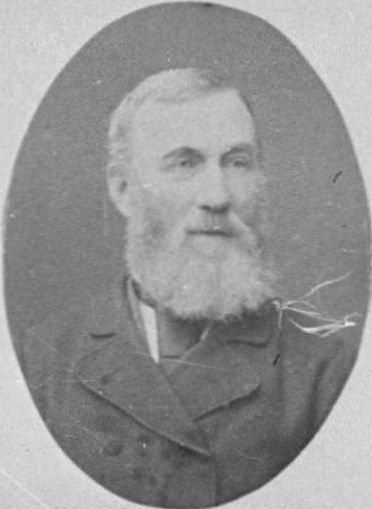
By Photographic copy of a montage of photographic portraits depicting members of the 1882 House of Representatives. All portraits taken by William Henshaw Clarke of Wellington. Copy of montage made by S P Andrew Ltd. - http://natlib.govt.nz/records/22802268, Public Domain, https://commons.wikimedia.org/w/index.php?curid=47936344
He represented the Timaru electorate from 1878 to 1890 when he died. The Cemeteries Act was enacted on 15 September 1882, during Richard Turnbull’s term as MP for Timaru (1878–1890). Parliamentarian voting records for this era were not always individually recorded, but he was present in the House during the passage of this legislation, which means it is entirely possible he voted for it unless he was absent on that day.
Turnbull was known for civic-minded and practical advocacy. His public reputation (from newspapers of the time) was of a steady, responsible representative focused on practical community matters: infrastructure, public health, roads, harbours, and orderly town development. The Cemeteries Act fits within that legislative culture.
1878–1879 6th Timaru Independent
1879–1881 7th Timaru Independent
1881–1884 8th Timaru Independent
1884–1887 9th Timaru Independent
1887–1890 10th Timaru Independent
TIMARU MUNICIPAL COUNCIL.
Timaru Herald, Volume VII, Issue 225, 24 July 1867, Page 2 paperspast/THD18670724.2.10
TO THE EDITOR OF THE TIMARU.Timaru Herald, Volume VI, Issue 185, 9 March 1867, Page 3
Sir,—You would greatly oblige me if, through the medium of your paper, you would allow me to call public attention to a matter which concerns us all. I refer to the disreputable state of our cemetery. It must shock the feelings of every one, if at all civilised, to see the confusion of the unsightly mounds scattered here and there and everywhere, without any attempt at regularity or order; so much so, that if walks were formed and the place laid out, it would be very unpleasant to those who happen to have relations buried right in the middle of the pathway. The whole place has a most miserable and neglected appearance. Numbers of the older graves have fallen in and left unsightly holes. The vegetation through the whole ground (except where small tracks have been trodden) is so strong and coarse, that it is next to impossible to go through any part of it. How painfully evident, too, is the number of newly-made graves, and how confusedly and awkwardly placed. I never could find out who were supposed to have the management of the ground. Whoever they are, they seem to have little thought or care about it. I am certain that the public would gladly subscribe to have the ground properly cleared and laid out. The cemetery is now a sad disgrace to a community such as ours, and says very little for our refinement of feeling, or even taste. The position of the ground is beautiful, and if laid out and trees planted about, there would be some satisfaction in visiting the resting-place of those we loved. I sincerely trust, now that the population of the town and district has so largely increased, and is daily increasing, that something will be done, either by the Council, or those with whom it rests.
I am, &c., MORTALITY. Timaru, March 6, 1867. paperspast/THD18670309.2.19
TIMARU AND GLADSTONE BOARD OF WORKS.
Timaru Herald, Volume IX, Issue 338, 22 August 1868, Page 2
TIMARU CEMETERY.
The following letter from the Provincial Secretary was then read:—
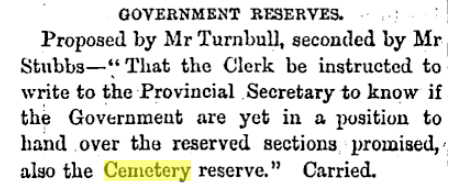
"Sir,—I have the honor to enclose a copy of a letter which I have received from Timaru, drawing the attention of the Government to the fact that part of the fence round the cemetery has been destroyed, that cattle and horses have access, trample upon the graves, and destroy the tombstones.
"The Reserve is at present vested in his Honor the Superintendent, as a public cemetery, but with a view to placing the care and management of it under local control, I should be glad if you would inform me whether the Timaru and Gladstone Board of Works will undertake the care of the cemetery, or, if not, if you would inform me what steps you would advise his Honor to take in reference to it."
The Chairman said he thought land in the cemetery had been sold—that was his impression; and if such was the case, the money derived from that source ought to be available to keep the cemetery in repair. It would perhaps be advisable to postpone any decisive answer to the letter until it was ascertained who had received the money for the land.
Mr Perry said that he had also heard of persons buying land in the cemetery for tombs. It appeared to him that the Provincial Government, if they had anything out of order in the district, they asked the Board of Works to take it over. The Borough Council in his opinion was the proper authority to have charge of the cemetery, and it was easier of access than the Board of Works, as it met oftener. Besides the cemetery was for the town only. He thought that whatever body took over the cemetery, the ground should be parcelled out to the different denominations, each denomination keeping its own ground in repair.
Mr Healey pointed out that there was a reserve for another cemetery behind the residence of Mr LeCren.
Mr Perry said that was a reserve made by Mr Rhodes, but it had not been used.
Mr Parker and Mr Matson agreed with Mr Perry that the Borough Council was the proper authority to look after the cemetery.
Mr Matson proposed—"That a sub-committee, consisting of Messrs Luxmoore, Perry, and Healey, be appointed to enquire into the cemetery reserve, and report at the next meeting."
The motion was seconded by Mr Healey and carried.
The Board then adjourned until Thursday September 3.
GOD’S ACRE. TO THE EDITOR OF THE TIMARU HERALD.
Sir, I shall feel obliged if you will insert the following in your paper, if it is not occupying too much space:— On going to inquire and make preparations to put a grave in the free ground in our cemetery in order, I was informed that such was against the rule, and not allowed. I could scarcely believe what the keeper told me, but was convinced on applying to higher authority.
Thus it appears that any persons who cannot afford to buy a block, are debarred from showing any respect whatever to their departed friends. It must lie there unkept, uncared for. This, to an Englishman, is strange, outrageous.
The arguments used for such an arrangement were that the sole revenue of the cemetery was sold land, and that the free ground might be required and used over again. Therefore, a body interred in the free ground of the Timaru Cemetery is not permanently buried, or put in its last resting place; but will, in all probability, be lifted, and its bones and remains thrown into the sea, into a pit, or they may be sold to enrich the cemetery, and made manure or anything else of. Can such really be the case in a civilised and Christian land? I trust not for always.
If it is not possible that the cemetery be carried on without such desecrations, for the lack of funds, are there not many who would willingly subscribe, and make it possible that the grave of a parishioner, however poor, be permanent and secure? And that friends of a dead person be enabled to show some respect for and attention to the grave.
I am, &c., One Aggrieved. P.S.—In case any such subscription be got up, I shall be glad to hear. paperspast/THD18820719.2.26
Timaru Herald, Volume IX, Issue 342, 5 September 1868, Page 2
CEMETERIES.
The Chairman brought up the report of the sub-committee in reference to the cemeteries in the town, which he read as follows:—
“The committee recommend that the Superintendent be respectfully requested to divide the cemeteries (reserves 122 and 146 in red) between the different denominations, and that in the meantime in the case of Timaru they should be handed over to the Borough Council, with power to dispose of sites for graves. The proceeds to be devoted to the maintenance of the cemeteries.
“The committee would suggest that the cemeteries at Temuka, Geraldine, and Waimate should be also divided, and in the meantime handed over to the custody of the Road Boards with the same power; the Temuka and Waimate cemeteries being at present unfenced.
“Memo—The north-west end of cemetery reserve to the south of Timaru (122 in red) is occupied chiefly by Episcopalians, and the north-east end by other denominations.”
The report was signed by the Chairman, and Messrs Perry and Healey.
The report was adopted, and Mr Perry proposed—“That a copy of the report of the committee appointed by the Board to inquire into the cemetery reserves be forwarded to the Secretary for Public Works.”
The motion was seconded by Mr Healey and carried.
The Chairman stated that enquiries had shown that there had been no money paid for sites in the cemetery, as was at first believed.
Timaru Herald, Volume XIII, Issue 570, 12 November 1870, Page 2
TIMARU CEMETERY.—The prisoners, four in number, undergoing sentence in the Timaru lock-up, are at present employed in clearing away the flax and tussocks in the cemetery— to the great improvement of this hitherto much neglected public property.
LATEST TELEGRAMS.
Timaru Herald, Volume XIII, 17 December 1870, Page 2
CEMETERY BOARD.—We observe by the Provincial Gazette of the 13th instant, that five Managers of the Timaru Cemetery Reserves have been appointed, namely, Messrs Hewlings, H. J. LeCren, Stericker, Belfield, and Healey. We have no objection to the gentlemen appointed, but we think all denominations should have been represented. We have, however, a serious objection to raise, and one which the public will do well to attend to. We do protest against the creation of any further “commissions” of this nature. We have in Timaru, Park “Commissioners,” Hospital “Commissioners,” and now Cemetery “Commissioners,” responsible to no one except the Superintendent. A system is being initiated by his Honor the Superintendent which is really dangerous to the liberties and rights of the people. It is simply personal Government, which ought to be resented by all our local bodies. The Park reserve should be in the hands of the Borough Council, who would be responsible to the ratepayers for every act performed. We hope it will be understood by the Commissioners that we are not objecting to their action, but it is the system of irresponsible commissioners, and the great power placed in the hands of the Superintendent, that we are opposed to. Such action is not local self-government, because the sole power, which might be used for political purposes, is placed in the hands of the Superintendent. paperspast.natlib/THD18701217.2.10
Untitled
Timaru Herald, Volume XIV, Issue 598, 18 February 1871, Page 2
THE CEMETERY BOARD. — The Board held a meeting at the Town Clerk’s office on Thursday last. We understand that although nothing definite has been arrived at by the Board as to the parcelling out of the South cemetery, it is its intention to leave a considerable portion of that cemetery, including all the ground in which burials have taken place, free to all, as heretofore. The vacant ground will probably be allotted to the different denominations on application. It is not, we believe, the intention of the Board to open the North cemetery for burials at present. paperspast.natlib.govt.nz/THD18710218.2.16
TIMARU CEMETERIES.
Timaru Herald, Volume XIV, Issue 598, 18 February 1871, Page 3
TO THE EDITOR OF THE TIMARU HERALD.
Sir,—The letter of T.W.F. contained in a recent issue of yours, dealt with the above subject in a candid and straightforward manner. I was pleased with the writer’s proposals, because I think they are consistent with fairness and justice to all parties. Still I know the question lingers in some minds—is it not equitable to expect that, in the event of a distribution of the cemeteries among the four religious communions of the town, the Nonconformists (i.e. the Presbyterians and Wesleyans) should take their portions in the new one? A little calm and impartial reflection on this matter, I think, would set it at rest, and would show that such a proposition is unjust, and could not therefore be entertained. Let it be remembered that this course would debar the Nonconformists of Timaru from ever again making use of the present cemetery with their own minister officiating. So says the New Cemeteries Act, and so say the principles of the consecrating bodies. Now it is not difficult to see that if any attempt were made to drive the non-consecrators, nolens volens, from the place where they have been allowed unlimited freedom of possession for the past ten years, it would be inflicting a hardship to which they need not, and would not submit. Without anything offensive, or invidious, it may be honestly asserted that their numbers are too considerable and their influence too extensively felt in this town to accept such an alternative. For one, I am fully prepared to believe that the gentlemen on the Commission would never sanction the proposal; and further, I think that if the matter were clearly placed before our Episcopalian and Roman Catholic friends, the great majority would never desire it,—i.e. if they were informed, as the Commissioners have been, that they would be at perfect liberty to have the services of their own minister in the Presbyterian and Wesleyan allotments in the present cemetery whenever they might desire it.
There is one disappointment at least which this arrangement would entail upon the consecrating bodies, to which I am not insensible. They would not then be able to consecrate the ground now occupied by so many of their dead. But this appears to be unavoidable, and by far the less of two evils—the only alternative being the absolute dismissal from the southern cemetery of the Nonconformist ministers, and the consecration of the graves of those who conscientiously object to the rite.
It appears to me that the first mistake was committed when those who consecrate began to enter upon land not set apart by that rite. If, as I believe is the case, it could not easily have been remedied, it is to be regretted, but it cannot now be mended.
Should the Episcopalians and Roman Catholics object after all to have the northern cemetery as their allotment, then it only remains that there can be no distribution. No one is disposed to insist upon their taking it. And this, after all, in my judgment, would be the best solution of the difficulty.
I am, &c., R. B. paperspast/THD18710218.2.21.1
Page 3 Advertisements Column 3
Timaru Herald, Volume XIV, Issue 614, 15 April 1871, Page 3
TIMARU CEMETERIES.
The following Clause of the “Regulations for the management of the Timaru Cemeteries,” is published for general information:—
Persons desirous of obtaining an exclusive right in any plot of ground in the Cemetery for the purpose of making graves or family vaults, or erecting monuments, may do so at a rate not exceeding 10s per square yard, such persons shall receive the following document signed by one of the Managers and the Secretary:—
Received from A. B., of ——— the sum of ——— for that piece of ground, part of the ——— Cemetery, at ——— numbered ——— on the plan of the Cemetery in the custody of the Managers; the said piece of ground to be held by the said A. B. subject to the rules for the time being in force for the management of the said Cemetery.
Signed ——— Manager. ——— Secretary.
In accordance with the above notice, the public are informed that the time for the purchase of ground in the occupied part of the South Cemetery will EXPIRE on the 31st JULY NEXT.
H. BELFIELD, paperspast/THD18710415.2.14.3
Correspondence.
Timaru Herald, Volume XV, Issue 662, 30 September 1871, Page 3
THE TIMARU CEMETERY.
TO THE EDITOR OF THE TIMARU HERALD.
Sir,—It is with very painful feelings I wish to call your attention to the uses to which the Timaru cemetery is being put.
On Sabbath afternoon I happened to walk towards the cemetery, and on rising the brow of the hill leading thereto, I was surprised to see the gates wide open. I knew that no service was being held on the ground. But Sir, how much more was I surprised, on entering the cemetery to find a mob of horses grazing on, and trampling over the graves.
Let us think for a moment on the outraged feelings of the mourner who beholds the earth which covers the remains of all that was once dear, scattered to the winds, and trampled under horses’ hoofs. I know not who is responsible; but Sir, such a state of things that would not for a moment be tolerated amongst the very heathen, reflects most disgracefully on a community calling itself Christian.
I could say more on the matter, but trusting that some abler pen than mine may take the matter up.
I am etc.,
A TOWNSMAN.
Timaru, September 25, 1871.
The Timaru Herald. THURSDAY, JULY 20, 1882.
Timaru Herald, Volume XXXVII, Issue 2442, 20 July 1882, Page 2
A CORRESPONDENT drew attention yesterday to a fact, if it be a fact, of a very painful character in connection with the Timaru Cemetery. The graves in the “free ground,” it is stated, are not allowed to be kept in order by the friends of those buried there, but are regarded as being under the control of the Cemetery Board, and available for future burials, if required. That is to say, we suppose, that payment has been made to secure the sole right to the ground in that part of the Cemetery; the Board have the sole charge of the graves there, and cannot recognise any private or individual interests in them. They may and do, no doubt, sometimes bury two or more bodies in the same grave. It stands to reason, of course, that since the only revenue of the Board is derived from the sale of plots, which carries with it the perpetual right to the care and guardianship of the plots, they must draw a distinction between “free ground” and purchased ground. If not, then nobody would purchase ground, and the revenue of the Board would vanish. The distinction is that the Board retain all rights over the graves in the free ground, and, for the sake of economising space and funds, use the same grave, if required, for several burials. That, however, appears to us to be quite a sufficient distinction, and we cannot for the life of us see why the friends of those buried in the free ground should not be allowed to keep the graves in order, if they choose to do so as a labour of love and without thereby acquiring any rights. This, we believe, is the practice in numberless burying places, such as parish churchyards at Home. The poor pay nothing for the privilege of depositing their friends’ bones in “God’s acre”; but they are not for that reason debarred from planting flowers on the grave, or putting up a humble tombstone to keep the memory of their dear ones green for a generation or two. It may be that the graves are opened again and again to receive new inmates, but only at long intervals and with due care; and when that happens, it is a very light task to restore the turf and the flowers, and to set up again the stone at the head. We have often seen graves with a stone at each end, or two at one end, or with a record of several departed ones engraved on a single stone. We are not aware of any reason why the same system should not be adopted here. paperspast/THD18820720.2.6
TIMARU CEMETERY BOARD.
Timaru Herald, Volume XXXIX, Issue 2838, 27 October 1883, Page 3
The annual meeting of the Timaru Cemetery Board was held yesterday afternoon in the Borough Council Chambers. Present – Mr J. H. Sutter (Chairman), Mr T. M. Harney, Mr J. Mee, and His Worship the Mayor.
The minutes of the last annual meeting were read and confirmed.
The Chairman made a statement as to the financial position of the Board. There was £475 at fixed deposit in the Union Bank of Australia, chiefly a balance of old Government grants; there was £10 17s 4d cash in hand and about £9 10s was now due for rent of the North Cemetery Reserve. The caretaker’s cottage had been insured for £300.
Mr Willway, who had been appointed to audit the accounts, attended, and stated he had gone through the books and vouchers and found them in order, with the financial result stated by the Chairman. Mr Willway had also been appointed to collect outstanding accounts on burial plots and he reported that he had collected the greater part of them, and gave some account of the remainder, most of those now outstanding appearing to be bad debts.
The Chairman told a peculiar story. A man died in the Hospital a short time ago, leaving a few hundreds behind him, and no will. A distant relative instructed the undertaker to purchase a plot in the cemetery, and he did so, giving his cheque to be held as security for it until the Public Trustee should pay the funeral expenses. These came to £15, and in reply to an application for the amount, the Trustee had replied that the funeral expenses of intestates were not allowed beyond £10. The undertaker was therefore placed in a difficulty, and the only way to relieve him, the Chairman suggested, was to take back the title to the plot, and make the burial a free one.
A cheque for £2 6s was passed for payment to Mr Willway, £2 2s for auditing the accounts, and 4s for commission.
The members then drove to the cemetery to inspect the ground and buildings, Mr J. Hamilton joining in the inspection. The caretaker’s cottage was found in good order, but the south wall of the pretty little mortuary chapel was found to be very damp, and the ground beneath saturated with water. The condition of the ground was evidently chiefly due to this rain water from the roof lying about, no means having been provided to take the water from the down spouts. It was agreed that a sufficient number of drain pipes should be procured and laid down, to keep the ground dry, and that the south wall should be cemented and painted. The grounds were found in neat and good order, the gravelled walks having just been cleared of weeds. The Chairman pointed out that the ground that had been allotted to strangers, for free burial, and which contained space for 120 to 130 graves, was now quite full, and some other space must be set apart and marked out for free burials. The members of the Jewish persuasion had, a considerable time ago, been allowed six blocks of 40 plots each, in the south-west corner of the ground, and having had it consecrated they had now under the Act full power over it, and proposed to fence it in. The members of the Board considered that the Jews did not really require so much space (one-twelfth of the whole cemetery), and had been asked to give up a portion of it, but no final answer had been received. They are to be further communicated with, the Chairman explained, by Mr Jonas, who is a member of the Board. It was decided that should the Jews consent to abandon part of the ground they claim, the Chairman should have the portion given up marked out for a free ground; and in case of their non-compliance to have a portion of the south-eastern quarter laid out for that purpose.
The cemetery is only five acres in extent and the Board appeared to be impressed with the rapid manner in which it is filling up. An adjoining section of equal extent, five acres, the property of Mr Banks, of the Church, was glanced at, and considered to be very suitable to form an enlargement of the cemetery, and one of the members undertook to write to the owner to ascertain on what terms he would dispose of it.
The inspection concluded, the Board returned to town and separated.