
Have you heard about the wreck of the Akbar brigantine ship that wrecked at Timaru in a vicious easterly gale? This is a story of five people who were lost at the sea, arrived as strangers and how the government stepped in to bury them at the Timaru Cemetery.
If you stand today at the Redruth side of the cemetery, there is a wide area of lawn that to many, it might look empty, but in actual fact there are over 700 people who rest there in Free Ground, and listed on the Tiaru District Councils cemetery database as Row 0. It hard to imagine the chaos and fear of the night that brought them here.
A Storm That Never Gave Them a Chance
On the night of 29 June 1879, the Akbar was anchored off Timaru’s open roadstead with nearly 300 tons of coal still aboard. She was a wooden American-built brigantine of about 204–230 tons, owned and captained by John Watt. The roadstead, with no harbour to shelter vessels in those days, ships anchored near the shore and smaller vessels transported cargo and people between. But that night, the wind came straight onshore with such force that nothing held.
Around 3.30 a.m. the first anchor cable parted. An hour later the second one snapped, leaving the ship adrift in darkness, torrential rain and heavy seas. As she drifted north the Akbar struck an offshore reef. The blow washed Captain Watt overboard. From that moment, the crew had almost no control. The ship grounded near Washdyke Lagoon just before dawn and immediately began breaking apart. Survivors later said she “split open from stem to stern” within minutes.
Six men managed to reach the beach alive, battered and shaken. They crawled to daylight at Belfield’s farmhouse at Ashbury Park. Five others did not make it.
The lifeboat Alexandra was not launched during the wreck of the Akbar. And rescue from the Rocket Brigade never came. When the Akbar got into trouble in the early hours or the morning, no one on shore knew what was happening out in the darkness. The first people to rush to the rescue were the Timaru Rocket Brigade, who mustered as soon as the harbour alarm gun finally fired at dawn.
By then, the ship had already broken to pieces on the beach at Washdyke, and the six survivors had struggled ashore on their own. The Brigade could only help recover bodies and care for the men who had made it through the surf. The Alexandra lifeboat was never launched; the wreck happened between 3.30 and 5 a.m. in pitch-black conditions, with enormous breaking seas that made any lifeboat launch impossible, and the ship disintegrated far too fast for a crew to be called out. No other vessels could help either, as the ships anchored nearby were themselves dragging, colliding, or close to grounding in the same gale.
The lack of distress rockets from the Akbar and a clogged harbour signal gun meant the alarm came too late for any organised rescue. It was a disaster that unfolded so quickly, and in such violent weather, that no one could reach the vessel before it was lost.
- Captain John Watt. About forty, experienced, and familiar with rough seas, but even he couldn’t save his vessel once both anchors failed. He was swept away after the reef strike and drowned before the Akbar hit shore. His body was recovered the next day.
- Margaret Watt. Twenty-eight, the captain’s wife. She had sailed with her husband for company, as many mariners’ wives did. A seaman strapped a life buoy around her in the last moments, and she held on as long as she could. A breaking wave took her before daylight.
- Edward “Ned” Brissen. Around 35, the Liverpool-born boatswain. A steady hand and the ship’s practical backbone. He was last seen near Mrs Watt on the wreck before the surf swallowed them both.
- John Thompson. The Akbar’s cook, a married man with family waiting for him in Spitalfields, London. His body came ashore early and was one of the first identified by the surviving mate.
- James “Jim” Shea. Nineteen. A young able seaman, also from Liverpool. His body wasn’t recovered for days.
All five died by drowning, confirmed at an inquest held in Timaru during the first week of July 1879.
The survivors reached shore alive:
- Edward James Bynham (Bylund) First Mate, identified bodies at the inquest. Returned to his wife and family in Auckland. His role as first mate meant he provided the most detailed account of the tragedy.
- John Wright Passenger; relative of a Timaru chemist Mr Cook.
- David “Davy” Bradley Able Seaman; badly bruised.
- Charles Dahlin (Dalhem) Able Seaman; survived with injuries. Historical accounts suggest he resumed maritime work.
- Richard Humphreys Able Seaman; helped secure the lifebuoy on Mrs Watt. He was a 30-year seafaring veteran. Survived with bruising; continued his seafaring life.
- James Waglett Able Seaman (French); injured, taken to hospital.
Timaru Steps In
None of the five had family here. The captain and his wife were visitors; the others had no local ties. The Akbar ship herself was uninsured. Once the bodies were recovered, the duty fell to the authorities.
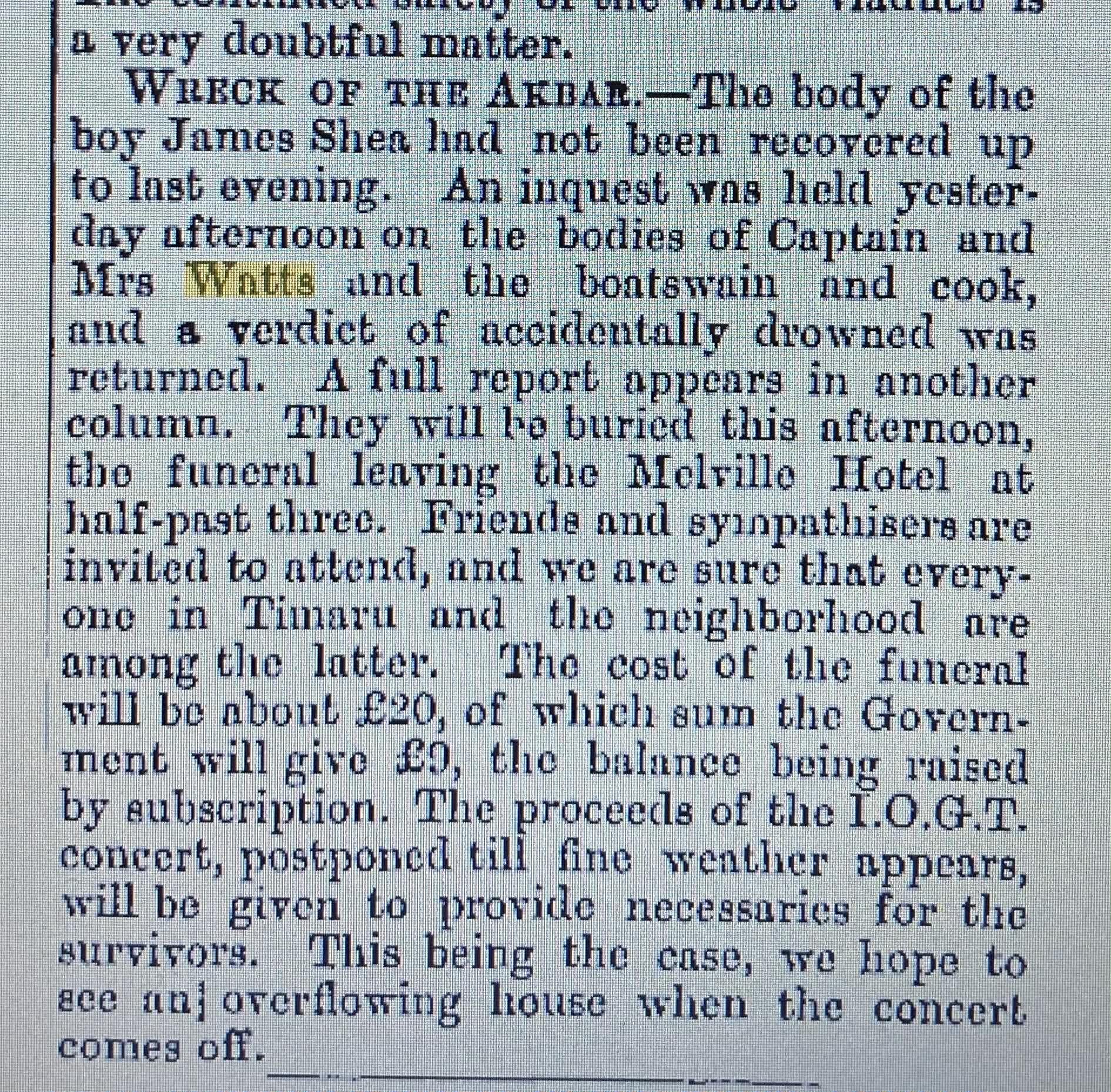
The funeral cost around 20 pounds. The government contributed 9. The rest was raised by generosity from around the town. People wanted to help. The wreck had shocked everyone; it was Timaru’s deadliest maritime loss up to that time.
On the day of the funeral the coffins left the Melville Hotel at half past three. The papers reported a large crowd. Friends, sympathisers, townsfolk, Rocket Brigade men who had stood helpless on the beach at dawn – they all walked behind the hearses. The procession made its way up to the cemetery, and the five were buried side by side.
Why Row 0 Matters
Those five graves at Row 0 mark a turning point in Timaru’s relationship with the sea. The tragedy added weight to calls for a proper harbour, better rescue systems and reliable warning signals. Within a few short years, the breakwater had grown, and Timaru was no longer an exposed anchorage where ships were left to face whatever the weather decided to throw at them. And out there on that area of lawn lie the five strangers the town claimed as its own. They didn’t choose Timaru as their final resting place. It is lovely to read that Timaru took these strangers in and offered dignity where there might otherwise have been none.
Side Quest: Who Was Mr Belfield?
Mr Belfield was Captain Belfield Woollcombe, usually known simply as Belfield Woollcombe, the owner of Ashbury Park, the farm property north of Timaru where the Akbar survivors found shelter. He was one of the early European settlers in the district, a prominent farmer and community figure. Ashbury Park (named after his English family estate, Ashbury in Devon) later became part of modern Timaru as the northern suburbs grew. The location of his farmhouse in 1879 matches exactly where the six survivors would have walked after crawling ashore at Washdyke. So the “farmhouse of Mr Belfield” where the survivors were taken in was the home of Belfield Woollcombe, whose family left a long legacy in this area, including the naming of Ashbury Park.
Side Quest: Who Was the Harbourmaster That Night?
The man responsible for watching over the anchorage that night was Captain James Mills, Timaru’s harbourmaster in 1879. He spent the long hours of the storm up at the lighthouse, scanning the darkness for any sign of trouble. When the Akbar began drifting shoreward, he tried to fire the harbour alarm gun, but the mechanism failed him in the wet, gale-blown conditions. By the time he managed to get a shot off at dawn, the ship had already been smashed to pieces on the beach. Mills carried that responsibility heavily. His job was to warn the Rocket Brigade in time, and while the circumstances were beyond anyone’s control, the failure of the gun that night became one of the storm’s most painful legacies.
The coroner did not criticise Mills personally, and neither did the Harbour Board. Instead, attention fell on the equipment, not the harbourmaster.
Side Quest: who was at the Inquest
Dr Trevor, was the coroner for Timaru. He presided over the inquests held between 1 and 4 July 1879, examining the recovered bodies of Captain John Watt, Margaret Watt, Edward Brissen, and John Thompson. James Shea’s body had not yet been recovered when the first inquests were held. No negligence or misconduct was attributed to the crew or captain. The gale was judged sudden and severe. The lack of distress rockets and the clogged harbour alarm gun were noted issues.
Side quest: Was the Harbour Alarm Gun Tampered With?
One small twist in the Akbar story is the harbour alarm gun — the very thing meant to warn the Rocket Brigade when a ship was in danger. Officially, the failure that night was blamed on the weather. The gale had blown so much rain and sea spray onto the foreshore that the powder inside the gun was wet and the mechanism clogged. It simply would not fire when the harbourmaster tried it in the dark.
But there was another story floating around town at the time, the sort that spreads quickly after a disaster. Some locals believed the gun had been deliberately interfered with. People were tired of it being fired for drills, and there were murmurs that someone had stuffed it with sand or otherwise blocked it. Nothing was ever proven, and the newspapers never named a culprit, but the idea stuck. It didn’t help that the gun chose the worst possible moment to fail.
Whether it was the weather or mischief, the result was the same: the alarm didn’t sound until dawn, and by then the Akbar was already in pieces on the beach.
Side Quest: How Did the Akbar Tragedy Change the Way the Harbour Was Run?
The loss of the Akbar jolted the whole town into facing the reality and danger of an exposed roadstead. For years people had argued about whether Timaru really needed a proper harbour. Some said the breakwater would solve everything. Others said it was too expensive and too slow. But after 29 June 1879, the debate changed. Five people had died within sight of town, and the public mood hardened. The gale showed, in the most brutal way, how vulnerable every ship, its caro and crew were.
In practical terms, the Harbour Board tightened procedures almost immediately. Shipmasters were reminded that when a gale threatened, they were expected to put to sea rather than ride it out at anchor. The harbour signal gun and rockets were checked more carefully. The Rocket Brigade drilled more often, and their equipment was kept in better condition. The issues raised at the inquest — the clogged gun, the lack of distress rockets on board, and the delays in raising the alarm — all became talking points for improvement.
And then there was the breakwater... a man made structure for ships to pull up to. Work had already begun in 1878, but progress was slow. The Akbar tragedy added heavy pressure to get the structure finished. It strengthened the argument that Timaru could not go on like this — with ships unloading cargo by surfboat, sitting at the mercy of the weather. Within a few years the breakwater was extended and improved, and by the mid-1880s Timaru finally had a sheltered harbour that made wrecks like the Akbar far less likely.
So although nothing could be done for the five who rest in Row 0, their story helped push the town toward a safer, better-run port. The sea had delivered a terrible lesson, and Timaru — painfully — took it on board.
Side Quest: Did the Akbar Tragedy Affect the Lifeboat Alexandra?
In a way, yes. The Akbar tragedy didn’t damage the lifeboat Alexandra physically, but it absolutely affected how the town thought about her — and about rescue readiness at Timaru in general.
When the Akbar wrecked between 3.30 and 5 a.m., the sea was simply too wild for any lifeboat to be launched, and by the time dawn came, the ship had already broken apart. But that didn’t stop people from asking uncomfortable questions afterwards: Should the lifeboat have been ready sooner? Should the crew have been called earlier? Should there have been a night-duty system in place?
The inquest stopped short of blaming the lifeboat crew. The truth was that no lifeboat in New Zealand — or anywhere in the world — could have lived in that surf in total darkness. Yet the tragedy exposed a deeper problem: Timaru relied too heavily on luck and daylight. A lifeboat that couldn’t be used in the dark or in extreme surf left a gap that everyone now saw clearly.
Public frustration grew even stronger three years later during the 1882 Benvenue and City of Perth disaster, when the Alexandra again faced challenges in heavy seas, and volunteers were killed trying to launch her. By that point, the message was impossible to ignore: the open roadstead was too dangerous, and the lifeboat alone was not enough.
So while the Akbar didn’t lead to an immediate overhaul of the Alexandra, it did:
- reinforce the need for better training
- highlight the limitations of open-sea launches
- fuel public support for completing the breakwater
- expose gaps in night-time and severe-weather rescue capability
- contribute to the push for a more modern lifeboat service in the 1880s
The Akbar didn’t break the Alexandra — but it broke the illusion that she, on her own, could protect ships in Timaru’s merciless open roadstead.
Timeline of the Wreck of the Akbar, 29 June 1879
Monday, 23 June 1879
-
Akbar, a wooden American-built brigantine of about 204–230 tons, arrives at Timaru from Newcastle, New South Wales.
-
She is carrying about 350 tons of coal. Roughly 300 tons remain on board by the end of the week as unloading proceeds slowly by surfboat (standard for Timaru’s open roadstead).
-
Akbar anchors offshore, about four miles from Timaru town and roughly one mile offshore.
Saturday Evening, 28 June 1879 – Weather Deteriorates
-
A sudden, severe south-easterly gale develops, with heavy rain and huge seas.
-
Multiple vessels are anchored in Timaru’s exposed roadstead, including the Akbar, Pelican, Sea Bird, Annie Bow, George Noble, Clan Campbell, Oceola, and steamers Beautiful Star and Star of the South.
-
Harbourmaster Captain Mills watches conditions from the lighthouse through the night.
Sunday, 29 June 1879 (Early Hours) – Akbar in Extreme Danger
~3.30 a.m. – First Anchor Cable Parts
-
Akbar’s primary anchor cable snaps under the strain of the onshore gale.
-
The ship begins to drift.
-
Captain Watt orders the crew to let go the second (spare) anchor, which temporarily checks the drift.
~4.30 a.m. – Second Anchor Cable Parts
-
The second anchor cable also parts.
-
Akbar is now completely adrift in darkness, with no way to hold her position.
-
Seas are extremely heavy; wind is blowing “dead on shore”.
Drifting Northward
-
The ship drifts past other anchored vessels.
-
She narrowly avoids collision with the barquentine George Noble, whose crew shout warnings as Akbar appears through darkness.
Strikes Offshore Reef – Captain Swept Overboard
-
About half a mile from the beach, Akbar strikes a rock or reef.
-
The collision throws Captain John Watt overboard. He is lost in the surf.
~4.50–5.00 a.m. – Ship Grounded and Destroyed
Grounding at Washdyke
-
Akbar is driven onto the shingle beach near the Washdyke Lagoon, roughly 1.5 miles beyond Dashing Rocks (north end of Timaru).
-
The moment she strikes the shore, the hull begins to break apart.
Breaks Up Within Minutes
-
Survivor testimony reports she “split open from stem to stern” almost immediately.
-
Huge breaking seas sweep the decks.
-
Mrs Margaret Watt is last seen holding a lifebuoy, but is swept away.
-
Boatswain Edward Brissen, Cook John Thompson, and 19-year-old seaman James Shea are also lost in the surf.
Dawn (~5.30 a.m. onwards) – Aftermath on Shore
Rocket Brigade Arrives Too Late
-
The harbourmaster fires the alarm gun, but it is initially clogged and delays the warning.
-
The Timaru Rocket Brigade musters at dawn, but by the time they reach the area the Akbar is already a total wreck and bodies are washing ashore.
Six Survivors Reach Land
-
Six men—First Mate Edward Bynham (Bylund), passenger John Wright, and seamen David Bradley, Charles Dahlin, Richard Humphreys, and James Waglett—survive by clinging to wreckage.
-
Several are badly bruised and nearly naked; their clothing torn off by the surf.
-
They struggle up the beach at daybreak and make their way to Mr Belfield’s farmhouse (Ashbury Park), where they receive warmth, clothing and care.
29–30 June 1879 – Recovery Efforts
-
Wreckage, timber, and coal scatter along the coastline for miles.
-
Bodies of Captain Watt, Mrs Watt, Brissen, and Thompson are recovered on 29–30 June.
-
James Shea’s body is not immediately found (still missing by 1 July).
1–4 July 1879 – Inquests
-
Coroner holds inquests on the recovered bodies.
-
Cause of death found to be drowning due to the wreck of the Akbar.
-
No misconduct or negligence is attributed to the captain or crew.
-
The gale is considered sudden, severe, and unavoidable in an open roadstead.
-
Issues noted:
-
No effective distress signals could be fired (rockets/blue lights wet).
-
Harbour alarm gun malfunction delayed the Rocket Brigade.
-
Akbar’s anchoring “springs” may not have been rigged as strongly as ideal.
-
5 July 1879 – Government-Funded Funeral
-
With no family in Timaru, the government pays £9 towards a £20 funeral; the remainder raised by public subscription.
-
The funeral procession leaves the Melville Hotel at 3.30 p.m.
-
A large crowd attends.
-
The five victims are buried together in Row 0, Timaru Cemetery.
Summary of Fatalities
-
Captain John Watt, master and owner
-
Margaret Watt, his wife
-
Edward Brissen, boatswain
-
John Thompson, cook
-
James “Jim” Shea, 19-year-old able seaman/ship’s boy
Total lost: 5
Total survivors: 6
Researched and compiled by Geoff Cloake. roselyn Fauth and Carmern Haymen