TIMARU
Botanic Gardens
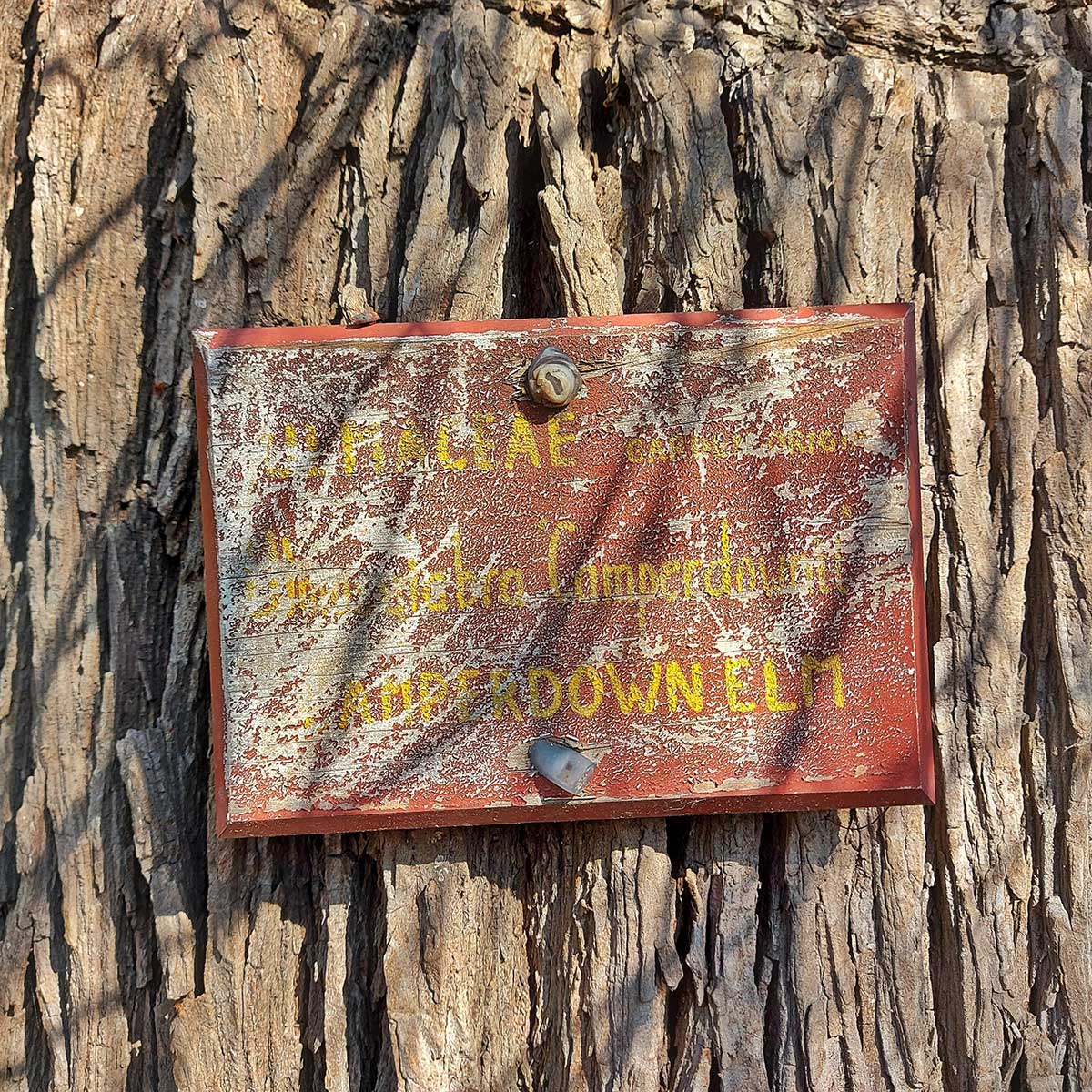
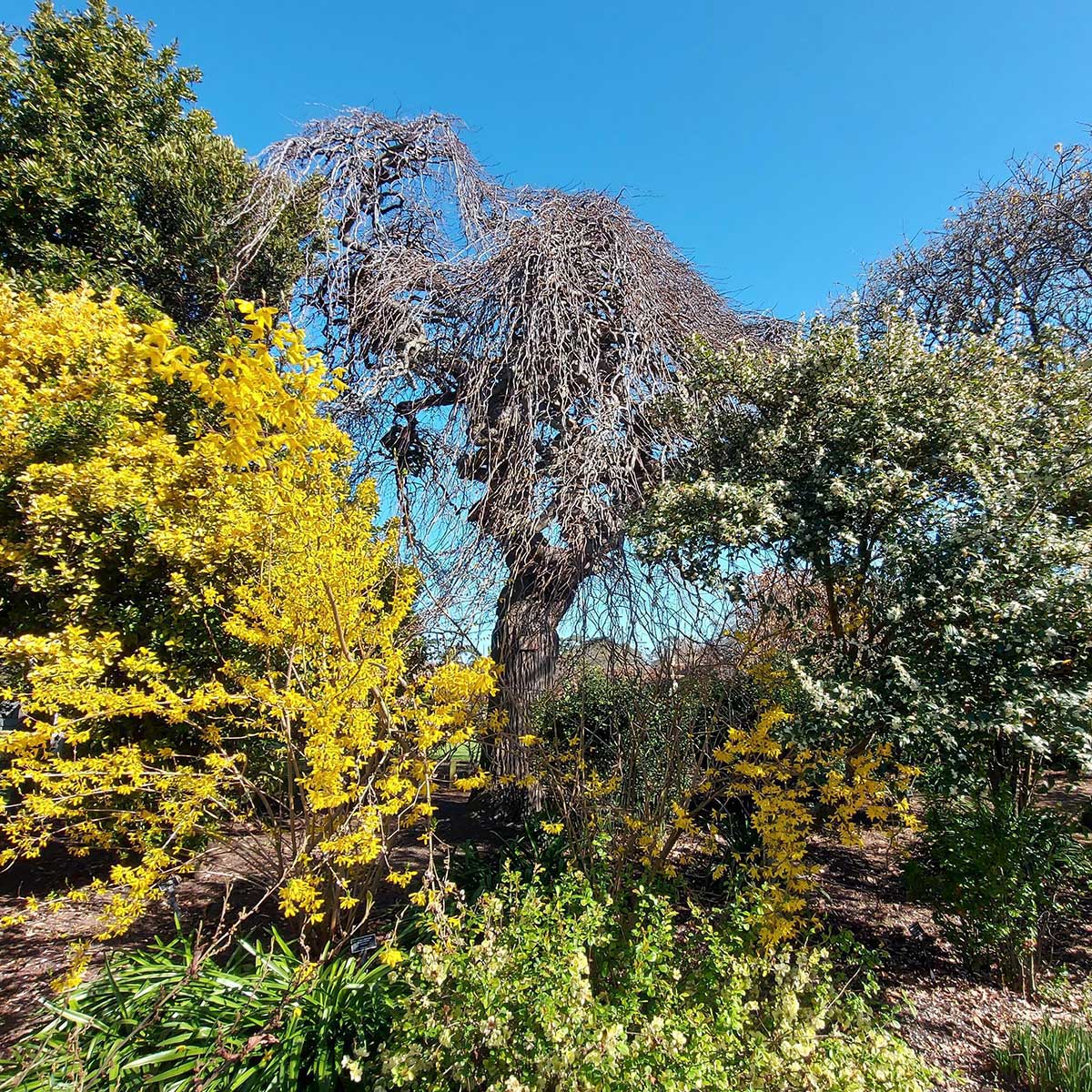
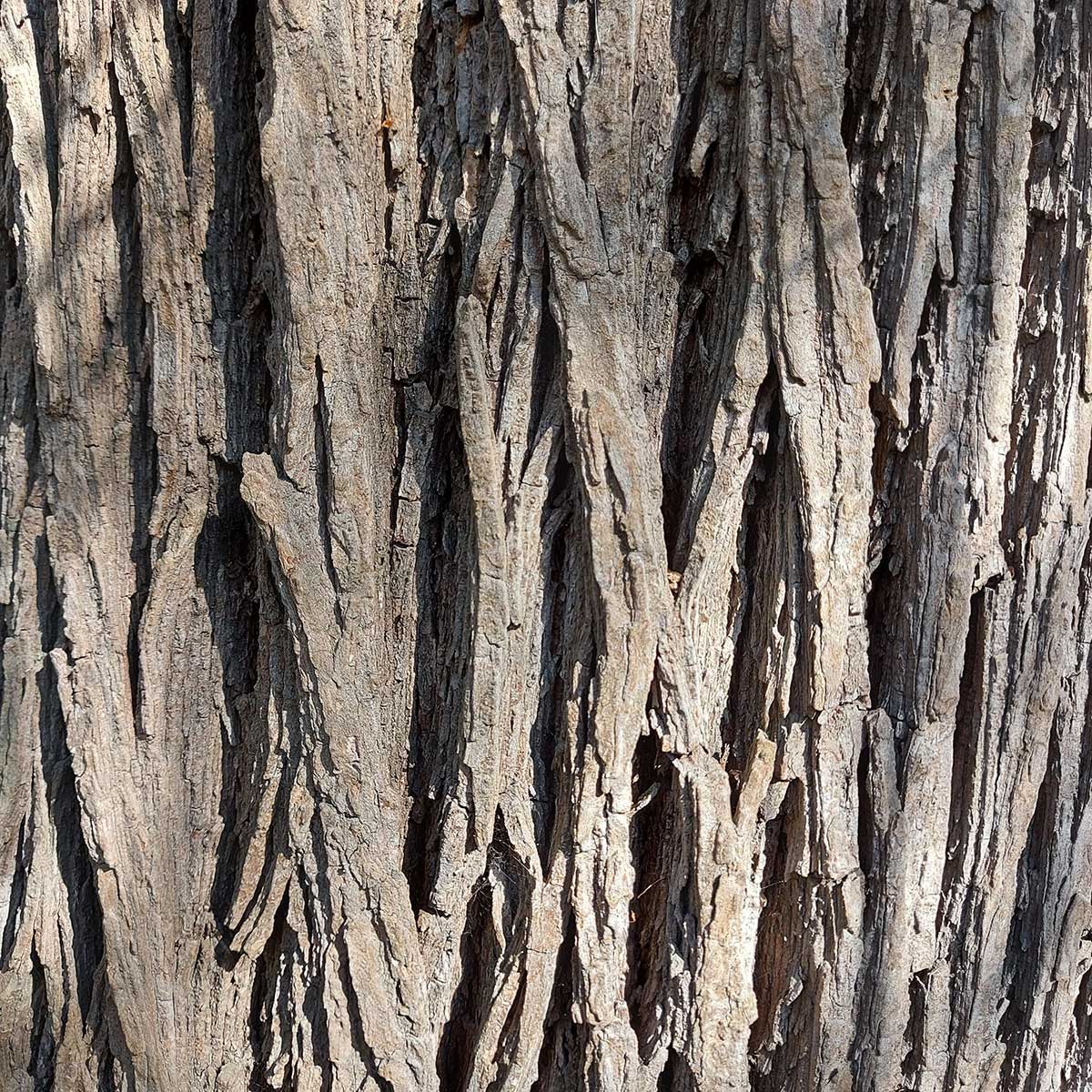
Hidden in the northeast corner of the Timaru Botanic Gardens - Anderson Rose Garden is a 7.80m Camperdown elm. It was planted aprox 1860!
The Wych Elm cultivar Ulmus glabra 'Camperdownii', commonly known as the Camperdown Elm, was discovered about 1835–1840 as a young contorted elm growing in the forest at Camperdown House, in Dundee, Scotland, by the Earl of Camperdown's head forester, David Taylor.
Ulmus glabra, the wych elm or Scots elm, has the widest range of the European elm species, from Ireland eastwards to the Urals, and from the Arctic Circle south to the mountains of the Peloponnese in Greece; it is also found in Iran.
Elms can be recognised by their asymmetrical, oval leaves that are toothed around the edges and have very short stalks. Wych elm leaves are larger than those of other elms, taper to a sudden point at the tip, and are hairy on both sides.
'Wych' in wych elm refers to its wood being pliant (easily bent/influenced), and not to witches, who were said to shun elm trees. This characteristic made the wood largely unsuitable as a building material, nor does it make a good fuel. However, like alder wood, elm wood withstands wet conditions very well.
Elm mythology and folklore
In Greek mythology, the hero Orpheus rescued his beloved wife Eurydice from the Underworld by enchanting everyone there with his harp music. He then paused to play her a love song, at which spot the first elm grove was said to have sprung up.
In Celtic mythology, too, elm trees were associated with the Underworld. They had a special affinity with elves who guarded the burial mounds, their dead and the associated passage into the Underworld.
Elm trees in Britain can grow to become some of the tallest and largest native trees. Like the oak, they often had very specific customs and folklore attached to individual, named trees. Charming examples include the Tenor, Bass and Alto elms on Humberside, or the Dancing elms of Devon around which May Day dances were held. (These trees have all sadly succumbed to Dutch elm disease.)
As well as their widespread use in hedges, their stature made them imposing landmarks and boundary markers. Travelling preachers and judges would often pronounce from beneath them. Their large distinctive shapes feature in many English pastoral paintings by Constable and his contemporaries. Examples include Constable’s famous “The Haywain” painting.
The elm’s wood bends well, or distorts easily, depending on which way you look at the situation. Indeed the ‘wych’ in wych elm refers to its wood being pliant, and not to witches, who were said to shun elm trees. This characteristic made the wood largely unsuitable as a building material, nor does it make a good fuel.
However, like alder wood, elm wood withstands wet conditions very well. This meant it was a popular choice for the building of boat and barge hulls, bridge foundations, and cartwheels. Like Scots pine, hollowed-out elm was used to make urban water pipes before the introduction of metal ones. Its pliancy was also put to use in a variety of ways. In Scotland the stick used to play shinty, called a caman, can be made from a number of woods. Elm was often a favoured choice as it often has a natural bend already in the wood. Failing that, it could easily be heated, bent and set to the required shape. Medieval Welsh archers made their longbows from elm wood, whereas English bowmen preferred yew.
It is interesting to note that both the yew’s and the elm’s mythology is bound up with death and the transition into the Underworld, and that both woods were used to such deadly effect in medieval warfare. Elm’s connection with death does not end there, as its wood is traditionally used to make coffins. The wood’s durability underground may have played a part in this choice. Perhaps people who knew elms well were reminded of their own mortality when remembering the elm’s reputation for dropping large boughs without warning on otherwise still, warm days. This led to the old saying “Elm hateth man, and waiteth.”
In Scotland wych elm is the more common species of elm. In Gaelic it is known as leamhan, as in Loch Leven in Kinross, and was valued for its roles in the dyeing of wool. Intermittent colours in woollen yarns (by which a weaver could more easily create a pattern in the weave) could be introduced by way of an early form of tie-dyeing. Twine made from the inner bark of the elm tied tightly at regular intervals, to form ‘hanks’ of the yarn, was used to stop a dye from reaching the wool. A yellow dye could also be derived from the elm, and the leaves were fed to livestock when other fodder was scarce.
In spite of elm’s associations with death and the Underworld, people also looked to this tree for medicinal cures. The inner bark was chewed or boiled into a liquor to treat colds and sore throats, while the boiled bark was also used to treat burns.
“When the elmen leaf is as big as a mouse’s ear, Then sow barley never fear;” Part of a rural planting verse.
Sources and further reading:
- Darwin, T. (1996) The Scots Herbal: the plant lore of Scotland. Mercat Press.
- Fife H. (1994) Warriors and Guardians: native highland trees. Argyll Publishing.
- Frazer, J. (1993) The Golden Bough: a study in magic and religion. Wordsworth.
- Mabey, R. (1996) Flora Britannica. Sinclair-Stevenson: London.
- Milliken, W & Bridgewater, S (2004) Flora Celtica: plants and people in Scotland. Birlinn: Edinburgh.
- Paterson, J.M. (1996) Tree Wisdom. Thorsons: London.
- Vickery, R. (1995) A Dictionary of Plant Lore. Oxford University Press: Oxford.
- treesforlife.org.uk/elm-mythology-and-folklore