Ever wondered why Timaru has a stunning collection of heritage buildings on Stafford Street?
Download: Colourful Facts 1868 Timaru Fire.pdf
The Great 1868 Timaru CBD Fire
Timaru has very special architecture, but it came from immense destruction. A fire erased two thirds of the early business part of town, paving the way for the heritage buildings we see today.
1868 In the same year Timaru became a Borough, one of the most disastrous fires ever known in the colony took place on 7 December.
17 Years after the first European house was built on George St, the town had grown to around 1250 dwellings. The business part of town was one street just under 1km. The buildings were wooden with shingle roofs.
The fire originated in a small cabinet makers workshop behind a furniture warehouse on the corner of Great Southern Rd, (Stafford St) and Church St. (Arrowed).
1 Boy left one pot of glue melting on a small stove for a few moments. At 3:30pm some shavings caught fire, and within minutes the building was in flames. Imagine what must have gone through the boys mind when he discovered the fire.
1 Tap handle could have given access to a water tank, but it was missing. There were no networks of water pipes then, only a few wells scattered around the town. The fire was starting to spread to near by properties.
32 Members in the Hook and Ladder Company only had buckets, ladders and poles with a hook attached. With no sufficient water supply, all they could do was attempt to pull down buildings and structures with the hope of preventing the fire from spreading.
3 Hours is all it took. A hot nor-west wind fanned the flames and by 6:30pm all that remained were rows of chimneys and ashes.
39 Wooden buildings were destroyed. A reporter estimated property worth "at least £70,000", about $8 million today, was lost. No-one died but more than 120 people were left homeless with the clothes on their backs. Not everyone was insured.
1 Enquiry into the cause of the fire was taken by B. Woolcombe Esq with a jury, the verdict “Accidental fire, with carelessness.”
16 Months after the fire, a public meeting saw a unanimous vote to establish a volunteer fire brigade. A fire engine was loaned by a Christchurch insurance company.
1869 A council bylaw ruled that new buildings in the CBD had to be constructed of masonry. The 1870 Landing Services Building is a great example of this.
The architecture reflects times of growth and prosperity in the district’s history. It’s amazing to think...
What was a dirt track for bullock wagons, lined with a wooden buildings, could emerge from the ashes to become sealed Stafford Street for cars, lined with significant heritage buildings.
- A “WuHoo” to discover and admire.
Join the history hunt
Learn more at The South Canterbury Museum
Read about the disaster on paperspast.natlib.govt.nz/newspapers/CHP18681210.2.17 - PRESS 10 Dec 1868 P3.
Read about it in the Jubilee History of South Canterbury 1916, and the book When The Smoke Clears, 1995.
- These are also the source for Wuhoo Timaru Fact Sheet © WuHooTimaru 2021
The 1868 Timaru Fire Colourful Facts
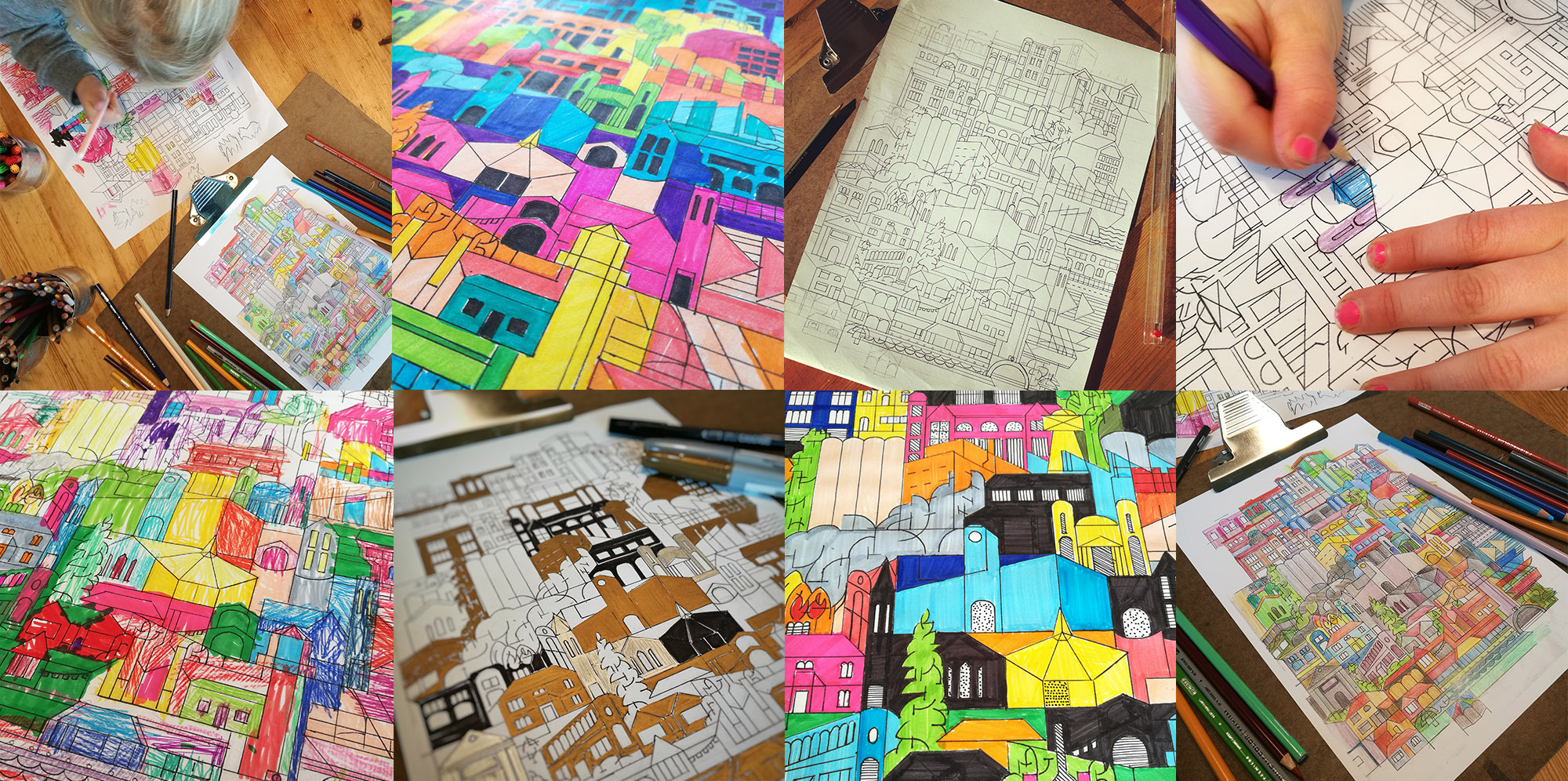
Ever wondered why Timaru has a stunning collection of heritage buildings on Stafford Street? Over 150 years ago a devistating fire destroyed the commercial heart of early Timaru. Years the later the CBD rose from the ashes to buildings constructed of masonary. How many significant buildings can you find in our Colourful Facts sheet
Download: Colourful Facts 1868 Timaru Fire.pdf
 Location where the fire broke out

The cabinet maker's workshop highlighed with the arrow is where the 1868 fire originated, now hosts Hallensteins on the corner of Church St and Great Southern Rd, now Stafford St.
Stafford Street Timaru
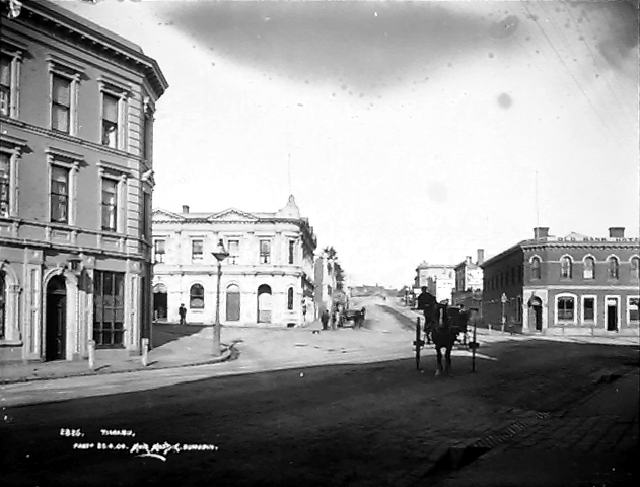
Photo by Muir & Moodie studio. Dry plate negatives Te Papa (C.014407)
This is a Street Scene of the commercial area in Timaru and the Old Bank. Across the road a scene of utter devistation unfolded in 7 December 1868 destroying two thirds of the early business part of town. This paved the way for many of the heritage buildings we see today. Some of these buildings were demolished to make way for larger modern buildings.
The original tavern where the Old Bank stands today, was built on the corner of Church and Stafford Street in 1864 by the father of Cecil Walkden Wood who invented the motor tricycle. Through the years it has been known as a tavern, hotel, pub, restaurant and backpackers and was now called The Old Bank Cafe and Bar. The tavern was built on the Bank of New Zealand agency site which is where it gets it's name.
Some of the the heritage buildings we can see on and near Stafford Street today.

https://paperspast.natlib.govt.nz/newspapers/CHP18681210.2.17
GREAT FIRE IN TIMARU.
IMMENSE DESTRUCTION OF PROPERTY.
[FROM OUR OWN CORRESPONDENT.]
Timaru, Dec. 8.
Timaru is in ruins. One of the most disastrous fires ever known in this colony took place here on Monday afternoon, 7th Dec., by which two-thirds of the business part of the town has been destroyed. It originated in a small workshop behind a furniture warehouse on the Great South Road, both occupied by D. Munro. Glue was being melted there, upon a small stove, when suddenly the place took fire, and in a few minutes the furniture warehouse, from which most of the contents had been just saved, was enveloped in flames. Water was scarce, but no abundance of it could have prevented the progress of the fire, for a violent nor’-wester raged at the time, fanning the flames, and carrying firebrands in every direction. The whole townspeople were in great consternation, eagerly removing their effects, expecting that the all-devouring fire would reach them.
The flames soon caught the shops of Knight, painter; Wood, saddler; Solomon, draper; French, seedsman; Younghusband, bookseller; Greer, tobacconist; Jacobs, watchmaker; Erskine, grocer; Weaver, tailor; Stubbs, butcher; Perry, solicitor; Watkins, druggist; Bank of New Zealand; Club Hotel; Clarkson and Turnbull’s drapery and ironmongery stores; the Post-office; Telegraph-office; Postmaster’s house; Beldy, tobacconist; Butler, chemist; Solomon, draper; Bilton, music-seller; house of E. D. Burne, Union Bank of Australia; King, butcher’s shop and house; Murison, baker; Melton’s stables; Mountford, photographer; brick building occupied by Frazer Brothers; and Pogonowski, barber, a loss of property valued at £80,000.
In the evening the whole street known as the Great South road was a scene of utter ruin and desolation, for nothing remained but rows of brick chimneys, surrounded by burning heaps of ashes.
A number of special constables were sworn in for the night, to watch the smouldering fire, and to protect property.
The insurance offices involved are the Royal, the Imperial, the Liverpool, London, and Globe, the New Zealand, &c. The agents held a meeting this morning to consider what course to take in the interests of their employers.
An enquiry into the cause of the fire took place at the Royal Assembly rooms this afternoon before B. Woolcombe, Esq., and a special jury, and after considering a mass of evidence, the jury found a verdict of “Accidental fire, with carelessness.”
Clarkson and Turnbull open to-morrow with the goods saved, in George Gray Russell’s store; the Bank of New Zealand, in Mr F. LeCren’s auction room opposite; and the Post-office and Telegraph have taken up quarters in the Custom-house.
The town cannot recover from this blow for some years, and great sympathy is felt for Messrs Clarkson and Turnbull, whose interests in the town were large, and who have so largely contributed to advance the trade and prosperity of this port and district.
[From the “Timaru Herald.”]
Monday last may indeed be called “black Monday” for Timaru, as on that day there occurred one of the most disastrous fires that has ever taken place in New Zealand, a fire that in the short space of a little over an hour swept away over thirty buildings, and destroyed as far as we at present know at least £70,000 worth of property. Unfortunately the wind was blowing fiercely from the nor’west at the time, and to this cause may be assigned the reason that so many buildings, both isolated and in blocks, were destroyed, as the wind carried the burning embers and fired the shingled roofs of houses 200 or even 300 yards distant from where the fire was raging.
As the “Timaru Herald” office was destroyed, and all our staff were engaged in saving what was possible from the burning building, we cannot give in this issue so full an account of the tremendous conflagration as we should have wished. The following is a list of the buildings destroyed:—
ON THE WEST SIDE, MAIN SOUTH ROAD.
Mr D. Munro’s furniture warehouse; Mr Kitson’s offices (New Zealand Insurance Company); Mr Nelson, tailor; Mr Knight, painter; Mr Wood, saddler; Mr Seymour, watchmaker; Mr Salomon, draper; Mr French, seedsman; Mr Younghusband, bookseller; Mr Green, tobacconist; Mr Jacobs, watchmaker; Mr Erskine, grocer; Mr Watkins, chemist; Mr Williamson’s offices; The Bank of New Zealand; the post and telegraph offices; private cottage up George street; Messrs Clarkson and Turnbull’s warehouses; Mr Beldy, hairdresser; Dr Butler, chemist; Messrs Clarkson and Turnbull’s ironmongery store; the “Timaru Herald” offices; Mr D. Salomon, draper; Mr Bilton, bookseller; Mr Byrne’s private house; executors James King, butcher’s shop and house; Messrs McCan and Morgan, bakers; Mr Hitch, tinsmith.
ON THE EAST SIDE, MAIN SOUTH ROAD.
Mr Weaver, tailor; An empty shop; Premises of the Timaru Butchering Company; Mr Perry’s offices; the Club Hotel; Mr Mountford, photographer; Mr Melton, private house; Mr Melton’s stables; Mr Turnbull’s brick building, occupied by Fraser Bros., butchers, and Mr Pogonowski, hairdresser; a small private house.
The following buildings were damaged:— Messrs Cain, Munro and Co’s warehouse; Mr Hutton, grocer; Messrs Todd, drapers; Mr Green, Ship Hotel.
The fire was first seen to break out in a cabinet maker’s workshop, at the back of Mr D. Munro’s furniture warehouse. The boy usually attending there was for some reason absent for a few moments, and Mr Munro, who was in his front store, was told that his workshop was on fire. He immediately rushed to the spot and endeavoured to confine the fire to that locality, but all efforts made were futile, as the flames speedily caught the furniture warehouse, and in a few minutes it was levelled to the ground. The fire also extended backwards, and ignited some timber in the yards of Cain, Munro and Co., and it was feared that the whole stock of timber would be burnt, together with a large stock of coal lying in the same yards. But plenty of willing hands were ready, and the timber was saved; and by the same means the house occupied by Miss Rose, standing at the back of the timber yards was saved, for its destruction was certain if the fire had spread amongst the stacks of timber.
The warehouses of Cain, Munro and Co. were in imminent danger, being only about 12 or 14 feet from Mr Munro’s furniture warehouse, but a body of men set to work to cover the roofs and portions of the building nearest to the fire with blankets, and kept them saturated with water, which was fortunately handy. At one time the danger was so great that the windows in that part of the warehouse the most removed from the fire were smashed open, and gangs of men were employed in removing the stock to a building in the vicinity.
As soon as it was perceived that the warehouse must be destroyed, a large body of men set to work to save as much as possible of the stock inside the building, and the street opposite was strewed with a quantity of furniture and miscellaneous goods. We believe a large quantity of furniture was thus saved, but still Mr Munro is a heavy loser, as we understand he was uninsured.
Meanwhile the fire burnt furiously, and soon enveloped the offices of Mr Kitson, and the shop of Mr Nelson, tailor, in a broad sheet of flame. From these buildings we are not aware if any goods were saved. The shops of Mr Knight, painter, and Mr Wood, saddler, were then caught, and speedily succumbed to the flames. At this point an attempt were made to arrest the fire (as between Mr Wood’s and the next house, occupied by Mr Seymour, watchmaker, there is a gap of about twenty feet), by pulling down the shop occupied by Mr Wood, but all to no purpose, as long before the verandah posts were cut away, the fire had taken a firm hold of the building. A few goods were saved from these buildings, but we believe of comparatively small value, and Mr Wood is a considerable loser, although insured.
One or two men employed in the upper story of Mr Wood’s, in throwing goods into the street, had a somewhat narrow escape as they remained in the burning building long after the roof and walls were on fire. The people below repeatedly shouted to them and warned them of their danger, but most likely the howling of the wind prevented them hearing, and so they remained till forced to quit by the blinding smoke and flames. They left the building not a moment too soon, for it fell directly afterwards. We are not aware whether Mr Knight was insured, but if not he must be a very heavy loser, as we think but little of his stock was saved.
It was about this time that the flames were blown across the street and seized on the house occupied by Mr Weaver, tailor, at the same time continuing their devastating course on the side of the street it originally started from by extending to Mr Seymour’s. Mr Weaver’s shop, and the one adjoining, then empty, were speedily destroyed, and the fire then caught the premises of the Timaru butchering company, and from thence extended to the new offices of Mr Perry, which were likewise utterly consumed. From that block of buildings, from Mr Weaver’s to Mr Perry’s offices, we are not aware what property was saved, neither do we know the value of insurances effected on each building. Mr Perry was fortunate enough to save all his deeds, but some were slightly charred.
The shops of Messrs Todd, drapers, Mr Hutton, grocer, and the Ship Hotel, on the same side of the street, but higher up, being on the north side of Beswick street, and fronting the furniture warehouse, where the fire commenced, narrowly escaped destruction. The whole of the shop fronts were charred, and the glass broken by the intense heat. Most of the goods were taken from these premises, but a great many were destroyed by the hasty removal.
All the time the fire was devouring the building on the east side of the main road, it had crossed the narrow space intervening between Mr Wood’s and Mr Seymour’s on the west side, and but few minutes elapsed when Mr Seymour’s house was in flames. A large portion of Mr Seymour’s stock-in-trade was carried off the premises, and his loss is, we understand, comparatively small.
As soon as Mr Seymour’s house had caught, it was seen that at all events the whole of that block of buildings was doomed, and in fact a very short time elapsed and the fire was raging with great fury from Seymour’s at the one end to Erskine’s, the grocer, on the other. In this block were included the premises of Mr Salomon, draper; Mr French, seedsman; Mr Younghusband, bookseller; and Mr Jacobs, watchmaker. Every building fell one after the other, like a pack of cards. We do not know the value of property saved from this block, but we believe it to be comparatively trifling to what was destroyed. Mr Seymour was uninsured; Messrs Salomon, French, and Younghusband were insured. Mr Salomon, though, is a very heavy loser, as only very lately he received a large quantity of new goods, which were nearly all destroyed. We are not aware whether Messrs Jacobs and Erskine were insured or not.
It was thought that here the fire would have stayed, as a gap of about seventy yards intervened between Mr Erskine’s shop and Mr Watkins’, the chemist, but the wind blowing hard down the street carried with it fragments of burning debris, and the lighter particles crossing Mr Watkins’ shop fell on the Bank of New Zealand, a detached building standing at least 130 yards from Mr Erskine’s shop, where the fire then was raging. At this time the shop of Mr Watkins, chemist, with the offices of Mr Williamson, architect, were still uninjured, and wet blankets were put up on the northern side to protect them. Even before the Bank of New Zealand had taken fire, the fine building of Clarkson and Turnbull, at the opposite corner, had been ignited by the flying fire. Then it was known that no power on earth could save that entire block.
The occupants of the shops and offices at once commenced to bundle the contents of their buildings into the streets, and to endeavour to save the most valuable things. But in less time almost than it takes us to tell the story, the entire block was one sheet of flames. The Post and Telegraph offices were in flames before much could be saved, and the batteries of the Telegraph department were all lost, thus cutting off communication until others can be received from Christchurch. Adjoining the Post-office was the boot and shoe department of Messrs Clarkson and Turnbull, containing a very heavy stock, and the flames leapt into this shop in a second of time. They then spread to the other parts of the building with equal rapidity until the whole of the corner premises were enveloped, and it was impossible longer to carry out things with safety. From all their departments in the corner shop, a two story building, and by far the finest in Timaru, we believe that only a little more than a thousand pounds worth of stock was saved.
Some of the drapery was turned into the street, but the smoke from the block of buildings to the north, and the intense heat of the flames, were such as to drive back the most daring. The loss of Messrs Clarkson and Turnbull must be most serious, as they had an enormous stock, and were only partially insured. The Bank of New Zealand was at this time blazing on the roof, and Mrs Chisholm and her family had little time to escape, but some of the private property was rescued by daring volunteers. The attention of volunteers was also directed to saving the books and documents of value in the bank, and we are glad to learn that nothing of value in that respect was lost.
The fire was making rapid headway towards the top of the hill, to the south of the town. The roofs of the buildings appeared to take fire simultaneously, as they were all made of shingle, and rendered like matchwood by the dry nor’-west wind. There was a small roadway between the stores of Clarkson and Turnbull and the next building, Mr Beldy’s shop, but this was covered over by an upper span containing one store-room. Mr Beldy’s place was of course next devoured, and as far as we know he saved nothing, and was uninsured. Adjoining Mr Beldy’s shop, on the south side, was the chemist’s and druggist’s shop of Dr Butler, who resided on the premises. A few of the most valuable and dangerous chemicals were taken out of the shop, but everything else was lost, including clothing and bedding, and Mrs Butler and her family only escaped with their lives.
Next to Dr Butler’s was the ironmongery store of Messrs Clarkson and Turnbull, from which goods were being pitched into the street, but this lasted for only a moment, as the flames drove men back, and most of the goods thrown out of the shop were burnt in the middle of the road, or on the opposite side of the street. We believe the stock was only insured to the extent of £300 or £400. Then came the “Timaru Herald” office, a comparatively new building, one portion of which was let off to Mr D. Salomon. A number of persons were here engaged in carrying out cases of type to an open space at the back, and in taking down presses, &c. Others were employed in throwing out paper from the windows of the upper room. Before much was done in this way the men had the fire falling upon them through the roof, and were compelled to desist. The principal portion of the newspaper type was saved, but the whole of the jobbing type, frames, and other materials were destroyed.
The paper thrown into the street was burned before it could be carried away, and not a sheet of any description was saved, beyond a small quantity which had been partly printed in anticipation of Wednesday’s (to-day’s) issue. The presses went through the fire, but as we write we are hopeful that one may be patched up so as to enable us to strike off a few impressions on Wednesday. The men worked bravely to rescue everything possible, but some of the materials taken into the back part of the premises were melted into a mass; and when we tell our readers that brass galleys were run into a lump with the glass from the windows, they will realise something of the intense heat. Here a dog belonging to Mr Belfield, was burnt to death, as it refused to leave the office as long as its owner remained, and not seeing its owner leave, in the end was burned in the flames. Both Mr Horton and Mr Belfield lost their coats, the latter with a watch in it, and the men in the office barely escaped from the building in time. The building and the printing material were both partially insured.
The shop of Mr D. Salomon, belonging to Messrs Horton and Belfield, was of course in flames as soon as the “Herald” office, and Mr Salomon rescued little of his stock, which was, we believe, uninsured.
Next in order came the shop of Messrs Inwood and Bilton, with only a space of about three feet intervening, as an entrance to the printing office. Mr Bilton’s shop took fire long before any other in the same block, indeed before the Bank of New Zealand. Fire was blown on to the roof from the other end of the town, where the fury of the flames was terrific, but it was fortunately discovered in time, and the fire stayed for the moment. This enabled Mr Bilton to get out his most valuable things, including pianos, bedding, &c., and in which he was assisted by willing volunteers. The goods were placed on the opposite side of the street, but here they caught fire and had to be further removed to the beach. Mr Bilton was insured on his stock, and we believe will not be a very heavy loser.
The fire then rushed into the private residence of Mr Byrne (who is now absent from home) and swept it down the ground in a very short time, but whether Mrs Byrne succeeded in saving anything we have not learned. We greatly fear, however, that little or nothing was saved.
We must here break our narrative to notice the opposite side of the street, for long before the fire had reached the point to which we have carried our readers, it had crossed the road and carried down the Club Hotel, from which scarcely anything at all was rescued. Fears were entertained that it would also lay hold of the stores and offices of Messrs G. G. Russell and Co., but that part of their premises most exposed was roofed with slate, and wet blankets were kept on the face of the building, and men were posted at various places to put out the fire driven thither by the wind, which fortunately saved the buildings. Captain Scott, who resides on the eastern or sea side of the Club Hotel, cleared out his furniture, but fortunately the house occupied by him escaped, as did also, we may say in a miraculous manner, the stables on the hill, immediately in rear of the Club Hotel, belonging to Messrs Barton and Gardiner.
We took our readers up to the point when the fire had destroyed the residence of Mr Byrne, but it did not rest there for a second. The butcher’s shop, the next building travelling southwards, occupied by the executors of the late J. King, about thirty or forty feet from Mr Byrne’s house, although a plastered building, was gutted almost instantly. Then the flames carried down the adjoining building, a bakery and pastry-cook’s shop, occupied by Morgan and M’Con, where little was saved, and where there was no insurance.
Another building still followed, the shop and house occupied by Mr Hitch, tinsmith, who lost almost everything. But here the fire stayed. On the opposite side of the street a similar scene of awful destruction was being enacted. The house and shop occupied by Mr Mountfort, photographer, from its character, fell a ready prey to flying fire, and soon showed only a chimney standing.
Next to this building was a roadway leading to Melton’s stables, and on the other side a fine new brick building belonging to Mr Turnbull, which was divided into two shops, one occupied by Fraser Brothers, butchers, and the other by Mr Pognowski, hairdresser. This building was generally believed to be safe, but the fire devoured the woodwork in an instant of time, and soon the walls fell in. A small wooden building adjoining of course did not escape.
The fire also at the same moment took hold of Melton’s stables, where little beyond the horses was saved.
All the way along the same street, where the places were much more scattered, there was nothing to be seen but people hurriedly clearing their homes in anticipation of the scourge reaching them. But beyond the points we have named on either side of the main street it did not spread, and about six o’clock the worst was over.
As far as we can ascertain the following list will show the amount of liability incurred by different insurance companies, viz.:—
Victoria ... ... ... £2200
New Zealand ... ... 8000
Imperial ... ... 4000
London, Liverpool and Globe 8000
London and Lancashire ... 3500
North British ... ... 2500
Royal ... ... ... 2000
Total ... ... £30,200
Such is the account, perhaps somewhat imperfect, of the greatest disaster that has ever visited our town, and such a frightful contingency as the scourge of fire visiting Timaru, we have more than once pointed out and advised remedial measures to be adopted such as providing an ample water supply. Our suggestions having unfortunately however always passed unheeded. There is no doubt, that if the town had possessed an engine of sufficient power to throw water say to the height of the Bank of New Zealand, and a supply of water at hand, we should not have to deplore the loss of that building, or the block of buildings commencing at Clarkson’s and Turnbull’s, for if it had been possible to have kept the roofs and walls of these buildings saturated with water, there was some chance of their being saved.
A great quantity of property was left in the streets all night, and the volunteers were called out and kept watch and ward over it during the night, assisted by a large body of special constables sworn in for the purpose. The fire was burning all night, and gave a most weird-like appearance to the town, at times burning up with vivid brightness and then again sinking and giving out volumes of black foetid smoke. Yesterday morning the ruins in places were so hot that it was dangerous to walk over them. Danger was also apprehended from chimneys falling, one or two did fall by themselves, and a few were pulled down to prevent accidents.
PUBLIC MEETING.
In the evening a public meeting was held at the Royal Hotel, when there was a large attendance, the Mayor presiding. Its object was to discuss what steps should be taken to provide food and lodging for those deprived of their homes. The landlords of the Royal Hotel, and other hotels left uninjured, were authorised to provide food and shelter for as many of the sufferers as they could. Mr Healey placed three cottages, Captain Cain his bonded store, Captain Crawford the Government landing shed at the disposal of those who wanted shelter. Steps were taken to protect property during the night and a general meeting fixed for the following day.
THE INQUEST.
An inquiry into the origin of the fire took place yesterday, at one o’clock, before B. Woollcombe, Esq., Coroner, at the Royal Hotel. The room was crowded. From the evidence it appeared that a workman in the employ of Mr D. Munro had lit a fire to heat a glue pot. The fire was lit in a stove in the workshop, and some shavings must have caught fire while the boy was outside. After going into the whole case, the verdict returned by the jury was “Accidental,” but as a rider they expressed their opinion that greater care might have been exercised on the part of Mr Munro with regard to the stove in his workshop, where the fire originated.