
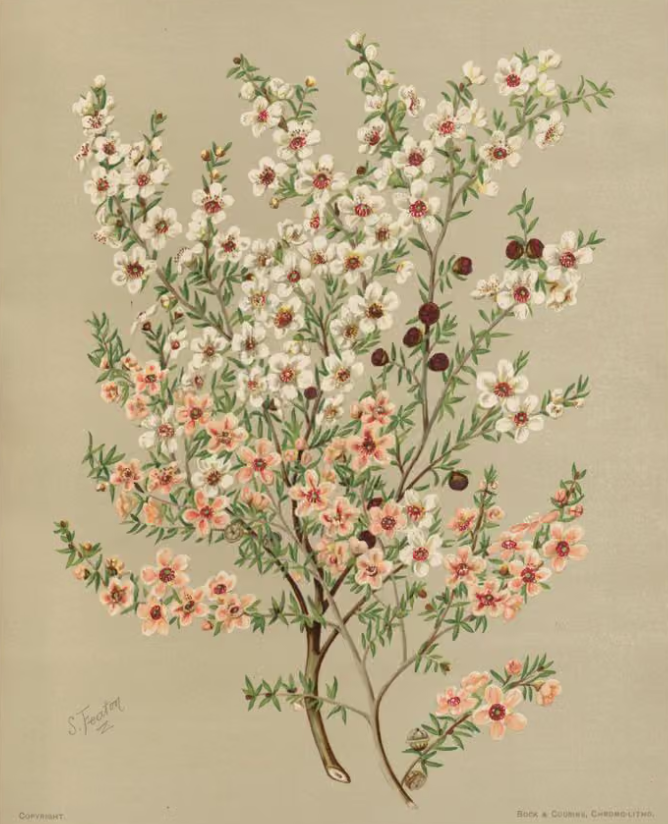
Manuka - Leptospermum scoparium. Plate 34. From the book: The art album of New Zealand flora : being a systematic and popular description of the native flowering plants of New Zealand and the adjacent islands : volume 1;., 1889, Gisborne, by Sarah Featon, Bock & Cousins. Te Papa (RB001317/034a)
Mānuka (Leptospermum scoparium) is another of Sarah's beautifully illustrated plants. Its small white or pink flowers produce nectar and pollen that attract native bees, flies, moths, beetles and geckos. According to the Department of Conservation, these flowers are an important food source for native wildlife. Mānuka can also self-fertilise, although cross-pollination may provide benefits. Following fertilisation, woody capsules form, containing tiny seeds. Today, introduced honeybees collect mānuka nectar and produce the honey that has become such a valuable New Zealand export. But mānuka was reproducing long before European honeybees arrived. Mānuka's survival doesn't depend on the introduced honeybee. Our commercial mānuka honey industry does.