
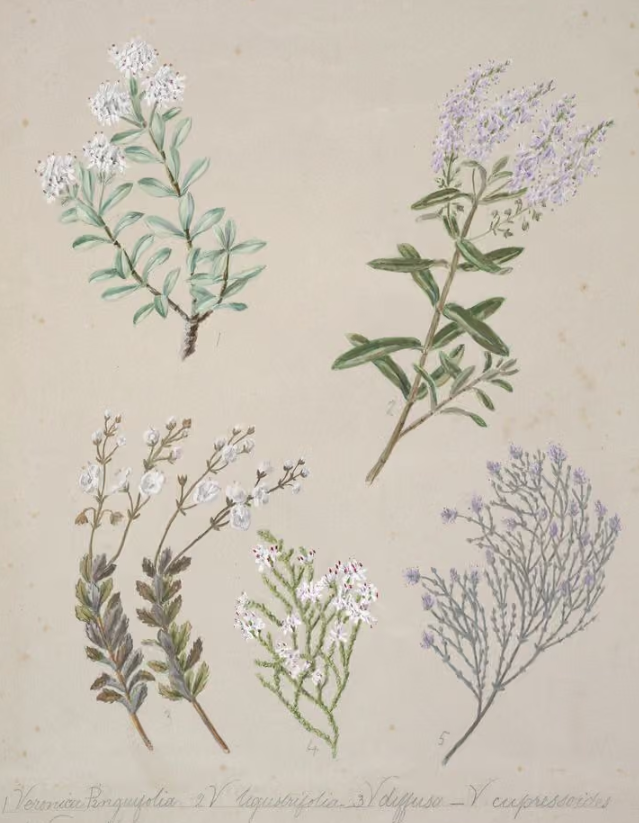
Hebe pinguifolia; Hebe ligustrifolia; Parahebe diffusa or Parahebe catarractae subsp diffusa; Hebe hectorii; Hebe cupressoides., circa 1885, New Zealand, by Sarah Featon. Purchased 1919. Te Papa (1992-0035-2277/27)
Sarah Featon painted five native hebes and related plants on one sheet: Hebe pinguifolia, Hebe ligustrifolia, Parahebe diffusa, Hebe hectorii and Hebe cupressoides. Many plants once called hebes are now classified as Veronica. Their small flowers attract a variety of insects, including native flies and beetles. Some are also visited by native bees. A 2021 scientific study found that native flower beetles (Dasytes subcyaneus) transferred pollen between flowers of several hebe species. Hoverflies also visited. After fertilisation, hebes produce tiny seeds in dry capsules, often dispersed by wind.
Featon's Veronica pinguifolia has been recorded around Mount Peel and Four Peaks, while Veronica hectorii grows in alpine parts of the South Island, including the Aoraki/Mount Cook region. Another illustrated plant, Veronica cupressoides, is now nationally endangered. Habitat loss, grazing and competition from introduced plants have contributed to its decline, while invasive vegetation can prevent seedlings becoming established. The exact pollinators and self-fertilisation abilities differ between hebe species, and some remain poorly studied. So these tiny flowers remind us of something important: a plant may produce viable seeds, but those seeds still need suitable habitat to grow.