
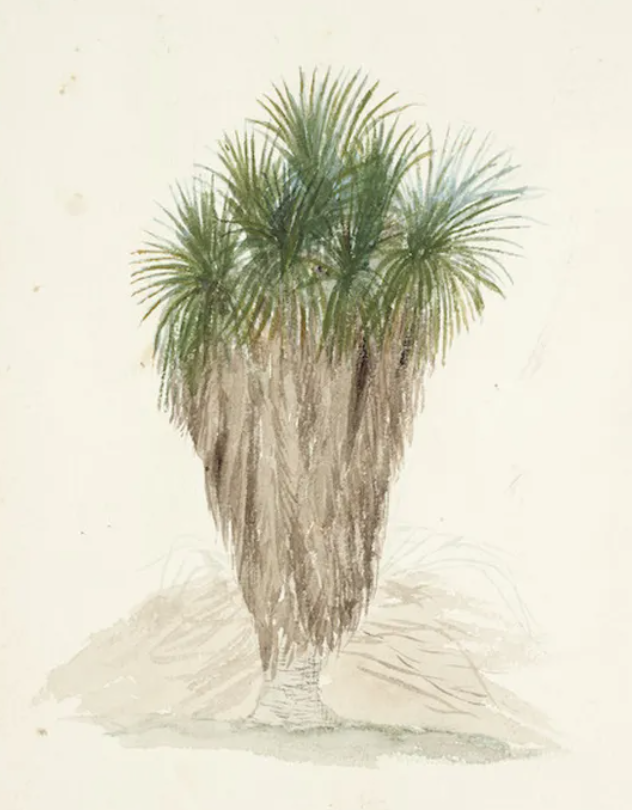
Artist unknown :[Cabbage tree with protective skirt of dead leaves. ca 1900-1904]. Artist unknown :[Seventeen watercolours by a passenger on the SS Kaikoura. ca 1900]. Ref: A-428-006. Alexander Turnbull Library, Wellington, New Zealand. /records/22770971
Tī kōuka (Cordyline australis), or cabbage tree, has a particularly strong Timaru connection. In a 1961 study of nineteenth-century survey maps, botanist W. B. Johnston found the lower downs near Mount Horrible described as having “cabbage trees, grass and flax.”
In spring and summer, tī kōuka produces large sprays of tiny, sweetly scented white flowers. Native insects, including flies, moths and beetles, visit these flowers, as do introduced bees today. Birds can also contribute. Scientific experiments published in 1996 showed that tī kōuka is largely self-incompatible. It produces little or no viable seed when fertilised with pollen from the same tree, making the transfer of pollen between different trees important. After fertilisation, the flowers develop pale berries eaten by birds, including kererū, tūī and korimako. The birds help disperse the seeds. One native tree can depend on insects for pollination and birds to carry the next generation somewhere new.