
New Zealand Entomologist, 1995, Vol. 18 Distribution of bumble bees in New Zealand New_Zealand_Entomologist_1995_Vol_18_Distribution_of_bumble_bees_in_New_Zealand.pdf
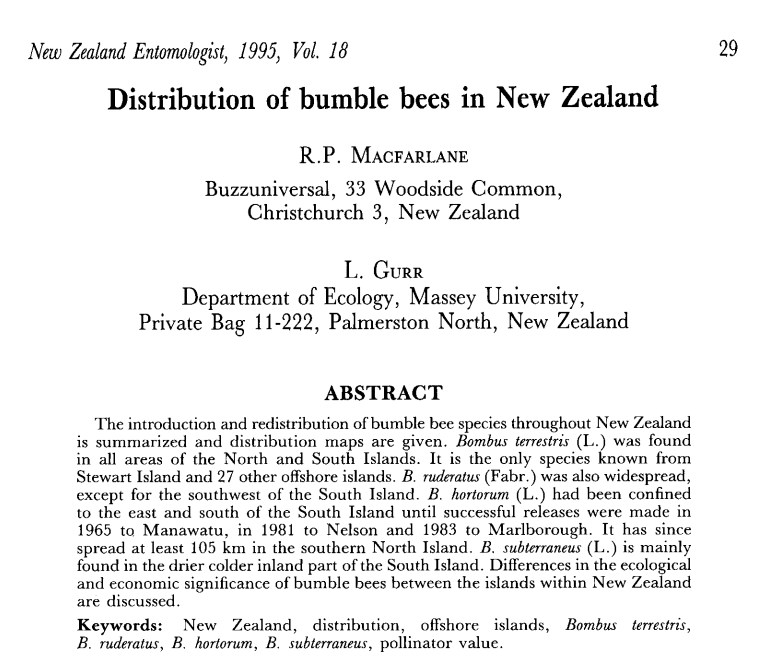
In 1995, entomologists R. P. Macfarlane and L. Gurr published Distribution of bumble bees in New Zealand, investigating how introduced bumblebees had spread across the country. They examined records of more than 28,000 bumblebees visiting over 300 types of flowers. Their research traced the first attempted introductions in 1875–76 and the successful release of 93 queens near Christchurch in 1885. By the time of their study, four introduced bumblebee species were established. They recorded the long-tongued Bombus subterraneus around Orari and Pareora Gorges, Sherwood Downs, Ashwick Flats and Fairlie, while the more widespread Bombus terrestris had been observed foraging as high as 2,500 metres around Aoraki/Mount Cook. Bumblebees originally introduced to pollinate red clover had spread far beyond the paddocks they were intended to help.
What interested me most was how these newcomers had become part of our wider ecosystem. The researchers reported that Bombus terrestris also pollinated at least 53 native plant species, while introduced bumblebees could help weeds such as gorse produce seeds. They were valuable to farming, particularly clover, lucerne and horticultural crops, but their spread also raised conservation questions, especially on offshore islands. The study doesn't establish that bumblebees harmed those native plants, but it shows how introducing one group of insects can create new relationships across an entire landscape. We brought bumblebees to help reproduce introduced crops. More than a century later, they were also visiting native flowers and potentially helping introduced weeds spread. It's another example of our two overlapping histories of pollination.