
By Roselyn Fauth
I was born in 1983 in the Jean Todd Ward at Timaru Hospital. So were my three siblings. Later, my two daughters arrived there as well. Babies take their first breath there. People come and go. You walk in focused on the moment and walk out without really thinking about the name on the door. Jean Todd.
I always thought it was just a name. Probably someone official, or the first to work there, or a donor. On one of my pregnancies I was admitted to the ward for weeks with severe cholestasis. Thanks to a naughty liver I was crazy itchy, but the obvious concern was stillbirth, and so I was happy to be in the care of professionals and monitored closely.
Over those weeks (I saw and heard) so many women come and go. I had time to think about things while my six foot frame let my feet dangle over the end of the short bed. I had the most amazing care, particularly from my midwife’s student who followed our journey through her placement. Kendra was amazing, and went on to care for many of my friends, including my younger sister.
Midwives are in a special role. They see it all — and sadly, not just the highs. I think the profession is incredible and certainly, in my experience, our South Canterbury mothers and babies were very well cared for.
It was then that I started to wonder. Who was Jean Todd and why was the ward named after her? This is what I learned, and my reflection on the nurse they accused and then tried to honour... Jean Todd who died Masterton 18 Aug 1929, Trained at Wellington Hospital from 1897. Sister, Wellington Hospital 1901 – 1906, and Matron, Timaru Hospital 1906 – 1916. Assistant Matron, Wellington Hospital 1916 – 1918. Secretary, Wellington Branch New Zealand Trained Nurses’ Association
Jean Todd was a nurse. A matron. She worked at Timaru Hospital from 1905 to 1915. For twelve years she led the nursing staff. As matron, she would likely have lived at or near the hospital, as was common at the time. She would have known every part of that place. She would have managed rosters, patient care, young nurses still learning, mothers in labour, all of it. She held it together.
But then things started going missing. Linen, crockery, cutlery, blankets and food. Someone whispered it might be Jean. The hospital secretary made quiet suggestions. There was no charge, no public hearing. But the Board chose to believe the doubt. In the Kai Tiaki journal (April 1925), it stateted that “Miss Todd… felt so much the imputations upon her honesty and rectitude… that she sent in her resignation”. And in Patricia Sargison’s thesis (Essentially a Woman’s Work, 2001), stated that Miss Todd resigned in 1915 when accused of dishonesty, and that she was refused the right to appear before the board. Her innocence was not revealed until years later.
Doctors and nurses tried to stop her. Members of the public too. But the Board accepted it. But to the wider community as she was not publicly accused at the time she left, her absence left a cloud over her name... at least in the eyes of those who did not know the full story. Jean Todd moved to Wellington after resigning from Timaru Hospital in 1915, and by 1925, she was working as Secretary of the Wellington Branch of the New Zealand Nurses’ Association (NZNA), as confirmed by Kai Tiaki: The Journal of the Nurses of New Zealand (April 1925).
“Miss Jean Todd of Timaru Hospital, ‘an upright Christian woman’, was accused of dishonesty in 1915, refused the right to appear before the board, and resigned, heartbroken. Her innocence in the matter was not established until 1924, when it was discovered that the hospital secretary had been stealing from the board for years...” - Patricia Sargison’s 2001 thesis Essentially a Woman’s Work
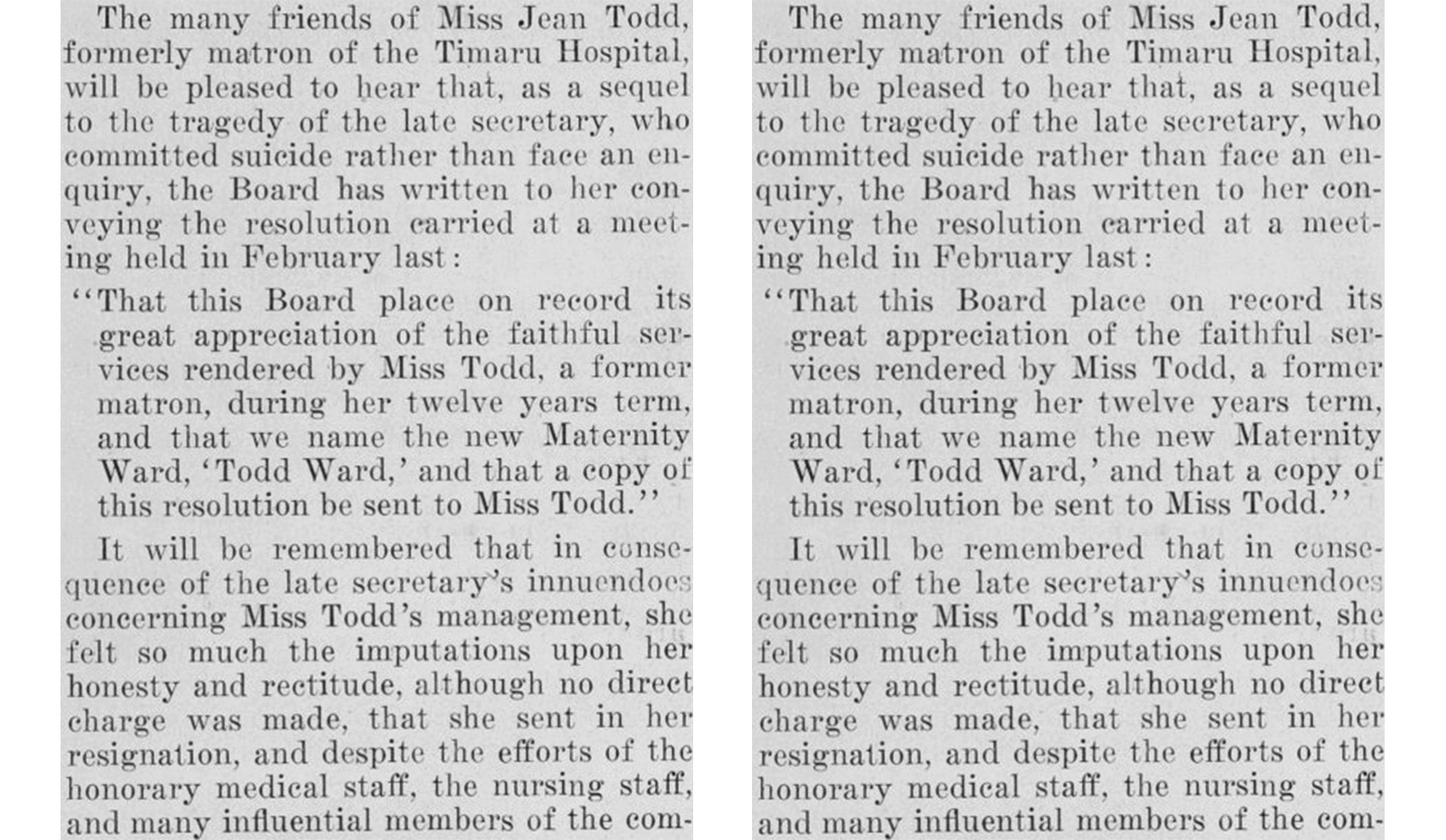
In March 1916, the Board granted her three months salary. A month later they made a public statement to thank her. But the community went further. On 30 March 1916, the mayor, Mr Guiness, presented her with a substantial cheque and a gold watch at a public gathering. He spoke of the noble work she had done, and how much she was respected across all parts of the community. Still I imagine the damage to her pride had been done. Particulary as she never got her job back. She never stood before the Board to clear her name in person.
Then, in the early 1920s,years after Jean had left, more hospital supplies went missing. This time, an investigation proved that the items were taken by the Board Secretary for his own home. The same secretary who had pointed fingers at Jean. In 1924, the Board demanded his resignation. He took his own life not long after.
“The remainder of the Board would not work with him and his resignation was demanded in 1924. He committed suicide a short time later.” - The Timaru Herald, 31 July 1993 (quoted by Rhonda Markby)
"Jean Todd of Timaru Hospital, ‘an upright Christian woman’, was accused of dishonesty in 1915... Her innocence was not established until 1924, by which time she was described as 'an invalid'..." - Patricia Sargison’s 2001 thesis, Essentially a Woman’s Work.
I really felt for Jean, and I also wondered what kind of situation must have led the secretary to steal from their boss and ultimately the community. Maybe the guilt of pointing the finger and seeing the effects of their dishonesty over what probably felt like just a few sheets impact someone elses life so deeply. Whether is was due to financial hardship, personal desperation, entitlement or stealing for someone else, well, that part of the story remains unspoken and we may never fully understand why.
In January 1925, in an effort to make amends, the hospital opened its first official maternity ward and named it the Jean Todd Maternity Ward. Later, in June 1961, the Jean Todd Maternity Annex was opened, and her name is still in use today. Jean Todd died in 1929 in in Masterton, four years after the ward was named.
Jean Todd trained at a time when nursing was changing. Florence Nightingale had set up her training school in London in 1860, and created a new model of care. Nurses had to be literate, of good character, and willing to be trained to train others. It was no longer just about natural caring. It became a profession, but one still shaped by ideas about womanhood.
Some women from wealthier families used it as a path to independence. They became leaders in hospitals. But most nurses came from working class homes. They worked in people’s houses or in small hospitals. They were expected to be obedient, selfless and silent. Their work was essential, but often invisible.
Jean worked within that system. She led, she managed, she cared. But when power and protection were needed, they were not offered to her.
Timaru in those years was changing too. The port was busy. Wool and grain moved through the yards, stores and over our shores. Children played at the new Port Resort, Caroline Bay. Families were growing. Births still mostly happened at home or in small private maternity homes, like Whare Nana on Wai iti Road. Jean Todd worked for the Timaru Hospital Board, which oversaw the hospital and held the power to appoint or remove senior staff like the matron. Slowly, the hospital became the place more families turned to. Jean helped make that possible. She helped shape what maternity care looked like in our town.
Her supporters never forgot her. But I still wonder what it must have felt like. To be blamed for something you did not do. To lose your life’s work. To be given a plaque years later and told thank you.
Now, when I walk into the Jean Todd Ward, I say her name differently. I think of the woman behind the sign. I think of what she carried. What she gave. And how much almost went unsaid.
Jean Todd.
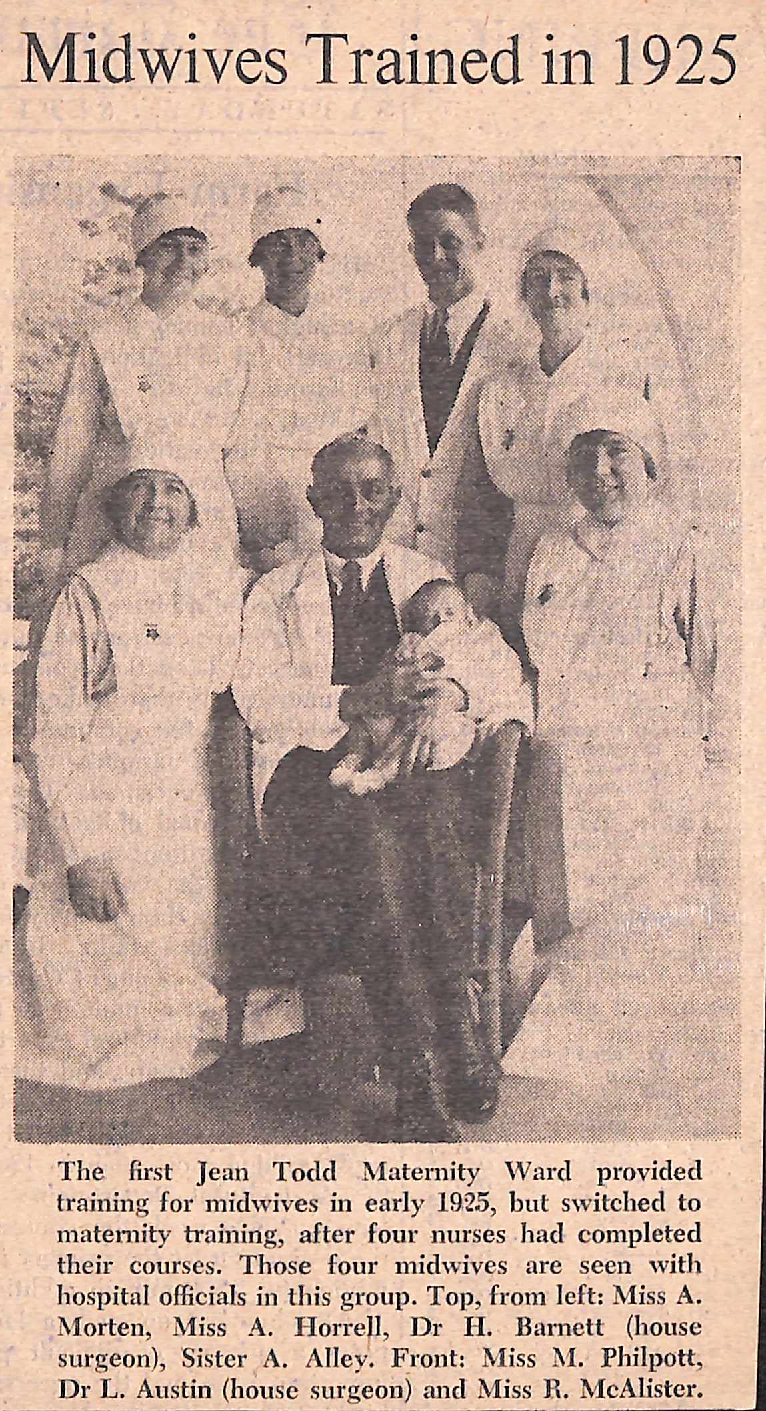
Midwives trained in 1925 (26 Sep 1964). Aoraki Heritage Collection, accessed 15/06/2025, https://aorakiheritage.recollect.co.nz/nodes/view/7645
The Jean Todd Maternity Ward was not just a place for mothers and babies. In its early days, it was also a place of learning. In 1925, it began training midwives, and four nurses completed their courses before the focus shifted to maternity care. Those first midwives — Miss A. Morten, Miss A. Horrell, Miss M. Philpott and M. McAlister — stood proudly with hospital staff in a photograph alongside Dr H. Barnett, Dr L. Austin and Sister A. Alley. It is a quiet reminder that the ward carried forward Jean’s legacy not only in care, but in education too — passing knowledge from one generation of women to the next.
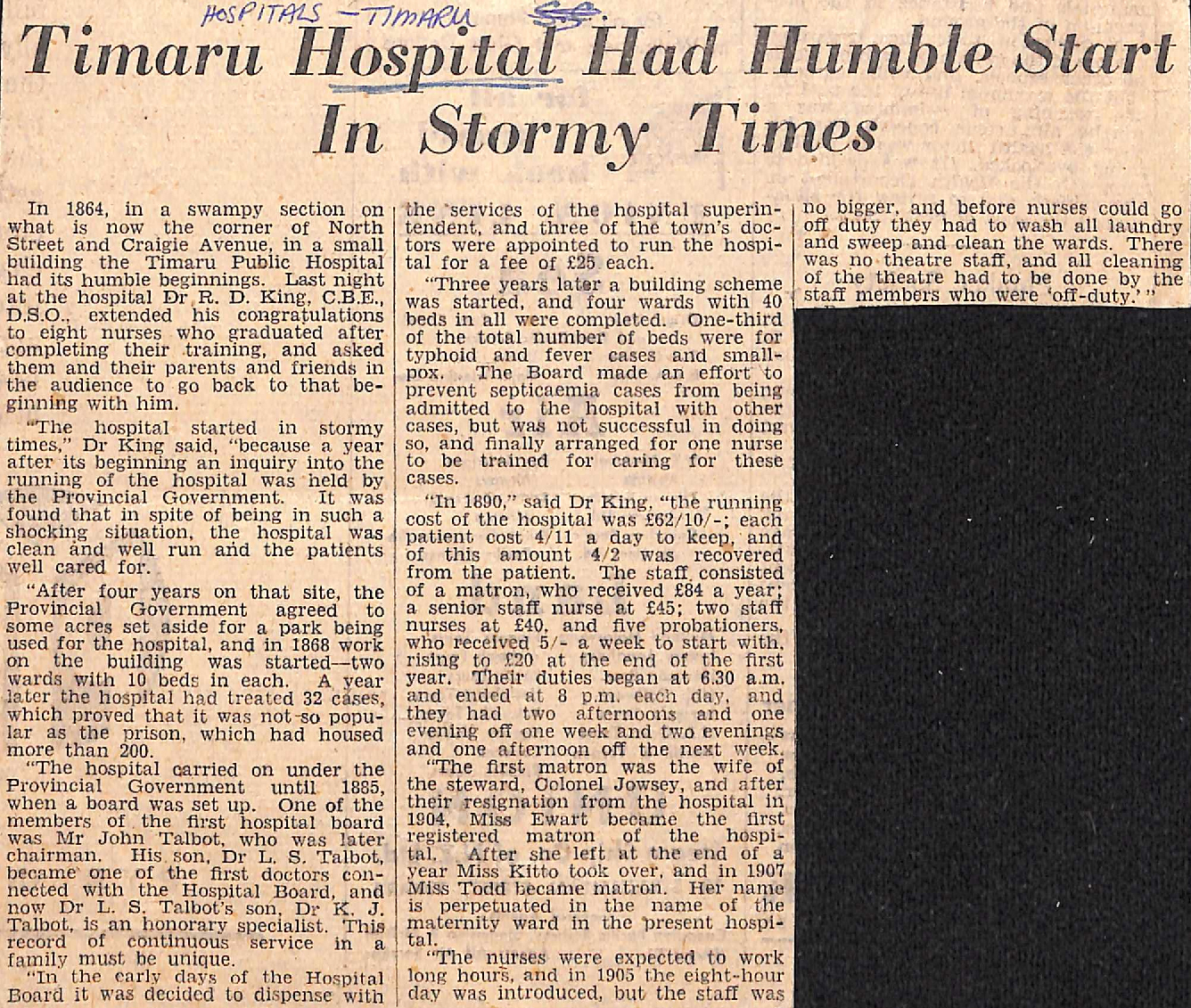
Timaru Hospital Had Humble Start In Stormy Times (1960s). Aoraki Heritage Collection, accessed 15/06/2025, https://aorakiheritage.recollect.co.nz/nodes/view/7631
Timaru Hospital Had Humble Start — Stormy Times in a Long Hour
In 1864, in a swampy section on what is now the corner of North Street and Craigie Avenue, in a small building, the Timaru Public Hospital had its humble beginnings.
Last night at the hospital, Dr R. D. King, C.B.E., D.S.O., extended his congratulations to eight nurses who graduated after completing their training, and asked them and their parents and friends in the audience to go back to that beginning with him.
“The hospital started in stormy times,” Dr King said, “because a year after its beginning an inquiry into the running of the hospital was held by the Provincial Government. It was found that in spite of being in such a shocking situation, the hospital was clean and well run and the patients well cared for.
“After four years on that site, the Provincial Government agreed to some acres set aside for a park being used for the hospital, and in 1868 work on the building was started — two wards with 10 beds in each. A year later the hospital had treated 32 cases, which proved that it was not so popular as the prison, which had housed more than 200.
“The hospital carried on under the Provincial Government until 1885, when a board was set up. One of the members of the first hospital board was Mr John Talbot, who was later chairman. His son, Dr L. S. Talbot, became one of the first doctors connected with the Hospital Board, and now Dr L. S. Talbot’s son, Dr K. Talbot, is an honorary specialist. This record of continuous service by one family must be unique.
“In the early days of the Hospital Board it was decided to dispense with the services of the hospital superintendent, and three of the town’s doctors were appointed to run the hospital for a fee of £25 each.
“Three years later a building scheme was started, and four wards with 40 beds in all were completed. One-third of the total number of beds were for typhoid and fever cases and smallpox. The Board made an effort to prevent septicaemia cases from being admitted to the hospital with other cases, but was not successful in doing so, and finally arranged for one nurse to be trained for caring for these cases.
“In 1890,” said Dr King, “the running cost of the hospital was £62/10/-. Each patient cost 4/11 a day to keep, and of this amount 4/2 was recovered from the patient.
“The staff consisted of a matron, who received £84 a year; a senior staff nurse at £45; two staff nurses at £40; and five probationers, who received 5/- a week to start with, rising to £20 at the end of the first year. Their duties began at 6.30 a.m. and ended at 8 p.m. each day. They had two afternoons and one evening off one week, and two evenings and one afternoon off the next.
“The first matron was the wife of the steward, Colonel Jowsey, and after their resignation from the hospital in 1904, Miss Ewart became the first registered matron of the hospital. After she left at the end of a year, Miss Kitto took over, and in 1907 Miss Todd became matron. Her name is perpetuated in the name of the maternity ward in the present hospital.
“The nurses were expected to work long hours, and in 1905 the eight-hour day was introduced. But the staff was bigger, and before nurses could go off duty, they had to wash all laundry and sweep and clean the wards. There was no theatre staff, and all cleaning of the theatre had to be done by the staff members who were off-duty.”
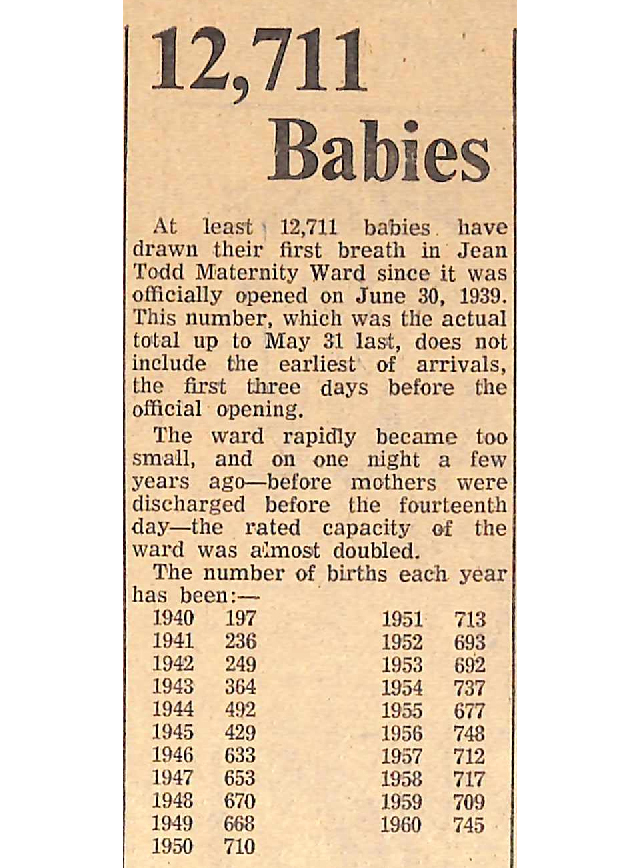
12,711 Babies (08 Jun 1961). Aoraki Heritage Collection, accessed 15/06/2025, https://aorakiheritage.recollect.co.nz/nodes/view/7597
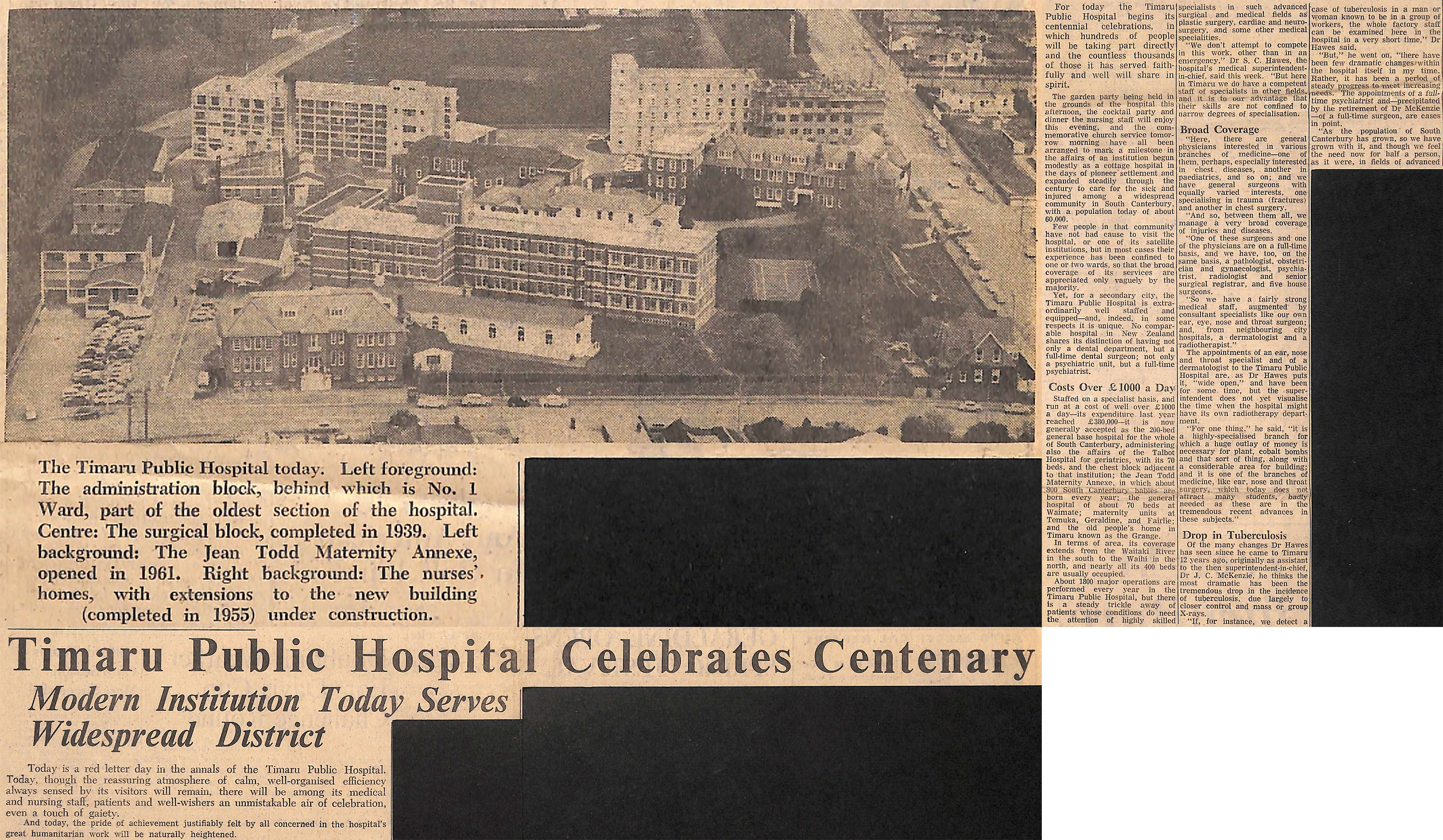
Timaru Public Hospital Celebrates Centenary: Modern Institution Today Serves Widespread District (26 Sep 1964). Aoraki Heritage Collection, accessed 15/06/2025, https://aorakiheritage.recollect.co.nz/nodes/view/7699
References
-
Patricia Sargison, Essentially a Woman’s Work: The Management of New Zealand Public Hospitals, 1880s–1920s, PhD thesis, University of Otago, 2001.
Covers Jean Todd’s resignation, the internal politics of hospital administration, and her later vindication. -
Kai Tiaki: The Journal of the Nurses of New Zealand, Vol. XVIII, No. 2, 1 April 1925, p. 56.
Reports the hospital board’s resolution to honour Jean Todd and recounts community support following her resignation. -
Rhonda Markby, “Jean Todd’s Name Lives On,” Timaru Herald, 31 July 1993.
Retells Jean Todd’s story, the theft scandal, and the naming of the maternity ward.
-
Timaru Herald, “Timaru Hospital Had Humble Start — Stormy Times in a Long Hour.”
Historical address by Dr R. D. King recounting the development of Timaru Hospital and the naming of the Jean Todd Ward. -
Capital & Coast District Health Board, Jean Todd, Matron 1916–1918.
Confirms her role in Wellington and date of death in Masterton, 18 August 1929.
-
New Zealand Births, Deaths and Marriages Historical Records.
Registry for verifying Jean Todd’s death and related details.