
By Roselyn Fauth
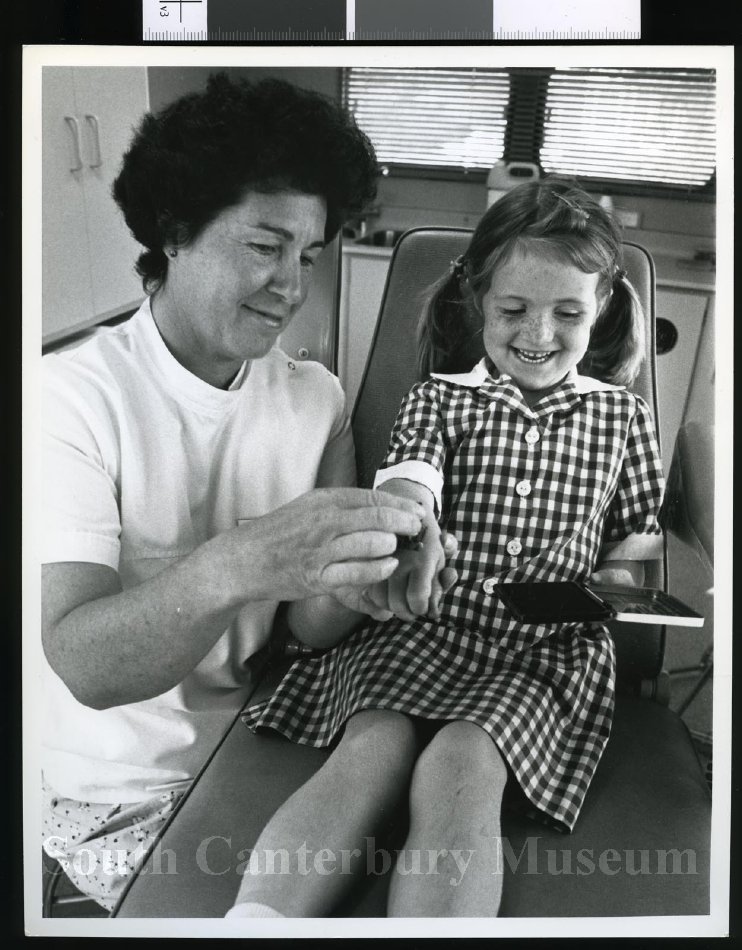
Dental Nurse Janet Jones, with student Vanessa Robinson (aged 5) in the Dental Caravan at Main School, dated 1 March 1991. South Canterbury Museum Catalogue Number 2012/186.5103. On 4 April 1921, a two-year training programme for school dental nurses began in Wellington by the Department of Health's School Dental Service - a first in the world! Women trained in the new profession of "school dental nurse" after the first female dentist was registered in 1881. Since 1991, dental nurses became known as dental therapists but the name 'dental nurse' lingers on for many people. From 2006, the school-based School Dental Service was transformed to a Community Oral Health Service (COHS) emphasising preventative care. Dental services currently available for young people from birth up to their 18th birthday are described by Health New Zealand Te Whata Ora https://timdc.pastperfectonline.com/photo/F24A01C3-2BF9-4CB5-BFFE-649468541375
When we think about dental history, it is easy to picture an old high street practice, a brass plate on the wall, and a patient brave enough to sit in the chair. But I found out, that one of the most important dental story's in New Zealand was not only about dentists. It was about children.
In 1921, New Zealand did something pretty remarkable. It began training school dental nurses for a state funded School Dental Service, the first scheme of its kind in the world!
The idea grew out of a grim reality. Children’s teeth were widely described as being in appalling condition, and the government of the day was becoming increasingly interested in child health, hygiene, and prevention.
That national story is well known. What interests me just as much is what happened when that idea reached South Canterbury...
Before school dental clinics, dental care in Timaru was already part of town life, but it was largely private. In the early 1900s, local dentists advertised extractions, artificial teeth, and surgery rooms in central Timaru. If you could pay, treatment was there. If you could not, or if your family delayed, children might simply carry on with pain, decay, and all the trouble that followed.
The School Dental Service began to change that. Timaru appears to have been an early South Canterbury centre for the new service, with its school dental clinic opening around 1926. But the clinic did not arrive as a neat finished solution. Almost as soon as it was established, the strain began to show. In 1928, the Director of Dental Hygiene told a Timaru meeting that the clinic had opened a little over two years earlier. At first two nurses had been stationed there, but one had resigned because of ill health, leaving Nurse Smith to carry the work alone for a full year.
This detail reminds us that public health reforms may sound tidy on paper, but on the ground they depend on real people, often women, doing demanding work day after day. It also reminds us that Timaru was not simply receiving a government service like a parcel in the post. Local communities had to organise around it, advocate for it, and help sustain it.
That was even more obvious beyond Timaru. Temuka established a clinic in the 1920s, while Waimate had to keep pressing for one. Fairlie struggled too, held back in part by a shortage of nurses and the practical burden of raising local contributions. So this is not only a Timaru story. It is a South Canterbury story of uneven access, local persistence, and a region trying to make a modern health service work across scattered communities.
The school dental nurse was a new kind of working woman.
Her training was rigorous and her role was controversial. Some in the medical and dental professions opposed the scheme when it began, yet the system endured and became one of the most distinctive parts of New Zealand’s child health history. In town after town, women in white uniforms became the face of preventive dental care for generations of children.
Seen from Timaru, the School Dental Service marked a shift in how society thought about children. Oral health was no longer simply a private family matter or a bill to be met at a surgery. It became part of a wider public promise that children deserved care before things became desperate.
That promise was never perfect. Clinics were stretched. Rural districts waited. Money was tight. Staff were in short supply. Yet the idea took root.
Today, when children in South Canterbury still receive public dental care. My daughter brought home her school dental check notes the other day. And I have memories of Mrs Browns dental clinic at Waimataitai when I was a school lass. She used to turn the cotton swabs into butterflies and bees. I didn't have the dental fear that my dad recalls. both my father and father in law, have a very different memory of dental care, that haunts them to this day. All of us, one way or another are part of a line that reaches back more than a century. The buildings may have changed, the equipment certainly has, and the language is different now, but the principle remains surprisingly familiar.
Good teeth, like good health, were never only about teeth. They were about dignity, access, and what a community chooses to protect.
We have a wee way to go though. The other day my dentist was expressing his concerns over dental care for children, and his sadness when a unhealthy mouth greeted him, and required extraction. It would be interesting to know where to now, to continue the good world first work that New Zealand has been known for.
Fun Fact: My great grandfather was a dentist in the Netherlands. I remember visiting him and him proudly showing me his retirement gift... at first it looked like a clock set in marble... but on closer inspection I realised it was actually his patients teeth set in a peach resin!
Are you ready for a side quest?
Timaru’s dental history moved from private town dentists to a public child-health service, and that shift tells us something bigger about care, class, women’s work, and community responsibility. What did dental care look like in Timaru before children could get it free at school?
Dental history can sound a bit clinical at first. But once you start looking closely, you'll see there is a story that is more than teeth. It is about children, women’s work, country districts, committee rooms, and the slow local arrival of a very big idea: that we could see the importance of children’s health and to make an impact, the whole community had to rally to help improve children's health.
The national turning point came in 1921, when New Zealand began training school dental nurses for the state funded School Dental Service, the first scheme of its kind in the world.
It was created because children’s teeth were widely described as being in appalling condition. The records are pretty blunt about it. This was not seen as a small problem, or a private family matter. It was a national concern, and New Zealand’s answer was bold, practical, and unusually focused on prevention.
But in Timaru, dentistry had a history before school clinics.
That is one of the first side quests I followed. Long before the School Dental Service reached South Canterbury, local dentists were already advertising their services in town. In 1884, J. D. Hellewell was advertising as a surgeon dentist in Timaru. By 1900, the British Dental Institute in Church Street was offering artificial teeth and other dental work. By 1916 and 1918, the American Dental Company in Stafford Street was advertising Mr A. W. Willis as dental surgeon, with a nurse in attendance and artificial teeth as a specialty. Dentistry was certainly here. But it belonged mostly to the world of private payment, professional rooms, and people who could afford to present themselves for treatment.
That is what makes the next side quest I think so important. When school dental care reached Timaru, it changed not only where treatment happened, but who it was for.
In July 1928, the Director of Dental Hygiene told a Timaru meeting that it was a little over two years since the Timaru Schools’ clinic had opened. At first, two nurses had been stationed there. But one resigned because of ill health, and Nurse Smith was left to carry on alone for twelve months. I keep coming back to that detail. She is there in the record, doing skilled, difficult, repetitive work, yet she appears only as Nurse Smith, with no first name to make her easier to hold onto. So much of women’s work in health seems to sit exactly there: essential, visible in practice, and strangely blurred in memory.
That same 1928 report makes clear that Timaru’s clinic was not some effortless success story handed down from Wellington. It was under pressure. There were too many children and not enough staff.
By 1931, the Minister of Health had approved a permanent third operating nurse for the Timaru Schools’ Dental Clinic, but only if the local association was prepared to meet the departmental charges. That small piece of administration tells us a fair bit. Public health may have been national in vision, but in places like Timaru it still depended on locals to get in behind it find funds and get organised.
In March 1926, Nurse Cato had recently taken charge of the dental clinic at Temuka District High School, and the town formally welcomed her. A week later, the Acting Director of Dental Hygiene visited and met Nurse Cato at the clinic. By August that year, reports noted that she had carried out hundreds of operations and treated well over a hundred patients in a month. Another notice later in 1926 suggests her first initial may have been H. Cato. I love this little Temuka side quest because it widens the map, and tells us how dentistry was evolving in South Canterbury.
Not every place moved at the same pace, though, and that is another important side quest.
In January 1928, Waimate Public School was still reported as being without a dental clinic, despite having striven for one for a long time. By December that year, the Waimate dental clinic nurse was reporting 140 attendances and 278 operations for the month of November, which suggests the service had finally arrived, even if the newspaper item I found did not name her. Fairlie’s path was slower again. In 1930 the chairman was still gathering information to submit to the Health Department about establishing a school dental clinic there, and in 1931 the required quota from the district had still not been fully subscribed.
A world first may sound grand when told from the capital, but in South Canterbury it unfolded in a much more uneven, practical way, shaped by distance, staffing, and local means.
Children at the time were reported across the page as statistics, recording the mouths inspected and work carried out. I wondered if the number punchers at the other end remembered those numbers were children. A child climbing the school steps with a sore mouth. A child sent in by a teacher. A child perhaps frightened, perhaps relieved, perhaps simply curious about this new room where adults peered into mouths and declared that care should begin before things became desperate. That, to me, is the heart of the story. The School Dental Service was not only a reform in technique. It was a change that was far fairer and effective than before for both the have's and have not's.
There is one more side quest worth following into the 1940s. By December 1943, Mrs B. Rodgers had been appointed dental nurse at Timaru Public Hospital.
That notice shows that dental care in Timaru was not only something done in a school clinic. It was becoming part of a wider public-health landscape.
School dentistry may be the most distinctive chapter, but it sits within a broader local story of oral health gradually moving from private rooms into the institutions of how our community cared for each other.
So perhaps that is the real shape of Timaru’s dental history.
Not a straight line, and not just a chronology of clinics rolled out. More a cluster of side quests. The old private dentists in town. Nurse Smith, carrying the load and leaving only a surname behind. Nurse Cato in Temuka, helping extend the service across the district. Waimate still waiting. Fairlie still fundraising. Hospital care appearing later as another thread in the weave. Follow them all, and dentistry stops being a narrow medical story. It becomes a South Canterbury story about access, labour, persistence, and the growing belief that children’s health was something a decent community ought to protect.
And perhaps that is why this history still feels close. The rooms have changed. The equipment has changed. The language has changed too. But the underlying question has not changed nearly as much as we might think. Who gets care, how early, how easily, and because of whose effort? In Timaru, as in so many places, the answers were never only about dentistry. They were about what sort of place people were trying to build together.
Sources
https://natlib.govt.nz/records/22632004
NZ History, “First school dental nurses begin training” https://nzhistory.govt.nz/page/first-trainee-school-dental-nurses-appointed
Te Ara, “Dental care” https://teara.govt.nz/en/dental-care
Te Ara, “Dental nurses to dental therapists” https://teara.govt.nz/en/dental-care/page-4
Papers Past, Timaru Herald, 10 July 1928, “Dental Hygiene” https://paperspast.natlib.govt.nz/newspapers/THD19280710.2.89
Papers Past, Temuka Leader, 25 March 1926, “Dental Clinic. Welcome to Nurse Cato.” https://paperspast.natlib.govt.nz/newspapers/TEML19260325.2.18
Papers Past, Temuka Leader, 1 April 1926, “Dental Clinic. Visit of Mr J. L. Saunders.” https://paperspast.natlib.govt.nz/newspapers/TEML19260401.2.19
Papers Past, Temuka Leader, 17 June 1926, “Dental Clinic” https://paperspast.natlib.govt.nz/newspapers/TEML19260617.2.9
Papers Past, Temuka Leader, 12 August 1926, “Dental Clinic” https://paperspast.natlib.govt.nz/newspapers/TEML19260812.2.17
Papers Past, Otago Daily Times, 27 November 1926, Temuka clinic report mentioning Nurse Cato https://paperspast.natlib.govt.nz/newspapers/ODT19261127.2.138
Papers Past, Timaru Herald, 19 October 1931, “School Dental Clinic” https://paperspast.natlib.govt.nz/newspapers/THD19311019.2.84
Papers Past, Waimate Daily Advertiser, 31 January 1928, Waimate still without a clinic https://paperspast.natlib.govt.nz/newspapers/WDA19280131.2.12
Papers Past, Waimate Daily Advertiser, 4 December 1928, Waimate clinic nurse’s November report https://paperspast.natlib.govt.nz/newspapers/WDA19281204.2.12
Papers Past, Timaru Herald, 10 April 1930, “Fairlie” https://paperspast.natlib.govt.nz/newspapers/THD19300410.2.89
Papers Past, Timaru Herald, 4 February 1931, “Fairlie” https://paperspast.natlib.govt.nz/newspapers/THD19310204.2.83
Papers Past, Timaru Herald, 15 December 1943, “Personal” https://paperspast.natlib.govt.nz/newspapers/THD19431215.2.17
Papers Past, Timaru Herald, 1 October 1884, J. D. Hellewell advertisement https://paperspast.natlib.govt.nz/newspapers/THD18841001.2.2.7
Papers Past, Timaru Herald, 24 February 1900, British Dental Institute advertisement https://paperspast.natlib.govt.nz/newspapers/THD19000224.2.2.8
Papers Past, Timaru Herald, 2 March 1900, British Dental Institute advertisement https://paperspast.natlib.govt.nz/newspapers/THD19000302.2.2.8
Papers Past, Timaru Herald, 5 March 1900, British Dental Institute advertisement https://paperspast.natlib.govt.nz/newspapers/THD19000305.2.2.7
Papers Past, Timaru Herald, 4 November 1916, American Dental Company advertisement https://paperspast.natlib.govt.nz/newspapers/THD19161104.2.35.4
Papers Past, Timaru Herald, 19 February 1918, American Dental Company advertisement https://paperspast.natlib.govt.nz/newspapers/THD19180219.2.18.3