
By Roselyn Fauth inspired by W A Anderson
It appears on coats, jackets, school blazers, memorial tables and donation boxes. We pin it on carefully, trying not to prick our fingers, and somehow that little burst of red changes how a whole day feels. In New Zealand the red poppy is most closely associated with Anzac Day, and the first national Poppy Day was held on 24 April 1922 after a shipment of French-made poppies arrived too late for Armistice Day the year before. Today the RSA’s Poppy Day remains its main fundraising activity, supporting veterans and their whānau.
For a long time, that was how I knew the poppy too, as remembrance, rather than a plant. The red Flanders poppy became linked with the dead of the First World War because it was one of the first flowers to grow on the battlefields of Flanders in Belgium. John McCrae’s 1915 poem “In Flanders Fields.” inspired people such as Moina Michael in the United States and Madame Guérin. Guérin became known as “The Poppy Lady of France” who helped to turn the red poppy into an international remembrance emblem. She promoted the sale of artificial poppies to raise money for children, veterans, and communities affected by war.
Colonel Samuel Moffatt was Madame Guérin’s representative in New Zealand in 1921. He is the man credited in the history books for bringing her poppy appeal idea to the New Zealand Returned Soldiers’ Association suggesting they join other Allied countries in wearing it. After Moffatt's visit, the NZRSA ordered 350,000 small and 16,000 large silk poppies from Madame Guérin’s French Children’s League. They were intended to be used for Armistice Day, but the shipment arrived too late. So the appeal was shifted to the day before Anzac Day in 1922, and it was such a success that the custom stuck. Since then, the poppy has been worn in New Zealand around 25 April 1922, making it the best-known flower of Anzac remembrance here.
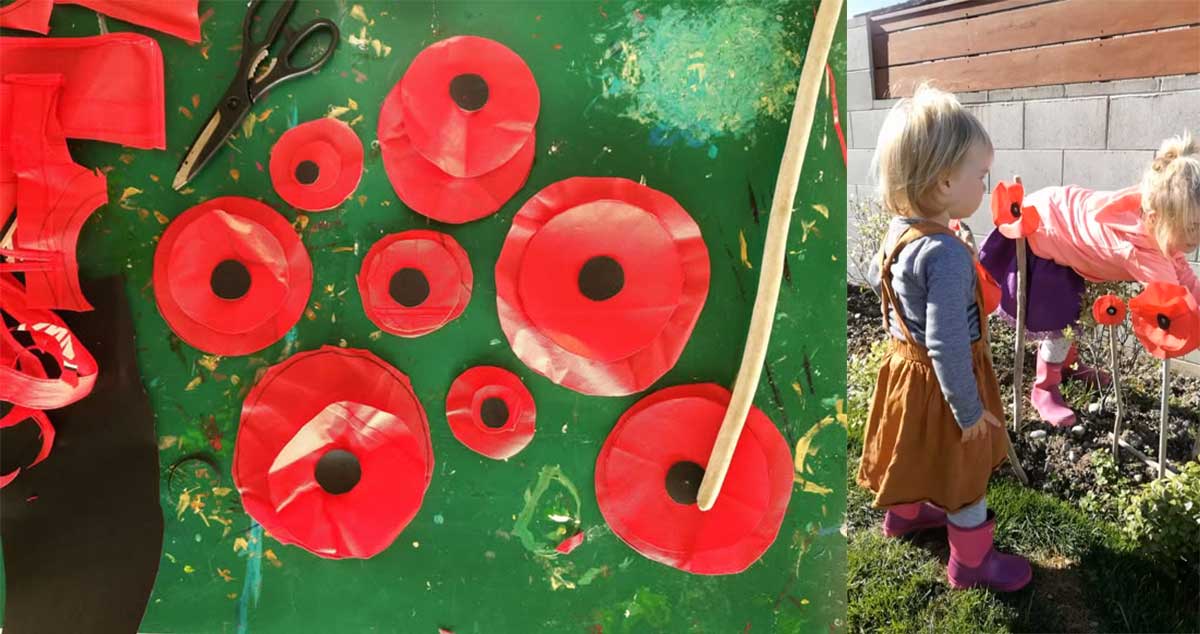
I remember making poppies with our kids during covid lockdown, when we couldn't gather for our annual ceremony out of red shopping bags and staking them into the lawn verge on the street.
I remember poppy's growing in our backyard growing up. I also remember someone telling my mum to avoid growing poppies in her garden as they could attract unwanted visitors.
I went back to A. W. Anderson, the Timaru botanist, conservationist and author who served as Curator of Reserves for Timaru City Council from 1932 to 1956. His book The Coming of the Flowers was published in 1950 and later republished as How We Got Our Flowers. Anderson wrote as a man who loved flowers deeply, but he also wrote as a storyteller. In his hands, the poppy was not just a symbol. It was a plant family full of geography, breeding, travel, fashion, memory and his own personal feelings from plants.
That is what makes his chapter on poppies so good to revisit at Anzac time. https://babel.hathitrust.org/cgi/pt?id=coo.31924000404834&seq=195
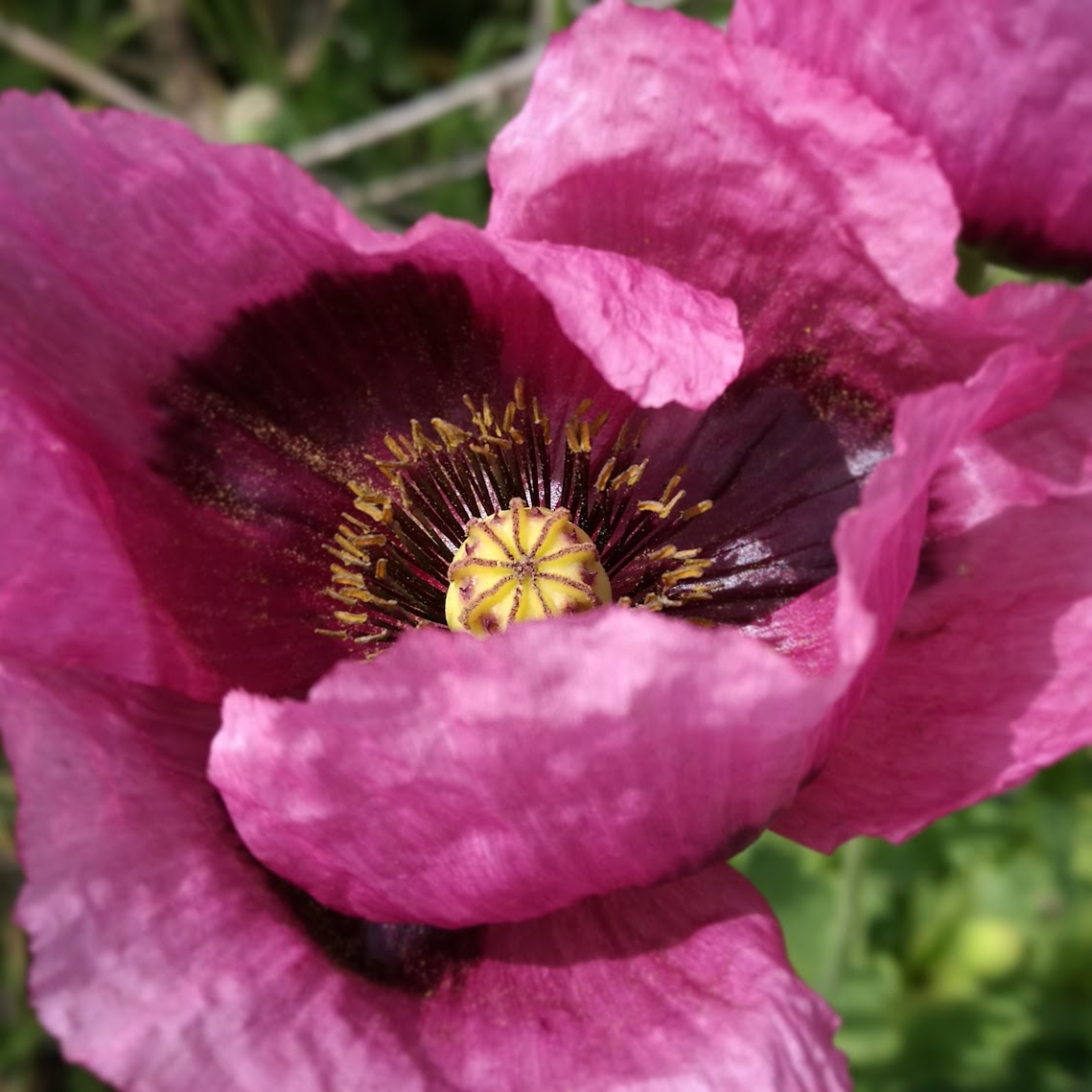
Photo By Roselyn Fauth
Anderson reminds us that the remembrance poppy was a flower long before it became a badge.
He lingers over the Oriental poppy, admires the Iceland poppy for indoor decoration, delights in the story of the Shirley poppy, and touches the much older and more difficult history of the opium poppy. Some of his geography and botany now need a little correction with the more modern knowledge we know now, but the spirit of what he was doing is a great wee read. Anderson, even 70+ years later, shows us that plants carry our stories and history of the past people and place.
Anderson was especially taken with the Oriental poppy, and you can see why.
He wrote of bold clumps of foliage and brilliant flowers, those creased, satiny petals with dark blotches at the base. He understood what gardeners still know instinctively, that poppies do not behave like dutiful bedding plants. They arrive in splendour, flower hard, and then often retreat, he said many poppies hurry through blossom time to get on with “the serious business of seed-making”.
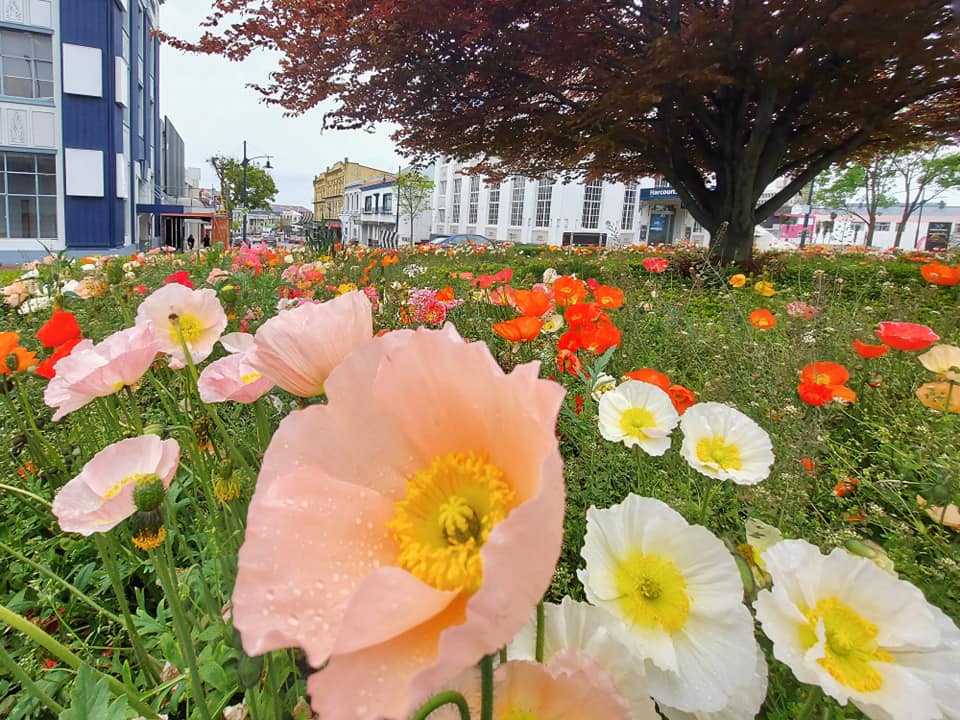
Beautiful colourful display poppy in Timaru CBD Oct 2021 - Photo By Roselyn Fauth
Where modern botany helps is in giving Anderson’s flower a clearer map.
Kew (As in the famous Kew Gardens in the UK) still accepts Papaver orientale, but places its native range from eastern Türkiye to northern Iran. Its near relative Papaver bracteatum, which Anderson treated as a blood-red form, is also now placed more precisely from eastern Türkiye to north-western and northern Iran. So Anderson’s old phrasing about distant valleys to the east was evocative rather than exact. The correction does not diminish his writing though. It simply lets us read it with a better atlas in hand.
(If you didn't know what Kew was, like me... Kew is the Royal Botanic Gardens, Kew, in Britain, one of the world’s leading botanical institutions. Its online database, Plants of the World Online, is a trusted source for current scientific plant names and distributions.)
I really enjoyed reading into the history of the poppies and the Perry's. 'Mrs Perry’ poppy was named for Amos Perry’s wife, Nancy Perry.
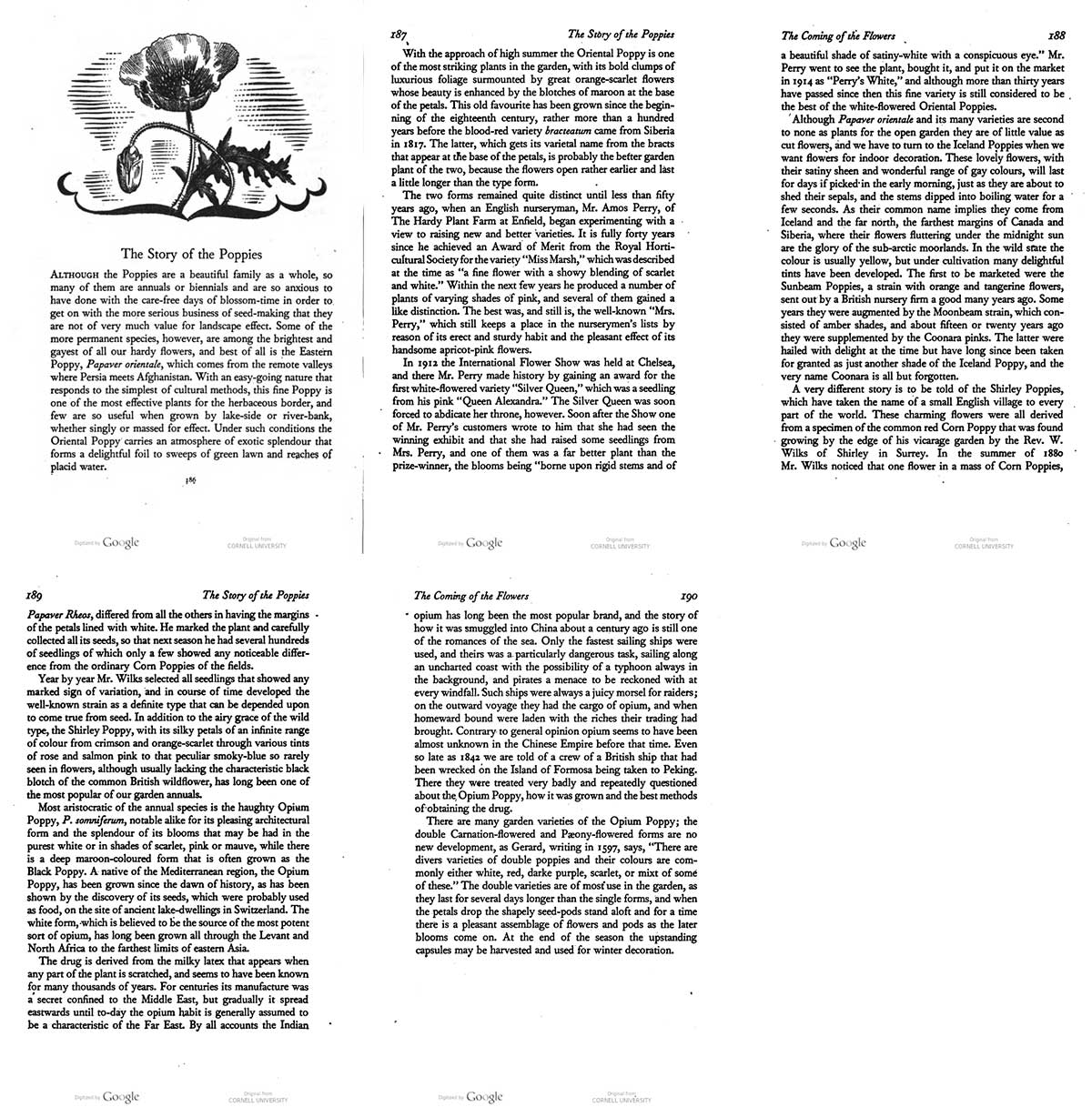
The two forms remained quite distinct until less than fifty years ago, when an English nurseryman, Mr. Amos Perry, of The Hardy Plant Farm at Enfield, began experimenting with a view to raising new and better varieties. It is fully forty years since he achieved an Award of Merit from the Royal Horticultural Society for the variety ‘Miss Mars,’ which was described at the time as ‘a fine flower with a showy blending of scarlet and white.’ Within the next few years he produced a number of plants of varying shades of pink, and several of them gained a like distinction. The best was, and still is, the well-known ‘Mrs. Perry,’ which still keeps a place in the nurserymen’s lists by reason of its erect and sturdy habit and the pleasant effect of its handsome apricot-pink flowers.
In 1912 the International Flower Show was held at Chelsea, and there Mr. Perry made history by gaining an award for the first white-flowered variety ‘Silver Queen,’ which was a seedling from his pink ‘Queen Alexandra.’ The Silver Queen was soon forced to abdicate her throne, however. Soon after the Show one of Mr. Perry’s customers wrote to him that she had seen the winning exhibit and that she had raised some seedlings from Mrs. Perry, and one of them was a far better plant than the prize-winner, the blooms being ‘borne upon rigid stems and of [p. 188] a beautiful shade of satiny-white with a conspicuous eye.’ Mr. Perry went to see the plant, bought it, and put it on the market in 1914 as ‘Perry’s White,’ and although more than thirty years have passed since then this fine variety is still considered to be the best of the white-flowered Oriental Poppies.”
- A. W. Anderson, “The Story of the Poppies,” in The Coming of the Flowers, pp. 187–188.
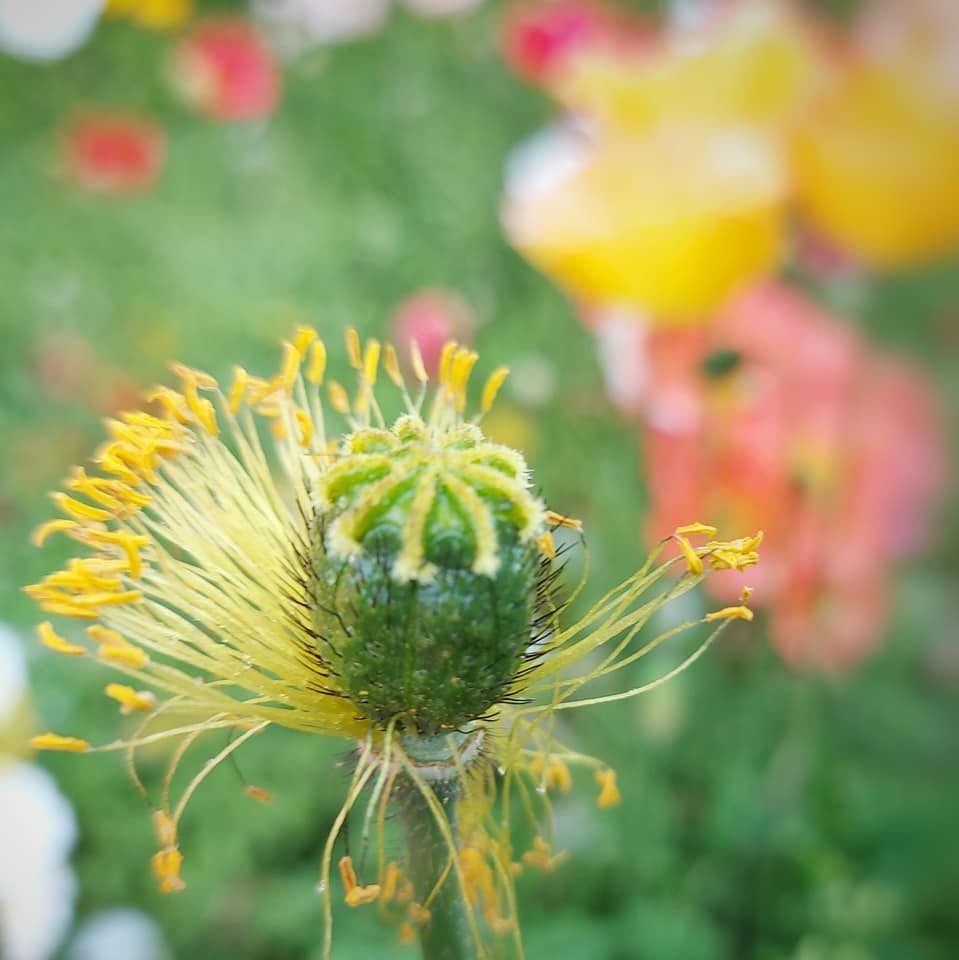
Photo By Roselyn Fauth
And at first I thought I understood what he had written but I wanted a wider information for context. So I went on a little side quest and learned why Anderson chose to write about them and how they are a big part of the poppy story.
Modern Oriental poppy breeding is generally traced to the early twentieth century, when the English nurseryman Amos Perry selected and introduced the salmon-pink cultivar ‘Mrs Perry’. The Royal Horticultural Society still describes it as a deciduous perennial with bristly foliage and large bowl-shaped salmon-pink flowers, darkly blotched at the base.Anderson was not merely name-dropping. He was recording the moment when one observant nurseryman helped widen the colour range of a famous flower. I reminded me that what I see in my friends and families gardens are not there always as nature intended. And just like my Anderson side quest, a poppy can sprout with a new characteristic and be bred to bring a new variety to our backyards and parks.
The Perrys remind us that flowers do not become famous just on their beauty. Someone notices them, selects them, names them, grows them on, and sends them out into the world. In the case of the Oriental poppy, one of the key figures was the English nurseryman Amos Perry of Perry’s Hardy Plant Farm, Enfield. Modern horticultural sources credit Amos Perry (1871 to 1953) with helping transform Oriental poppies from the older, mostly red forms into a wider and softer colour range. The University of Arkansas notes that modern Oriental poppy breeding began in 1906, when Perry selected a salmon pink form and introduced it as ‘Mrs Perry’. He later introduced 11 cultivars in a range of colours, helping open the door to the pastel shades gardeners still love.
The flower itself was not just a novelty, and the Royal Horticultural Society still describes ‘Mrs Perry’ as a substantial perennial, up to about a metre tall, with bristly foliage and large salmon pink bowl shaped flowers marked by dark purple blotches at the base of each petal. That makes Anderson’s interest in the Perrys much easier to understand... Anderson was not wandering off the subject ... he was pointing to the people who helped shape what gardeners came to expect from poppies.
The Perry story was a family one as well as about their successful and famous nursery. Plant Heritage records Amos Perry as Amos Perry V.M.H., linking him to Perry’s Hardy Plant Farm at Enfield, and notes that Amos and Nancy Perry had eight children. So even in this small corner of poppy history, we are back where good garden history often takes us: not only to plants, but to households, work, naming, and the quiet family labour behind what later looks effortless in bloom.
The Shirley poppy carries a different kind of history.
“A very different story is to be told of the Shirley Poppies, which have taken the name of a small English village to every part of the world. These charming flowers were all derived from a specimen of the common red Corn Poppy that was found growing by the edge of his vicarage garden by the Rev. W. Wilks of Shirley in Surrey. In the summer of 1880 Mr. Wilks noticed that one flower in a mass of Corn Poppies, [p. 189] Papaver Rhoeas, differed from all the others in having the margins of the petals lined with white. He marked the plant and carefully collected all its seeds, so that next season he had several hundreds of seedlings of which only a few showed any noticeable difference from the ordinary Corn Poppies of the fields.
Year by year Mr. Wilks selected all seedlings that showed any marked sign of variation, and in course of time developed the well-known strain as a definite type that can be depended upon to come true from seed. In addition to the airy grace of the wild type, the Shirley Poppy, with its silky petals of an infinite range of colour from crimson and orange-scarlet through various tints of rose and salmon pink to that peculiar smoky-blue so rarely seen in flowers, although usually lacking the characteristic black blotch of the common British wildflower, has long been one of the most popular of our garden annuals.”
- A. W. Anderson, “The Story of the Poppies,” in The Coming of the Flowers, pp. 188–189.
Anderson tells it as a story of close observation, and modern sources that I found support him. Reverend William Wilks developed the Shirley poppy from Papaver rhoeas, the corn poppy, after noticing an unusual flower and selecting from it over time. Oxford Herbaria notes that Wilks developed this much-loved garden strain from multiple selections of Papaver rhoeas in his garden at Shirley. This is a reminder that history does not always begin with grand expeditions or famous institutions, and that sometimes it begins when a person looks carefully at a flower and notices something... a possibility. Oxford also notes that poppy capsules open by a ring of pores, so the seed is literally shaken out from the top. I look forward to seeing a seed head and studying this closer.
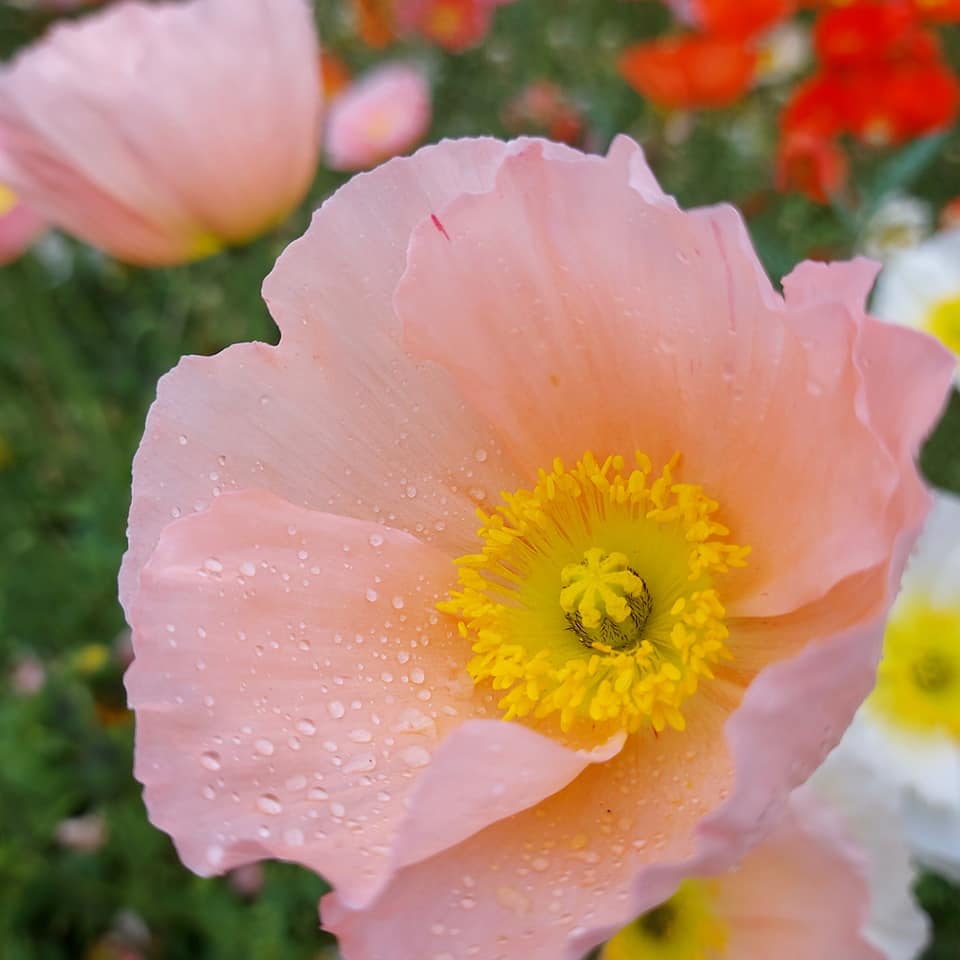
Photo By Roselyn Fauth
The Iceland poppy could be the best example in the chapter of how common names and scientific names do not always travel well together.
“Although Papaver orientale and its many varieties are second to none as plants for the open garden they are of little value as cut flowers, and we have to turn to the Iceland Poppies when we want flowers for indoor decoration. These lovely flowers, with their satiny sheen and wonderful range of gay colours, will last for days if picked in the early morning, just as they are about to shed their sepals, and the stems dipped into boiling water for a few seconds. As their common name implies they come from Iceland and the far north, the farthest margins of Canada and Siberia, where their flowers fluttering under the midnight sun are the glory of the sub-arctic moorlands.
In the wild state the colour is usually yellow, but under cultivation many delightful tints have been developed. The first to be marketed were the Sunbeam Poppies, a strain with orange and tangerine flowers, sent out by a British nursery firm a good many years ago. Some years they were augmented by the Moonbeam strain, which consisted of amber shades, and about fifteen or twenty years ago they were supplemented by the Coonara pinks. The latter were hailed with delight at the time but have long since been taken for granted as just another shade of the Iceland Poppy, and the very name Coonara is all but forgotten.”
- A. W. Anderson, “The Story of the Poppies,” in The Coming of the Flowers, p. 188.
Anderson wrote of a northern flower suited to cutting for the house, and gardeners still know it affectionately as the Iceland poppy. But Kew now accepts the name Oreomecon nudicaulis and gives its native range as southern and eastern Central Siberia to Yukon. So the flower commonly sold as the Iceland poppy is, botanically speaking, more Siberian and Yukon than Icelandic. That does not make the common name useless... but it reminds us that garden language and scientific language move at different speeds, and both are part of the cultural history of plants. Now I realise why keen gardeners take time to learn both names.
Anderson’s discussion of the opium poppy also deserves a mention, though it needs careful handling. Kew accepts Papaver somniferum and places its native range in Macaronesia and the western and central Mediterranean. Modern research has also strengthened the evidence that prehistoric farmers around the Alps were cultivating and using opium poppy on a large scale by about 5500 BCE. Anderson knew he was dealing with an ancient plant, and on that broad point he was right. Where later historians have added necessary nuance is in the history of opium and China. Britannica notes that opium was introduced to China by Turkish and Arab traders in the late sixth or early seventh century, and that the Qing state regulated it long before the height of nineteenth-century British smuggling.
That fuller history helps us avoid repeating old simplifications and honours the human cost bound up with this flower’s past.
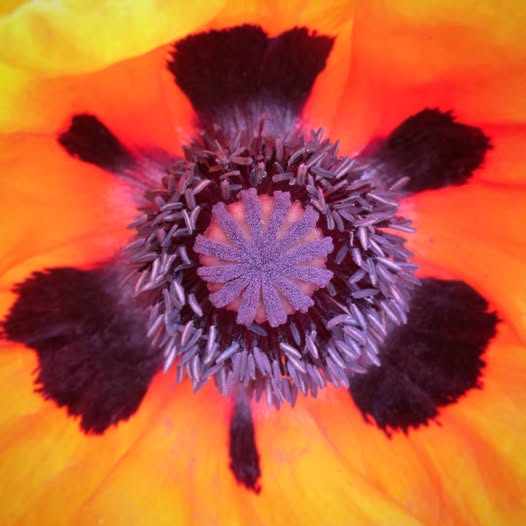
Photo By Roselyn Fauth
And then, after all that, the story comes back to the poppy on the coat.
The red poppy became an international symbol of remembrance after the First World War, helped profoundly by John McCrae’s poem In Flanders Fields, written in 1915. In New Zealand it became attached most strongly to Anzac remembrance, and Te Papa describes the Anzac poppy as the most powerful symbol relating to the impact of war in New Zealand society.
That is one reason the flower still feels so personal for me. It is not only symbolic... it is active. It asks us to remember the dead, and to notice the living who still carry the consequences of service and war.
What Anderson gave me, really, was not just a chapter about poppies.
He gave me back the depth of a symbol I thought I already knew. The poppy is still the bright red thing we wear in April. But it is also an Oriental blaze in the garden border, a Shirley variation noticed by a careful eye, a northern flower whose common name has outlived its botany, an ancient cultivated plant with a long Mediterranean history, and a reminder that plants carry people and place with them wherever they go.
Anderson's writing helps us see that when we hold a flower, we are often holding history as well.
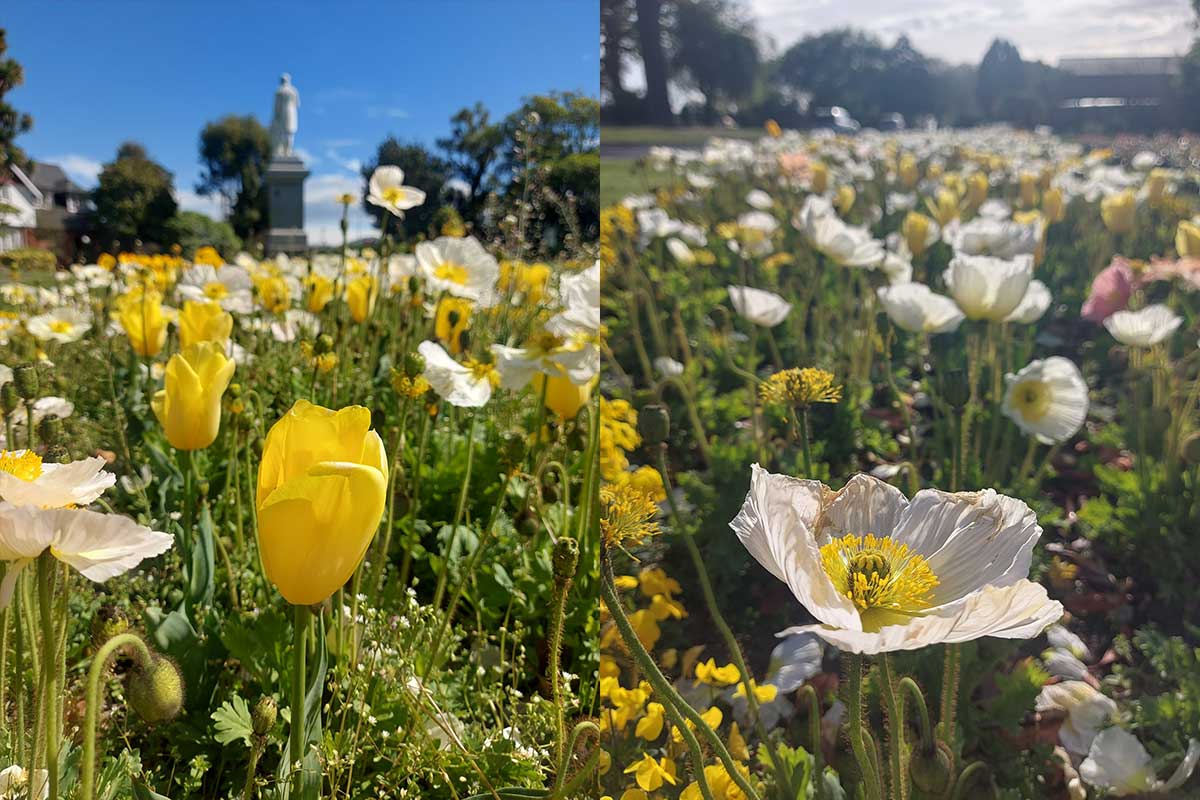
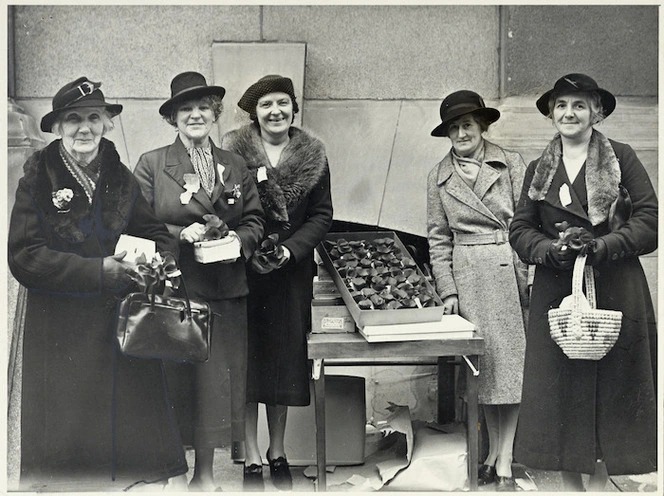
Image: Image: Women selling Anzac poppies, Wellington. Dominion Post (Newspaper): Photographic negatives and prints of the Evening Post and Dominion newspapers. Ref: EP-Days of Commemoration-ANZAC Day-05. Alexander Turnbull Library, Wellington, New Zealand. /records/22368945
That first appeal was an a huge success and over 245,000 small poppies and 15,000 larger ones were sold, raising £13,166 (around $1.34 million in today’s terms). Some of the funds were sent to support devastated communities in northern France, while the remainder aided unemployed New Zealand veterans and their families. The Poppy Appeal idea came from French campaigner Madame E. Guérin, who suggested artificial poppies be made by widows and orphans to support those affected by war. New Zealand placed its first order with her French Children’s League in 1921. This photograph, taken on 20 April 1940, shows five Wellington women who had sold poppies on the streets every year since that very first appeal. From left to right, Mesdames Gendall, Haldane, Anslow, Griffiths and Gourley.
“In Flanders Fields” by John McCrae (1915):
In Flanders fields the poppies blow
Between the crosses, row on row,
That mark our place; and in the sky
The larks, still bravely singing, fly
Scarce heard amid the guns below.
We are the Dead. Short days ago
We lived, felt dawn, saw sunset glow,
Loved and were loved, and now we lie
In Flanders fields.
Take up our quarrel with the foe:
To you from failing hands we throw
The torch; be yours to hold it high.
If ye break faith with us who die
We shall not sleep, though poppies grow
In Flanders fields.
It was written during the First World War in 1915 after the death of McCrae’s friend at Ypres.
For the Fallen
By Laurence Binyon
With proud thanksgiving, a mother for her children,
England mourns for her dead across the sea.
Flesh of her flesh they were, spirit of her spirit,
Fallen in the cause of the free.
Solemn the drums thrill; Death august and royal
Sings sorrow up into immortal spheres,
There is music in the midst of desolation
And a glory that shines upon our tears.
They went with songs to the battle, they were young,
Straight of limb, true of eye, steady and aglow.
They were staunch to the end against odds uncounted;
They fell with their faces to the foe.
They shall grow not old, as we that are left grow old:
Age shall not weary them, nor the years condemn.
At the going down of the sun and in the morning
We will remember them.
They mingle not with their laughing comrades again;
They sit no more at familiar tables of home;
They have no lot in our labour of the day-time;
They sleep beyond England’s foam.
But where our desires are and our hopes profound,
Felt as a well-spring that is hidden from sight,
To the innermost heart of their own land they are known
As the stars are known to the Night;
As the stars that shall be bright when we are dust,
Moving in marches upon the heavenly plain;
As the stars that are starry in the time of our darkness,
To the end, to the end, they remain.
Timeline
c. 5500 BCE
Prehistoric farmers around the Alps were cultivating and using opium poppy on a large scale, contributing to its domestication.
Late 6th or early 7th century CE
Opium was introduced to China by Turkish and Arab traders, according to Britannica.
1597
John Gerard’s Herball was published, showing that poppies were already firmly embedded in early modern botanical writing.
1753
Kew records Papaver orientale and Papaver somniferum as first published in Species Plantarum in 1753.
1821
Kew records Papaver bracteatum as first published in 1821.
1880 onwards
Reverend William Wilks developed the Shirley poppy from selections of Papaver rhoeas at Shirley.
1906
University of Arkansas Extension dates the beginning of modern Oriental poppy breeding to Amos Perry’s introduction of ‘Mrs Perry’.
3 May 1915
John McCrae wrote In Flanders Fields, the poem that helped establish the poppy as an international symbol of remembrance.
24 April 1922
New Zealand held its first national Poppy Day after the original 1921 shipment arrived too late for Armistice Day.
1950
A. W. Anderson’s The Coming of the Flowers was published.
1956 and later
The book was reissued as How We Got Our Flowers.
2021
Kew accepted Oreomecon nudicaulis as the current name for the plant widely known as the Iceland poppy.
Full links for sources
Aoraki Heritage Collection, Walter Anderson
https://aorakiheritage.recollect.co.nz/nodes/view/3960
National Library of New Zealand, How we got our flowers / by A. W. Anderson
https://natlib.govt.nz/records/21816012
Internet Archive, The coming of the flowers
https://archive.org/details/comingofflowers0000awan
NZ History, “The red poppy”
https://nzhistory.govt.nz/war/anzac-day/poppies
NZ History, “New Zealand’s first poppy day”
https://nzhistory.govt.nz/new-zealands-first-poppy-day-held
Te Papa, “Anzac poppy”
https://collections.tepapa.govt.nz/object/1161343
Veterans’ Affairs New Zealand, “100 Years of Poppy Day”
https://www.veteransaffairs.mil.nz/news-events/articles/100-years-of-poppy-day/
RSA, “Poppy Day”
https://www.rsa.org.nz/events/poppy-day-2
Kew, Plants of the World Online, Papaver orientale
https://powo.science.kew.org/taxon/urn:lsid:ipni.org:names:673641-1
Kew, Plants of the World Online, Papaver bracteatum
https://powo.science.kew.org/taxon/urn:lsid:ipni.org:names:673428-1
Kew, Plants of the World Online, Papaver somniferum
https://powo.science.kew.org/taxon/673724-1
Kew, Plants of the World Online, Oreomecon nudicaulis
https://powo.science.kew.org/taxon/urn:lsid:ipni.org:names:77307944-1
Royal Horticultural Society, Papaver (Oriental Group) ‘Mrs Perry’
https://www.rhs.org.uk/plants/366382/papaver-%28oriental-group%29-mrs-perry/details
Royal Horticultural Society, Papaver (Oriental Group) ‘Perry’s White’
https://www.rhs.org.uk/plants/366432/papaver-%28oriental-group%29-perry-s-white/details
University of Arkansas Extension, “Plant of the Week: Poppy, Oriental”
https://www.uaex.uada.edu/yard-garden/resource-library/plant-week/poppy-oriental-3-1-13.aspx
Oxford Herbaria, Papaver rhoeas
https://herbaria.plants.ox.ac.uk/bol/plants400/Profiles/OP/Papaverr
London Parks and Gardens Trust, “Rev. William Wilks and the Wilderness”
https://londongardenstrust.org/features/WilksWilderness.htm
University of Basel, “Swiss farmers contributed to the domestication of the opium poppy”
https://www.unibas.ch/en/News-Events/News/Uni-Research/Swiss-farmers-contributed-to-the-domestication-of-the-opium-poppy.html
Encyclopaedia Britannica, “Opium trade”
https://www.britannica.com/topic/opium-trade
Veterans Affairs Canada, “In Flanders Fields”
https://www.veterans.gc.ca/en/remembrance/get-involved/ways-remember/flanders-fields