
By Roselyn Fauth
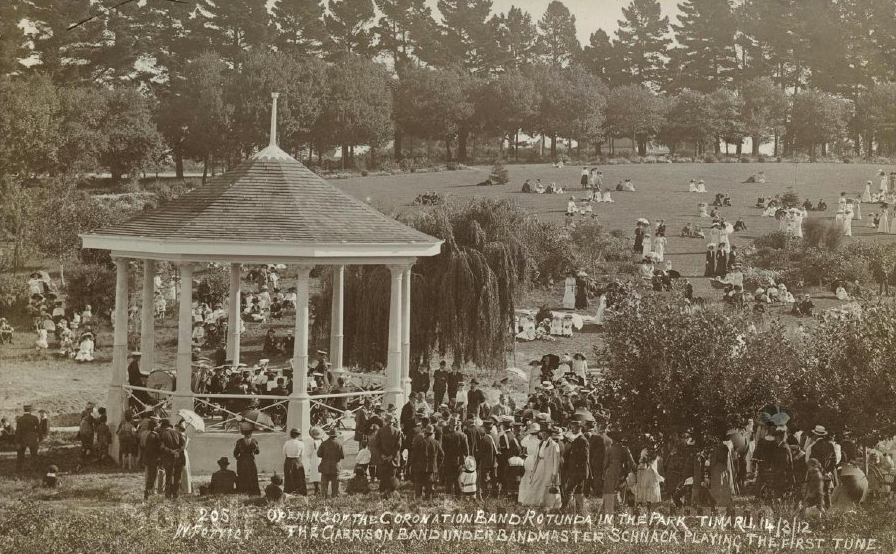
The opening of the Coronation Band rotunda in the Timaru Botanical Gardens in 14 March 1912. Crowds surrounding the rotunda watch as the Timaru Garrison Band, under Bandmaster Schnook, play the first tune. Bears a standard divided verso, postally unused, but with a brief message of good wishes.
I thought that our Timaru Botanic Gardens have been always been known by that name... turns out it was originally called the The Park.
I have been visiting the Timaru Botanic Gardens throughout my life. I was born at Jean Todd ward of the Timaru Public Hospital. And my mothers window looked out to the gardens. Mum and dad have photos of me in a pram being pushed around with my Oma. And I have many memories of licking ice creams and feeding ducks here with my nana.
Like most locals, I knew the Timaru Botanic Gardens as a peaceful place. A place to wander, sit, to bring children. A place to smell the earth, crane your neck up the trunks of old trees, smell roses, look closely at memorials and visit reguarly to take in the seasonal and changing colours.
I thought I knew the gardens, but the more I have looked into its history, the more I have realised that I did not really know it at all.
Our public gardens are also a record of how a young town thought about itself. What it valued. What it hoped to become. What it believed public life should include. Not just roads and shops and houses, but beauty, shelter, recreation, memory, and science...
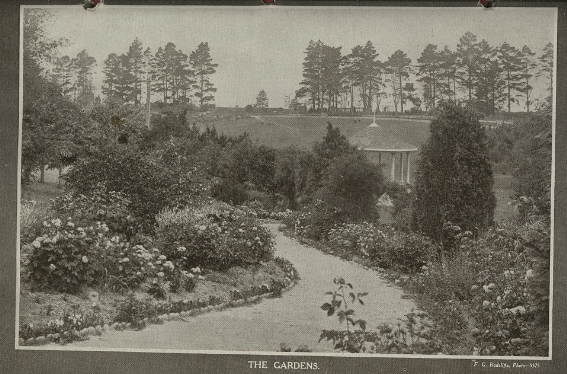
Frank Duncan & Co Ltd, In the Gardens Timaru NZ (1920). Aoraki Heritage Collection, accessed 09/04/2026, https://aorakiheritage.recollect.co.nz/nodes/view/29
Our Botanic Gardens hold so many stories.... more than plants, but stories about people. About their foresight, labour, and ultimately memories. When we walk through public places like this, how often do we stop and think about what had to happen for them to exist at all?
Before it was known as the Timaru Botanic Gardens, it was simply called The Park.
In 1864, local residents asked the Canterbury Provincial Council to reserve land at the southern end of Timaru for public use. The land was set aside as Reserve 314, around 23 hectares in all. Part of it was marked off for hospital purposes, and the rest became what locals called The Park. Not a finished garden. Not a grand botanical showpiece. Just public land held aside for the future.
That early beginning meant that the Timaru Botanic Gardens are among the older botanic gardens in New Zealand.
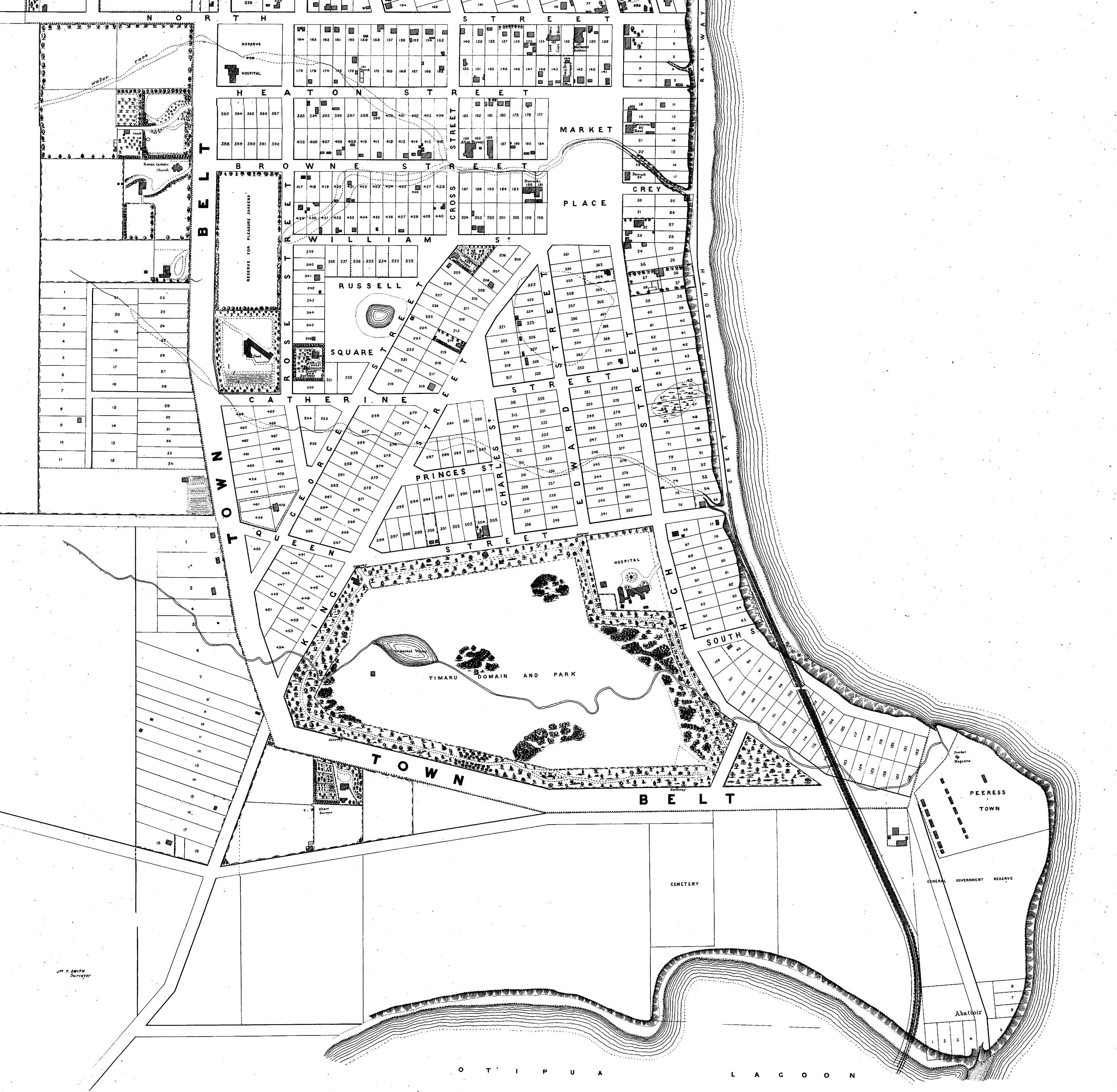
1875- Plan of Timaru Townships Canterbury, Courtesy of the Timaru District Council. Key features today include: Graeme Paterson Conservatory and Fernery, Ornamental ponds, Interpretive centre, Aviary, Cenotaph and War Memorial Wall, Anderson Rose Garden, Band rotunda, Children's playground, Species Rose Garden, Native plant collections, Threatened plant collections, Ornamental plantings, Pinetum, Queen Victoria Garden, Many plant collections. The Timaru Botanic Gardens provides some very attractive vistas as well as a year round interest for plant lovers. It is a photographer's delight. A highlight for children is feeding the ducks on a Saturday as by Sunday they are usually too well fed to be interested.
This was not a ready-made landscape of curving paths and mature trees.
A ranger was appointed. Budgets were slowly allocated, and trees were planted mainly around the perimeter, while much of the remaining land was still leased for grazing stock. The stock caused a few problems back in the day, and there are a few reports in the Timaru Herald where they got out and grazed in the cemetery over the road. The fencing of the cemetery was prioritised to keep the animals out.
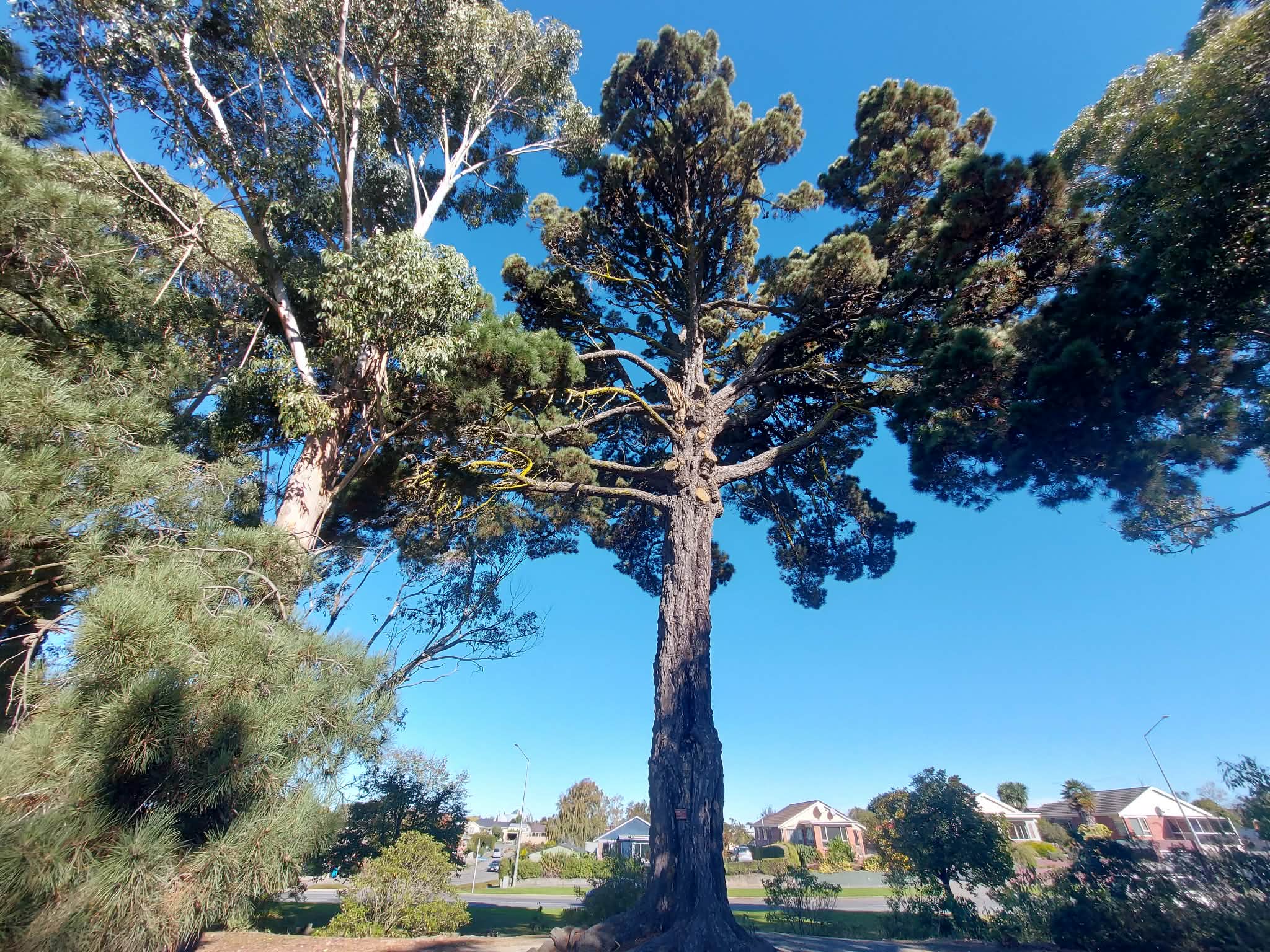
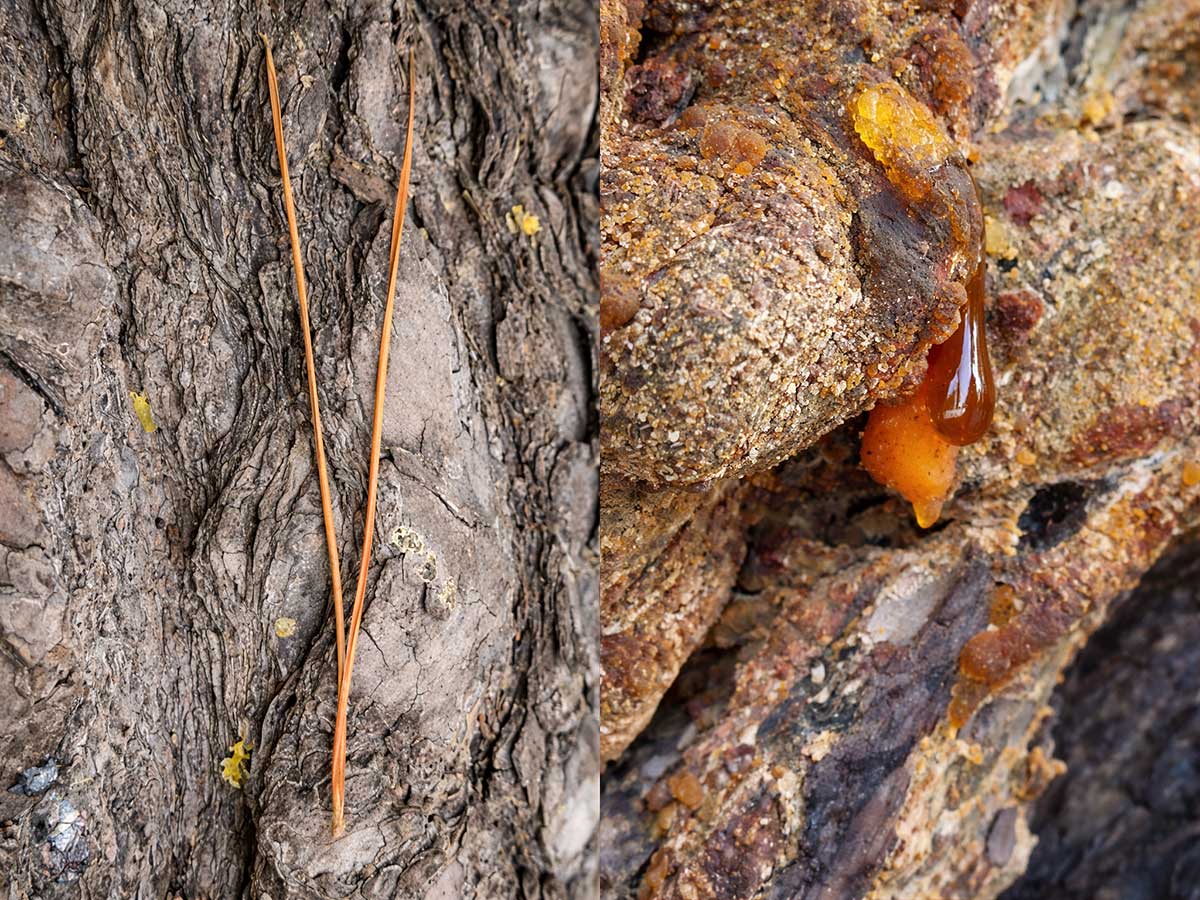
Some of the earlies trees were planted by prisoners, known at the prisoner pines. Two remain in the gardens today. You can see in the survey map above that the town "gaol" was close by on the town belt, no named Craigie Ave. The Jail is long gone, but the prison staff's homes over the road are still there.
The border of the gardens used to have a macrocarpa hedge that was planted to give shelter to the grounds to help the new plants establish and thrive.
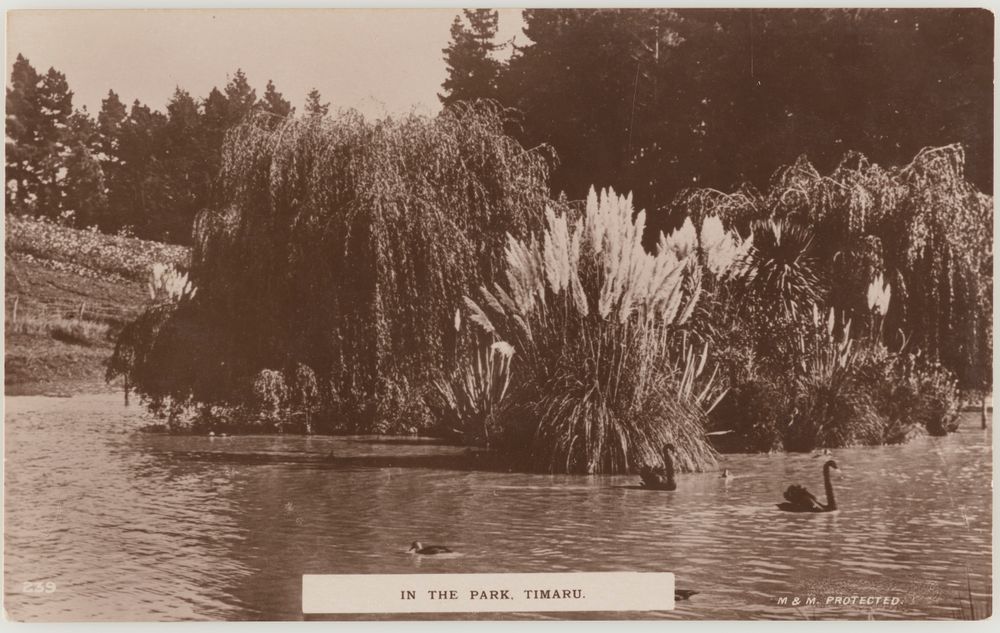
Timaru Botanic Gardens: In the Park, Timaru, 1912, Timaru, by Muir & Moodie. Purchased 1998 with New Zealand Lottery Grants Board funds. Te Papa (PS.002231) No known copyright restrictions.
Why were people in the nineteenth century so determined to create parks and reserves in the first place?
Part of the answer lies in what was happening elsewhere. Across Britain and Europe, growing towns and cities were becoming crowded, dirty and unhealthy. Parks were increasingly seen as essential public spaces. Places for fresh air, recreation, beauty and civic pride. New Zealand settlements absorbed those same ideas. A proper town was expected to have more than roads and shops. It was also expected to have common ground. Space to breathe. Space to gather. Space that belonged to everyone.
But South Canterbury adds its own layer to that story. This was an exposed landscape. Windy, open, still raw in many ways. A. W. Anderson later wrote about settlers in what felt like an “alien land” wanting to surround themselves with familiar trees and flowers. That line has stayed with me.
Planting was not just practical. It was emotional.
It gave shade and shelter, yes. But it also softened strangeness. It helped make a new place feel less harsh, less temporary, more like home. Who does not feel better when a place has trees?
The Park developed gradually.
Council records show that planting began in the late 1860s. The public were encouraged to donate trees, shrubs, bulbs, roots and seeds. Prisoners from Timaru Gaol were involved in early planting work. There was a ranger’s cottage. There were early budgets. There was practical management. There was public effort.
At times the garden had to be advcocated and argued for, funded, planted and maintained. It was shaped by named people and unnamed workers. By officials and donors. By gardeners, caretakers and labourers. By people whose names are in the record, and many whose names are not.
When we admire old public spaces, do we think enough about the hands that made them?
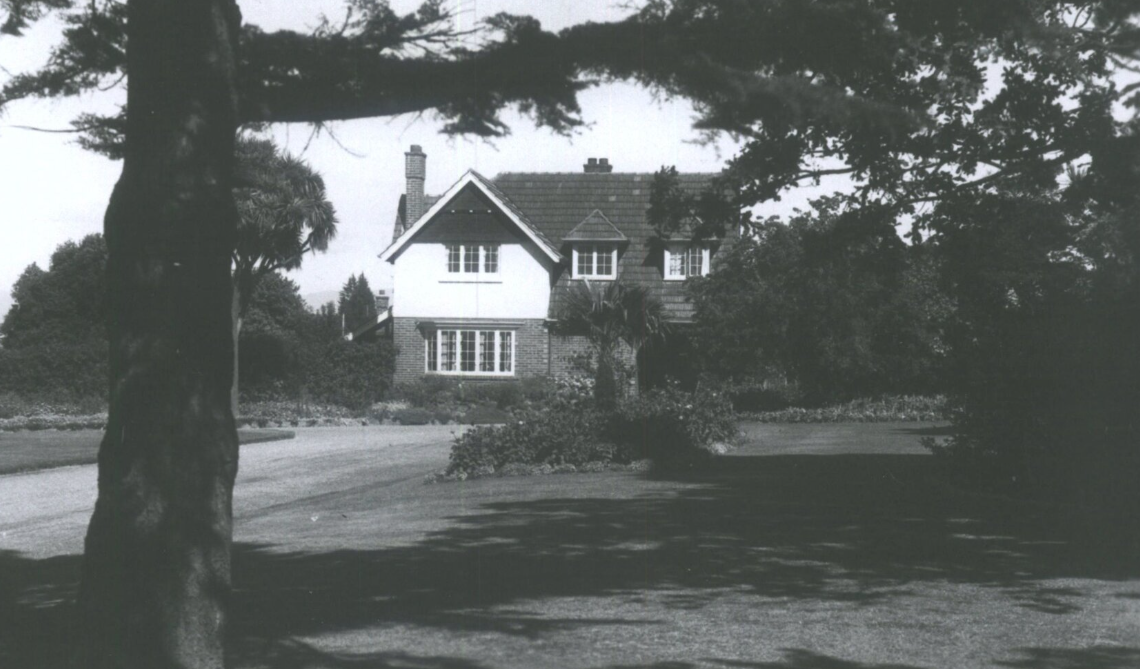
Gardens, Timaru, N.Z.. Hocken Digital Collections, https://hocken.recollect.co.nz/nodes/view/24243. I wonder if this is the original rangers cottage that $200 pounds was set aside for in 1872, or a more recent one. I am thinking this could be a more recent one, maybe from the early 1900s. I found a social media post on South Canterbury Museums Facebook page with a roof tile from the Curator's House in Timaru's Botanic Gardens. It was made by Guichard Carvin and Company, in Marseille, and dates from around 1914.
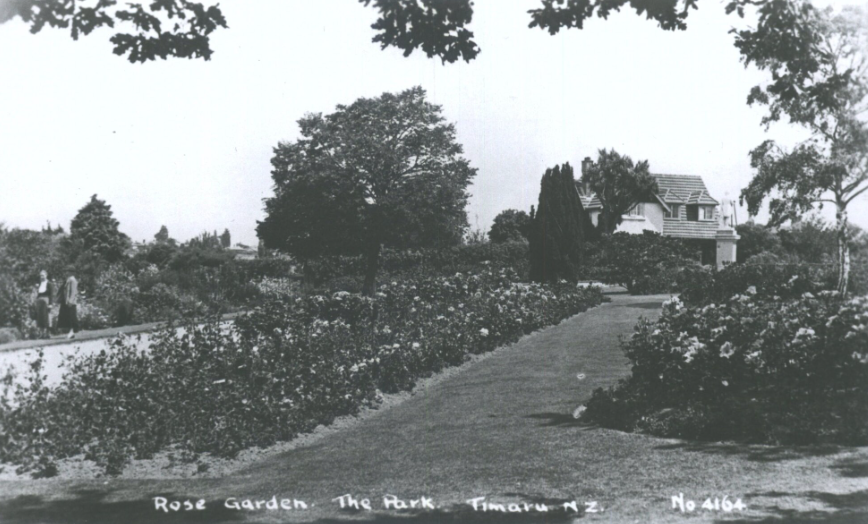
Rose Garden, The Park, Timaru, N.Z.. Hocken Digital Collections, accessed 08/04/2026, https://hocken.recollect.co.nz/nodes/view/24154
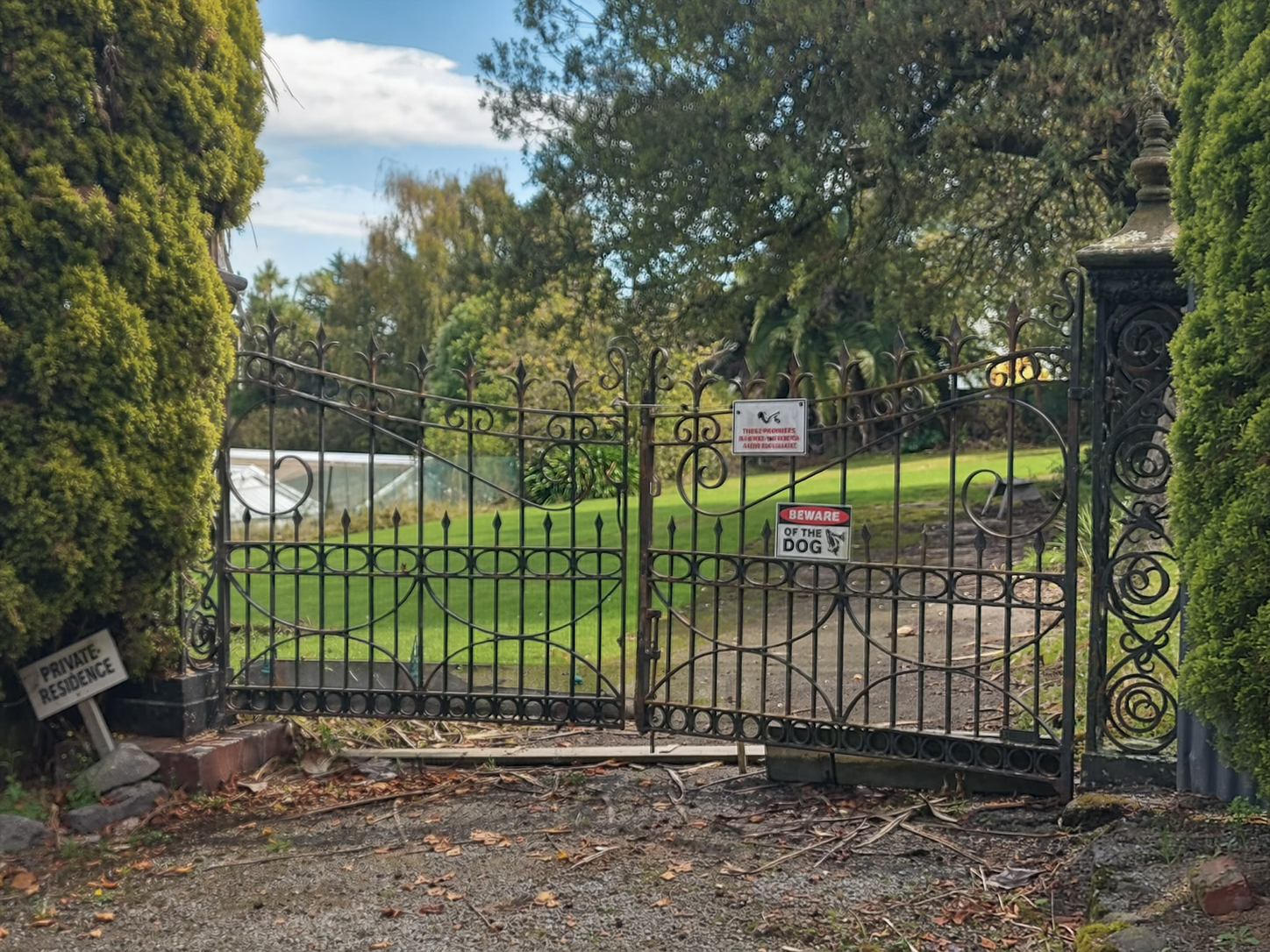
Gates at the Timaru Botanic Gardens. I assume they were once the key entry to the Caretakers Cottage. Photography By Roselyn Fauth 2026.
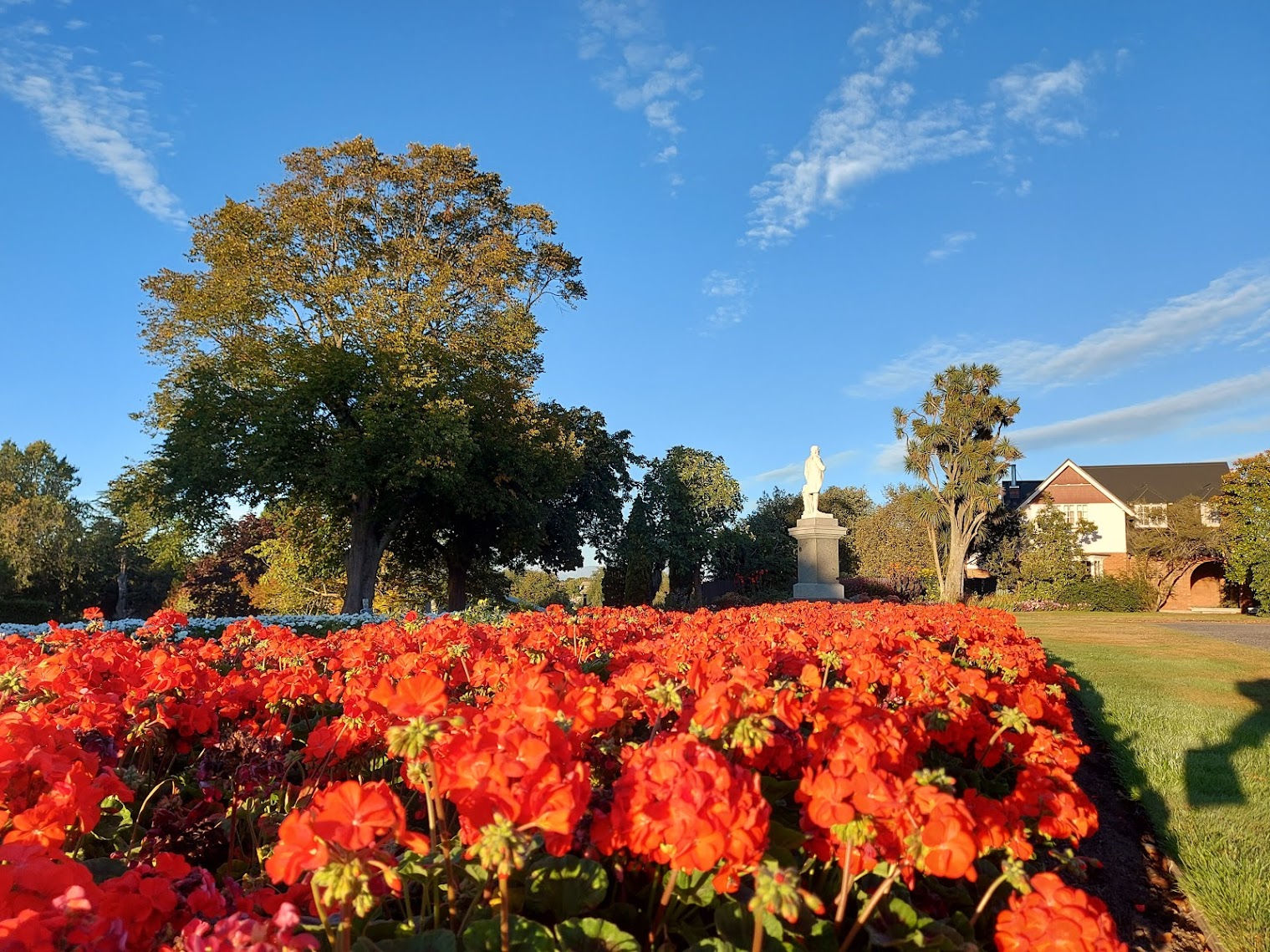
The Park starts to grow up
By the early twentieth century, the reserve was becoming something more ambitious.
The first glasshouse was built in 1905. The bowling green was excavated in 1908. Football and cricket grounds were levelled. In 1909, a climatological station was established. That mix of uses tells us a lot. The Park was never only about ornamental gardening. It was also about recreation, observation, sport and public life.
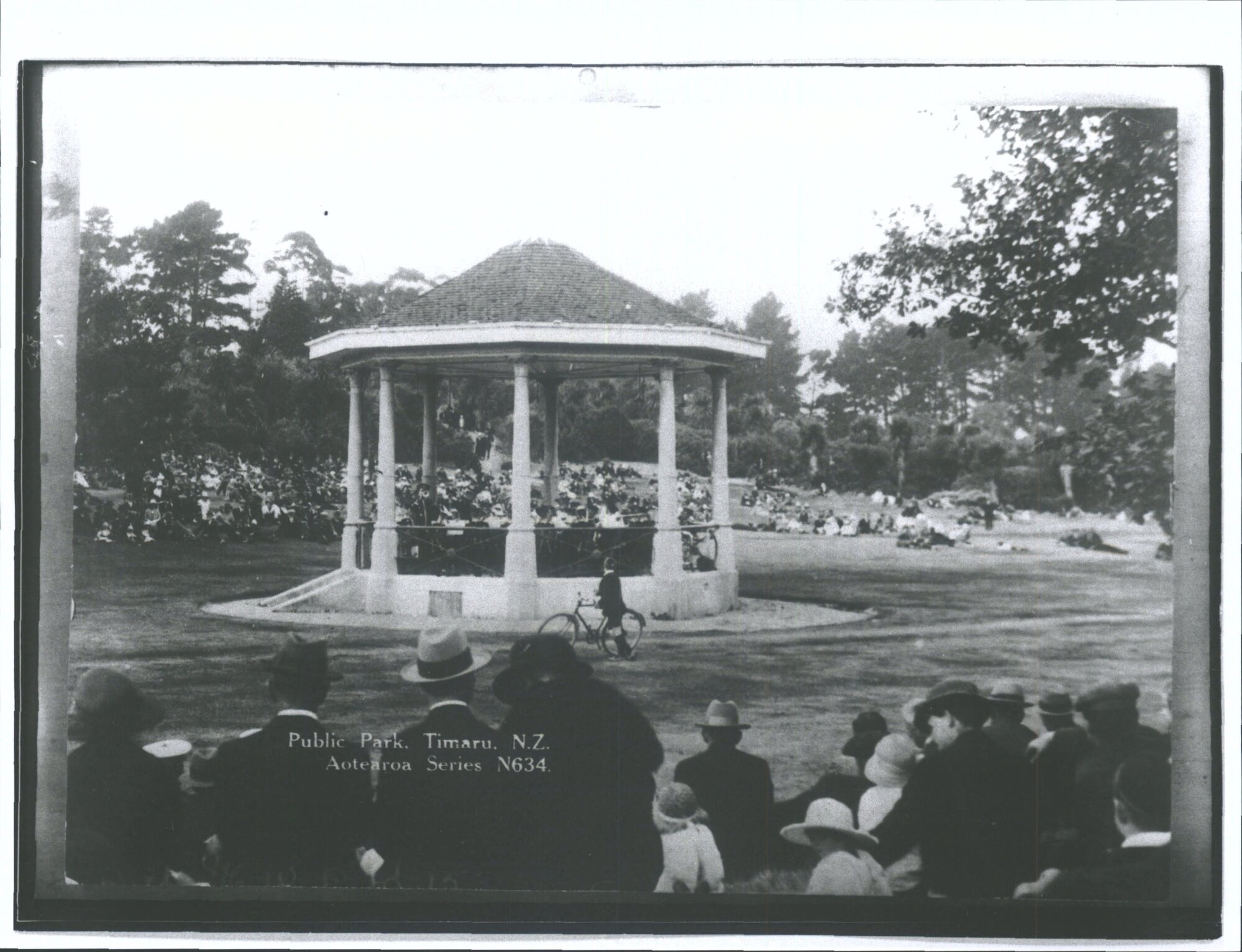
Public Park, Timaru, N.Z.. Hocken Digital Collections, https://hocken.recollect.co.nz/nodes/view/24162
In 1912, the Coronation Rotunda was opened. The Timaru Herald referred to the grounds as the “Botanical Gardens”, “formerly the Park, but no longer so”.
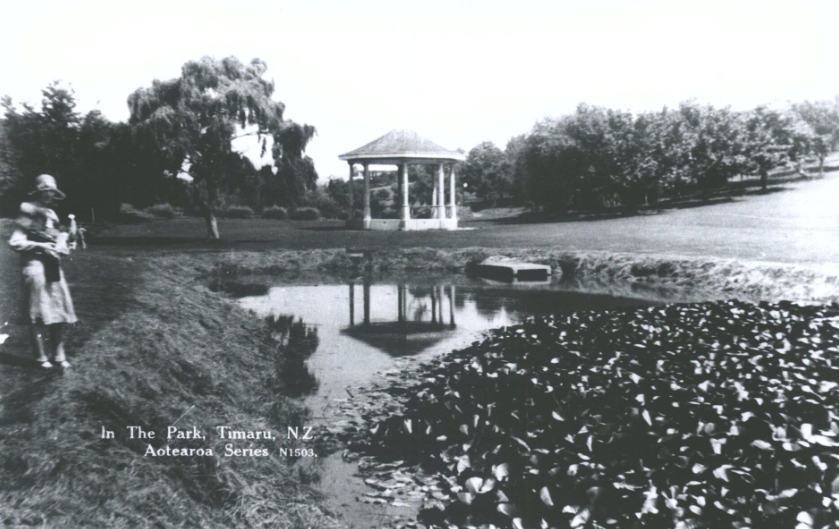
In The Park, Timaru, N.Z.. Hocken Digital Collections, https://hocken.recollect.co.nz/nodes/view/24223

Timaru Park (Mid-late 1920s). Hocken Digital Collections, accessed 08/04/2026, https://hocken.recollect.co.nz/nodes/view/24204
You can almost hear the shift in civic confidence. This was no longer just a reserve on the edge of town. It had become a place of gathering, music, ceremony and identity.

A Statue of Burns; The Unveiling Ceremony at the Timaru Botanic Gardens in May 1913. Aoraki Heritage Collection, https://aorakiheritage.recollect.co.nz/nodes/view/44
The following year, James Craigie presented the Robert Burns statue.
In 1914, a Floral Fete committee was formed to raise funds for improvements. A rustic bridge was built over the lower pond.
A native bush area was established. In 1919, the first children’s playground arrived.
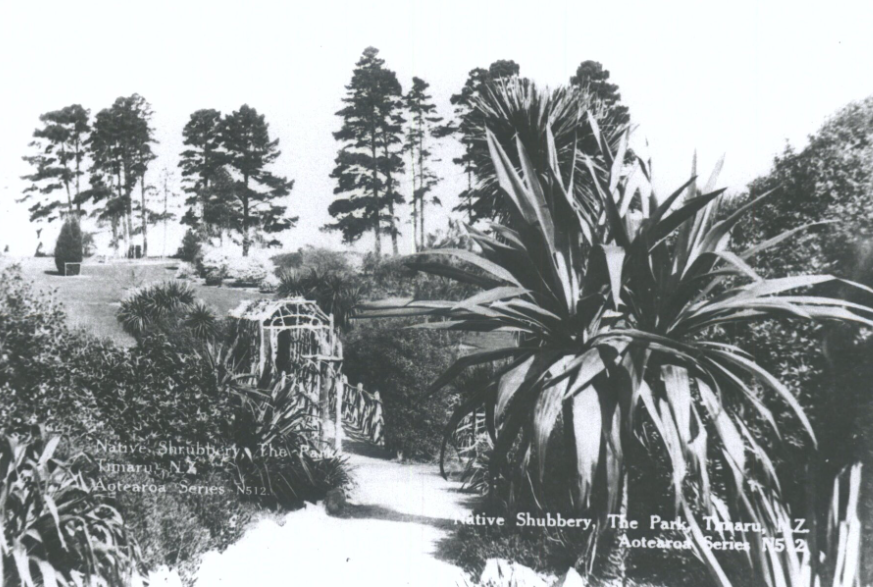
Native Shrubbery, The Park, Timaru, N.Z.. Hocken Digital Collections, https://hocken.recollect.co.nz/nodes/view/24167
I love these details because they remind me that the gardens were not shaped only from above. They were shaped by people caring enough to raise money, organise events and improve the place bit by bit. That bridge over the pond might sound like a small detail, but it says that someone thought the place should be not only practical, but delightful.

The Gardens, Timaru, N.Z.. Copied from album lent Mr Clyne, Hocken Digital Collections, https://hocken.recollect.co.nz/nodes/view/24235
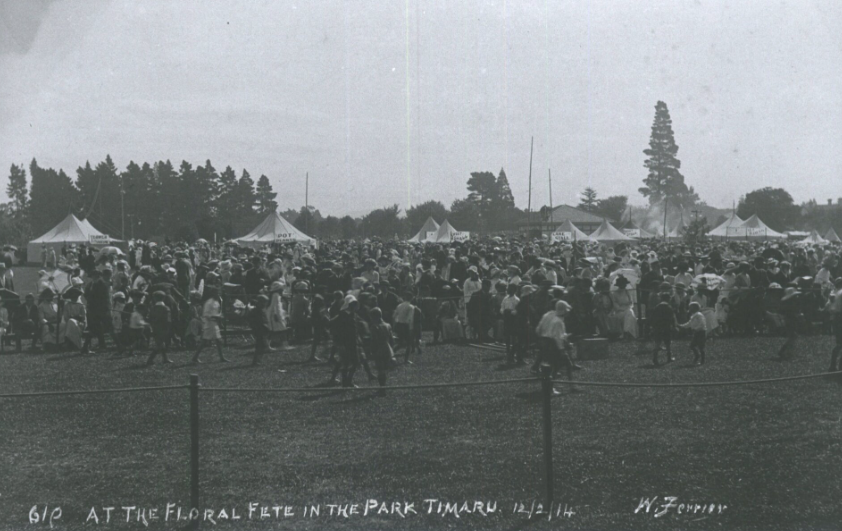
At the Floral Fete in the Park, Timaru (12th February 1914). Hocken Digital Collections, https://hocken.recollect.co.nz/nodes/view/24208
The tea kiosk is one of my favourite parts of the Botanic Gardens story.
In 1920, the Floral Fete committee raised most of the money for it. W. H. Broadhead drew up plans for a pagoda-style building. The contract was awarded in 1921. It opened in 1922, in time for the Floral Fete.
At first, it had no windows and no entrance door as we would expect now. Bench seats were bolted to the inside wall. Then, in 1923, because it had become so popular, windows were installed and chairs and tables were added after complaints that the roughcast wall was ruining people’s clothing.
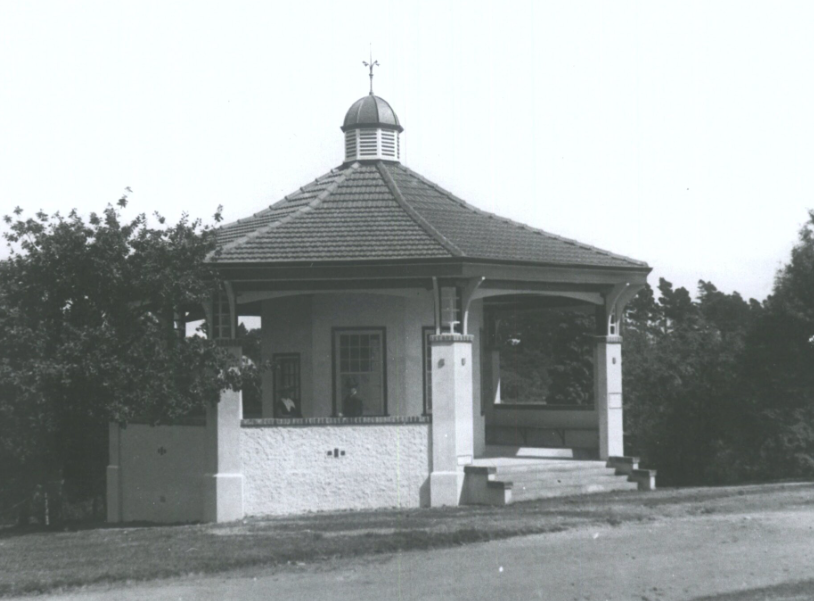
Tea Kiosk, Timaru Park (Mid-late 1920s). Hocken Digital Collections, https://hocken.recollect.co.nz/nodes/view/24200
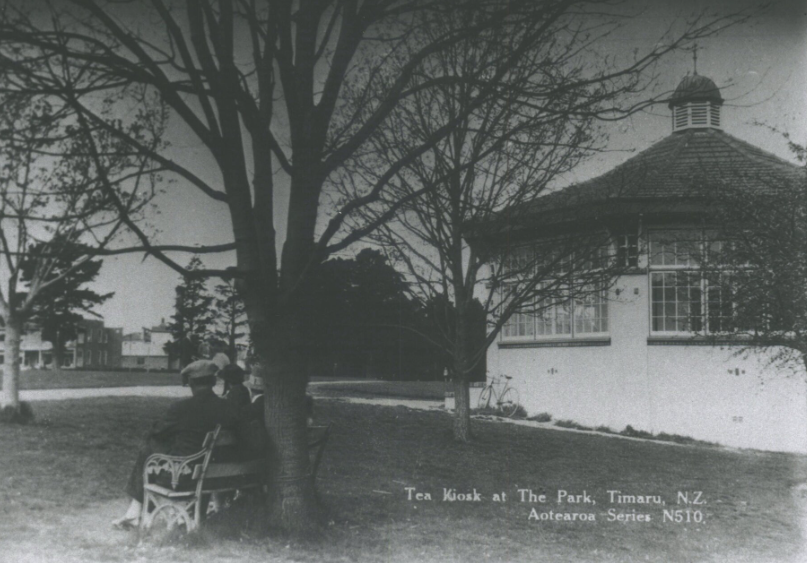
Tea Kiosk at the Park, Timaru, N.Z.. Hocken Digital Collections, https://hocken.recollect.co.nz/nodes/view/24231
By 1927 park patronage was growing significantly. Attractions included possums, kea, swans, deer, emu and even a monkey called Bridget! A lively public place. Social. Curious. A family destination.
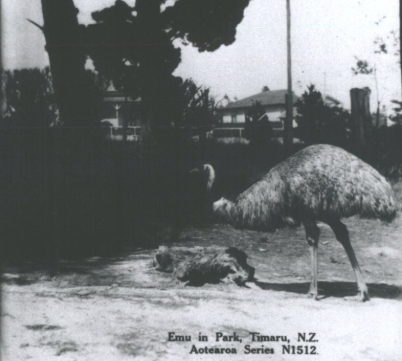
Emu in Park, Timaru, N.Z.. Hocken Digital Collections, https://hocken.recollect.co.nz/nodes/view/24219
Hard times left their mark too
The gardens also hold harder stories. During the Depression, unemployed men were engaged for manual work, including digging improvements to the duck ponds by hand. when we look out to the ponds today, it is hard to imagine the manual work that was done in difficult times. As they dug, I wonder if they could imagine the park 150 years later, where we enjoy oureslves in happier and easier times as a result of their effort.
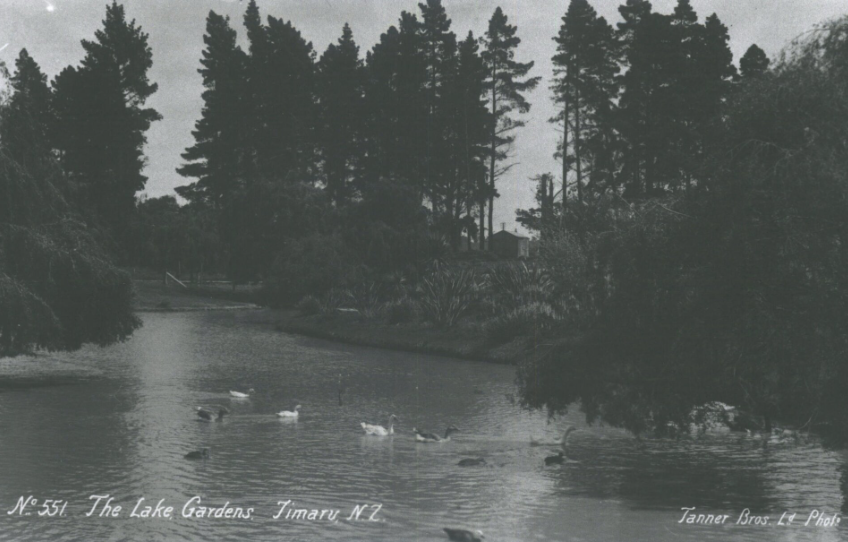
The Lake, Gardens, Timaru, N.Z.. Hocken Digital Collections, https://hocken.recollect.co.nz/nodes/view/24188

The Park, Timaru, N.Z.. Hocken Digital Collections, https://hocken.recollect.co.nz/nodes/view/24184
Gates, memorials and the maturing of the gardens
In 1935, the Gloucester Gates were opened by the Duke of Gloucester. That sounds ceremonial, and it was, but it also marked something deeper. The gardens had become a place worth framing.
By the late 1930s, collections were expanding. The cactus house, tropical house and fernery were added. Some 20,000 daffodil bulbs were donated between 1936 and 1939. In 1938, the Timaru Herald reported around 2,000 roses in bloom across more than 120 varieties.
The gardens were more than a place for strolling. They were becoming a place of collection, cultivation and botanical pride.
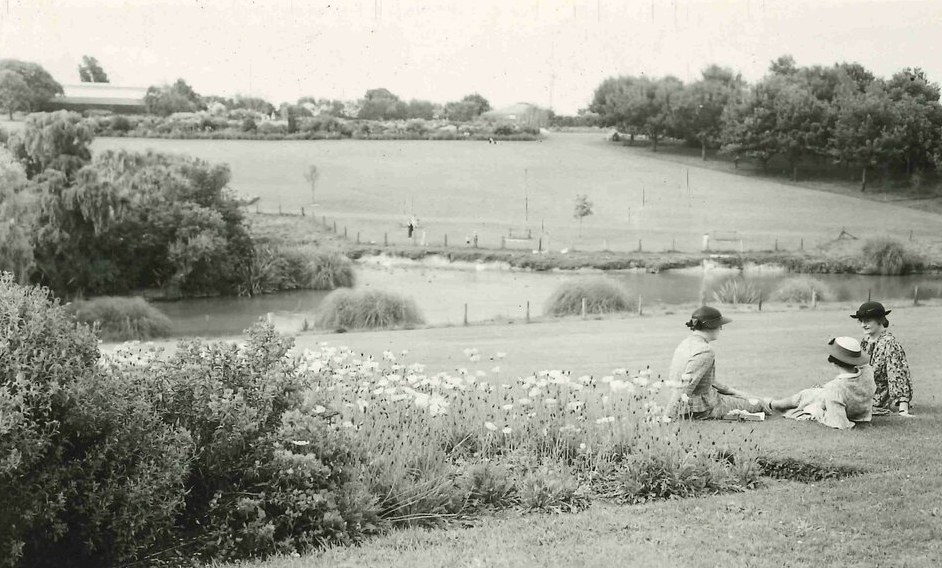
View across the duckpond, with three seated ladies in the foreground. Timaru Botanic Gardens. Tanner Brothers Ltd - aorakiheritage
The hospital beside the garden
Part of the reserve had been linked to hospital purposes from the early years, and more land was later used for hospital needs. It is tempting to see that simply as land lost from the gardens, but I think it also tells us something about how people understood wellbeing. Hospital and garden sat alongside one another as different forms of care.
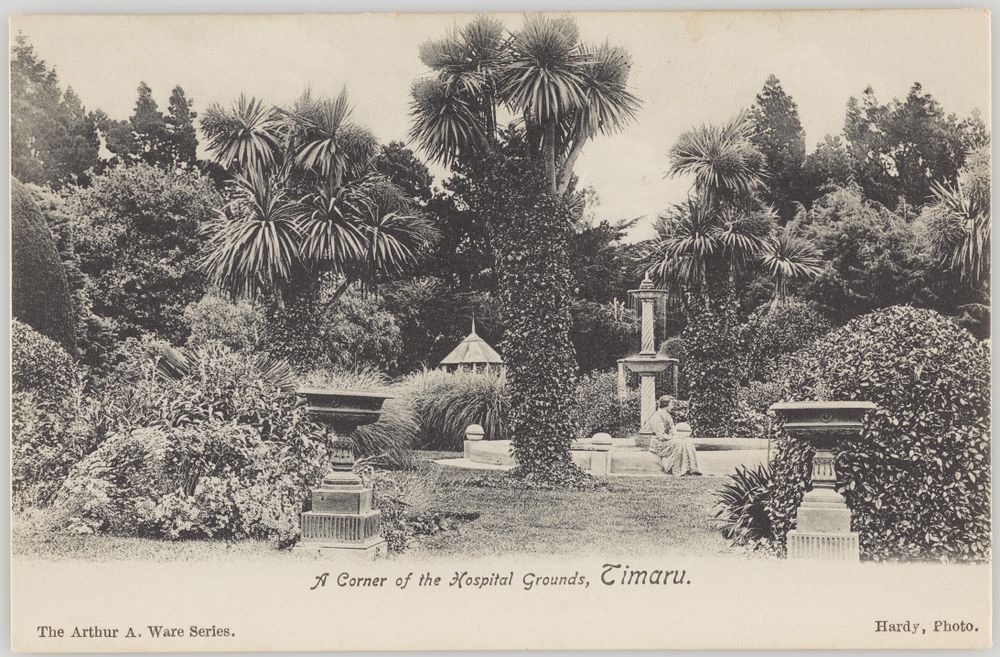
A Corner of the Hospital Grounds, Timaru, 1900-1910, Timaru, by Alfred Hardy. Gift of Patricia M. Mitchell, 1989. Te Papa (PS.000598)
South School, deer, carob and the Dawn Redwood... The 1940s bring some wonderful and strange details.
In 1940, pupils of South School planted 60 trees along the Domain Avenue frontage.
In 1945, deer kept within the gardens had escaped, caused damage and endangered staff, and were eventually destroyed. It is an uncomfortable detail, but it is part of the real story and should not be tidied away.
In 1946, a carob tree was planted beside the Gloucester Gates. Fun fact: carob seeds were used in ancient times as weights, helping form the basis of the carat system used by jewellers. Carob is also known as a chocolate substitute.
The Dawn Redwood
This may be one of my favourite plant stories in the whole gardens. The species was once believed extinct for around two million years until living trees were discovered in China in the 1940s. Seed from that rediscovery was distributed internationally, and a descendant of that remarkable survival story is now growing in Timaru.
What a thing to have in a public garden. Not just a tree, but a global botanical drama rooted quietly in South Canterbury.

Timaru Botanic Gardens. Photographer: D. Nicholson Item Code:R24804807
When The Park became the Timaru Botanic Gardens
In 1948, The Park officially became the Timaru Botanic Gardens.
That feels significant to me. Not because a name changed on paper, but because by then the place had earned it.
By that stage it had grown from reserved land into a layered public landscape with ponds, bridges, gates, plant houses, sports grounds, playgrounds, memorials, collections and deep public memory.
Also in 1948, a totara was planted near the band rotunda to celebrate Timaru becoming a city.
I find that symbolic. A native tree marking a civic milestone in a place that had long balanced exotic planting with newer respect for native flora.
A. W. Anderson
He was a major figure in Timaru’s parks and reserves from the early 1930s, and his influence seems to be everywhere once you start looking. He was associated with native plant conservation, wider beautifying work across South Canterbury, and later received the Loder Cup for his contribution to the cultivation and protection of New Zealand plants.
Anderson wrote about the old cabbage tree near the entrance. He remembered the early pines. He recognised the significance of the Dawn Redwood. Through him, the gardens stop being just a list of developments and become a place shaped by close observation and care.
Every historic place needs its interpreters. Anderson was one of them.
Mid-century change and public memory
From the late 1940s into the 1960s, plant collections continued to develop. In 1960, the Queen Victoria Garden Fountain was moved into the gardens from in front of the Timaru District Council building, and the sunken gardens were established. In 1964, the bird aviary opened.
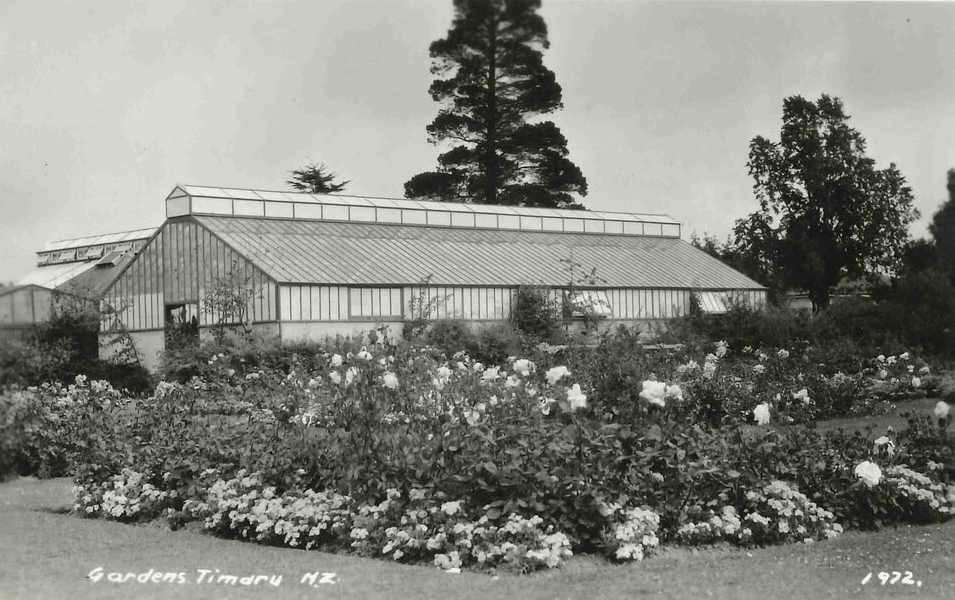
Gardens Timaru NZ. Aoraki Heritage Collection, https://aorakiheritage.recollect.co.nz/nodes/view/25
By 1965, the weather station in the gardens became the basis for the temperature reported for Timaru on national news, replacing the colder reading taken at the port. Apparently Timaru seemed to warm up overnight.
Loss, damage and reinvention
In 1973, the tea kiosk closed when the tenant did not renew the lease. In 1974, new glasshouses and amenities buildings were constructed. In 1975, a major storm damaged many trees. Public gardens are often talked about as if they simply endure unchanged, but they do not. They are vulnerable. Storms matter. Snow matters. Budgets matter. People matter. And yet they keep being renewed. In the 1980s, there were proposals for the closed kiosk, but nothing came of them for a while. In 1991, it reopened as an education centre.
Roses, memorial trees and later recognition
In 1989, the Species Rose Collection was established. It later grew into New Zealand’s largest public collection of species roses, with over 60 of the roughly 150 known species represented. In 2005, the Timaru Species Rose Border received the inaugural Heritage Roses Award.
The gardens also continued to gather memory with special tree plantings such as a tree that was planted for John Lennon in 1980.
Another marked 100 years since the first ascent of Aoraki / Mount Cook in 1994. Many plaques and commemorative plantings now recognise reunions, anniversaries, families and individuals.
Snow, anniversaries and legacy
In 2006, a major snowstorm, the biggest since 1946, caused significant damage throughout the gardens. Native plants were flattened. Trees split or lost limbs. The old carob tree, cork oak and several gum trees were badly affected. A reminder that these places are living things, not museum pieces.
Then, in 2014, the gardens celebrated 150 years since the land was formally gazetted as a public park. A Metrosideros ‘Maungapiko’, a cross between pōhutukawa and southern rātā, was planted to mark the anniversary. That same year, the Timaru Botanic Gardens were recognised as a Garden of National Significance by the New Zealand Gardens Trust.
Our gardens carry so many layers of history in one place.
Reserved land. Shelter planting. Grazing. Prison labour. Sports grounds. Rotunda. Burns statue. Floral fêtes. Tea kiosk. Children’s play. Animal attractions. Depression labour. Gates. Conservatories. Rose collections. Commemorative trees. Education. Storm damage. Renewal. That is a lot of history for one garden to hold.
What do we owe a past generation?
This is the question I keep coming back to. The people who first set aside this land in 1864 did not get to enjoy it as we do. The prisoners who planted early pines did not. The children who planted trees in 1940 did not see them mature for decades. The early gardeners and caretakers who sourced foreign plants, protected delicate specimens and nursed collections through bad weather and lean years did not get the full benefit of their own work.
We did.
So what do we do with that inheritance?
Do we simply enjoy it, which is fair enough? Or do we also try to understand it, value it properly, and pass it on well?
That, for me, is the deeper story of the Timaru Botanic Gardens. It is not just a story about a park becoming a botanic garden. It is a story about people thinking ahead... a story worth honouring.
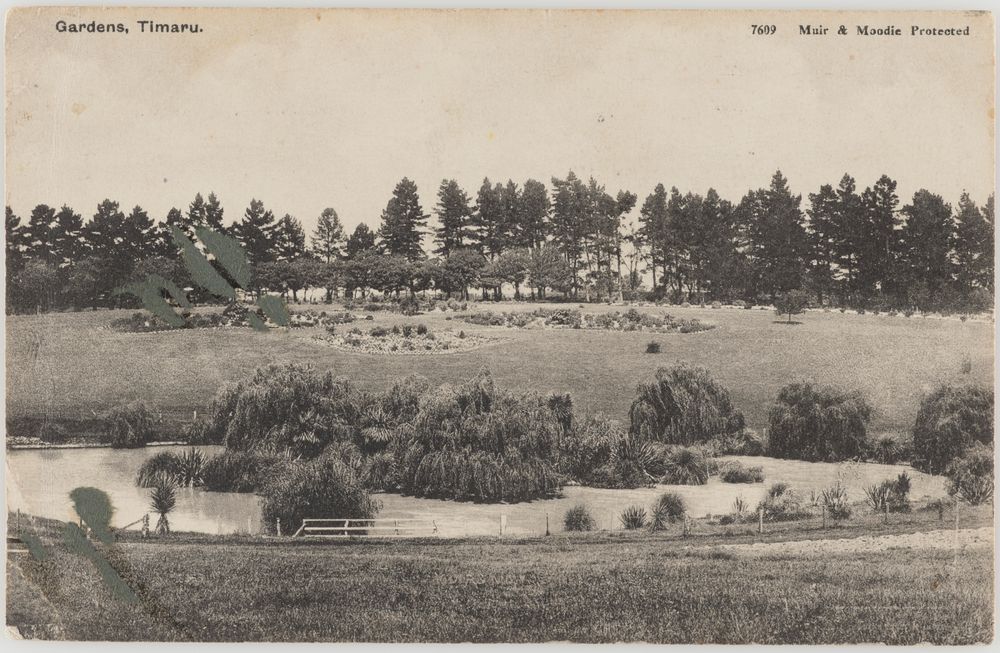
Gardens, Timaru, 1912, Timaru, by Muir & Moodie. Purchased 1998 with New Zealand Lottery Grants Board funds. Te Papa (PS.002216)

Souvenir of Timaru. Aoraki Heritage Collection, accessed 03/10/2025, https://aorakiheritage.recollect.co.nz/nodes/view/3697 Photograph of the statue of Robert Burns which stands at the west end of the Timaru Botanic Gardens. Presented to the people of Timaru by Member of Parliament (and former mayor) James Craigie, in 1913.
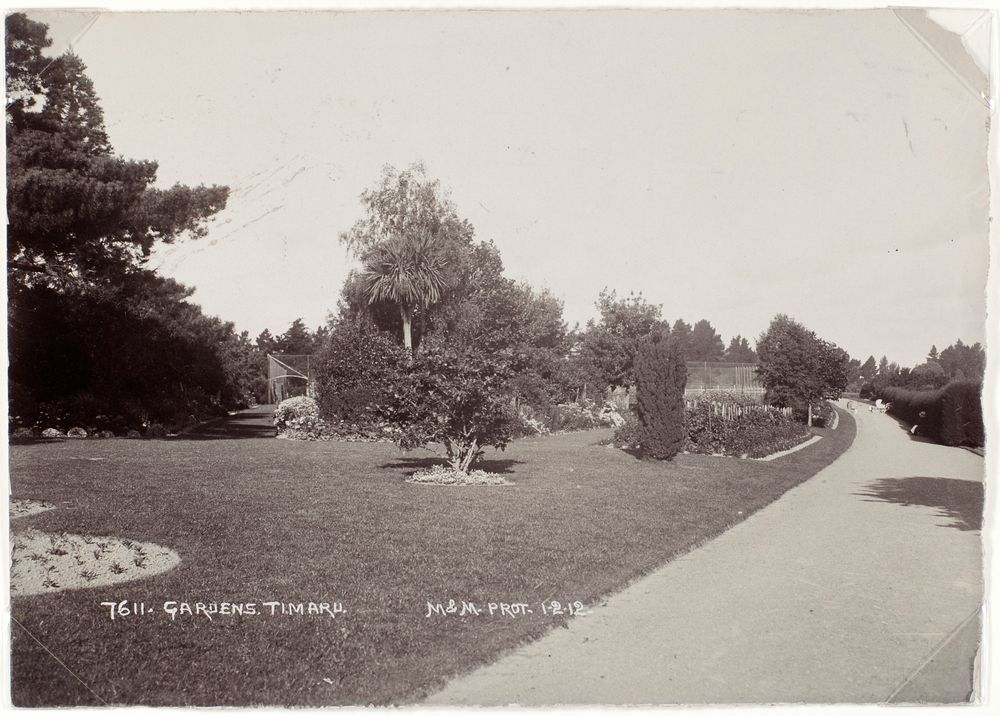
Gardens, Timaru, 1912, Timaru, by Muir & Moodie. Te Papa (O.001833)

Timaru Publicity Caption Aerial view of Timaru. Photographer V.C. Browne.
Bibliography
Published and online sources
Bartholomew, Keith. From Waste Land to a Garden of National Significance: Timaru Botanic Gardens 1864–2014. Timaru: author published / Timaru District Council history project, 2014.
https://www.timaru.govt.nz/news-and-events/latest-news/timaru-botanic-gardens-history-book
DigitalNZ. “Tea Kiosk, Timaru Botanic Gardens.” Accessed 10 April 2026.
https://digitalnz.org/records/54431098
New Zealand Gardens Trust. “Timaru Botanic Gardens.” Accessed 10 April 2026.
https://www.gardens.org.nz/visit/timaru-botanic-gardens
New Zealand Rose Society. “Timaru Botanic Gardens – Species Rose Collection.” Accessed 10 April 2026.
https://nzroses.org.nz/timaru-botanic-gardens-species-rose-collection/
New Zealand Rose Society. “Rose Species Collection.” Accessed 10 April 2026.
https://nzroses.org.nz/tag/rose-species-collection/
Te Ara: The Encyclopedia of New Zealand. “City Parks and Green Spaces.” Accessed 10 April 2026.
https://teara.govt.nz/en/city-parks-and-green-spaces
Te Ara: The Encyclopedia of New Zealand. “City Parks and Green Spaces.” Print version. Accessed 10 April 2026.
https://teara.govt.nz/en/city-parks-and-green-spaces/print
Te Ara: The Encyclopedia of New Zealand. “City Parks and Green Spaces, Page 1: Origins of Green Spaces.” Accessed 10 April 2026.
https://teara.govt.nz/en/city-parks-and-green-spaces/page-1
Te Ara: The Encyclopedia of New Zealand. “City Parks and Green Spaces, Page 3.” Accessed 10 April 2026.
https://teara.govt.nz/en/city-parks-and-green-spaces/page-3
Te Ara: The Encyclopedia of New Zealand. “City Parks and Green Spaces, Page 5.” Accessed 10 April 2026.
https://teara.govt.nz/en/city-parks-and-green-spaces/page-5
Timaru Civic Trust. “Timaru Civic Trust – Botanic Gardens.” Accessed 10 April 2026.
https://www.timarucivictrust.co.nz/blog/timaru-civic-trust-botanic-gardens
Timaru District Council. “Gardens.” Accessed 10 April 2026.
https://www.timaru.govt.nz/community/recreation/gardens
Timaru District Council. “Geraldine Domain.” Accessed 10 April 2026.
https://www.timaru.govt.nz/community/recreation/parks-and-sports-facilities/popular-parks/geraldine-domain
Timaru District Council. “Rose Gardens.” Accessed 10 April 2026.
https://www.timaru.govt.nz/community/recreation/gardens/rose-gardens
Timaru District Council. “Temuka Domain.” Accessed 10 April 2026.
https://www.timaru.govt.nz/community/recreation/parks-and-sports-facilities/popular-parks/temuka-domain
Timaru District Council. “Timaru Botanic Gardens.” Accessed 10 April 2026.
https://www.timaru.govt.nz/community/recreation/gardens/timaru-botanic-gardens
Timaru District Council. “Timaru Botanic Gardens History Book.” Accessed 10 April 2026.
https://www.timaru.govt.nz/news-and-events/latest-news/timaru-botanic-gardens-history-book
Venture Timaru Tourism. “Timaru Botanic Garden.” Accessed 10 April 2026.
https://www.vttourism.co.nz/activities/art-and-culture/timaru-botanic-garden
Newspapers and historical press sources
Timaru Herald. “BOTANICAL GARDENS.” 15 March 1912. Papers Past. Accessed 10 April 2026.
https://paperspast.natlib.govt.nz/newspapers/THD19120315.2.3
Timaru Herald. “TIMARU GARDENS.” 3 December 1938. Papers Past. Accessed 10 April 2026.
https://paperspast.natlib.govt.nz/newspapers/THD19381203.2.69
Timaru Herald. “NATIVE SECTION OF TEMUKA DOMAIN.” 14 February 1928. Papers Past. Accessed 10 April 2026.
https://paperspast.natlib.govt.nz/newspapers/THD19280214.2.14.3
Timaru Herald. “TEMUKA DOMAIN.” 21 October 1919. Papers Past. Accessed 10 April 2026.
https://paperspast.natlib.govt.nz/newspapers/THD19191021.2.8
Timaru Herald. “TEMUKA DOMAIN. GREAT POPULAR FETE. TO BE HELD TO-DAY. FOR IMPROVEMENT FUND.” 12 December 1912. Papers Past. Accessed 10 April 2026.
https://paperspast.natlib.govt.nz/newspapers/THD19121212.2.45
Local heritage and collection sources
Aoraki Heritage Collection. “Walter Anderson.” Accessed 10 April 2026.
https://aorakiheritage.recollect.co.nz/nodes/view/3960
Aoraki Heritage Collection. “Lonely, Strict Upbringing Led to Botanical Fame: A Profile of Mr A. W. Anderson.” Accessed 10 April 2026.
https://aorakiheritage.recollect.co.nz/nodes/view/1018
Aoraki Heritage Collection. Home page. Accessed 10 April 2026.
https://aorakiheritage.recollect.co.nz/
Anderson, A. W. “Historic Trees” [title approximate from clipping context]. The Timaru Herald, 30 August 1958. User-supplied clipping.
Interpretive panel. “Timaru Botanic Gardens” timeline panel.
Newspaper clipping collection relating to A. W. Anderson, Timaru parks and reserves, storm damage, and older tree history. User-supplied clippings, 2026.