
by Roselyn Fauth
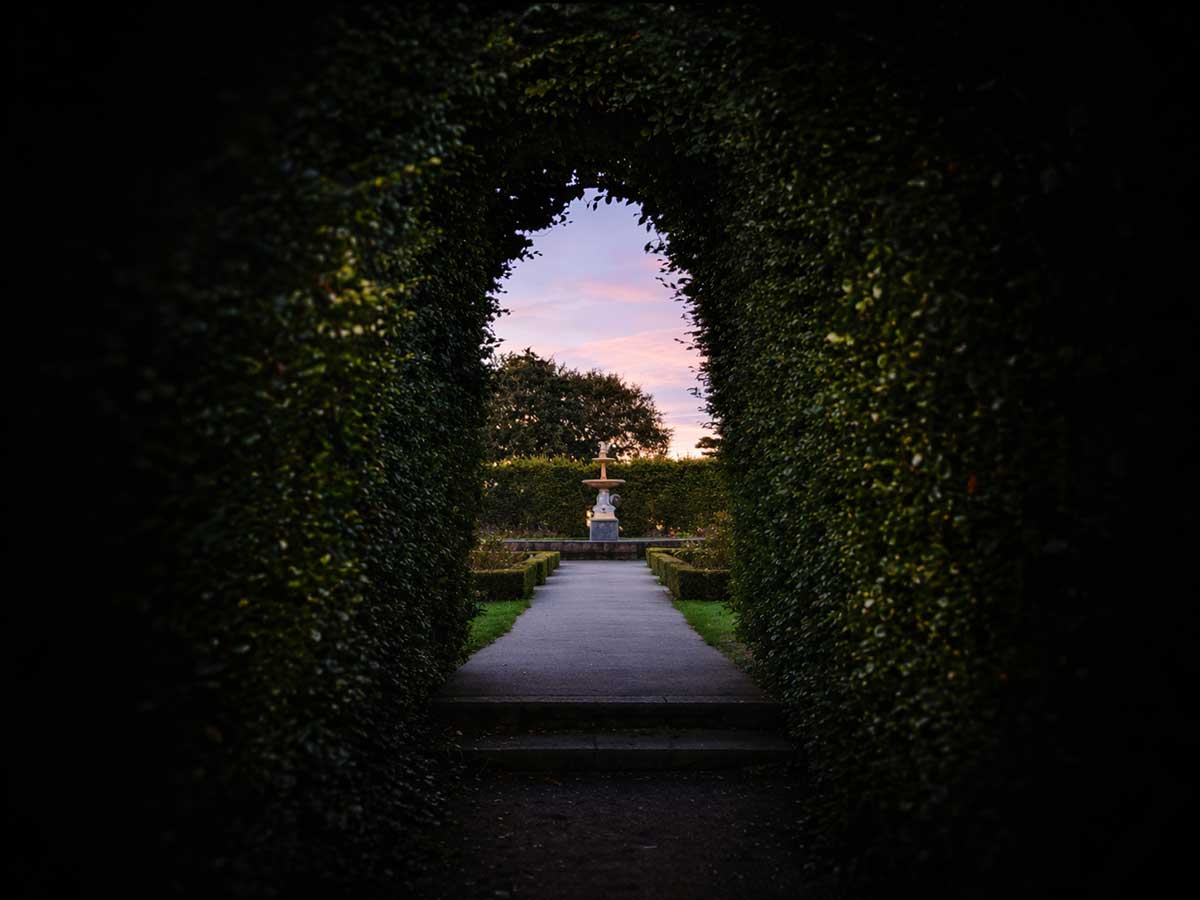
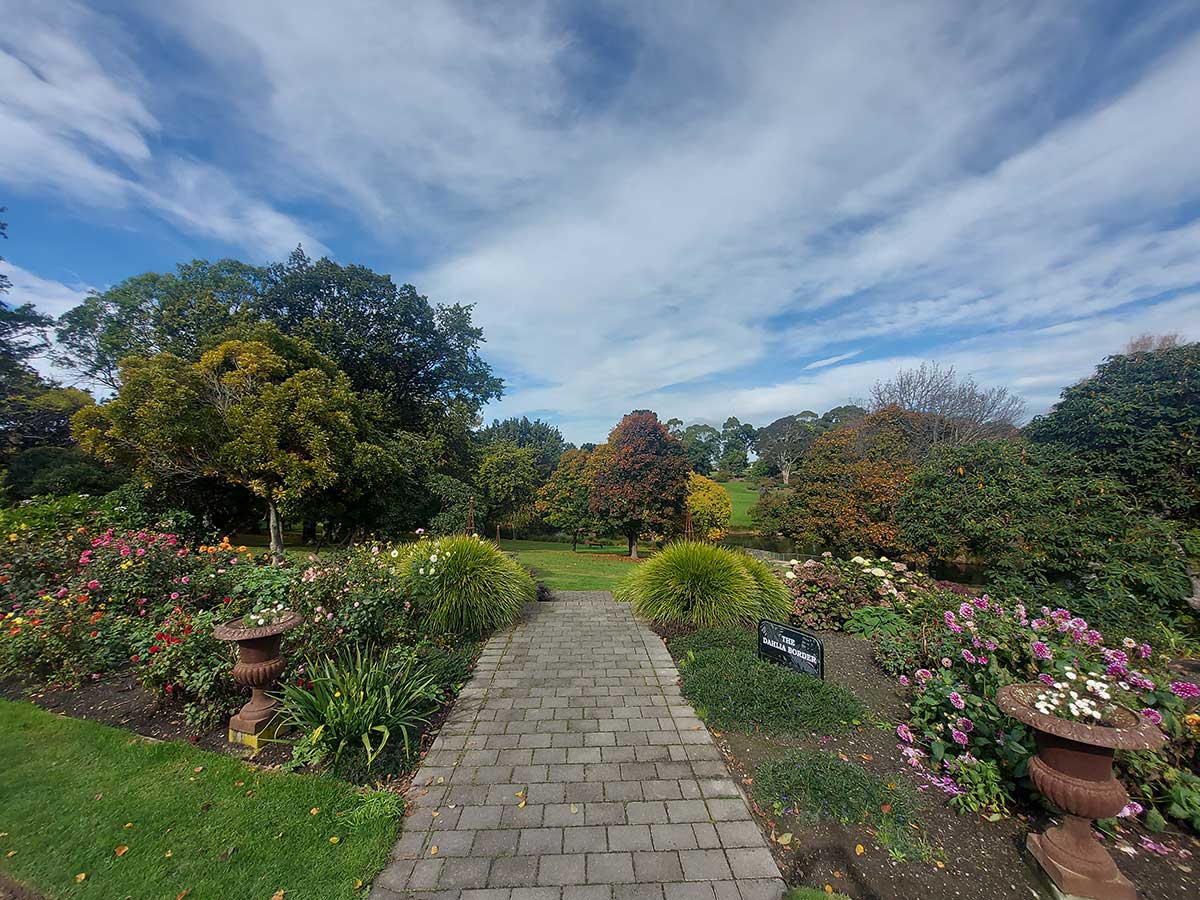
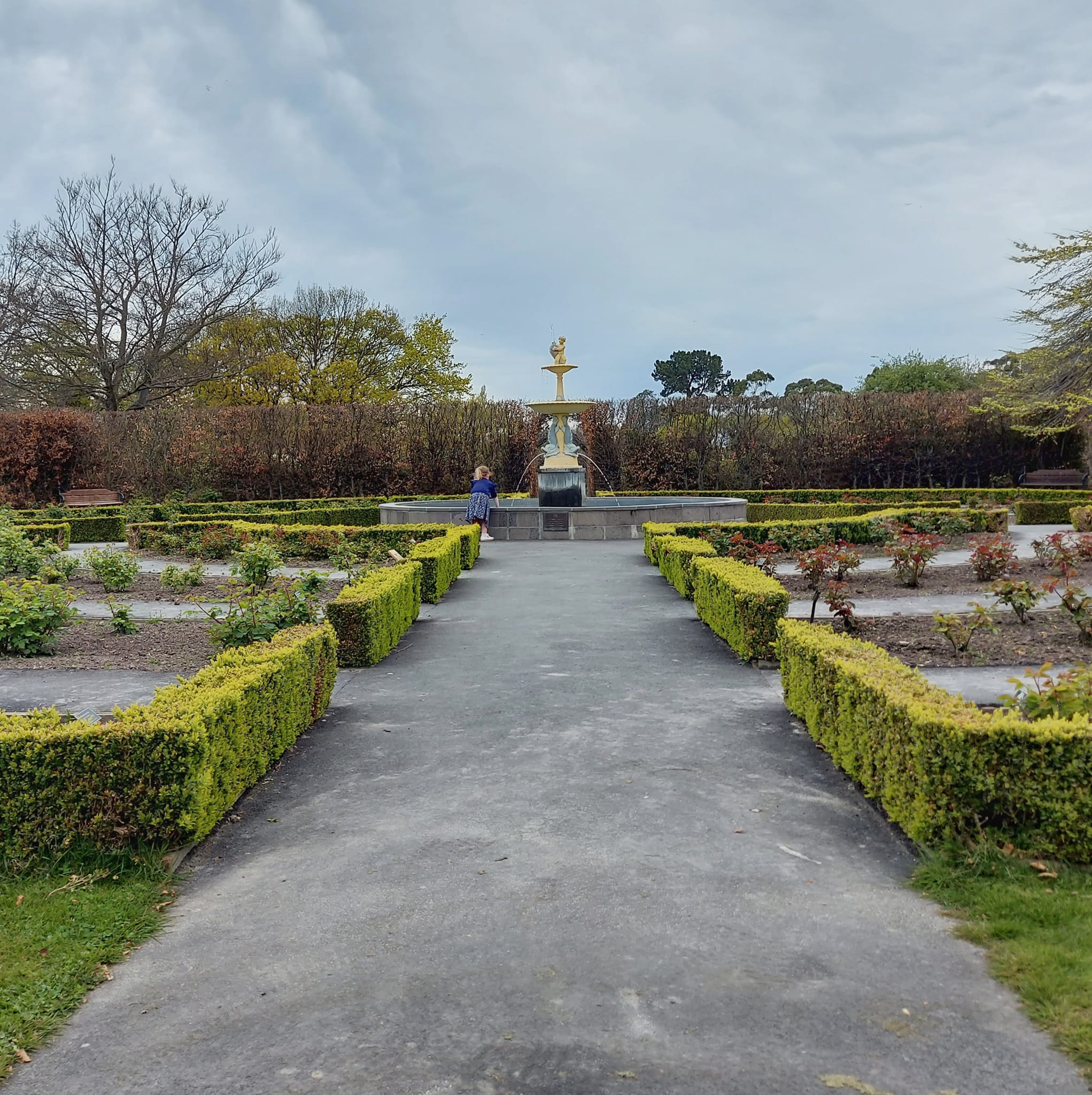
The Anderson Rose Garden from the southern arch at dusk April 2026 - Photography By Roselyn Fauth
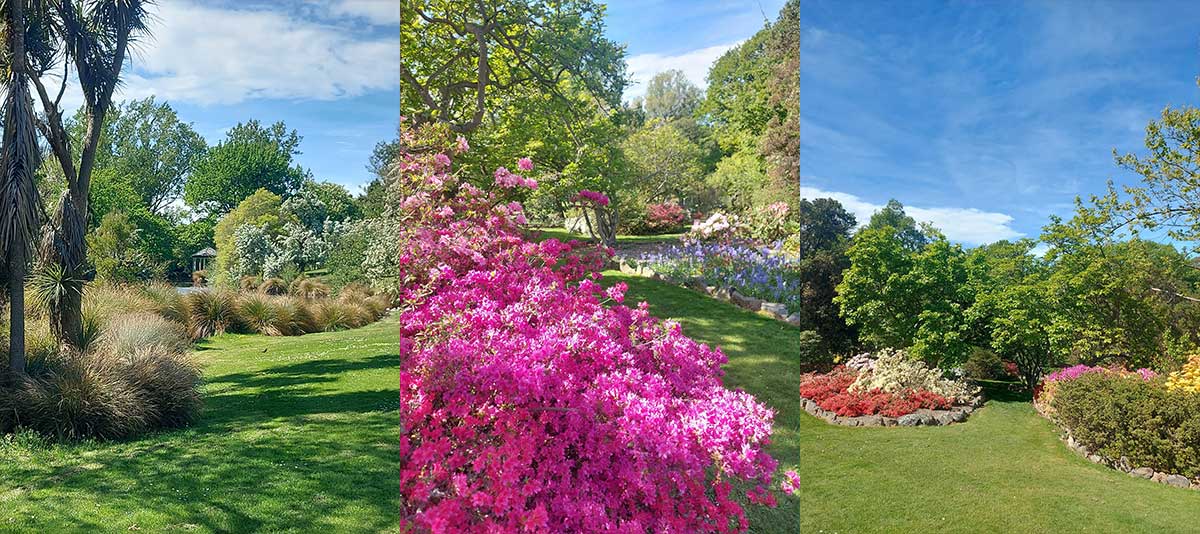
I have walked past the Anderson Rose Garden in the Timaru Botanic Gardens more times than I can count. It has been recognised as one of New Zealand’s Gardens of National Significance. Near the entrance is a lovely formal rose garden with a central fountain in a hedged walls. This fountain was gifted by the Friends of the Timaru Botanic Gardens in 2002. It has been a while since I learned about the man the garden was named after. So here is today's blog with my relearning of his story.
Alexander Walter Clarke Anderson, known as A. W. Anderson born on 3 March 1901 in Auchleven/Premnay, Aberdeenshire to Catherine Anderson and Alex Clarke. He died aged 86, 8 Oct 1986 in Timaru. He was a conservationist and author who was Curator of Reserves for Timaru City Council from 1932 to 1956. (Director of parks and reserves) until his retirement in 1957. He was married to Prudence Rose Collier born 1904 and had three sons.
Walter Anderson was known for more than his passion for roses. His full name was Alexander Walter Clarke Anderson. He was a botanist, writer, collector, propagator, curator, and public gardener whose influence ran right through Timaru’s reserves, parks and gardens, and far beyond them into the world of New Zealand native plant conservation.
Aoraki Heritage's website describes him as a well known local botanist, conservationist and author, and records that he served as Curator of Reserves for Timaru from 1932 to 1956. The Department of Conservation’s history of the Loder Cup remembers him as the 1974 winner and places him firmly among the important New Zealand champions of indigenous flora...
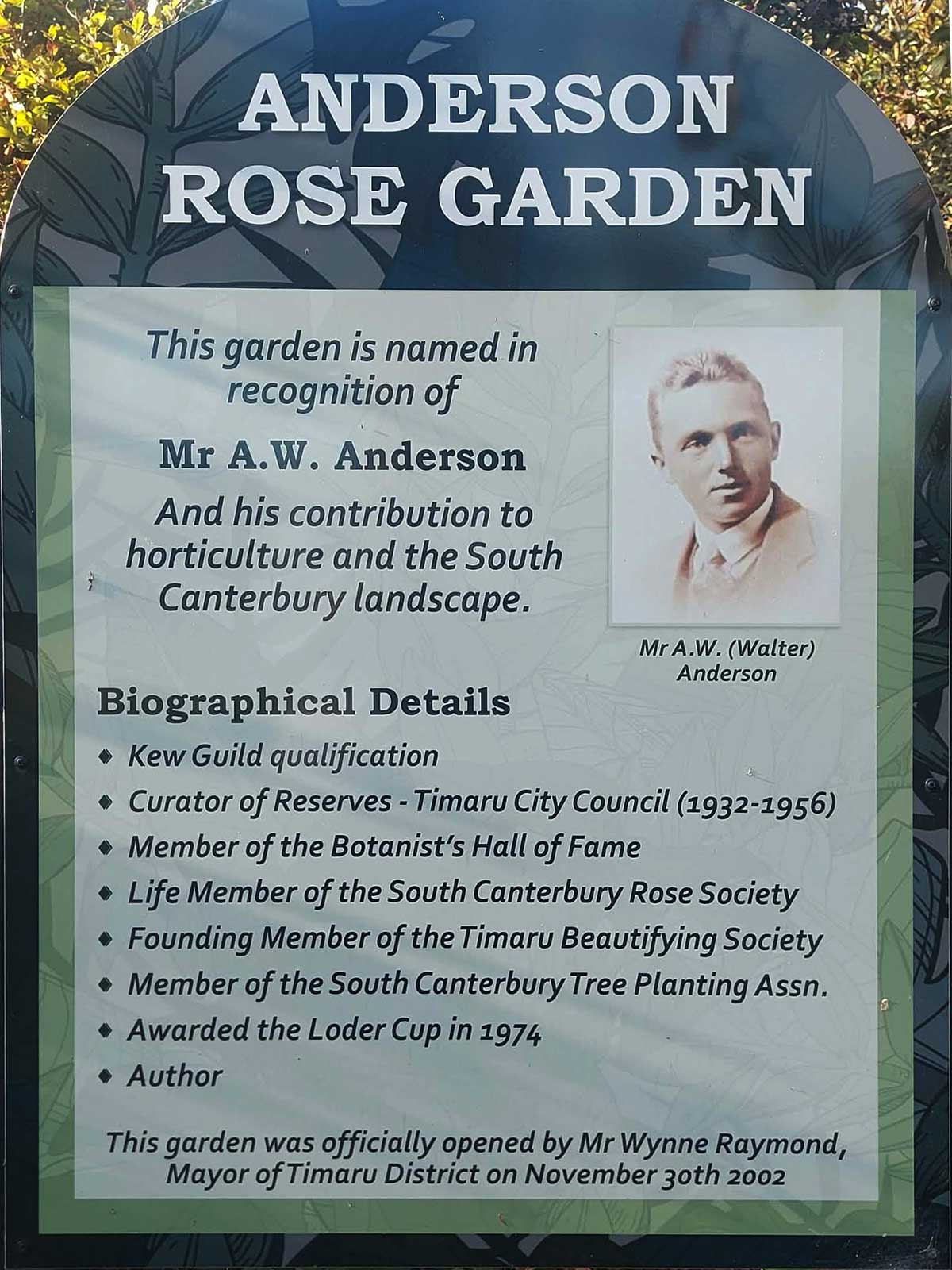
A sign at the Timaru Botanic Gardens reads: The Anderson Rose Garden is named in recognition of Mr A.W. Anderson and his contribution to horticulture and the South Canterbury landscape. Walter Anderson held a Kew Guild qualification and served as Curator of Reserves for the Timaru City Council from 1932 to 1956. He was a member of the Botanist’s Hall of Fame, a life member of the South Canterbury Rose Society, a founding member of the Timaru Beautifying Society, and a member of the South Canterbury Tree Planting Association. He was awarded the Loder Cup in 1974 and was also an author. The garden was officially opened by Mr Wynne Raymond, Mayor of Timaru District, on 30 November 2002.
His story began in Scotland, with a lonely boy walking the moors.
One of the clippings I found on Aoraki Heritage website, describes Alexander Anderson's childhood as a strict Presbyterian one. He lost his parents early in his life and wrote about his long solitary walks over the Scottish hills. He had written that this was where his fascination with wild plants began.

'The Square' in Premnay, three postcards from our Premnay album - Insch Connection Museum, , Aberdeenshire, Scotland.
Later he studied at the Royal Botanic Gardens, Kew in London.
Kew was first established as a royal pleasure garden, rather than as a public park. In 1759, Princess Augusta, the mother of George III, created a small botanic garden at Kew within the royal estate grounds. Its early purpose was to combine royal display, curiosity, and the growing 18th-century interest in collecting and studying unusual plants.
This became a major place for botanical and horticultural training and research. People studied there through Kew’s scientific and horticultural programmes. Kew became known for collecting, studying, classifying, and exchanging plants from across the British Empire and beyond. It played a major role in botany, horticulture, economic plants, and imperial plant networks. Today Kew still offers MSc, PhD, and other training opportunities in partnership with universities. It is now a UNESCO World Heritage Site.
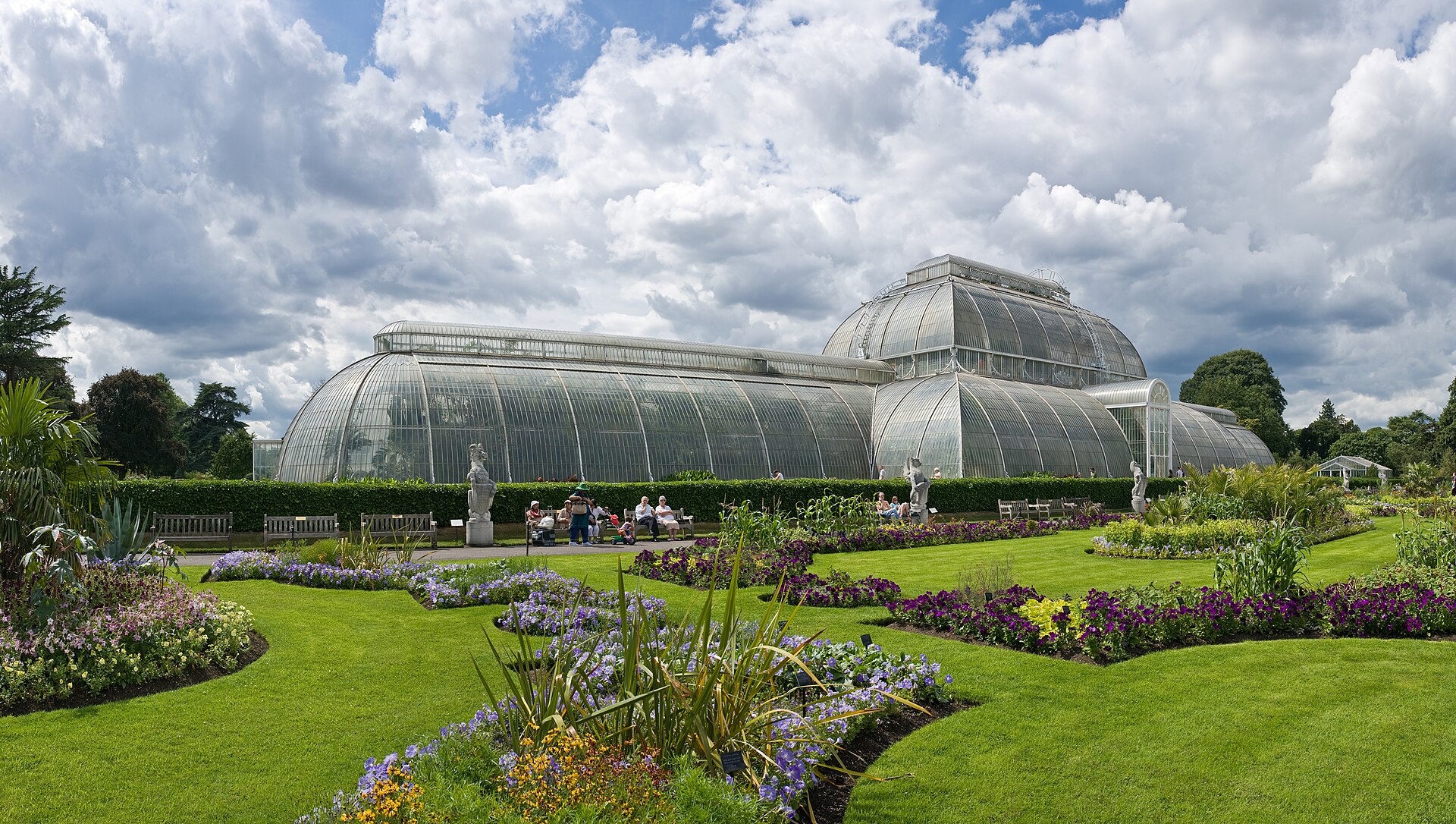
By Diliff - Own work, CC BY-SA 3.0, https://commons.wikimedia.org/w/index.php?curid=7392055. A view across the gardens to the Palm House in Kew Gardens, in London, England. This is a 4 segment panoramic image. Visible in the foreground of the palm house are some of the replicas of the Queen's Beasts: the Yale of Beaufort, the Red Dragon of Wales, the White Horse of Hanover, the Unicorn of Scotland, and the Griffin of Edward III.
Kew would have helped shaped New Zealand's botanic gardnes in a few ways, including scientific purpose, their plant-exchange networks, and their garden style.
Kew was the hub of a wider imperial botanic network, and New Zealand gardens were drawn into that system. Joseph Dalton Hooker, whose career was closely tied to Kew, became one of the key European authorities on New Zealand plants, helping place New Zealand flora within international botanical science. A later New Zealand horticultural history notes that this Kew-centred system of collecting, naming, and exchanging plants was reflected in the establishment of botanic gardens in New Zealand’s main centres.
Kew helped shape what New Zealand botanic gardens were for. Wellington Botanic Garden, formally established in 1869, was intended as a “central depot for botanical and acclimatising purposes” for the colony. Its links with Kew in the 1870s and 1880s were part of a broader imperial exchange of seeds and specimens. That meant New Zealand gardens were not only public pleasure grounds, but also testing grounds for useful plants, scientific study, and exchange with other botanic institutions.
Kew influenced the look and organisation of New Zealand gardens. Te Ara notes that New Zealand’s public gardens generally followed English garden and estate-park traditions, with lawns, paths, glasshouses, and collections of northern hemisphere trees and ornamental plants. In Wellington, Heritage New Zealand identifies “Gardenesque” elements, including an emphasis on scientific arrangement, plant form, and the display of both native and non-traditional species, all of which align with 19th-century botanic-garden thinking associated with places like Kew.
Kew’s influence reached New Zealand through trained staff such as Tannock and Anderson, who brought its methods, priorities, and horticultural culture with them.
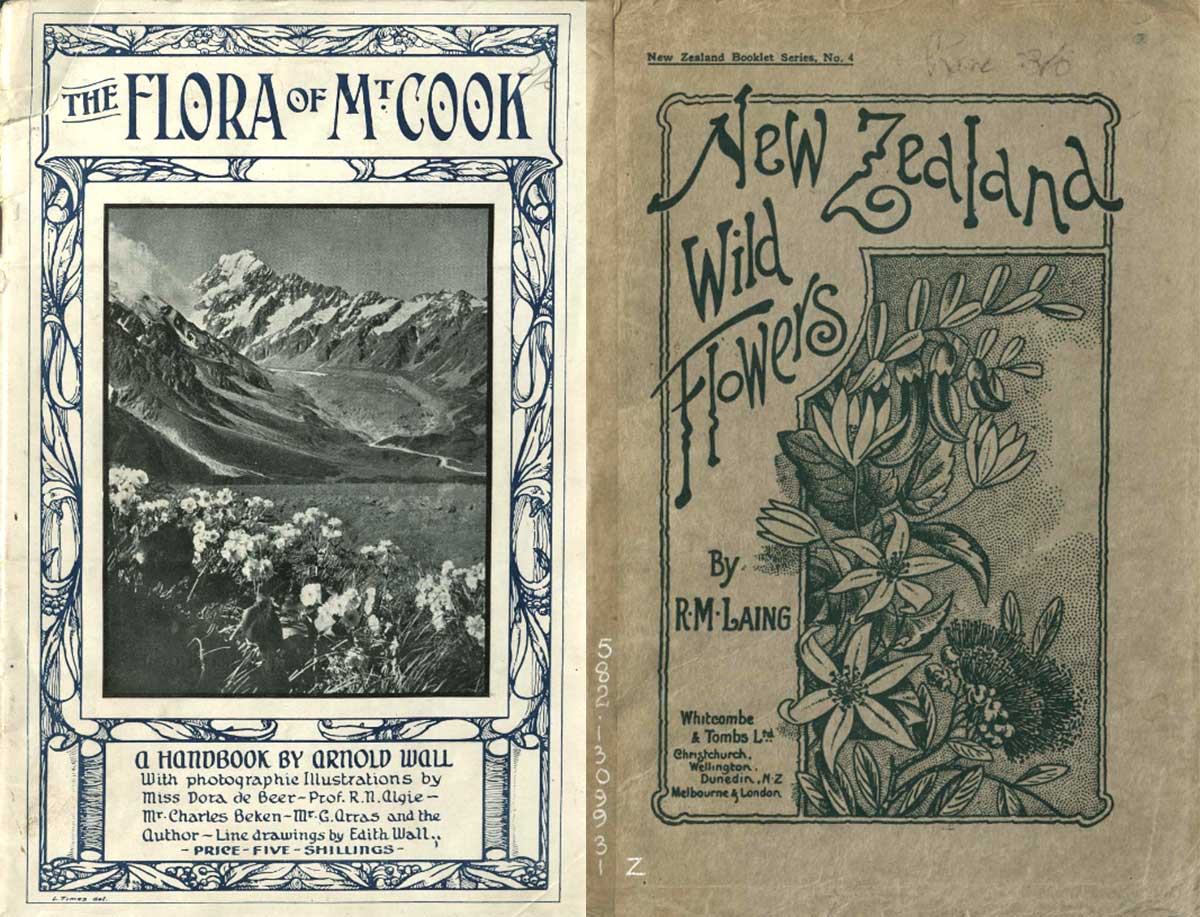
Publications on horticulture. LEFT Book about the flora of the Aoraki/Mt Cook region. Includes photographic illustrations and line drawings. By Arnold Wall. Published 1925. RIGHT Book of New Zealand wildflowers with black and white photographs, includes 'The Mountain Lily' (Ranunculus lyallii, commonly known as the Mt Cook Lily). By R M Laing, published 1916. I wonder how publications like these inspired and impacted the future generations of curators, gardeners and conservationists.

Finest daisy in the world The flora of Mount Cook
Anderson then came to New Zealand on a Kew Guild assisted passage and worked at the Dunedin Botanic Gardens under David Tannock.
The Guild was founded in 1893 to connect and support people who had studied or worked at Kew, and part of that support often included helping trained gardeners and horticulturalists find positions across the Empire, sometimes with help toward their travel or migration costs.
David Tannock secured a position as a gardener at the Royal Botanic Gardens, Kew in 1896 he and quickly progressed to become a foreman in the tropical section. He was appointed an instructor at the agricultural school in Dominica, West Indies, in 1898 on the recommendation of the director of Kew. Tannock advanced to become curator of the school's botanic garden, then officer-in-charge of the school. In February 1903 the Dunedin City Council appointed Tannock superintendent of reserves. On taking up the position in June he made a far-sighted report to the council, detailing how the Botanic Gardens and city reserves could be improved. He recognised that recreational attractions such as the maze, aviary, band rotunda, deer pen, aquarium and tea kiosk would promote the gardens' popularity. When he retired, 37 years later, he had achieved all these initial aims and many more. Tannock maintained a lifelong affiliation with the Presbyterian church. Learn a little about Tannock gives us an insight into Anderson. Who would have learned a great deal from him.
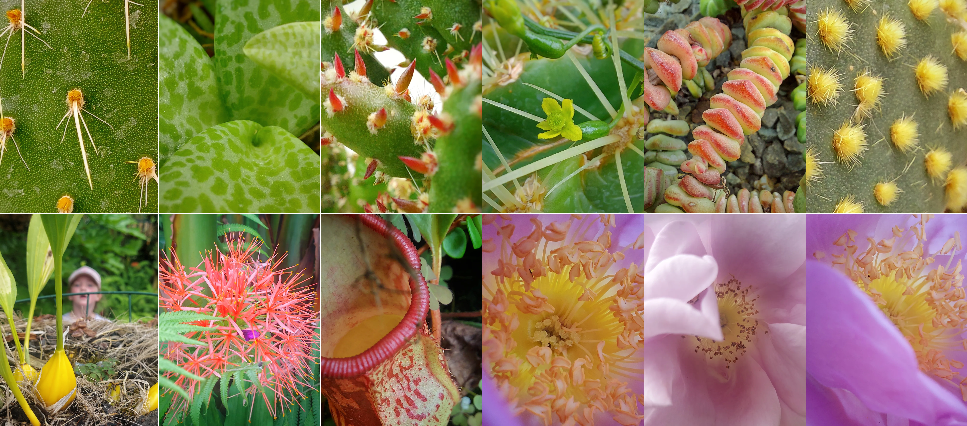
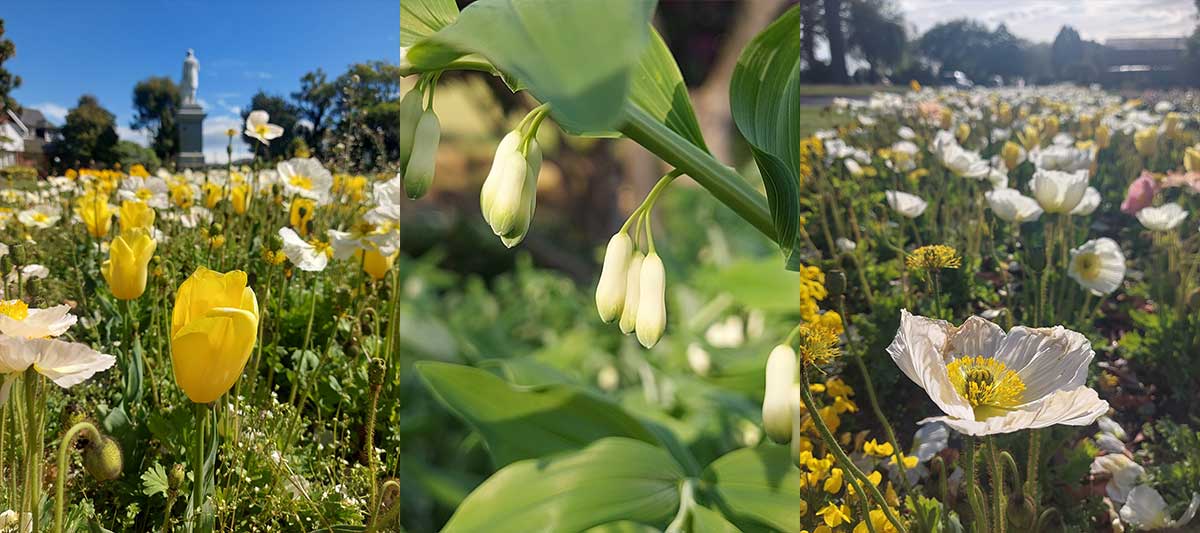
Photographs of exploring the Timaru Botanic Gardens in 2026
After working under David Tannock at the Dunedin Botanic Garden, Anderson arrived in Timaru 1932.
Anderson stepped into a landscape that already carried a long civic history. The Timaru Botanic Gardens had been set aside in 1864. Planting began in the late 1860s. Public donations helped stock the place. Funds for a ranger’s cottage was set aside in 1872 and much of the early work was carried out by convict labour from the Timaru Gaol just a few blocks away. Later came the glasshouse, the rotunda, the Burns statue, tennis courts, and all the layers of public recreation and civic identity that accumulate in a town garden over generations.

Gardens, Timaru, 1912, Timaru, by Muir & Moodie. Purchased 1998 with New Zealand Lottery Grants Board funds. Te Papa (PS.002216). During the depression (early 1930s) the council reduced wages and expenditure. Unemployed men were engaged for manual work, including improving the two duck ponds by digging them out by hand. Between 1936 and 1939, 20,000 daffodil bulbs were donated to the gardens and a few years later, in 1940, pupils of South School planted 60 trees along the Domain Avenue frontage of the gardens.
Anderson did not create the Timaru Botanic Gardens from scratch. He inherited them. He also inherited all the old ideas that came with public gardens in New Zealand, ideas about beauty, order, civic pride and improvement. Historians of New Zealand botanic gardens point out that these places were never just decorative. They were scientific spaces, trial grounds, places for public enjoyment, and expressions of civic ambition. They were also more complicated than that, shaped by colonial thinking, yes, but also by argument, contradiction and changing social values.

The corner of the reserve for the Timaru Botanic Gardens was carved off for a new hospital as seen here in this survey in the 1870s.
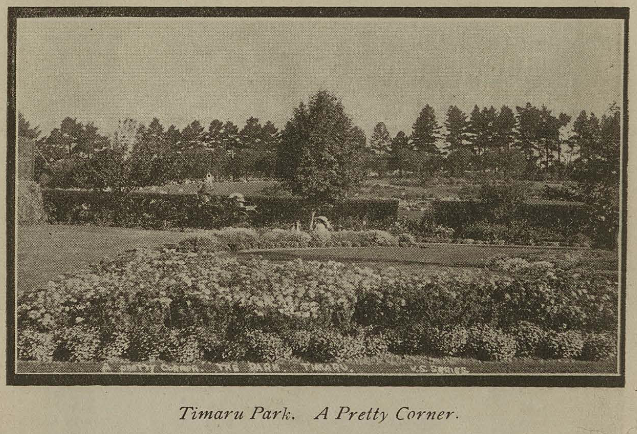
1914 Guidebook to Timaru and the wider Canterbury region, published 'under the auspices' of local borough councils to promote the region for tourism. Includes the following sections: South Canterbury, Timaru, Caroline Bay, The Domain, Assorted pleasures, Games for visitors, An ideal health resort: Timaru Electric Institute, Temuka, Ashburton County, Guide to picturesque Canterbury Christchurch, Weekend trips, Tours from Christchurch, North Canterbury, Industrial. Includes illustrations and maps. Guide to Timaru and Picturesque Canterbury. Aoraki Heritage Collection, https://aorakiheritage.recollect.co.nz/nodes/view/8396
Anderson seems to have stood right in the middle of that shift.
He cared about lovely public spaces and about native plants, alpine species, and teaching ordinary people to value what was unique to New Zealand. The official account of his Loder Cup says he took every opportunity to see native plants used in parks, housing developments and reserves in South Canterbury. A 1956 Royal New Zealand Institute of Horticulture record, made when he was named an Associate of Honour, notes that he had for many years been Timaru’s superintendent of parks and that he secured the first Metasequoia plant for New Zealand. He was local, and plugged into international plant networks.
The more I read, the more I realised his real legacy was not one garden. It was a way of thinking.
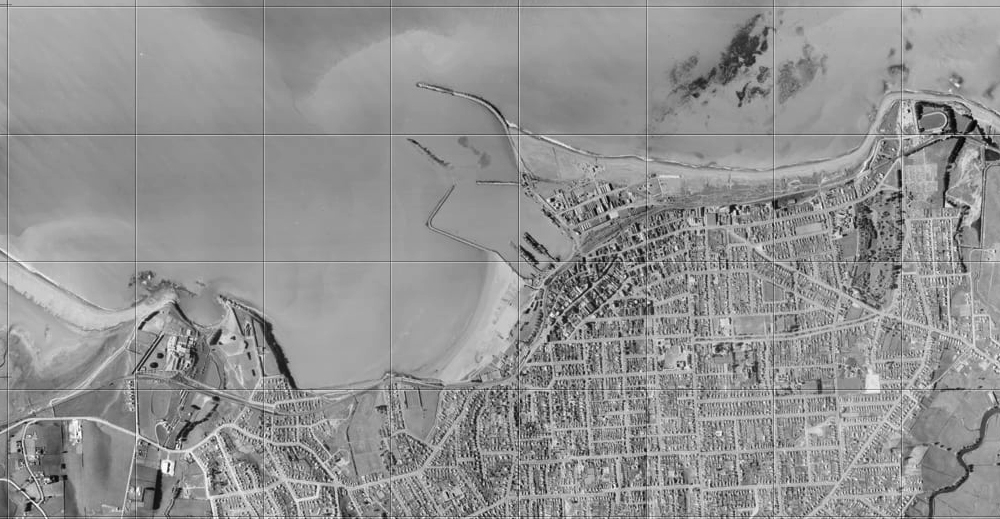
Combined Retrolens Historic Image by Geoff Cloeke. Sourced from http://retrolens.nz and licensed by LINZ CC-BY 3.0. We are so lucky to have a wide range of parks in most neighbourhoods in Timaru.

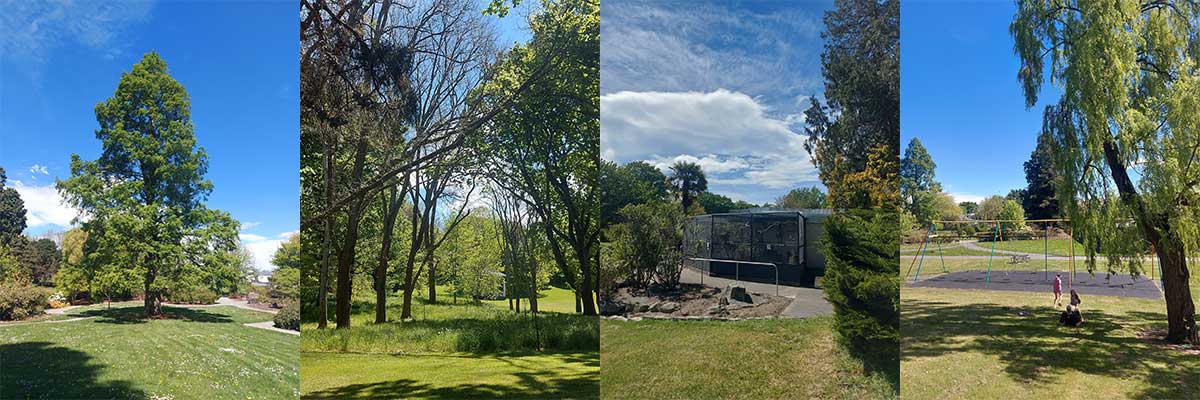
Established and stunning variety of trees at Timaru Botanic Gardens - Roselyn Fauth
A clipping about a borough beautifying scheme explained that Anderson and the Timaru Beautifying Society went house to house through King Street and Evans Street asking residents if they would like free trees for their front gardens. One 170 trees were taken up, flowering apples, cherries, spindleberries and scarlet oaks. He talked about people becoming more “tree minded”. I love that phrase. It is humble, practical and visionary all at once. It says beauty should not belong only to grand places.

Miscellaneous Plans - Borough of Timaru, South Canterbury, 1911 - T.N. Brodrick, Chief Surveyor Canterbury -ndhadeliver
A 1935 report on Timaru’s scenic reserve, now Centennial Park, shows Anderson working with ideas from David Tannock about native bush, English woodland, open glades and public picnic ground.
The present day council page records that Centennial Park was officially named in 1939, and the 1940 centennial planting ceremony made the purpose plain. Open space, native trees and public memory mattered. The future mattered. Children, one speaker said, should know the names of native trees. Not just admire them. Know them.

1956 Timaru Hospital and Timaru Botanic Gardens - PA-Group-00080 Whites Aviation Ltd Photographs- nlnzimage
Then there is Waitohi Bush.
Newspaper clippings credit Anderson with helping establish the reserve, and today Waitohi Bush still offers native forest, birdlife and public walking tracks.
He was also a writer. He published The Coming of the Flowers in 1950, and later gave the Banks Lecture on the botanical exploration of Canterbury. He wrote columns and articles and used the written word to move knowledge out of specialist circles and into public life. That, to me, is one of the loveliest things about him. He did not hoard his knowledge. He passed it on.
By the time he received the Loder Cup in 1974, the honour was richly deserved. The Department of Conservation records him as that year’s winner and highlights the same qualities that keep surfacing in the clippings, his native plant expertise, his alpine work, his civic planting, his Lake Tekapo garden, and his international reputation.
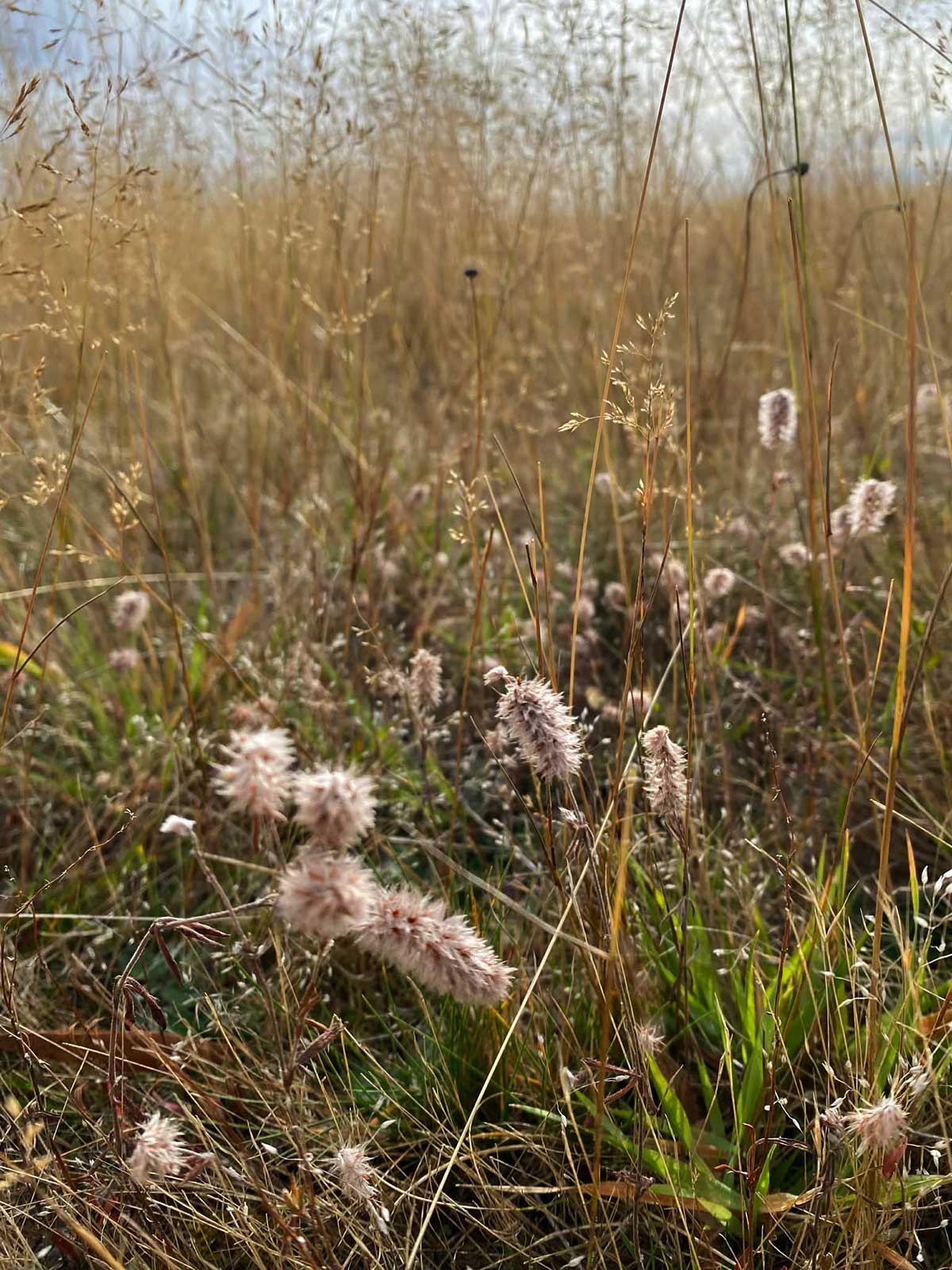
Alpine plants at Lake Alexandrina Tekapo - Photo Clarissa Doran
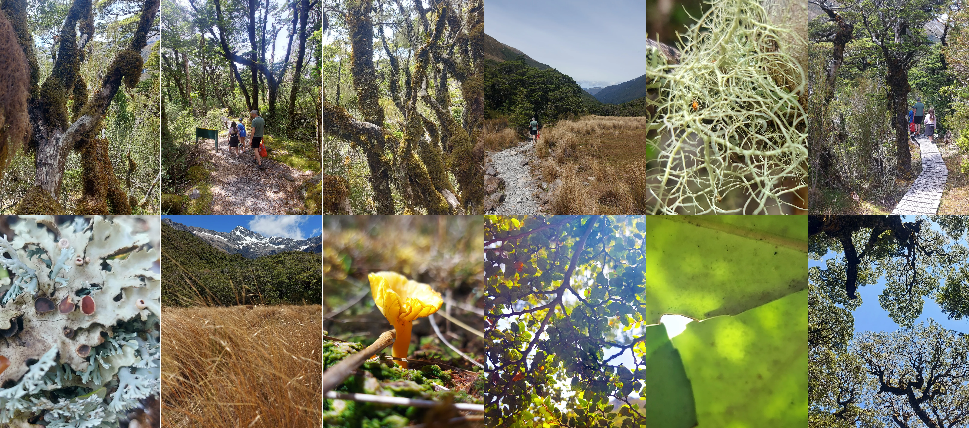
Alpine Plants at Arthurs Pass - Photography by Roselyn Fauth 2025

The Timaru Botanic Gardens also contains the Anderson Rose Garden with modern roses while a separate collection houses species roses, some of which are rare. The Anderson Rose Garden is a small, formal rose garden within the Timaru Botanic Gardens. It features rose beds in concentric circles around a central fountain. Each bed is surrounded by a low buxus hedge and contains multiple plants of a single rose cultivar. The garden was opened in 2002. It was named in recognition of Mr Walter Anderson's contribution to horticulture and the South Canterbury landscape. Mr Anderson was Curator of Reserves for Timaru City Council from 1932 to 1956 as well as being a noted author. He is a member of the Botanists' Hall of Fame.
I think the most interesting thing about Anderson is not the award... it is the fact that his name now sits on a rose garden entrance sign.
Timaru District Council’s walking guide says that the Anderson Rose Garden is named after Walter Anderson, a former Curator of Reserves. So there he is, still present in the gardens. But his actual life was bigger, scrappier and more far reaching than that. He was not just about display. He was about stewardship. He was about public land used well. He was about making room for native plants in civic life. He was about looking ahead.
In 2026 I was asked to give a talk about gardens to the New Zealand Gardens Trust confrence. Their theme was “Honouring the Past, Gifting to the Future.” The Trust’s 2026 conference in Timaru and Ōamaru is framed around gardens and landscapes that hold environmental, cultural and personal history while still evolving for future generations. Hamish Saxton has spoken about these landscapes as layered places that still resonate today. Reading about Anderson, I had the strange feeling that he had already been living that idea for decades.
Because that is what a good public garden really is.
Not just a pretty place. Not just somewhere to walk the dog or feed the ducks or admire a spring border. A public garden is a record of what a town values enough to make visible. It tells us what we think children should inherit. It shows whether we believe beauty belongs only behind private gates or out in the open where everyone can have it. It shows whether we care about memory, shade, birds, native flora, pleasure, rest and public life.

Postcard showing view of the curator's house at the Timaru Botanic Gardens. Aoraki Recollect
Anderson’s story tells us that these things did matter here.
He was part of a Timaru that believed a town should plant trees in ordinary streets, preserve bush, teach people plant names, care for reserves, think beyond the next season, and treat public beauty as something worth working for. I think that is worth being grateful for.
Grateful for the people who planted before us.
Grateful for the people who argued for reserves before the land was built over.
Grateful for the public gardeners who knew that botany, beauty and belonging were not separate things.
Grateful that someone thought it mattered enough to name a rose garden after a man whose real gift was much larger than roses.
So yes, I went looking for the man behind the name.
What I found was not just Walter Anderson. I found an older idea of civic life, one that still feels urgently modern. Plant well. Protect what matters. Share knowledge. Make beauty public. Leave something living behind.
That feels like a gift to the future to me.
OBITUARIES
A. W. C. Anderson
Internationally renowned botanist Mr Alexander Walter Clarke Anderson, of Timaru, has died aged 86.
Mr Anderson was renowned for his knowledge of plants, his skill as a collector and propagator of native plants, and as a writer.
Born in Scotland, he gained a position with Kew Gardens, London, early in his career. He believed this appointment was the cornerstone of the knowledge and interest in botany that he pursued throughout his life.
With a Kew Guild assisted passage he came to New Zealand and gained a position with the botanical gardens in Dunedin. In 1932 he became curator of reserves in Timaru, a position he retained until his retirement in 1956.
Mr Anderson used his wide knowledge of propagation techniques to grow and distribute some of New Zealand’s rarer native plants. These plants were often given to other gardeners in an attempt to ensure the survival of the species.
The exchange of plants and seeds with other countries meant New Zealand natives became more widely known.
Mr Anderson’s work has been recognised both in New Zealand and overseas. In the 1970s he was invited to join the botanists’ hall of fame.
Due to his international reputation in the field of seed and grass distribution, plant exchanges, papers, articles and books, the Hunt Botanical Library of Pittsburgh invited Mr Anderson to supply biographical details to be included in its files of the world’s most prominent and distinguished botanists.
Mr Anderson was awarded the Loder Cup in 1974.
The Loder Cup, presented annually by the Minister of Agriculture and Fisheries, recognised his attempts to encourage the protection and cultivation of native flora. This is a wonderful way to recognise and celebrate people who make a tangible difference to the preservation and protection of Aotearoa New Zealand’s indigenous flora. DOC website's criteria includes “encourage and honour New Zealanders who work to investigate, promote, retain and cherish New Zealand’s indigenous flora, has made a tangible difference to the protection of Aotearoa New Zealand’s indigenous flora, and has made a significant contribution over and above their employment expectations (if they work in the field of botany, plant conservation, or horticulture).” https://aorakiheritage.recollect.co.nz/nodes/view/3723
Each of these organisations may nominate one person or one group of people for the Loder Cup:
Royal New Zealand Institute of Horticulture
Royal Society Te Apārangi
New Zealand Botanical Society
New Zealand Plant Conservation Network
New Zealand Plant Producers Incorporated
Royal Forest and Bird Protection Society of NZ
Recreation Aotearoa
New Zealand Conservation Authority
Any Conservation Board
Any university in Aotearoa New Zealand
Any private person through one of the organisations listed above
"Gerald Walter Erskine Loder donated the Cup in 1926. He was born in 1861 in Sussex, England. He studied Law at Cambridge University and in 1886 he travelled to countries including Australia, New Zealand, China, Japan, Canada, and the USA, working as a barrister, businessman, politician, botanist, and plant collector. He was a Justice of the Peace, Deputy Lieutenant for Sussex, and served as President of the Royal Horticultural Society (1929-31) and President of the Royal English Arboricultural Society (1926-7).
In 1902, Gerald Loder purchased the Wakehurst Estate (West Sussex) and began expanding the garden, acquiring plants and seeds from various expeditions that he helped to fund, and within five years there were approximately 3,000 different species and cultivators. He practiced an interest in nurturing rare plants, particularly from the southern hemisphere, and particularly from New Zealand. In 1934, two years before his death he was made a peer, Lord Wakehurst of Ardingly.
Gerald Loder donated the Cup to New Zealand in 1926, after “having for many years taken an interest in the flora of New Zealand, and having cultivated as many New Zealand plants as possible at home”. Gerald Loder was captivated by our indigenous flora on his first visit to New Zealand in 1886, and remained passionatly involved with our "incomparable flora" until his death in 1936." - https://www.doc.govt.nz/news/events/awards/loder-cup-award/about-the-loder-cup-awards/
The first to receive the cup was Duncan and Davies Ltd from New Plymouth in 1929 at the Auckland Horticultural Society's Rose Show. This was for a display of more than 500 well grown native plants. It was probably the largest collection of plants to have been show in Auckland and contained many unique and unfamiliar specimens. Labels showed botanical names, habitat, cultivation details and usage. The Auckland District Council of the New Zealand Institute of Horticulture purchased the plants and presented them to the Auckland City Council for planting in the Fernery and along Exhibition Drive in the Auckland Domain.
Next to recieve the cup was Henry Bennett and son, Dunedin in 1931 and 1932. Henry Bennett and his sons were the only competitors for the Loder Cup at the Jubilee Show in Dunedin in 1931 and in Christchurch in 1932. The exhibits contained more than 800 specimens drawn from every botanical province including the outlying islands, and all altitudinal zones.
T Waugh and son, Wellington recieved the cup in 1933 at the National Flower Show in Wellington in 1933 for a good display of native plants in pots, including a fine collection of hebes.
Under new conditions the 1934 award was made to His Excellency Lord Bledisloe (DSc, PC, GCMG, KBE, Wellington.) in recognition of his distinguished advocacy of indigenous flora, and his services to New Zealand horticulture and forestry. The Governor-General arrived in the country with a collection of Dr Leonard Cockayne's works on New Zealand flora. He at once became a very enthusiastic admirer of our native flora and extolled "its verdant treasures" on every possible occasion. He presented a trophy known as the Bledisloe Cup to the Wellington Horticultural Society to be awarded annually to the garden, large or small, showing the best and most attractive use of New Zealand plants.
The Loder Cup was presented 1935 to the Trustees of R C Bruce, Whanganui, for its work in perpetuating the memory of its founder Robert Cunningham Bruce. In his will he left his residuary estate in the hands of trustees "for afforestation and making National Parks and Domains in New Zealand". This bequest was used for the acquisition of fine examples of virgin forest, which became Bruce Park at Silverhope, Rangitikei, and the A S Simpson Domain, Hunterville. The trustees have mainly subsidised Crown, local body, domain boards', and societies' efforts to achieve the Bruce ideals for preservation of native bush.

By Lincoln University - https://livingheritage.lincoln.ac.nz/nodes/view/29653, CC BY 3.0, https://commons.wikimedia.org/w/index.php?curid=123470156 New Zealand’s top conservation award for services to the protection of native plant species, the Loder Cup winner was Christchurch botanist, Dr Colin Burrows. The award acknowledges a lifetime spent studying, protecting and teaching others about New Zealand's native plant life. The 2010 Loder Cup was presented to Dr Colin Burrows in a special ceremony at Lincoln University by the Minister of Conservation Hon Kate Wilkinson.
Interestingly the only time David Tannock, Anderson's first New Zealand boss, and I assume mentor's name appears in the Loder Cup list of winners, is under Andersons award. It seems he was not recognised in this way.
1974 Alexander W Anderson of Timaru was awarded the recognition of the Loder Cup. The DOC website writes:
Mr Anderson's interest in plant life began when he roamed the Scottish moors as a boy. After four years at Littlewood Park, Scotland, he moved to Kew Gardens for a closer study of the practical aspects of soils, botany, entomology, and plant geography.
He was the first to receive a Kew Guild assisted passage to New Zealand when he found a position at the Dunedin Botanic Gardens under the direction of the late David Tannock. He learned about the indigenous flora and made many excursions into the mountains of Otago and Fiordland.
In 1932 Mr Anderson was appointed Director of Parks and Reserves in Timaru. Some particularly lovely alpine plants exist in rock gardens today because of his foresight and ambition to see them enjoyed by others. He sent a valuable collection of plants to Edinburgh University. In the course of his work he took every opportunity to see that native plants were used in parks, housing developments, and other reserves in the South Canterbury area.
In his retirement he created a fine garden at Lake Tekapo where many rare plants such as Convolvulus verecundus were displayed for students, botanists and gardeners. Walter Anderson enjoyed an international reputation and he was accorded and place with the world's most prominent botanists in the Hunt Botanical Library of Pittsburgh, Pennsylvania.
Many New Zealand horticultural societies and projects benefited from his knowledge.
He was a foundation member of Timaru Beautifying Society and also a member of the South Canterbury Treeplanting Association.
Mr Anderson planted Timaru’s Centennial Park and helped establish the Wai-iti bush reserve.
He was made the first life member of the South Canterbury Rose Society.
Mr Anderson is survived by his wife, Prudence, and three sons.
Side Quest: What was his book like
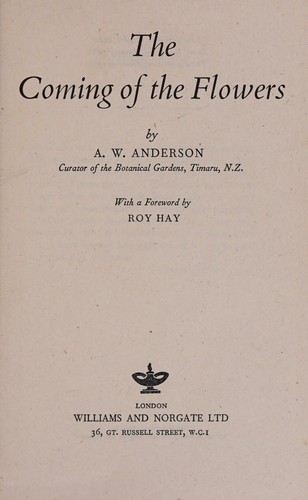
You can read his book online here: https://babel.hathitrust.org/cgi/pt?id=coo.31924000404834&seq=7
A few tips from Andersons book about Crocus according to his book:
The autumn crocus matters because it gives us saffron. He says it may not be the showiest autumn flower, but it is historically important because it is the source of saffron and even gave its name to the whole crocus group. Citation: Anderson, The Coming of the Flowers, p. 20.
Saffron had ancient prestige. He links saffron yellow with light, sacredness, and royalty, especially in the East, and says saffron-dyed garments had long been important. Citation: p. 20.
The origin of Crocus sativus was already a mystery. He notes that nobody really knew its original home, and that it did not match any known wild crocus exactly. Citation: p. 21.
He includes old stories about how saffron came to England. He mentions traditions that it may have come with the Romans, and also the story that a pilgrim smuggled a saffron corm into England in his staff, helping found the saffron industry at Saffron Walden. Citation: p. 21.
Saffron was valuable because it was so labour-intensive. He says huge numbers of stigmas were needed, which kept prices high and encouraged adulteration. Citation: p. 22.
It was used for much more than colour. He describes old beliefs about saffron as medicinal, culinary, antiseptic, and even useful against drunkenness. Citation: pp. 22–23.
By his time, saffron had declined commercially. He says it was once grown widely in southern England, but by then had largely become an ornamental plant. 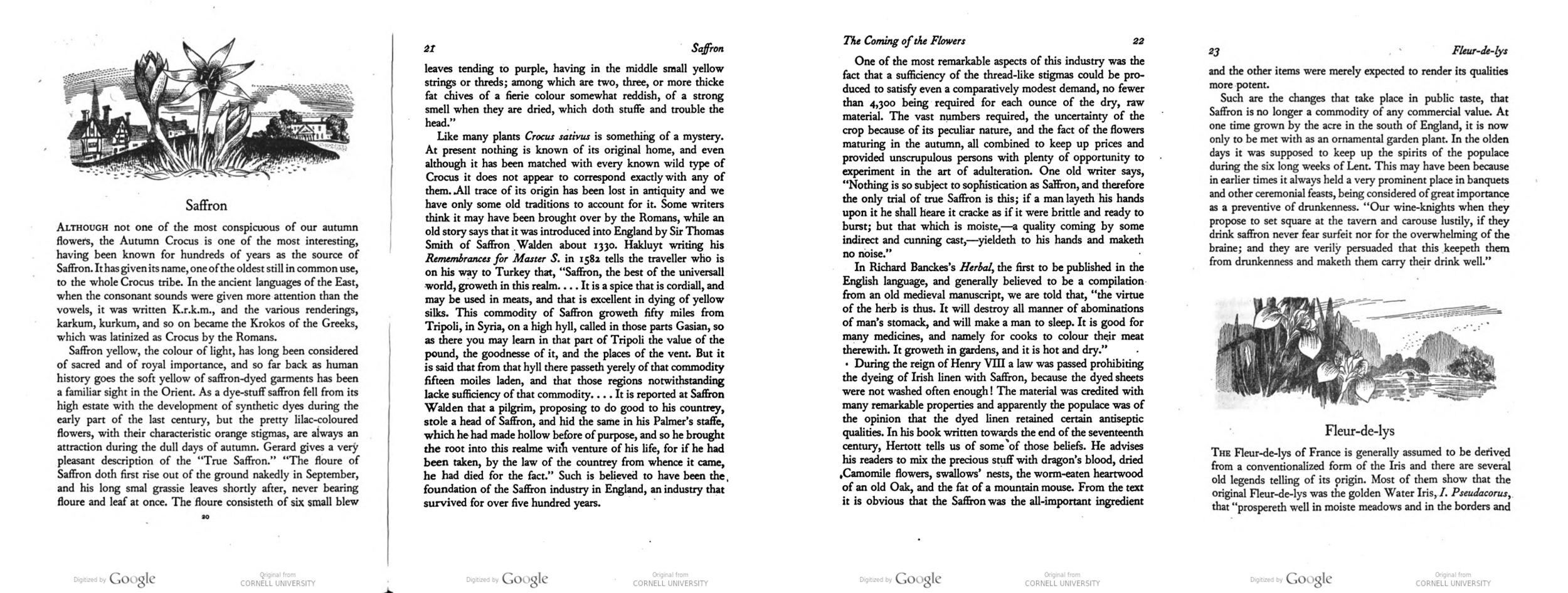

Medinella and Annabelle enjoy the crocus at the Timaru Botanic Gardens
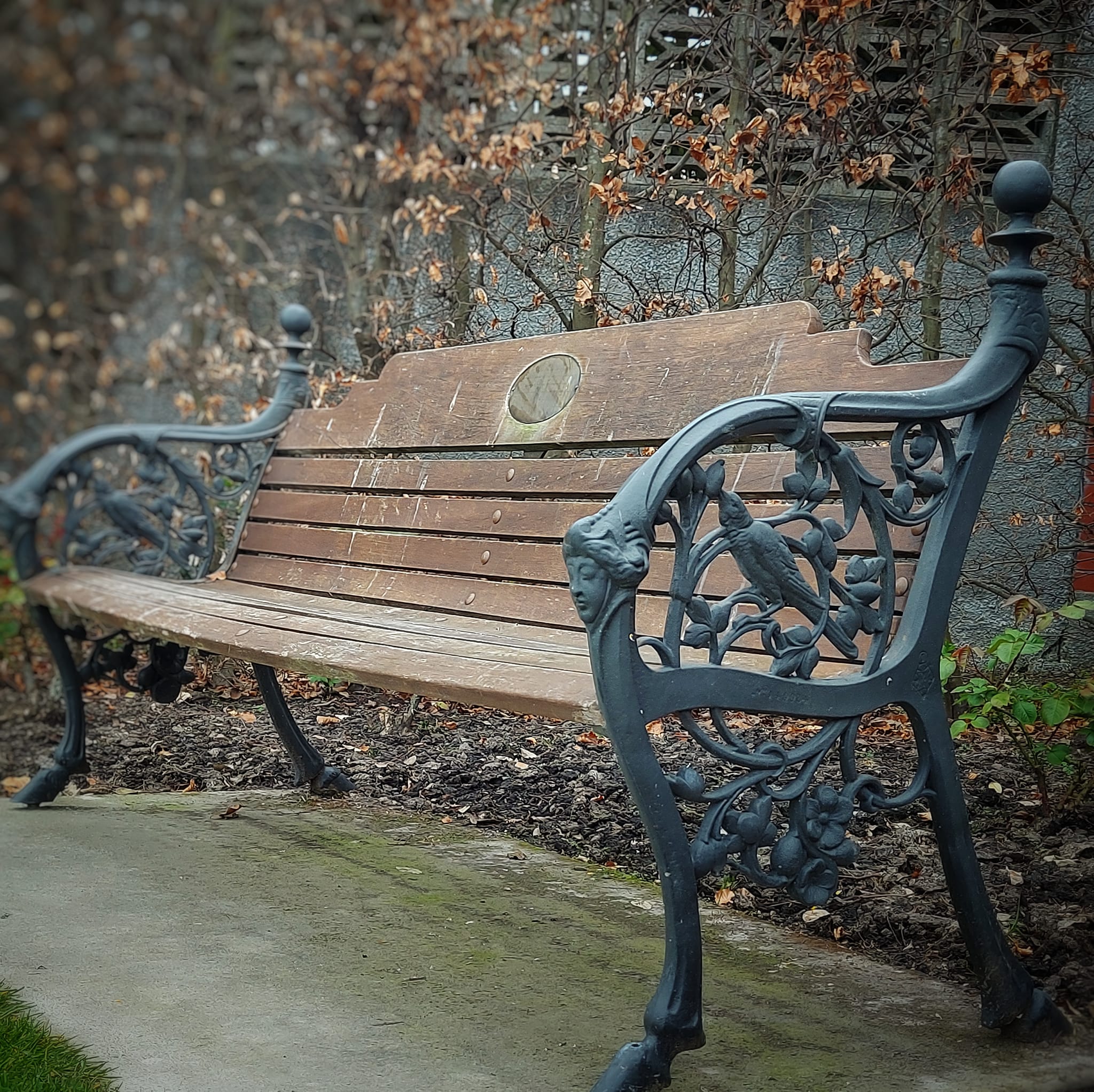
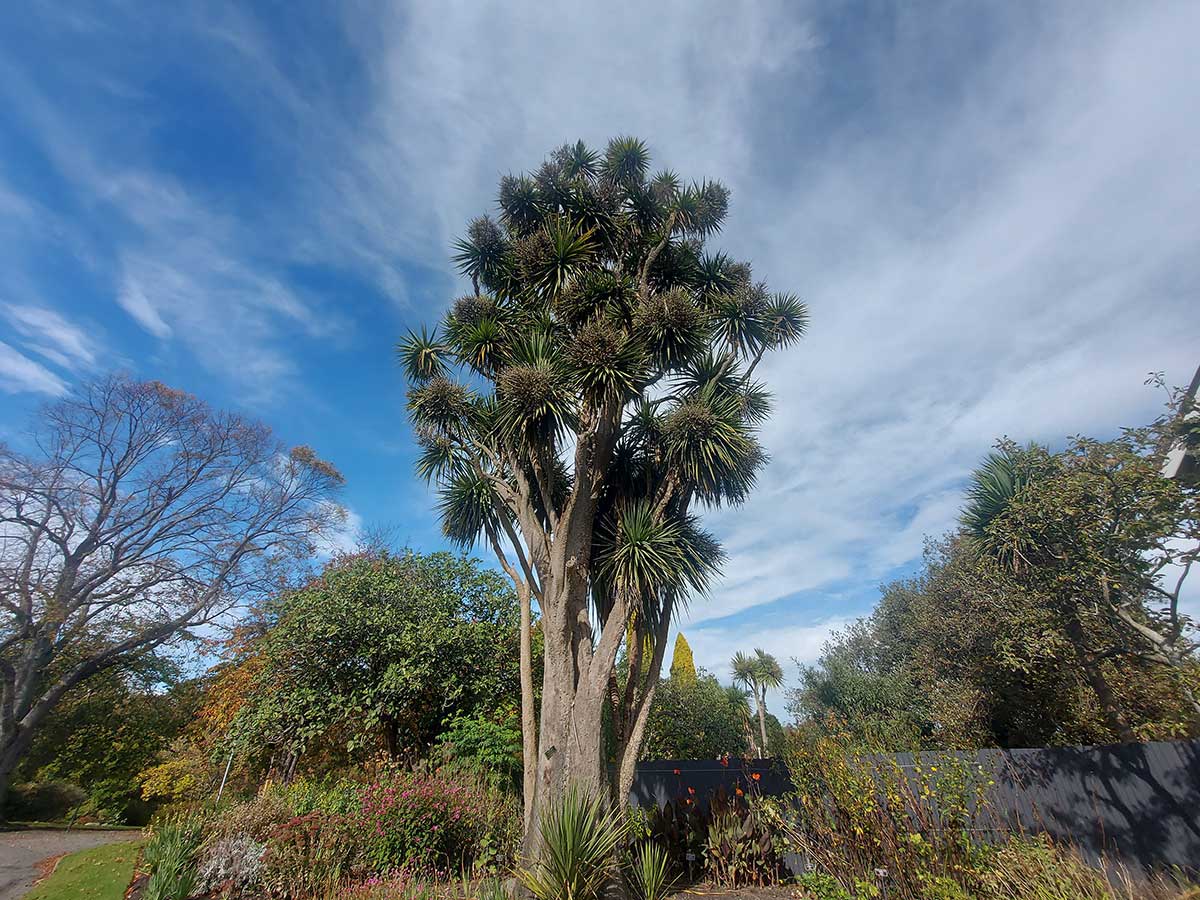
This Ti Kouka Cabbage Tree, could be the tree that Anderson wrote about.
The significant tree assessed is Cordyline australis, commonly known as the cabbage tree, located in the Timaru Botanic Gardens on King Street, Parkside, Timaru. More specifically, it stands in a garden plot between the house and the Robert Burns statue. The tree is thought to be pre-European in origin, although the exact year it was planted is unknown. Its STEM equivalent is 32, and it is recorded under Timaru District Plan 2005 ID 52.
At the time of assessment, this single cabbage tree measured 9.75 metres in height, with a canopy spread of 6 metres. Its trunk had a girth of 2.244 metres, measured at 1.4 metres above ground level. The height was calculated using a Suunto method. The tree was assessed by Peter Thomson on 20 May 1994, with a later photograph taken on 5 July 2018. The legal description of the land is Part Lot 1 DP 11137, parcel ID 81685, and the tree is owned by the Timaru District Council.
Under the Royal New Zealand Institute of Horticulture (RNZIH) Tree Evaluation Registration Form, the tree received a total score of 256, marking it as a tree of considerable significance. Its score reflects a combination of factors including its importance of position, its solitary presence, its significance within the setting, its useful life expectancy, and its good specimen form. Although the species itself was rated as very common, this individual tree was recognised for its strong contribution to the landscape and heritage character of the Botanic Gardens.
Overall, this cabbage tree is an important natural and historic feature within the Timaru Botanic Gardens. Its likely pre-European origin gives it particular cultural and historical value, while its prominent setting and notable dimensions contribute to its status as a significant tree within the Timaru District.

Postcard showing view of glasshouse at Timaru Botanic Gardens. Gardens Timaru NZ. Aoraki Heritage Collection, accessed 10/04/2026, https://aorakiheritage.recollect.co.nz/nodes/view/25
Alternations were underway in 1965 for a large conservatory with stone and concrete work to replace the pot-grown plants by curator R. S. Scott.. The gardeners planted 10,000 nemesias so they would be in full flower for the Spring Festival, along with tulips, anemones, and polyanthus. - Park Conservatory Alterations Designed For Tropical Plants (02 Sep 1965). Aoraki Heritage Collection https://aorakiheritage.recollect.co.nz/nodes/view/5615
SCENIC RESERVE
BEAUTIFYING PLAN OUTLINED
MR D. TANNOCK’S REPORT
Recently Mr D. Tannock, curator of reserves in Dunedin, visited Timaru to report on the planting of the scenic reserve, which was acquired by the Timaru Borough Council some time ago.
Mr Tannock has now forwarded his report, and in a covering letter states that he did not go into the matter in great detail, for he felt sure that the Borough Council, with the assistance of the Advisory Committee and the Superintendent of Reserves, Mr Anderson, would be quite up to elaborate the suggestions he had made. He would be pleased to assist further at any time, and would always take a keen interest in the development of the reserve, which he considered had great possibilities.
Native Bush
In his report, Mr Tannock said that the scenic reserve should be planted and laid out to represent native bush, an English wood, open glades and meadows, with groups and individual specimen trees. In the meantime he would not recommend the introduction of flower gardening or shrubberies, except at the entrance and where required to provide the undergrowth of native bush, with perhaps a few groups of coloured manukas, kakabeaks, olearias and hybrid brooms on the dry slopes above the old tram line. The aim should be to produce a wooded valley, with ornamental evergreen foliage of the various native trees, flowering trees for spring and summer, and autumn-tinted foliage trees for autumn and early winter. A few groups of golden willows and red stemmed dogwoods would provide colour during the winter. The only excuse for introducing strong growing pines was to suppress gorse and broom, to provide a background for the autumn-tinted trees, shelter for the natives and eventually the desirable bush conditions for our shade and moisture loving native bush and ferns.
General Policy
The general policy to be adopted in the meantime should be: (1) To get rid of the gorse, broom and elderberry; (2) To plant up the worst of the gorse and broom infested areas with quick growing conifers such as pinus radiata, Douglas fir and macrocarpa. These trees should be got in as soon as the clearing is carried out and before the gorse has time to recover, and with the exception, however, of a little clearing the first two years, they can be relied upon to look after themselves. In about ten years time they can be pruned, cleaned up and thinned, and in another ten years they can be cut out to make room for more ornamental and more interesting growth. It is our experience after the first pruning and thinning of pine and spruce forests, native vegetation appears as an undergrowth, the seeds having been conveyed by birds and other agencies. (3) To get together supplies of the various trees required and to grow these on in the nursery for the first one or two years. (4) To prepare pits for the trees during the summer and autumn, leaving these open to the weather until required. This would avoid the rush of work which is always characteristic of the planting season, and enables the planting of the dirt areas to be carried out in the autumn. If the area planted with conifers is fenced off, grazing could be continued over the remainder until the autumn, thus keeping down the growth of grass and weeds, in which there will be a danger of fire unless mown regularly.
Mr Tannock said taking the plan in sections as provided by the borough engineer and beginning at the Otipua Road entrance, there was a long narrow strip, and as it was desirable not to shade the road during the winter, he would recommend the planting of light foliage, deciduous trees such as silver and canoe birch, mountain ash and prunus pissardi. This would provide flowers in the spring, shade during summer and colour in the autumn. As there would be a considerable amount of stone walling on one side of the road, it might be found desirable to plant the top of the wall with berberis, senecios, veronicas and escallonias, which would eventually, to some extent, droop down over it. On the lower side between the road and the creek the birch, rowan and prunus might continue and be continued with the introduction of numbers of scarlet oaks, liquidambers and sugar maples to intensify the autumn colouring. Alongside the creek, poplars and golden willows could be planted, the level area already planted with specimen trees being left open for picnics.
Church Street Entrance
Beginning at the Church Street entrance where the road zig zagged down the hill, he recommended shrubs with a few smaller ornamental trees such as the various species and varieties of prunus and crab apples and almonds and crataegus. As the best and most comprehensive view of the whole reserve could be obtained from this entrance, it was not desirable to plant tall trees. The report went on to state that below the road was a large open area suitable for park like treatment with groups of trees and individual specimens, the open glades being available for picnics. The groups could consist of native beech, northern fagus solanderi, ribbonwoods, kowhai and English beech with poplars, willows and swamp cypress more towards the stream. A intervals the stream could be dammed up and the soil removed to form a shallow lake, which would give the reflections and landscape effect without being dangerous for children. The banks of the creek could be planted with rhododendrons and groups of rhododendrons could be introduced among the flowering trees, but these need not be put in at present.
Ponds
At suitable intervals the creek could be widened and dammed to provide for lakelets and it could be possible to arrange for one of these to be suitable depth for bathing. Near this could also be situated suitable shelter trees, dressing accommodation and sanitary conveniences. These should be hidden by suitable tree planting. Paths would be required at some time, and these could follow the course of the creek, with here and there a connection with the drive. A path would also follow the tram line from where the road left it to where it joined again. These paths could be formed now while labour was available. The conifers would be planted at six feet apart to provide an early canopy which would smother the gorse. The forest trees such as beech, both English and native, kowhais, wattles, gums, ribbonwoods, birch and mountain ash at nine feet.
The reserve should begin with ornamental trees and shrubs, pass over a patch of native swamp plants in association, with an English park scene, with Australian trees on the drier parts, merge into a native park scene and from it into native bush which would continue until they came to the conifere section, which after all, was only temporary, and would be replaced with a native forest later on.
Most Attractive Drive
“There should be a representation of an English wood, with daffodils, primroses and blue bells, an Australian bush, New Zealand bush and North American forest, and an effort should be made to grow as large a collection of species and varieties as will thrive and look healthy and happy with the minimum of maintenance. Grass will have to be mown and gorse and broom kept down and a sharp look kept for fires during dry weather. No doubt some trees will die and there will have to be replacements, but a stock of suitable trees and shrubs will have to be maintained in the nursery. Beyond this there should not be any great maintenance, and this will become less as the trees grow up and the bush becomes established.
“Should this reserve be developed as proposed, it will become a most attractive drive at all seasons, with interesting walks and useful picnic grounds, and be a distinct asset to the borough and district.”
Committee’s Report
The Scenic Reserve Committee reported that Mr Tannock’s report together with the plans that accompanied it was considered in detail and it is recommended that two sections be planted on Arbor Day, the curator and Mr Knowles in the meantime to visit the reserve and mark out sites for the trees; the route of footpaths to be decided after consultation with the borough engineer. It was recommended that a low rubble wall be erected along the boundary of Otipua Road, the work to be done by unemployed skilled workers to be subsidised; openings to be provided for the main road and footpath. It was also recommended that another section be planted with poplars this year, the curator to be authorised to procure 1000 pots for the Australian trees to be planted in yet another section. The committee also recommended that an appeal should be made for gifts of trees.
It was recommended that the curator be authorised to expend up to £50 on the purchase of any trees for planting in accordance with the scheme.
The report stated that a letter was read from the superintendent of Parks and Reserves, Invercargill, stating that the following plants had been donated specially for the new park: 500 populas fastigistis, 100 populas angustata robusta, 25 populas yunnanensis. It was recommended that a vote of thanks be passed to the Invercargill City Council for the gift.
Statement By Mayor
The Mayor said that he was sure they were all gratified to note that some tangible progress was now being made in regard to the planter of the new scenic reserve. This reserve, as Councillors would remember, was a long strip of about two miles in length extending from Otipua Road to the Claremont Road near Genii, and contained about 108 acres comprising about 38 acres of the quarry acquired from the Harbour Board at quite a nominal sum, 54 acres purchased from King’s Trustees and 16 acres generously donated by Mr George Bowker. Also considerable progress had been made in regard to the access from Otipua Road, one entrance following the route of the tram line and by the other through the land donated by Mr Bowker immediately at the end of Church Street West. In addition, a considerable amount of formation had been done on the roadway, which would give access to the level land in the valley itself. Steps were now being taken to plant a considerable area in the immediate future. Trees were being raised in their own nursery and at the same time a considerable quantity were also being purchased. It was felt, however, that more could be done and that a campaign should be launched to obtain, if possible, donations of trees, or money towards the purchase of same. For this purpose, the engineer was preparing a smaller and more compact copy of the very comprehensive plan which accompanied Mr Tannock’s report so that the same could be inspected for the information of all interested, and serve as an illustration of the proposal and a stimulus to citizens of Timaru to assist the scheme along. He reminded Councillors that the first trees were planted in the reserve on Arbor Day last year, and that it was proposed again to celebrate Arbor Day by further planting.
The Council passed a vote of thanks to Mr Tannock for his assistance.
https://paperspast.natlib.govt.nz/newspapers/THD19350709.2.24

A lovely WuHoo follower shared an image on display at the Pleasant Point Railway Museum. Alongside it was their own photo, taken while trying to find the same viewpoint today. They were happy for me to share the story, but wished to remain anonymous. Here are two scenes same spot, then and now of the rail at the bay. Thank you for sparking this afternoon’s curiosity-filled history hunt...
[CAROLINE BAY’S HISTORY]
Gardens Built From Drab Beach
Steady Growth Of Urban Attraction
“Caroline Bay is undoubtedly the main attraction to Timaru and many visitors are amazed to hear that that great area of lawns, shrubberies and sands has appeared and taken shape within the memory of many people on the sunny side of 60,” said the Borough Curator (Mr A. W. Anderson) in an address to delegates attending the conference of Chairmen of Reserves Committees and Parks Superintendents at Timaru yesterday.
The subject of his address was, “A Brief History of the Parks and Reserves in Timaru,” and he presented a resume of the steady growth of Caroline Bay as an urban attraction.
“When the first whalers arrived a little more than 100 years ago, there was a substantial shingle beach along the foreshore that was continuous with the 90-mile beach,” he said. “The construction of the first breakwater changed that. A strong ocean current running up the coast soon washed away the shingle and within a few years the clay cliffs were unprotected, and fell into the sea. So serious did the position become, that the railway was endangered and extensive protective works became necessary.”
“The result was that for many years there was no beach to speak of at Caroline Bay, and the first attempt to provide bathing facilities was made by a private company which built baths near the present entrance to the parking ground at the south end of the Bay, at a cost of £200. The remains of these baths disappeared with the extensions that took place in the years 1938-1940. The harbour development took shape and sand began to make its appearance and in 1891 within three years it had taken the form of one 700 feet to seaward but, in spite of this, it was a precious commodity and by-laws prohibited its removal.”
Rose to Occasion
“When it was seen that a shady beach was likely to take its appearance, the townspeople were not long in rising to the occasion. The Mayor (Mr J. Grandi) made a personal canvass of the town and raised £50 for Bay improvements and on Arbor Day, 1894, a great tree-planting picnic was organised and the children afterwards supplied with unlimited buns and tea. The first trees had been planted many years before by Mr W. Rutherford in the days before the sand began to accumulate and many of them still stand by the overhead bridge behind the bay tea-rooms. They were planted to hide the rubbish and night-soil shoot which at that time ran into deep water.”

Canterbury Maps 1935-39
“It was at a public meeting held in 1897 to discuss means of celebrating Queen Victoria’s Diamond Jubilee that the first public discussion took place on the advisability of cutting down the clay cliffs, levelling the spoil, and generally improving the appearance of Caroline Bay, continued Mr Anderson. The project was reluctantly abandoned because the cost of a seawall would have been prohibitive. Some weeks later, the Harbour Board was able to supply sufficient discarded timber for the purpose and the work went ahead. Every Thursday afternoon for months afterwards volunteers took their picks and shovels down to the Bay. By the time ‘Working Bee Terrace’ was completed, it was found that the sand was being deposited in such quantity as to make the protective wall unnecessary and the material was used for making seats and steps.”
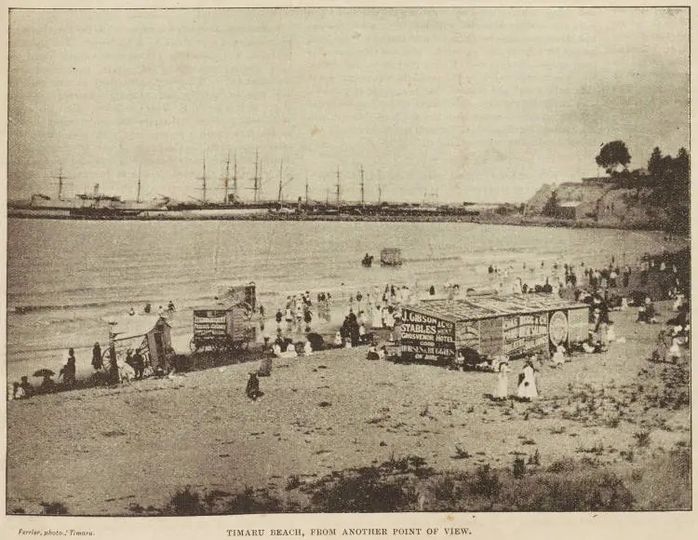
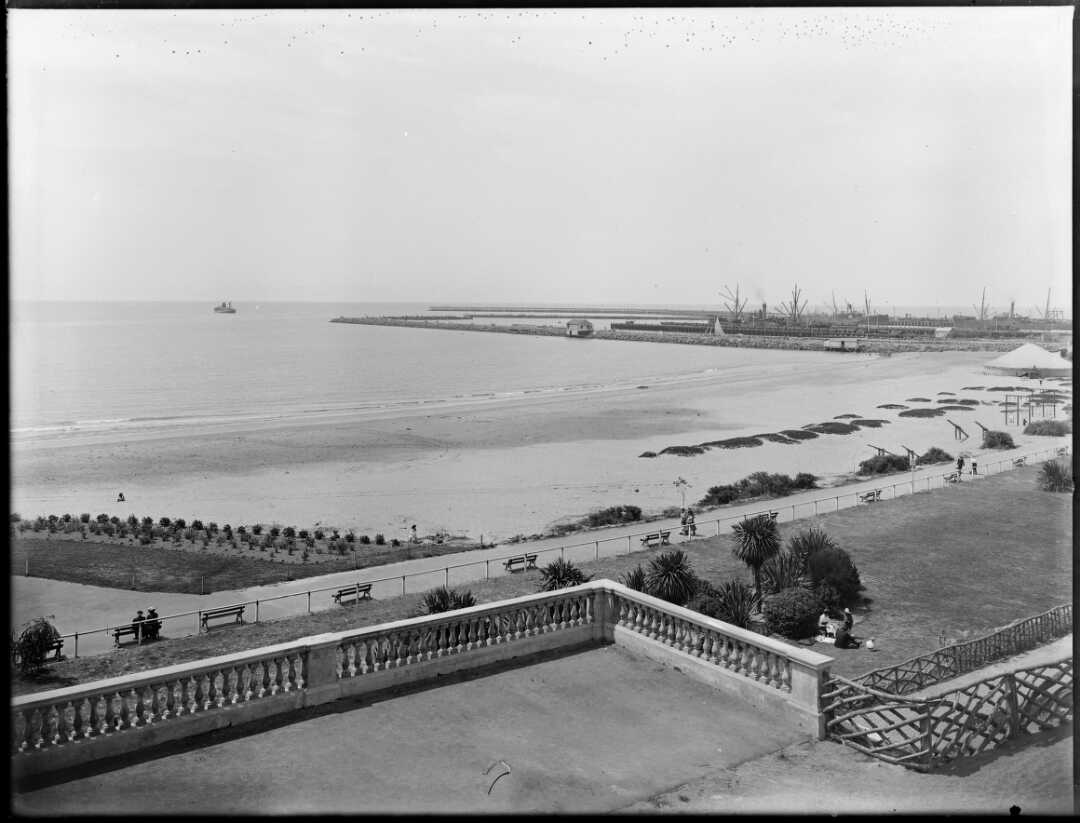
It's amazing to see how quickly the sand has built out at Caroline Bay since the breakwater at the Port was constructed in the 1880s. Before that, the sea lapped up to the bottom of the cliffs. This is pretty close to the Tearooms and where the new playground is being constructed, except look how close the sea was to the cliffs back pver 130 years ago! In this 1894 photo by William Ferrier, you can see bathing carts on Timaru's new Caroline Bay. People used carts moved by horses to get changed inside. And at one point they even backed into the sea, so ladies could keep their modesty while bathing. Interesting to see who has taken advantage of the advertising opportunity and sign written the carts.
“In 1903 the Harbour Board met the Borough Council and gave a tenure of four acres at a peppercorn rental. This included not only the sands then in sight but those under the sea in a line from the old mole to the Waimataitai Lagoon. As a result of the agreement the upkeep of Caroline Bay became a public responsibility, a total of £3200 being spent on improvements at that time. Tearooms were built in 1905 and in the spring of the year the clergymen of the town “respectfully but firmly” protested against the opening of the tearooms on Sundays. It became a matter of solemn debate during the greater part of the summer and it was finally agreed, on a small majority of votes, that the request be acceded to.”
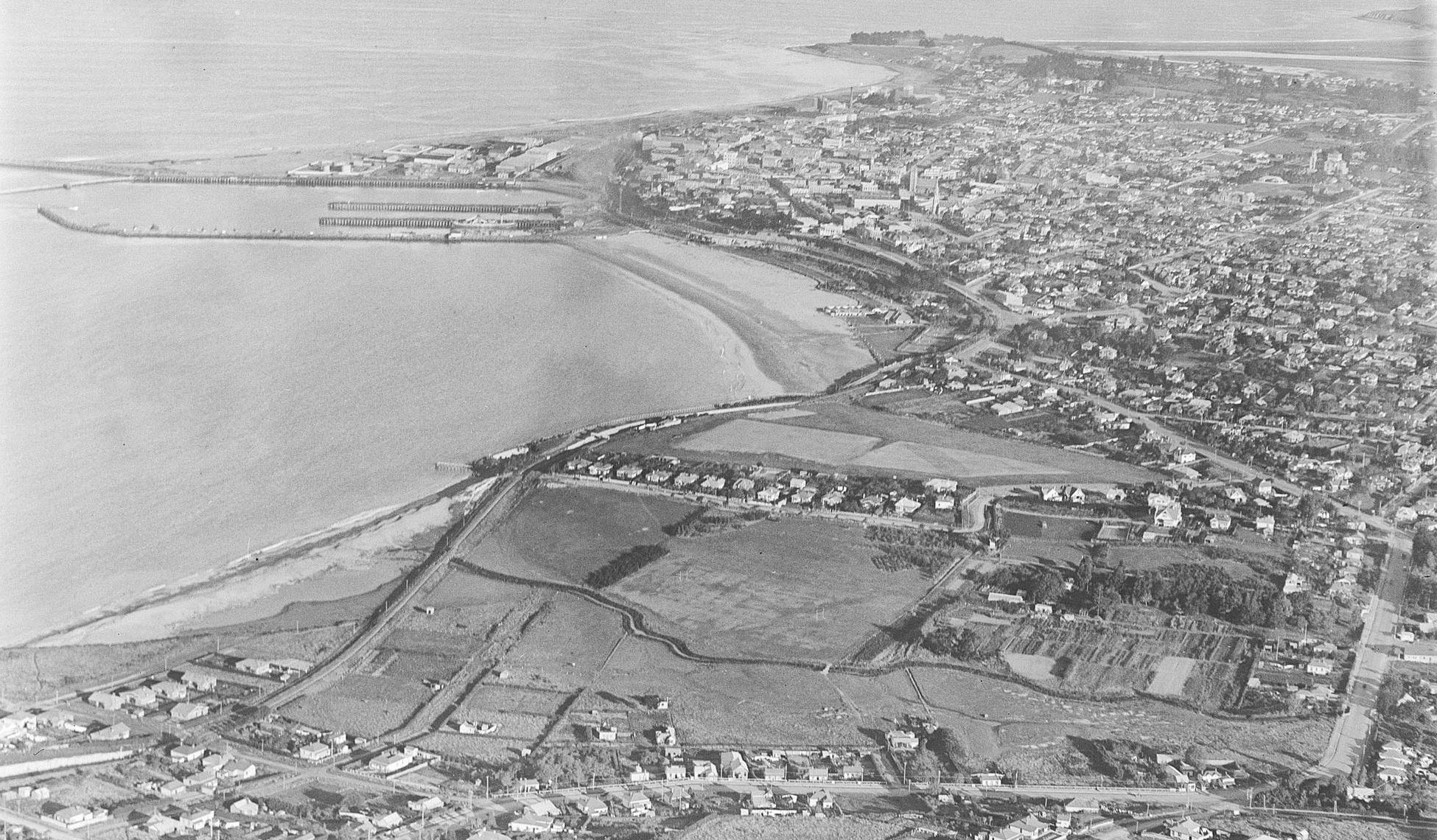
Aerial view of Timaru, showing Caroline Bay, harbour and town by Frank Douglas Mill - 1927-1937 - Auckland Libraries Heritage Collections FDM-0690-G
“In 1911 the Caroline Bay Association came into being for the express purpose of improving the Bay,” said Mr Anderson. “This Association is responsible for the carnival which has been run so successfully for many years with the result that many thousands of pounds have been handed over to the Borough Council for this work. One of the greatest contributions the Association made to the appearance of the Bay was in building the memorial wall between the lawns and the sand. For many years this gave the Bay a neat and tidy appearance, but the sand kept accumulating and extensions on the seaward side of the wall became necessary in the years immediately preceding the war.”
- https://aorakiheritage.recollect.co.nz/nodes/view/7608
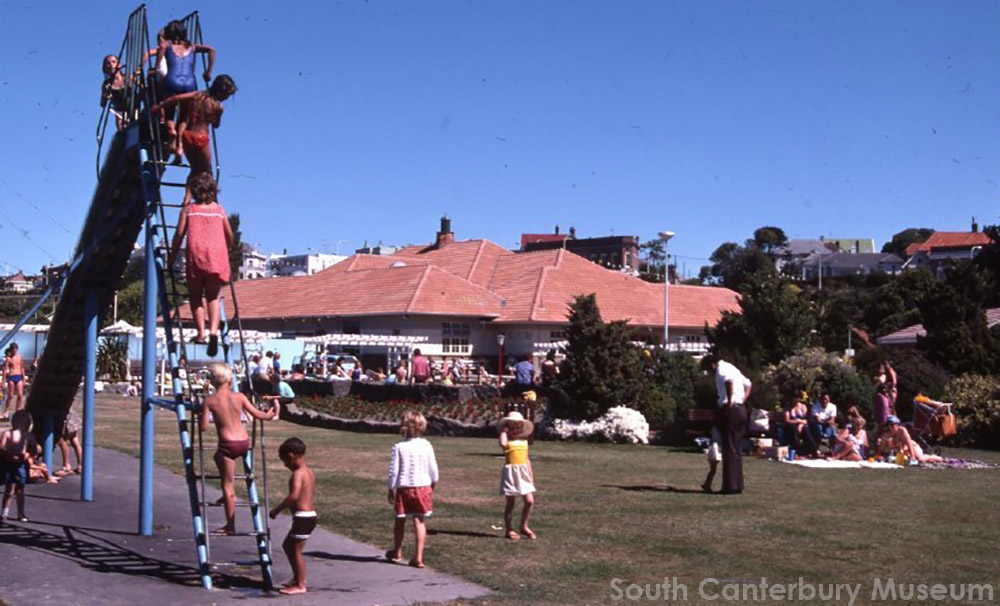
A slide showing the children's playground area on Caroline Bay in Timaru, circa 1980. Photographer L W McGrath, Courtesy of South Canterbury Museum 2014/008.033
Sources
Timaru District Council, Timaru Botanic Gardens
https://www.timaru.govt.nz/community/recreation/gardens/timaru-botanic-gardens
Timaru District Council, Rose Gardens
https://www.timaru.govt.nz/community/recreation/gardens/rose-gardens
Timaru District Council, Timaru Botanic Gardens Walking Tracks
https://www.timaru.govt.nz/community/recreation/walking-and-cycling/timaru-botanic-gardens
Timaru District Council, Centennial Park (Scenic Reserve)
https://www.timaru.govt.nz/community/recreation/parks-and-sports-facilities/popular-parks/centennial-park
Timaru District Council, Waitohi Bush
https://www.timaru.govt.nz/community/recreation/walking-and-cycling/waitohi-stream
Timaru District Council, Timaru Botanic Gardens History Book
https://www.timaru.govt.nz/news-and-events/latest-news/timaru-botanic-gardens-history-book
Department of Conservation, Loder Cup Award, 1929 to 1999 winners
https://www.doc.govt.nz/news/events/awards/loder-cup-award/1929-to-1999-winners/
Royal New Zealand Institute of Horticulture, Associates of Honour
https://www.rnzih.org.nz/pages/AHRIH_Recipients.htm
National Library of New Zealand, The botanical exploration of Canterbury / A.W. Anderson
https://natlib.govt.nz/records/21660876
Internet Archive, The Coming of the Flowers by A. W. Anderson
https://archive.org/details/comingofflowers0000awan
Aoraki Heritage Collection, Walter Anderson
https://aorakiheritage.recollect.co.nz/nodes/view/3960
Aoraki Heritage Collection, Obituary: A W C Anderson
https://aorakiheritage.recollect.co.nz/nodes/view/3013
Papers Past, Timaru Herald, 9 July 1935, SCENIC RESERVE
https://paperspast.natlib.govt.nz/newspapers/THD19350709.2.24
Papers Past, Timaru Herald, 5 April 1940, THE CENTENNIAL
https://paperspast.natlib.govt.nz/newspapers/THD19400405.2.40
New Zealand Gardens Trust, Conference 2026, Honouring the Past, Gifting to the Future
https://www.gardens.org.nz/
Meeting Newz, Garden conference to spotlight South Canterbury and North Otago
https://www.meetingnewz.co.nz/news/around-new-zealand/item/4263-garden-conference-to-spotlight-south-canterbury-and-north-otago
Archives Online, Wellington City Council, Botanic Garden Board
https://archivesonline.wcc.govt.nz/nodes/view/888075
JSTOR summary, botanic gardens cast in the colonial mould
https://www.jstor.org/stable/pdf/24811410.pdf
Nature, progress and science in the Christchurch Botanic Gardens
https://www.research.ed.ac.uk/en/publications/colonial-transformations-nature-progress-and-science-in-the-chris
Lonely, strict upbringing led to botanical fame: A profile of Mr A. W. Anderson
Obituaries: A. W. C. Anderson
Gift of Trees: Planting in Front Gardens
Timaru man awarded Loder Cup
Loder Cup presented to Timaru botanist
Caroline Bay’s History: Gardens Built From Drab Beach
Timeline
c. 1900 to 1901: Born in Scotland.
Childhood: Orphaned young, raised by grandfather and aunts, develops interest in wild plants.
Early 1920s: Works at Littlewood Park, then studies at Kew Gardens.
1920s: Receives Kew Guild-assisted passage to New Zealand, works at Dunedin Botanic Gardens under David Tannock.
1932: Appointed to Timaru reserves role.
1930s: Promotes beautification schemes, native planting, and reserve development in Timaru.
1939: Centennial Park is officially named.
1940: Centennial Grove planted with native trees during Timaru centennial celebrations.
1950: Publishes The Coming of the Flowers.
1956: Named Associate of Honour of the RNZIH. RNZIH notes he secured the first Metasequoia plant for New Zealand.
1959: Publishes The Botanical Exploration of Canterbury as the Banks Lecture.
Late 1950s: Retires from Timaru reserves work. Sources vary between 1956 and 1957. Retirement years: Develops an alpine garden at Lake Tekapo and continues advising, writing and promoting New Zealand plants.
1974: Awarded the Loder Cup.
1986: Dies in Timaru.
Today: Anderson Rose Garden in Timaru Botanic Gardens still bears his name.