
By Roselyn Fauth

Members of the National Council of Women of New Zealand (NCWNZ) in a group portrait published in the Auckland Weekly News on 21 April 1899. Auckland Libraries Heritage Collections, AWNS-18990421-08-01. The National Council of Women of New Zealand was established in 1896, three years after women in New Zealand won the right to the vote, as an umbrella organisation uniting a number of different women's societies that existed in New Zealand at that time. Its founding president was Kate Sheppard, who had led the campaign for women's suffrage. In 1993 it comprised 47 nationally organised societies and 36 branches throughout the country. No known copyright restrictions https://kura.aucklandlibraries.govt.nz/digital/collection/photos/id/170133
Our $10 note celebrated a critical milestone in the womens history timeline sharing Kate Sheppard NZ Suffergette who helped champion womens right to vote. When Women gained the right to vote, a world first, in 1893. I assumed that was the peak of success and that it was plain sailing from there. But learning about the National Council of Women, particularly the South Canterbury Branch has made me realised that was not the case.
From a distance that achievement might look like the womens history's happy ending... but it was not. Yes, women could vote, but... there was still a long way to go. They still had less legal power, fewer opportunities, and far too little say over the institutions shaping daily life. That is why the National Council of Women of New Zealand was formed in Christchurch in 1896, to bring women’s organisations together and push for fairer laws, better education, better health, and a stronger public voice.
That national purpose helps explain why a South Canterbury branch mattered. The South Canterbury opened around 1929, going by a tree and plaque outside the Timaru Library marked the 60th jubilee of the National Council of Women, South Canterbury 1989. This tree marks a moment in the local womens history timeline.

New Zealand 1992 Ten Dollar note featuring Kate Sheppard. While travelling in England in 1894, Kate Sheppard, leader of New Zealand's successful campaign for women's suffrage, was asked by the International Council of Women (ICW) to found a council in New Zealand. The first convention of the National Council of Women of New Zealand assembled in Christchurch in 1896 and elected Sheppard as president to 'encourage the formation of Societies of Women engaged in trades, professions and social and political work'. About 25 women attended, representing eleven societies. The group was solidly middle class, and several women had been or were teachers.
The catalyst of World War I precipitated a revival of the women's movement in New Zealand. In 1916 Henderson, Sheppard and writer Jessie Mackay set in motion plans to reactivate the council. https://wuhootimaru.co.nz/blog/956-from-kakahu-school-to-suffrage-jessie-mackay-s-timaru-roots-and-national-legacy
To understand why women here needed to band together for this cause, I think we have to imagine life in South Canterbury between the wars.
Timaru was a practical, hard-working town, surrounded by farms and smaller settlements, and women’s lives were full. They were raising children, running households, helping on farms and in businesses, volunteering, fundraising, nursing, teaching, organising church events, and carrying a great deal of the social life of the district. Yet the wider system still treated women’s concerns as secondary. National women’s organisations were responding to inequalities in marriage, education, paid work, politics, and social expectations, and those were not distant Christchurch or Wellington problems. They were woven through ordinary life here as well. Some might say these were society norms, but that doesn't mean normal was what everyone wanted.
By the early 1940s, the Timaru branch was clearly active and engaged in local issues. In April 1943, the Timaru Herald identified Mrs D. S. Kemshed as president of the National Council of Women, Timaru Branch. By December that year, the branch’s final meeting for 1943 had become a social gathering for delegates, members, friends, and other organisations, and Mrs Kemshed reported that she had attended a protest meeting about the proposed sale of part of Timaru Park. That is such a revealing little piece of the story. It shows the branch was not simply talking in general terms about the status of women. It was stepping into the civic questions of the town itself.
The same report brings the war years right into focus. The Timaru branch had correspondence from the mayoress, Mrs Hanan, about releasing girls from the services for harvest work. That sounds like a small detail, but it says a lot. These women were thinking about labour shortages, wartime pressures, and the practical running of district life. They were not operating in theory. They were dealing with the realities of South Canterbury as it was being lived.
This is also where women such as Christine Hanan help me understand the broader world around the branch. She was the driving force behind the formation of the South Canterbury Kindergarten Association in 1944, served as its president for 12 years, and was involved with the YWCA, the South Canterbury Health Camp Association, and the Timaru Women’s War Auxiliary during the Second World War. I cannot claim she stood for the whole NCW story, but she clearly belonged to the same Timaru network of women who saw local needs and organised to meet them.
The branch was active beyond central Timaru. In 1945, Mrs Kemshed, now described as president of the National Council of Women, spoke in Geraldine about arranging peace in the world after the war. That matters because it reminds us this was a South Canterbury story, not just a Timaru one. The branch connected town and country, and it reached into the wider district.
Then in 1947 Timaru stepped onto the national stage. The town hosted the eighteenth annual Dominion conference of the National Council of Women of New Zealand. About 100 official delegates and many other visitors came from around the country, and the conference opened with a service at St Mary’s Church, Timaru. I find that image quite moving. For a few days, Timaru became a gathering place for women debating reform, representation, and the future. It says a great deal about the standing of the South Canterbury branch that this national meeting happened here.
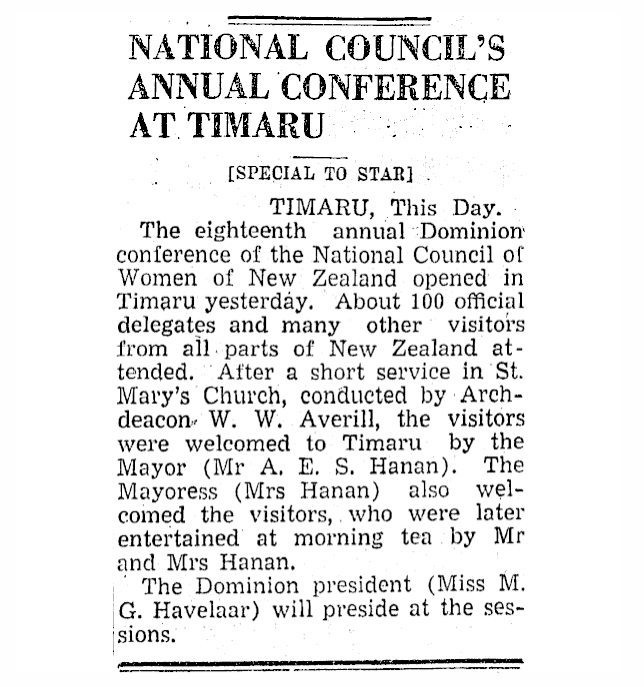
NATIONAL COUNCIL’S ANNUAL CONFERENCE AT TIMARU
Greymouth Evening Star, 19 April 1947, Page 8
As the decades went on, local women kept carrying that work forward. One of the clearest South Canterbury figures I found was Laurel McAlister. Born in Temuka, active in the YWCA in Timaru, she represented the association on the South Canterbury branch of the National Council of Women and later became NCW’s dominion treasurer in 1957 and 1958. Her wider life crossed welfare, housing, hospital governance, church work, and community support. She feels very representative of the sort of woman who gave organisations like this their strength, practical, thoughtful, deeply involved, and alive to the fact that women’s rights were bound up with health, housing, family life, and social justice.
By the late twentieth century the branch was still part of Timaru life. The 1989 jubilee tree outside the library marked its long local presence, and in the museum material I was looking at, Joan Evans appears as one of the later women who carried the branch forward. By 2006, the South Canterbury National Council of Women was still meeting in Timaru, and the issues being raised were strikingly practical: kinship care, travel costs for home-based carers, education, and health. That continuity feels important. The language changed with the decades, but the instinct was the same. Women here could still see where the gaps were, and they still believed in coming together to do something about them.
Even more recently, South Canterbury National Council of Women still had a place in local civic life. Timaru District Council committee papers from 2021 and 2022 show Robin Peterson representing South Canterbury National Council of Women on the Safer Communities Committee in the District Council Building, King George Place, Timaru. That is a quiet but telling sign of longevity. This was not just a historical movement that vanished into sepia photographs. Its local legacy still sat at the civic table.
What moves me most is how closely that long local history still speaks to the organisation’s present-day purpose. NCWNZ says it has a long and proud history of improving the quality of life of women, families, and the community, and today its strategic vision is a Gender Equal New Zealand. It is still working through national conferences, resolutions, submissions, research, public advocacy, and reporting under CEDAW. It has run Gender Attitudes Surveys, is building a Gender Dashboard, and continues to push government and public institutions to face the gaps that remain. In other words, the tools have evolved, but the heartbeat is familiar.
So when I think about the South Canterbury branch now, I do not think of it as just another committee from the past. I think of women in Timaru, Temuka, Geraldine, and across the district who understood that having the vote did not mean the work was finished. They met in churches and halls, argued over local issues, hosted national conferences, built alliances, wrote resolutions, protested decisions they thought were wrong, and kept insisting that women’s lives mattered. Some of that work was public. Much of it was quiet. But it helped shape the place we live in now.
That is what I have come to admire most. They did not wait for perfect conditions. They saw what was unfair, what was missing, and what needed to change, and they got on with it. Here in South Canterbury, that mattered. It still does.
Sources with full links
NZ History, The National Council of Women
https://nzhistory.govt.nz/page/national-council-women
NZ History, National Council of Women of New Zealand
https://nzhistory.govt.nz/women-together/national-council-women-new-zealand
NZ History, National Council of Women formed
https://nzhistory.govt.nz/womens-movement-gathers-in-christchurch-to-form-national-council-of-women
Te Ara, Women’s movement
https://teara.govt.nz/en/womens-movement/print
Aoraki Heritage, National Council of Women South Canterbury 60th jubilee tree
https://aorakiheritage.recollect.co.nz/nodes/view/4982
Papers Past, Timaru Herald, 1 April 1943, Congress of Women
https://paperspast.natlib.govt.nz/newspapers/THD19430401.2.20
Papers Past, Timaru Herald, 15 December 1943, National Council of Women
https://paperspast.natlib.govt.nz/newspapers/THD19431215.2.10
Papers Past, Timaru Herald, 29 September 1945, Geraldine report mentioning Mrs Kemshed
https://paperspast.natlib.govt.nz/newspapers/THD19450929.2.13
Papers Past, Greymouth Evening Star, 19 April 1947, National Council’s annual conference at Timaru
https://paperspast.natlib.govt.nz/newspapers/GEST19470419.2.99
Papers Past, Te Awamutu Courier, 5 May 1947, opening of Dominion conference at St Mary’s Church, Timaru
https://paperspast.natlib.govt.nz/newspapers/TAWC19470505.2.27
Papers Past, White Ribbon, 1 June 1947, annual conference at Timaru
https://paperspast.natlib.govt.nz/periodicals/WHIRIB19470601.2.27
Te Ara, McAlister, Laurel Grace Barker
https://teara.govt.nz/en/biographies/5m1/mcalister-laurel-grace-barker
Aoraki Heritage, Christine Hanan
https://aorakiheritage.recollect.co.nz/nodes/view/1891
Aoraki Heritage, Hanan Kindergarten Opened By Minister For Social Welfare
https://aorakiheritage.recollect.co.nz/nodes/view/1861
Aoraki Heritage, South Canterbury Kindergartens
https://aorakiheritage.recollect.co.nz/nodes/view/1878
Beehive, South Canterbury National Council of Women, Timaru, 18 November 2006
https://www.beehive.govt.nz/speech/south-canterbury-national-council-women
Timaru District Council, Safer Communities Committee Minutes, 25 November 2021
https://www.timaru.govt.nz/__data/assets/pdf_file/0007/599092/Safer-Communities-Committee-Minutes-25.11.2021.pdf
Timaru District Council, Safer Communities Committee Agenda, 24 March 2022
https://www.timaru.govt.nz/__data/assets/pdf_file/0009/618588/Safer-Communities-Committee-Agenda-24.3.2022.pdf
NCWNZ, About
https://www.ncwnz.org.nz/about
NCWNZ, Archive
https://www.ncwnz.org.nz/archive
NCWNZ, Submissions
https://www.ncwnz.org.nz/submissions
NCWNZ, Promoting and using CEDAW
https://www.ncwnz.org.nz/cedaw
NCWNZ, NCWNZ collaboration for alternative CEDAW report 2024
https://www.ncwnz.org.nz/ncwnz_collaboration_for_alternative_cedaw_report_2024
Timeline
1893
New Zealand women won the vote, but legal, economic, and social inequalities remained.
13 April 1896
The National Council of Women of New Zealand was formed in Christchurch to unite women’s organisations and work for reform.
Circa 1929
The South Canterbury branch appears to have been established around this year, inferred from its recorded sixtieth jubilee in 1989.
1 April 1943
Mrs D. S. Kemshed was reported as president of the National Council of Women, Timaru Branch.
15 December 1943
The Timaru branch held its final meeting for 1943, reported attendance at a protest meeting over the sale of part of Timaru Park, and discussed wartime issues including releasing girls from the services for harvest work.
1944
Christine Hanan drove the formation of the South Canterbury Kindergarten Association and became a key figure in the district’s women’s welfare and childcare work.
29 September 1945
Mrs Kemshed, president of the National Council of Women, spoke in Geraldine, showing the branch’s reach beyond Timaru.
April 1947
Timaru hosted the eighteenth annual Dominion conference of the National Council of Women of New Zealand. About 100 delegates attended from around the country. The conference opened with a service at St Mary’s Church, Timaru.
1957 to 1958
Laurel McAlister of South Canterbury served as NCW dominion treasurer after representing the YWCA on the South Canterbury branch.
1989
A tree and plaque outside the Timaru Library marked the 60th jubilee of the National Council of Women, South Canterbury.
1990s
In local museum material, Joan Evans appears as a later South Canterbury branch president. This is from local collection research rather than one of the public web sources above.
18 November 2006
The South Canterbury National Council of Women was still active in Timaru, raising issues including kinship care, carers’ travel costs, education, and health.
25 November 2021
Robin Peterson represented South Canterbury National Council of Women on Timaru District Council’s Safer Communities Committee.
24 March 2022
South Canterbury National Council of Women was again listed in Timaru District Council committee papers, showing continuing civic representation.
Today
NCWNZ’s work centres on a vision of a Gender Equal New Zealand, using research, resolutions, submissions, and CEDAW reporting to keep pushing for change.
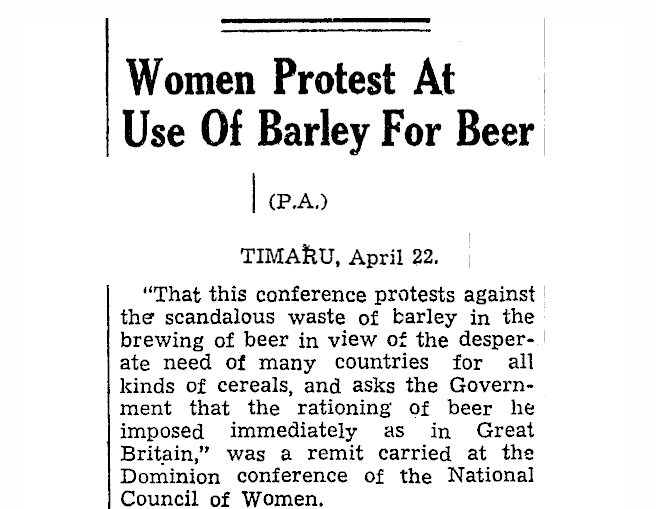
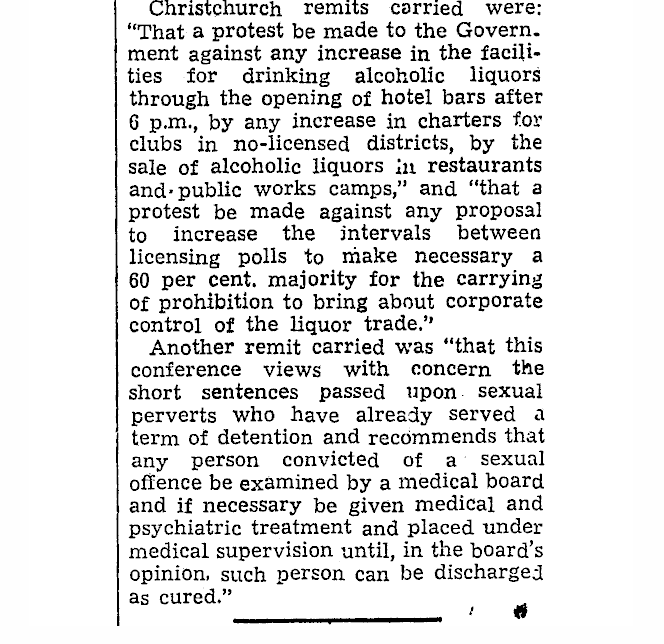
Women Protest At Use Of Barley For Beer
Hawke's Bay Herald-Tribune, Volume 90, Issue 179, 22 April 1947, Page 4
https://paperspast.natlib.govt.nz/newspapers/HBHETR19470422.2.40
Wider context: Milestones in New Zealand women and electoral politics
- 1867
Women ratepayers in Nelson and Otago Provinces began voting at the local level. - 1875
The New Zealand Parliament made it compulsory in all provinces for women ratepayers to be allowed to vote in municipal elections. - 1893
New Zealand women aged 21 and over voted in the national general election for the first time.
On 20 December 1893, women also voted in the Māori seats for the first time. - 1919
The Women’s Parliamentary Rights Bill was passed.
Rosetta Baume, Aileen Garmson Cooke, and Ellen Melville became the first women to stand for Parliament. - 1933
Elizabeth McCombs was elected after her third attempt, becoming New Zealand’s first woman Member of Parliament. - 1947
The Honourable Mabel Howard became New Zealand’s first woman Cabinet Minister, serving as Minister of Health and Minister in charge of Child Welfare. - 1949
Iriaka Matiu Rātana was elected, becoming the first Māori woman MP. - 1984
Dame Frances Wilde became the first woman MP elected as a party Whip.
Dame Ann Hercus became the first Minister of Women’s Affairs, and also the first woman to hold the Police portfolio. - 1990
Dame Catherine Tizard became New Zealand’s first woman Governor-General. - 1995
Georgina Beyer was elected Mayor of Carterton, becoming the world’s first openly transgender mayor.
In 1999, she became the world’s first transgender Member of Parliament. - 1996
Pansy Wong became the first Asian woman elected to Parliament. - 1997
Dame Jennifer Shipley became New Zealand’s first woman Prime Minister. - 1999
Luamanuvao Dame Winnie Laban became the first Pasifika woman elected to Parliament. - 2005
Margaret Wilson became the first woman elected Speaker of the House of Representatives.
National Council of Women and South Canterbury timeline
- 1893
New Zealand women won the vote, but legal, economic, and social inequalities remained. - 13 April 1896
The National Council of Women of New Zealand was formed in Christchurch to unite women’s organisations and work for reform. - Circa 1929
The South Canterbury branch appears to have been established around this year, inferred from its recorded sixtieth jubilee in 1989. - 16 September 1931
The monthly meeting of the South Canterbury Branch National Council of Women was held in the Y.W.C.A. Clubroom in Timaru. - 16 November 1932
A meeting at the Y.W.C.A. Club Room included representatives from the South Canterbury Women Teachers’ Association, W.C.T.U., Woodbury Women’s Institute, Timaru High School Old Girls’ Association, Trained Nurses’ Association, Y.W.C.A., Mothers’ Union, and Women Citizens’ Association. - 1 April 1943
Mrs D. S. Kemshed was reported as president of the National Council of Women, Timaru Branch. - 15 December 1943
The Timaru branch held its final meeting for 1943, reported attendance at a protest meeting over the sale of part of Timaru Park, and discussed wartime issues including releasing girls from the services for harvest work. - 1944
Christine Hanan drove the formation of the South Canterbury Kindergarten Association and became a key figure in the district’s women’s welfare and childcare work. - 29 September 1945
Mrs Kemshed, president of the National Council of Women, spoke in Geraldine, showing the branch’s reach beyond Timaru. - April 1947
Timaru hosted the eighteenth annual Dominion conference of the National Council of Women of New Zealand. About 100 delegates attended from around the country. - April 1947
The conference opened with a service at St Mary’s Church, Timaru. - 1957 to 1958
Laurel McAlister of South Canterbury served as NCW dominion treasurer after representing the YWCA on the South Canterbury branch. - 1989
A tree and plaque outside the Timaru Library marked the 60th jubilee of the National Council of Women, South Canterbury. - 1990s
In local museum material, Joan Evans appears as a later South Canterbury branch president. - 18 November 2006
The South Canterbury National Council of Women was still active in Timaru, raising issues including kinship care, carers’ travel costs, education, and health. - 25 November 2021
Robin Peterson represented South Canterbury National Council of Women on Timaru District Council’s Safer Communities Committee. - 24 March 2022
South Canterbury National Council of Women was again listed in Timaru District Council committee papers, showing continuing civic representation. - Today
NCWNZ says its work centres on a vision of a Gender Equal New Zealand, using research, resolutions, submissions, and CEDAW reporting to keep pushing for change.