
By Roselyn Fauth

Joan Evans, posed with a pair of photographs, 28 April 1992. Evans is holding a photo frame with photographs showing Mayor Hanan standing next a tree and another of a plaque that reads: "75th Anniversary of Timaru this tree was planted by his Worship the mayor A E S Hanan JP 13 - 7 - 47". National Council of Women, South Canterbury Branch. South Canterbury Museum - Catalogue Number 2012/186.2887
I will be honest with you, I was not looking for Joan Evans... I was looking for history about Ashubury Park's gate. I was on the South Canterbury Museum's website and found a lot of photo's of her. I thought to myself, if there are this many photos of her in a regional museum collection, then she must have a great story. Suddenly the gate did not seem nearly as interesting as the woman holding the memory. And once I started following that thread, Joan Evans turned out to be far more than a name in a caption. So I embraced the side quest curiousity and went huting for Joan's story. It's facinating... so here is today's blog about Joan, daughter of a mayor who made important ripples of impact for women...
The first thing that makes Joan significant is that she appears to have been a keeper of civic memory in the most literal sense. Timaru District Council’s notable tree report records two plaques beside the anniversary tree. One states that the tree was planted by His Worship the Mayor, A. E. S. Hanan, on 13 July 1943. The other records that the replacement tree was planted on 8 September 1992 by “Mrs J. Evans daughter of Mr Hanan.” That one detail felt especially interesting to me. Joan’s photograph becomes a bridge between one public ceremony and another, between the Timaru of the 1940s and the Timaru of the 1990s, between inherited memory and active remembrance.
Her father, Alfred Ernest Stanley Hanan, served as Mayor of Timaru until his death in 1950. I am still a little uncertain exactly when his mayoralty began. The South Canterbury Museum profile dates it from 1944, while Aoraki Heritage suggests 1942, and the 1943 anniversary tree record shows he was already mayor by July 1943. What the sources do agree on is that he was a First World War veteran and a man of considerable civic presence.
Now we have a maiden name to help us learn more about Joan. Joan Elizabeth Hanan. The elder daughter.
Her father was also very much a working mayor, rooted in the practical life of the town. A 1944 newspaper profile noted that he had lived in Timaru for 23 years and practised there as a chemist, with interests centred on the health and welfare of the people. That matters. It suggests a man whose public life was not detached from ordinary needs, but shaped by them. His mayoralty seems to have carried that same practical streak, whether in civic development, memorial projects, or emergency response.
Hanan helped shape Timaru’s public identity. He was instrumental in establishing the Lamp of Remembrance above the council building, proposed as part of a wider wartime memorial idea, and he pushed for Timaru’s elevation to city status once the population threshold had been passed. Then there is the Hanan Shield, still one of the best known trophies in Heartland rugby, presented in 1946 by A. E. S. Hanan as Mayor of Timaru for competition between South Canterbury, Mid Canterbury, and North Otago. His name is still spoken every rugby season, which is no small legacy.
But this is not only a story about a prominent father. It is helpful context for Joan, because it allows us to imagine the home she was raised in and the kinds of conversations that may have happened around the dinner table.
It turns out Joan’s mother, Christine Hanan, was also a formidable community builder in her own right. Aoraki Heritage describes her as the driving force behind the formation of the South Canterbury Kindergarten Association in 1944 and says she served as its president for 12 years. The same record links her with the YWCA, the South Canterbury Health Camp Association, and the Timaru Women’s War Auxiliary during the Second World War. In other words, the Hanan household was not simply a mayoral household. It was a household in which women’s organising, children’s welfare, and community service must have been central.
The newspaper clippings I found in the Aoraki Heritage Collection show Joan’s mother as more than a decorative mayoress hovering at the edges. She was a woman up to her elbows in the real work of early childhood education. At the 1953 opening of Hanan Kindergarten, she spoke about years of striving by local committees and the need to raise money and mobilise support. In coverage of West End Kindergarten, the tribute to Alfred Hanan sits beside the equally important story of women who canvassed, planned, fundraised, and built. Another clipping records Mrs A. E. S. Hanan as chairman of the original Timaru Play Centre committee in 1944.
Taken together, these clippings make the Hanan family look less like a single public figure with supporters around him, and more like a civic partnership. I think the mayor helped open doors, and Christine helped establish and build what went through them.
That is the world Joan Evans seems to have inherited.
By 1995, one museum caption identifies her as President of the South Canterbury branch of the National Council of Women. Nationally, the NCW had been founded in 1896 as an umbrella body to unite women’s organisations and work for women’s rights, justice, and wider social reform. After its revival in 1919, branches became increasingly important in taking national principles into local communities. Aoraki Heritage’s record of a South Canterbury NCW 60th jubilee tree in 1989 suggests that the South Canterbury branch had been part of that local civic fabric since about 1929.
But Joan’s public life seems to have reached beyond NCW. A Timaru Herald clipping in the local collection places her firmly within the Women’s Division of Federated Farmers, usually known as WDFF. That matters, because WDFF was not simply a social club for farmers’ wives. It was one of the most important rural women’s organisations in New Zealand, created to support women and families in country districts, reduce isolation, improve health and welfare, and give rural women a stronger collective voice. It worked through local branches and provincial executives, which meant women could begin in their own district and build into wider leadership through years of committee work and community service.
That structure helps explain Joan’s own path. The clipping says she became involved in WDFF after her marriage to Wynne Evans in 1958, when her mother in law introduced her to the Maungati branch. From there she progressed to the South Canterbury executive, served on the co-ordinating committee for several years, chaired it for a term, became vice-president in 1975, and president in 1980.
She was, in other words, not a figurehead dropped into leadership because of her family name. She came up through the local work. That feels important.
So much of women’s community leadership has historically happened in ways that do not always leave bold monuments behind. It happens in branch meetings, fundraising drives, transport rosters, welfare support, educational work, hall committees, and phone calls made at the right moment. Organisations such as WDFF helped hold rural life together. They looked after practical needs, but they also created leadership opportunities for women whose labour was often essential and rarely celebrated enough.
The 1982 golden jubilee clipping about South Canterbury’s WDFF says Joan believed the organisation had made a significant contribution to the life and development of the district, and that it owed a debt of gratitude to those who had worked hard for it over the previous half century. She also spoke warmly about the support given by husbands and families, recognising that women’s public service was often made possible by a wider web of shared effort. The same report notes that only 14 women had held the presidency in the 50 years since the executive was formed, and that Joan herself had become president in that jubilee period.
Seen in that light, Joan’s work with WDFF connects directly back to the world shaped by her mother. Kindergartens, play centres, health, welfare, women’s committees, rural support networks, practical service. This was all part of the same wider civic fabric. It was the largely female, committee based, get things done kind of public life that can so easily be overlooked because it does not always come with titles chiselled in stone.
This is what makes Joan so interesting to me. She seems to sit at the meeting point of two kinds of public service that are often wrongly separated. One is the visible, official, remembered kind, mayoral office, commemorative trees, shields, plaques, speeches. The other is the patient, committee based, largely female kind, kindergartens, play centres, health education, welfare work, rural support networks, and women’s advocacy.
Joan appears to have belonged to both worlds.
Her family gave her one inheritance. Organisations such as the National Council of Women and WDFF gave her another.
There are also hints that Joan’s own community life ranged even wider. Another museum record places “Joan Evans and Hilary Muir-Slater” in a setting tagged with health education and health food. These are only fragments, but they are telling fragments. They suggest a woman whose interests were not narrow or ceremonial, but tied to the practical wellbeing of families and communities.
I knew I had seen the anniversary plaque somewhere. It is at Caroline Bay, near the end of the memorial wall by the drinking fountain. Mayor Hanan planted a tree there on 13 July 1943 for Timaru’s 75th anniversary. On the reverse is a metal sign explaining that a replacement tree was replanted on 8 September 1992 by Mrs J. Evans, daughter of Mr Hanan. Perhaps the photograph I found at the museum was taken for a Timaru Herald story on that replacement planting. I like that possibility. It feels fitting.
The more I followed Joan, the more she seemed like one of those women history often leaves half visible.
Not absent, but tucked into captions, committee lists, newspaper snippets, and family memories. Yet these are often the women who carry a surprising amount of civic weight. They preserve stories. They hold institutions together. They remember what matters. That, perhaps, is why the museum has so many photographs of Joan Evans. She was present where memory was being handed on.
My next side quest is to read through the Papers Past reports that record, in 1945, the Girls’ High School Company of the Girl Guides winning a trophy presented by Mrs A. E. S. Hanan. She is described there as the South Canterbury president. I had a quick look back at the Aoraki Heritage website and noticed that Timaru Girls’ High School yearbooks have been scanned and copies are available online from 1921 onwards. That feels like the obvious next place to search for Joan Hanan, Denise Hanan, and other family connections.
In the end, this side quest turned into something much richer than I expected.
I went looking for a gate and found a family who helped shape Timaru in several different ways. A father whose name still lives on in civic memory and rugby tradition. A mother who poured her strength into children, women, and community welfare. And a daughter who seems to have become both a keeper of civic memory and a women’s leader in her own right.
Joan Evans matters not because she was famous, or first, or the most celebrated person in the room. She matters because her life seems to show how communities are really built. Partly by the people whose names end up on shields and plaques, yes. But also by the people who keep turning up, organising, encouraging, serving, and remembering.
And often, by women like Joan.

20121862888 Joan Evans with newspaper National Council of Women 11 April 1996 South Canterbury Museum - Catalogue Number 2012/186.2888 https://timdc.pastperfectonline.com/photo/9BC795B5-57AD-4C65-BF4F-234155969913
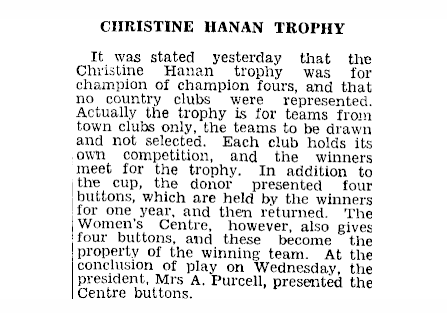
CHRISTINE HANAN TROPHY
Timaru Herald, Volume CLVII, Issue 23158, 23 March 1945, Page 3
https://paperspast.natlib.govt.nz/newspapers/THD19450323.2.23
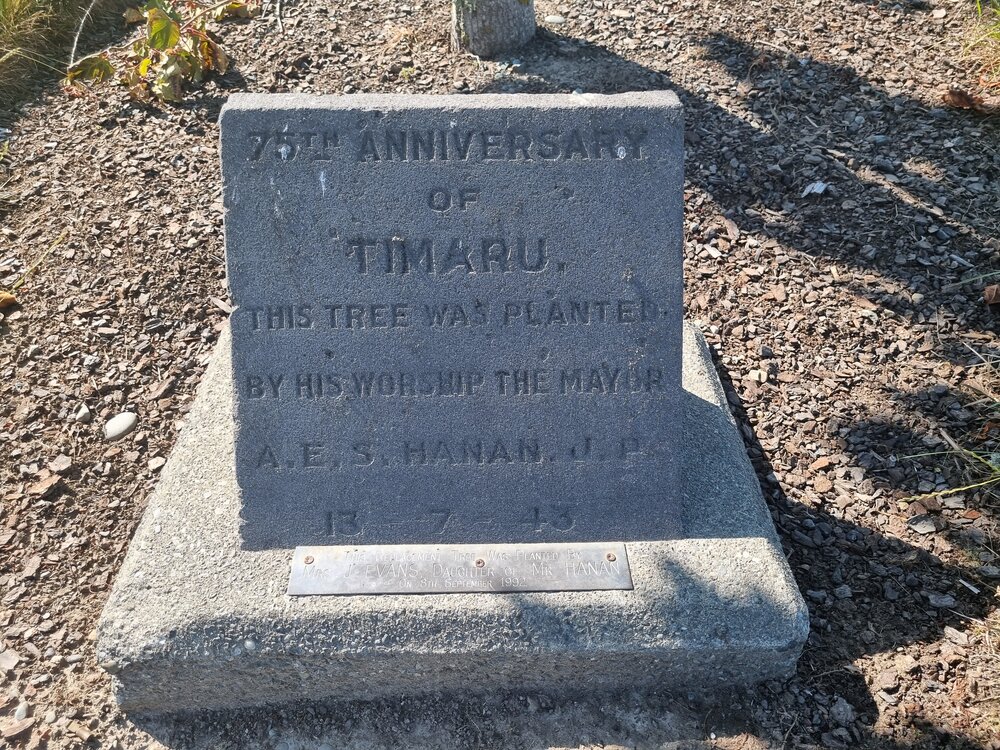
75th Anniversary of Timaru commemorative tree (28 Feb 2023). Aoraki Heritage Collection, https://aorakiheritage.recollect.co.nz/nodes/view/4966
I knew I had seen that plaque somewhere! It is at Caroline Bay at the end of the memorial wall where the drinking fountain is. Mayor Hanan planted a tree here in 13-7-1943 for the 75th Anniversary when he was Mayor. On the back of the plaque is a metal sign, that explains a replacement tree was replanted there by Mrs Jane Evans, daughter of Mr Hanan on the 8th September 1992. Perhaps the photo that I found at the musuem was taken by the timaru herald for a story on the replacement tree planting.
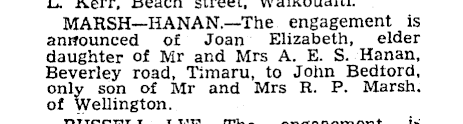
ENGAGEMENTS Otago Daily Times Issue 26986 22 January 1949 Page 1 https://paperspast.natlib.govt.nz/newspapers/ODT19490122.2.2.2
A 1949 engagement notice announced the engagement of “Joan Elizabeth, elder daughter of Mr and Mrs A. E. S. Hanan, Beverley Road, Timaru” to John Bedford Marsh of Wellington.
Presidents
There is no question of design, but, significantly, the president of the South Canterbury executive in its golden jubilee year is Mrs A. R. (Joan) Evans, of Pareora, a daughter-in-law of the founding president, Mrs Janet Evans.
“It is purely coincidental that I am president on this important occasion,” Mrs Evans said.
A daughter of a former Mayor of Timaru, the late Mr A. E. S. Hanan, she first became involved in the WDFF after her marriage to Mr Wynne Evans in 1958. She was introduced by her mother-in-law to the Maungati branch from which she eventually graduated to the South Canterbury executive. A member of the co-ordinating committee for several years, and its chairman for a term, she became vice-president in 1975 and president in 1980.
Mrs Joan Evans
Mrs Evans says she believes the South Canterbury WDFF has made a significant contribution to the life and development of the district, and that it owes a debt of gratitude to those who have worked for it so hard over the last half-century.
“I feel, too, that our members, especially the officers, have to thank their husbands and families for the support they have given over years,” she said. “Without that support, perhaps, our organisation may not have been able to make the progress it has.” Because the term of president has usually covered three years, only 14 women have held the office since the executive was formed 50 years ago.
After Mrs B. E. Evans stood down in 1938, Mrs W. Buchan was elected until 1942 when Mrs Evans assumed office again, until 1944.
Since 1944, the incumbents have been: Mesdames G. A. Davey (1944-48), J. O’Neill (1948-50), J. Holmes (1950-52), E. S. Elworthy (1952-57), J. G. D. Willcocks (1957-61), I. E. Ibbetson (1961-64), A. D. Talbot (1964-67), L. F. Baker (1967-71), E. W. Jones (1971-74), A. J. Milne (1974-77), I. Scott (1977-80), Mrs A. R. Evans (1980--). Of the presidents, four became involved in Dominion affairs — Mrs B. E. Evans as a councillor and vice-president, Mrs A. D. Talbot is now in her second term as president, Mrs E. W. Jones is a vice-president, and Mrs I. E. Ibbetson served as a councillor.
Four South Canterbury members have been made Dominion members of honour — Mesdames R. A. Riddle, J. A. McLeod, K. Clarke, and L. F. Baker.
WDFF: Presidents (11 Sep 1982). Aoraki Heritage Collection, https://aorakiheritage.recollect.co.nz/nodes/view/4344