
20 April 2025
From Whales to Gold: Timaru's Flash Billy was one of the three Larrikins who discovered one of the West Coast’s richest gold-bearing leads.
You might have seen some of our recent Facebook posts and blogs on a deep dive into early Timaru's whaling history. That curiosity has now led us down an unexpected road... Larrikins Road, near Kumara on the West Coast. It’s here we learned about the special link between the whale hunters of Timaru and the gold hunters of Kumara. From Caroline Bay shore to Taramakau glacial gravels... I think we've got a pretty cool story for you.
While visiting Greymouth, we paid our respects at the graves of Sarah (1862-1939 77 yrs) and William Williams (1856-1936 80 yrs) and shared their story with our girls Medinella and Annabelle. Our family loves to go history hunting for free fun, and so the girls have learned to be patient and curious. Learning about people from the past, and visiting special locations has been a lovely way to connect to history and stories. And by doing so, we've learned a bit more about ourselves. It makes our free time meaningful and I think if our kids know where they have come from, they can better know themselves and make better choices for their future. WuHoo Timaru is a result of our free fun and history hunting - with the aim to help you find free fun too.
So... buckle in... here is what we learned so far... it started as a short story, and I've accidentally written a novel - but I think it's worth the read!


Above: Success! We found them. The Fauth Family from Timaru, on a history hunt at the Greymouth Cemetery, paying our respects at the graves of Sarah and William Williams. Chris, Medinella 10, Annabelle 6, and Roselyn Fauth. Chris grew up in Greymouth and his ancestors lived in Kumara. The family go on adventures to find free fun, and share their stories to inspire others to learn about the past and have meaningful fun with their families for free.
Our West Coast history hunt started at the Greymouth Cemetery. We paid our respects to William Williiams and his wife Sarah. And shared the story of Yankie Sam, Ann, Rebecca and their son Flash Billy the Larikin, with our kids.
Now usually when you talk about people in history you use their surname, but there are so many Williams's it gets confusing, so I'll stick with the first names to help you stay on track.
William was the son of Samuel "Yankie Sam" Williams (c. 1871-1883), one of the earliest European pioneers of Timaru, a whaler from the states, who jumped on board the ship The Caroline from Australia to New Zealand, to hunt whales for the Weller Brothers. He was stationed at the shore in at Timaru, with his friends Long John Coffin and Billy the Bull. Joseph, George and Edward Weller are immortalised in the folk song “Soon May the Wellerman Come” - circa 1850-1860, and its fun to think that Sam could have sung the shanty by the sea in Timaru. People sometimes disregard the whaling in Timaru because it was such a short two season bllip on the history timeline. But their work and life here is significant because it marked the area's earliest sustained Māori–Pākehā contact and laid foundations for settlement and trade. The Weller Brothers went bankrupt and so Sam after his whaling days (at Caroline Bay and Patiti Point between 1839–1841), found work with George Rhodes at Island Bay, Akaroa. Sam wouldn't have known it at the time, but his employment and friendship with George Rhodes, guided one of the country’s great pastoral expansions into South Canterbury. Sam's knowledge of the Timaru area inspired Brothers William and George Rhodes founded the Levels run (named after the Rhodes’ home district in Yorkshire) in South Canterbury. A small cottage was built on what is now George Street which was used as a landing site for ships anchoring in the bay.
The Levels station was a huge area of land. The Rhodes applied for three runs between the Opihi and Pareora Rivers, drove some 5,000 sheep from their existing flocks to these new runs in 1851. It was the Liberal era of Seddon Government, that subdivided South Canterbury into smaller blocks to open up farming opportunities to more people. (We get to Seddon later... incase you thought this was a random fun fact!)
Second fun fact, The Levels is the sheep station is where James MacKenzie famously rustled 1000 sheep on a pass inland. The MacKenzie District is named after him.
The Austalian gold rush kicked in. Sam joined the band wagon and went to hunt for gold at the Ballarat goldfields 1851 in Australia. For context the Otago gold rush kicked off at Gabriel’s Gully in 1861, and then over on the West Coast in 1865. The value of this gold enabled New Zealand to kick-start its emerging economy and establish itself as a young British colony. For many like Sam, hunting for gold and the dream of striking it rich, a way out of poverty during the Great Depression.

Here's a snap of our family with Chris parents who live on the Coast, walking through the Greymouth Cemetery on the hunt to find William Williams grave. This was the third attempt, and much more successful thanks to help of my father in law Paul Fauth who grew up in Greymouth. Photography By Roselyn Fauth 2025
I don't know a lot about Williams mother Ann Mahoney (also recorded as Anne Manry). I have read she was an Irish immigrant who lived in Ballarat, Australia. It is there that Sam and Ann met, and had their first child Rebecca in 1854 and moved to Timaru New Zealand. I haven't found any marrage records, so I am careful not to assume they were married.
He returned to Timaru sometime around 1854 or 1856 to work for the Rhodes with Ann and daughter Rebecca. George Rhodes gave them his primitive 6m long daub cottage (a simple early dwelling made by smearing a mixture of clay, mud, and straw over a woven stick framework), on the site next to what is now the Timaru Landing Services Building. When you stand there now, the sea feels like its miles away, but before the construction of the Port, the waves would have lapped on the shore where the railway line is today. Geroge Rhodes also helped him and Ann establish the town’s first pub and accommodation house. There were so many firsts there, the birth of Timaru's first European child in 1856, the first licenced publican 1858, the first in town to have his pub burn down 1862, even the first edition of the Timaru Herald was printed in their kitchen! And with parents running the town’s easliest pub and accommodation house, it probably won’t surprise you that Williams cradle was a gin crate!
William was born when very few Europeans lived in Timaru when Queen Victoria reigned the new colony. Just to give you an idea of who was around and arriving at the time of William birth... George Rhodes first arrived in the area around 1847-1850s. Frances Stubbs arrived in Lyttleton 1852 and helped bring the first cattle to South Canterbury for the Rhodes Brothers. "He witnessed Timaru’s first house being built and early settlers living in old Māori grass huts". He worked for Rhodes Bros, then managed Pareora Station, later founding Timaru’s first auctioneering business, and serving as clerk for Geraldine County. In 1853 William Hoornbrook arrived in the Temuka area to manage the Arowhenua Station. A year later his wife Margaret Hoornbrook joined him as the first white woman to enter South Canterbury. Thier son Richard was the first European baby born in South Canterbury in November 1854 at Arowhenua Station. In 1857 Captain Belfeild Woollcombe arrived in Timaru as the Government's Representative and lived in Ashbury House next door to where the Ashbury Park Kindergarten is now. And Captain Henry Cain arrived the same year 1857 to establish a general store and landing service for Henry Le Cren at the foot of Strathallan Street.

The cased and coloured ambrotype pictured here. ... shows Rebecca and William Williams, the children of one of our earliest settlers Samuel and Ann Williams. Rebecca Hobbs born 1854 Ballarat, Victoria, Australia, and died 1856 buried in Linwood Cemetery, Christchurhc. It would have been a relatively rare and expensive item for a working man like Sam. His story, which also mentions his son William Williams, born 1856 in Timaru, was the first European child born in Timaru and used a gin crate as his crib. - Courtesy of the South Canterbury Museum 3438.
In March 1st 1860 Sam opened the Timaru Hotel what is now on the corner of George and Stafford Street. The Rhodes brothers owned the building, and Sam owned the furnishings. Tragically, after being in New Zealand for only four or six years, Ann collapsed in the doorway of their new Timaru Hotel, and died in November 1860, leaving Sam to raise three year old William and six year old Rebecca. Sam married the childrens nurse/governess Mary Ann Gardiner who was 25 years younger than him, and they had another daughter, Emily. His second wife Mary did a runner to Hokitika with thier child. And there are a few notices published in the Timaru Herald by Sam saying he would not be accountable to her debts.
Two years to the day the hotel opened, in 1862, a fire, deliberately set by a disgruntled pub guest at 2am, destroyed the Timaru Hotel. The Rhodes who owned the building had insurance, but the furnishings inside were Sam's. Sam lost everything in the fire bar a few account books, and heroically helped all of his guests to safety. Hugh Williams was blamed for the 2am arson, and a newspaper article stated he was sentenced to death.
The hotel was rebuilt using bricks from the clay onsite. The first meeting of the Timaru Borough was held in a room of the Club Hotel. The hotel was rebuilt as the Club Hotel it operated for over a century and closed in 1970, demolished in 1973 after concerns about its strength if there was an earthquake.
Sam sold the Hotel in 1865 to John Melton (the framed sale document used to hang on the Timaru Library wall) then he moved with his children to run hotels at Birdling’s Flat and Hotel Wellington in Christchurch.
His descendants wrote in the family history book that Sam's later years were marred by hardship. He passed away in 1883, aged 66, and is buried in Timaru with a bluestone monument raised by his friends. There is no mention of Ann on the headstone, and to this day I am still unsure where she was buried. The Timaru District Council and the South Canterbury Museum have tried to help me find her, but the records are scarce from back in the 1860s.
Next time you visit the Caroline Bay playground in Timaru, see if you can spot the gin-inspired juniper berries — a nod to his family.

From whaling connections through his father, to being part of Timaru’s first pub, losing his mother at a young age, working as a carpenter in Christchurch, and raising nine children while toiling in the goldfields, imagine the change he witnessed. His life is just one of many stories of early European settlers who helped lay the foundations of community life we know today. From sleeping in a gin cradle on the East Coast to becoming the West Coast’s Fancy Billy, a goldmining Larrikin from Timaru, his journey must have had grit and spirit to make the most of those times.
So what be came of William - Timaru's first European lad? Why was he a Larrikin, nicknamed Flash Billy? And what was his life like after Timaru?

William Williams, was born in Timaru in October 1857 and died in Greymouth in 1936. He worked for a time in Christchurch as a carpenter, then walked to Kumara in the 1870s in search of gold. One of the stories says veteran miners deceive them about the best spots to go hunting, but they strike gold anyway. Their claim is dubbed “The Larikins”. William was one of those infamous trio of "Larrikins" and was nicknamed "Flash Billy" Williams due to his Christchurch attire. Their gold discovery was significant in the area, during the second to last New Zealand gold rush in Kumara.
After reading old newspaper articles, blog posts, and a wonderful family history book written by a Williams descendant, I learned that in the 1870s, William, who was working as a carpenter, walked with a group of mates from Christchurch to Kumara to try his luck in what would become New Zealand’s second-to-last gold rush.
The West Coast gold rush had officially begun in 1864, but it was not until mid 1876 that Kumara kicked into a new gear. Some accounts say gold was first discovered by two men Cashman Houlahan & Party, who were operating an illicit whisky still in the bush near Richard Seddon’s house. That quiet patch of forest quickly transformed into a bustling mining town as 6000 of hopeful diggers poured in from around the country and the world to investigate the claim. Rich deposits of coarse gold were found in ancient Taramakau glacial gravels lying in the bottom level. To extract gold here it would take more money and preparation than other areas.
The practical method was to use a Hydraulic sluice using high-pressure water to wash away entire hillsides. Over two decades, miners carved out an immense network of tunnels, water races and sludge channels. Much of the land behind Kumara was sluiced away into the Taramakau River. There were seven gold leads fanning out from Dillmanstown on the Kumara Goldfeild, about three kilometres to the south-eastof Kumara.
By 1882 there were twenty claims on Dunedin Flat, Shamrock Terrace, the upper parts of the Larrikins Terrace, and Bakers Flat discharging into the No.1 Channel. However only nine parties could use the channel at any one time because of limitations to the water supply.
By 1878 there were 47 hotels operating in Kumara, four in Dillmanstown and two at Larrikins. In the first year of the rush the amount recived in gold revenue was 50 pounds less than the amount recieved by the warden for spirit licences!
Fun fact: Kumara was named in 1863 by surveyor Arthur Dobson, who adapted the name from kohimara, a Māori word referring to the striking flowers of the bush lawyer vine.
Supplementary fun fact: Kumara was also home to Richard “King Dick” Seddon, who followed the gold from Victoria to New Zealand, settled in Kumara in 1881, and over thirteen years won five consecutive elections. He would go on to become New Zealand’s longest-serving Prime Minister.
By the time William Williams and his companions arrived in Kumara, they were stepping into one of the country’s most dynamic goldfield settlements. Kumara was not just a place of fortune — it was a town that shaped New Zealand’s political and social landscape.
There are two versions of what happened next — and both are great yarns.
The family history book, held in the South Canterbury Museum, tells how the young men asked for directions and were cheekily pointed to a patch behind Dillmanstown — an area the seasoned miners claimed was barren. William and his mates likely began working in the streams and soon sank a shaft beneath the forest floor. They struck gold. According to the book, their celebrations were so wild that the group earned the nickname “The Larrikins.”

Left: Signpost for the Larrikins Road. Center: Section of an information sign at Kumara about the Larrikins. Right: looking down Larrikins Road. Larrikins was one of the most prosperous gold-bearing leads in the Kumara district. Located near Dillmanstown on New Zealand’s West Coast. Mining operations at Larrikins Lead continued into the 1890s, although the workforce gradually declined from five men to three by 1896.- Photography by Roselyn Fauth 2025
The Kumara information panel offers an even more colourful account: “Larrikins was a tongue-in-cheek reference to the rowdy behaviour of some young men who broke some windows and caused the ‘Man in Blue’ to inquire after their welfare... They took to the bush for it and, for amusement in the day time, they commenced to sink a shaft... Good gold was got in the shaft, hence the Larrikins Rush.”
However it unfolded, their shaft became part of what was later called Larrikins Lead — one of seven gold leads fanning out from Dillmanstown: Shallow Lead, Shamrock Lead, Dunedin Flat, Ross Terrace, Scandinavian Lead, Mignonnette Flat, and Larrikins. The richest were Dunedin Flat and Larrikins. By 1888, when a travelling ministerial party visited the site, the Larrikins story was already folklore.
It was a lovely drive through the area, imagining the excitement that once filled the air and the celebrations of the Larrikins. I wonder which story is true. Were they cheeky lads hiding from the police when they struck gold, or young men lairing up at the pub after a lucky find of one of the the West Coast’s richest gold-bearing leads? A gang chasing fortunes with Flash Billy, much like his father, the whale hunter turned publican, Yankie Sam.

Along Larrikins Road lies a pile of rocks, remnants from the gold mining days known as tailings. We chose one from the roadside and brought it home as a way to remember the Williams family. Our next step is to work with the Timaru District Council and the South Canterbury Museum to explore the possibility of creating a memorial to the family here in Timaru, using this very rock. Photography: Roselyn Fauth, 2025
The men associated with the claim were Frank Payne, Sam Deans, and Billy Williams. Their team, “Payne and Party”, worked the site using water power from Holmes’ water race. Mining continued into the 1890s, though the workforce dropped from five men to three by 1896.

West Coast New Zealand History (6th Jan 2024). Map of Kumara 1891 including Larrikins. In Website West Coast New Zealand History. Retrieved 12th May 2025 06:52, from https://westcoast.recollect.co.nz/nodes/view/31708
Williams sharp Christchurch attire probably stood out among the moleskin-clad miners, and earned him nickname “Flash Billy.”
William did more than strike gold. He built a life on the West Coast. He fathered nine children with his wife Sarah, and was buried in Greymouth cemetery aged 91, leaving a legacy that stretched from Caroline Bay to the Taramakau. William served on the school committee, the volunteer fire brigade, and performed in the town band. He was the West Coast Running Champion from 1882 to 1884, defeating visiting Australian champion Tommy McLaughlan, and also won a rifle shooting medal the same year. Both his solid silver trophy and medal are preserved today in the West Coast Historical Museum in Hokitika.
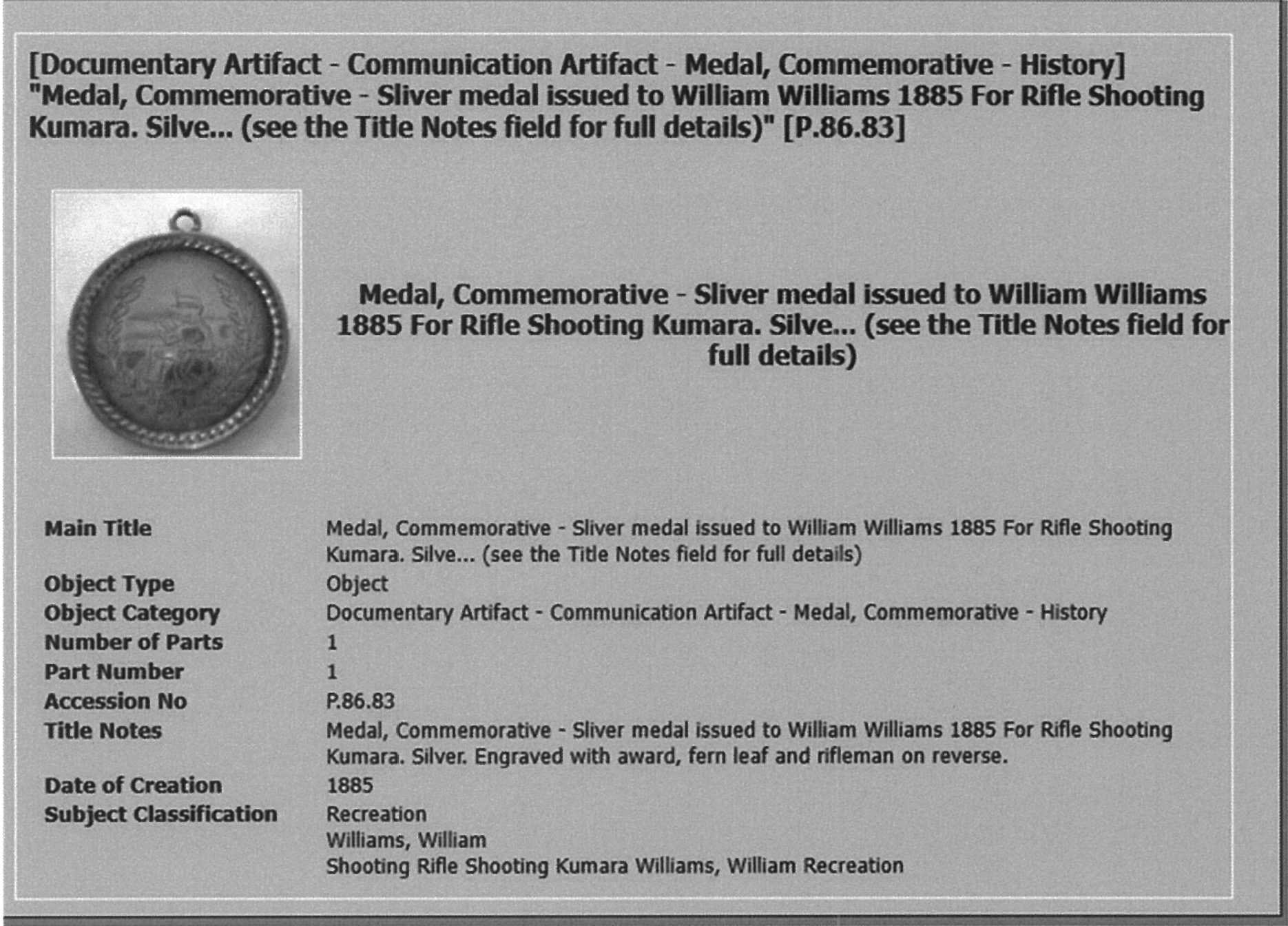
A catalouge record from the Hokitika Musuem for a silver Rifle Shooting medal in 1885.
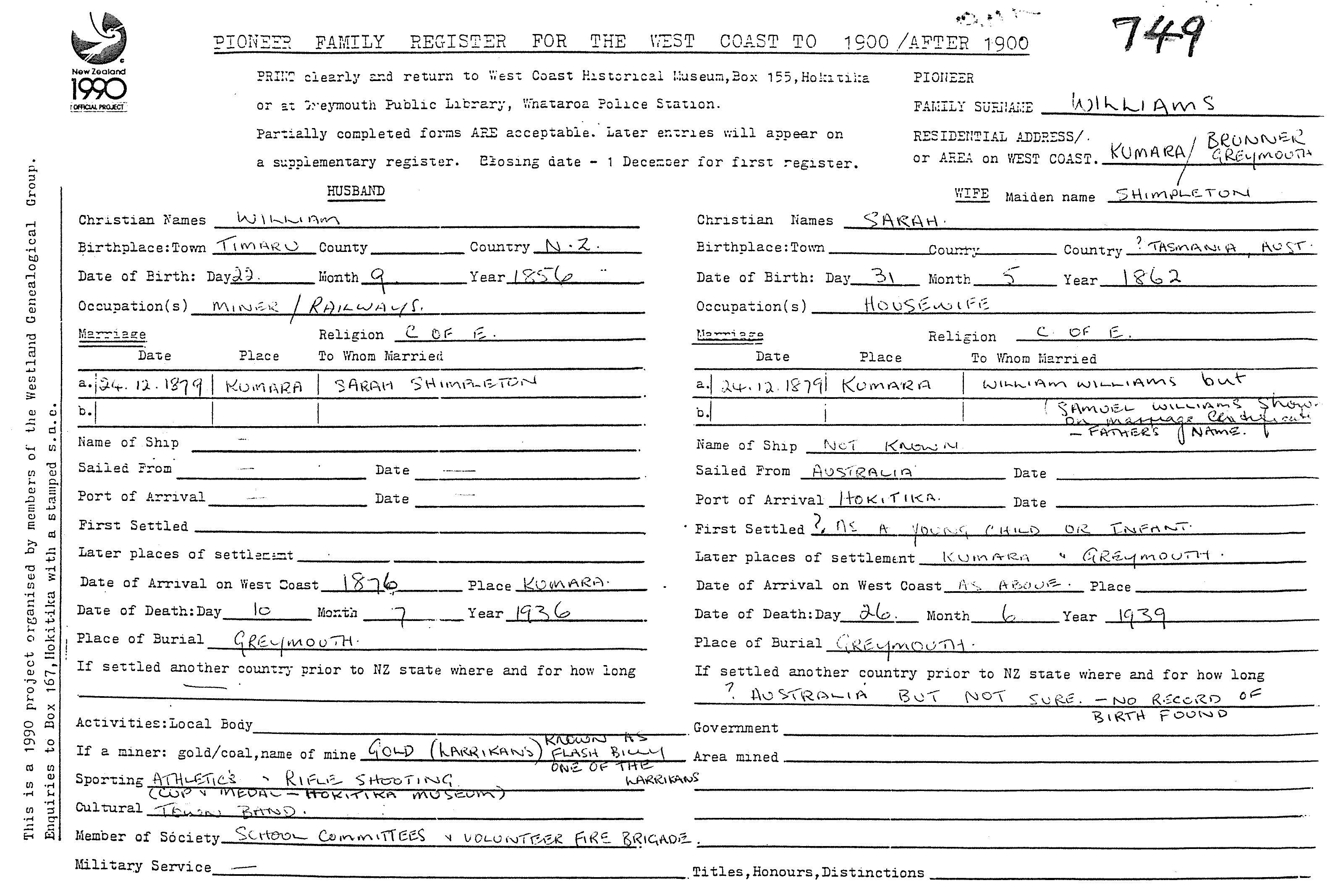
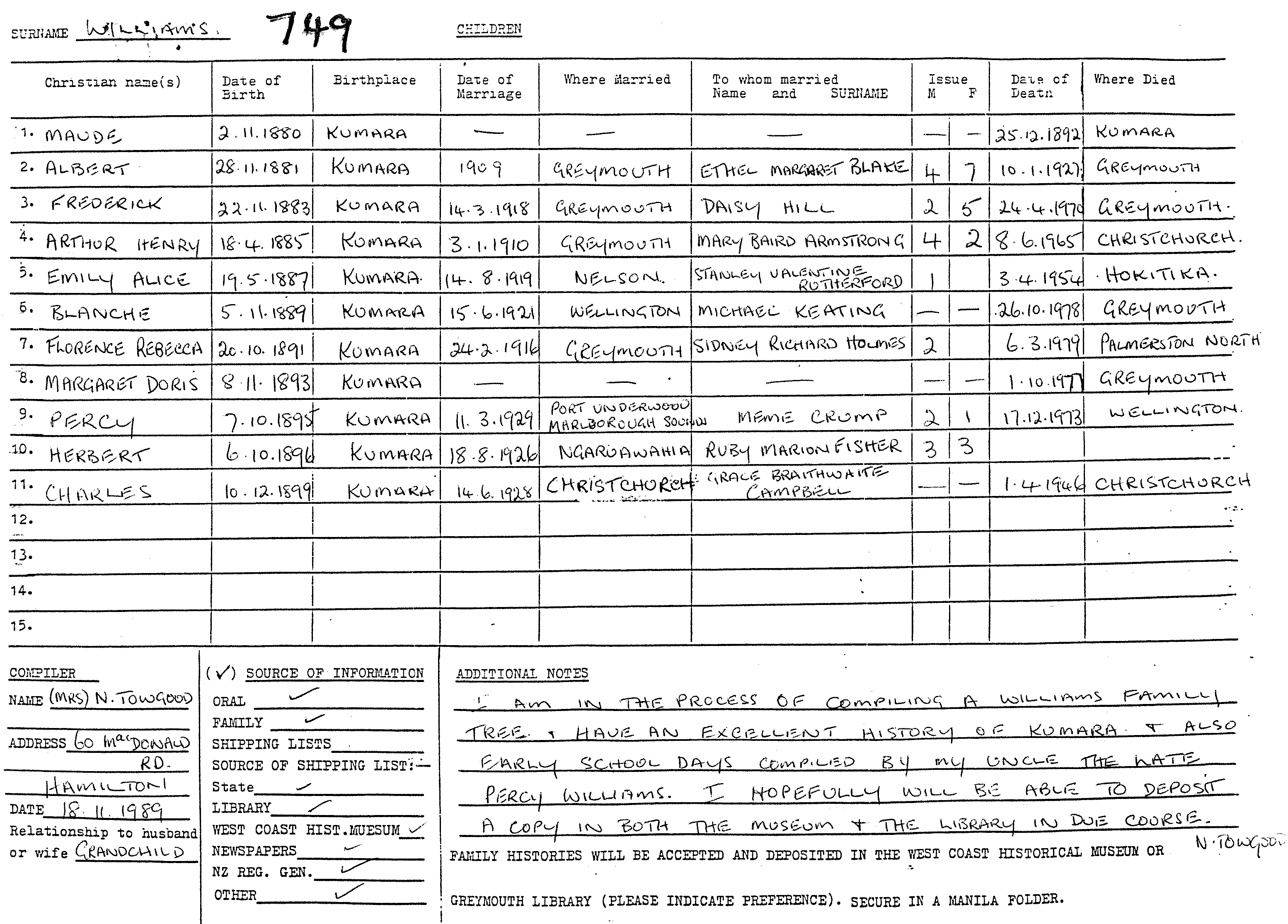
From being Timaru’s first recorded birth to becoming a family man and goldfield figure, William Williams’ life bridges two of New Zealand’s most iconic frontier worlds... the whaling East Coast of South Canterbury and the wild, gold-streaked landscape of the West Coast.
While this may be something of a tangent, it's fascinating to consider how the lure of gold and the promise of opportunity influenced people across the globe in the mid-1850s. The California Gold Rush (1848–1855) was quickly followed by the Victorian Gold Rush in Australia, which began in 1851 and continued through the 1860s. These events sparked waves of migration and adventure, shaping the destinies of individuals and entire regions. In New Zealand, the first known European discovery of gold in the South Island was in Otago, and occurred in October 1851 at Goodwood, near Palmerston. However, it failed to trigger a gold rush at the time. It wasn't until the significant gold strike at Gabriel’s Gully near Lawrence in 1861 that Otago experienced a full gold rush, drawing thousands of hopeful prospectors to the area. The Gold Rush fever spread to the West Coast (1864–1867). News of a potential gold field at Kumara, more than a decade later, in 1876 marked the second to last major gold rush in New Zealand.
While we set out to learn more about William and early European settler life, we also discovered more about the area and our children’s ancestral roots on the Coast. It is so much easier to learn about the past through people, and we found it fascinating to consider how the lure of whales and gold, and the promise of opportunity influenced people across the globe in the mid-1880s.


1868 Photograph of the foot of George Street, Timaru, circa 1868. It was built in 1851 by George Rhodes and his employees. It was the only habitation between Lake Ellesmere and the Waitaki River at the time. The cottage was a simple structure with battened sides, a clay-plastered exterior, and a thatched tussock roof, located near present-day George Street. In 1857, Archdeacon Harper visited Timaru during his journey from Christchurch to Moeraki and was warmly received by Samuel Williams, his wife, and son. A commemorative plaque was placed on the site in 1955. Harper's letters from September 1857 mention encountering an old whaler (Williams) living in a hut with his family near the sea coast. Williams shared whaling stories with Harper during this visit; his wife provided directions for Harper's journey to Waimate. The building is pictured in the centre is a landing service building (either the Timaru Landing and Shipping Company or the George Street Landing Service), while Rhodes' original cottage is to the left. South Canterbury Museum 2000/210.095

This railway survey shows the floor plan of the Rhodes Cottage where the Williams raised their family. The First edition of the Timaru Herald was printed in the Williams kitchen on George Street - June II 1864 - Vol 1 No 1

Medinella Fauth points to the plaque on the Timaru Landing Services Building - Photo Roselyn Fauth
When the Williams family vacated the cottage to move into the Timaru Hotel, it was occupied by Captain Scotte, the Rhodes’ business agent. In 1867, it passed into the hands of S. S. Griffin, who held it until 1872, when it was sold for fourteen pounds and demolished to make way for a commercial building.
George Rhodes used the headland what is now George Street in Timaru, to land stores and materials. He built Timaru’s first Eurppean house, a daub cottage in 1851, it only had three walls! This 20 foot long hut stood by the beach to service his boat landing for his sheep farm at Levels. George Rhodes married Elizabeth Wood in 1854 at Lyttelton. And when they moved out to the Levels near Pleasant Point, the Williams family moved in. William Williams is the first recorded brith of a European baby in the area. His cradle was a gin crate. He was born on September 22, 1856. Archdeacon Harper, on his first trip south, christened William in the cottage. 1857 The Wiliams converted the house into a general store and informal lodging. William Williams died in 1947, aged 91.
Sam managed early landing operations for the Rhodes brothers on the shore at George Street. Together with Ann, he added a lean-to onto the cottage with bunk beds, establishing Timaru’s first pub and accommodation house. In 1860, after around six years of living in New Zealand, Ann Williams (nee Mahoney also recorded as Manry) died in the doorway of their Timaru Hotel, leaving Sam to raise their two children alone. Despite our efforts, we have been unable to find her grave — likely due to the lack of formal burials recorded in the earliest days of settlement.

Register of Deaths, Saint Mary's Church Timaru Parish records of deaths. Ann appears to be listed as number 12, November 18, 1860, 36 years. Photography by Roselyn Cloake with permission of the South Canterbury Museum 2025. William is recorded above. In 1860 Morris Corey and Robert Boubius became the first individuals to be buried in the Timaru Cemetery following a drowning incident off the coast of Timaru. They were part of a group of six experienced boatmen who had emigrated from England to Lyttelton in 1859 and were employed by Le Cren and Cain to work on their landing service at Timaru. The group included John Wilds, Morris Corey, Robert Boubius, Henry Clayson, William John Roberts and John J. Bowles. Boat handling was a perilous occupation and Henry Clayson also drowned shortly after arriving. He was replaced by Phillip Foster, another boatman from Deal.

The grave of Timaru Whaler, Samuel Willams (Yankie Sam). He died at Timaru on June 29, 1883, at the age of 64. A bluestone monument erected by his friends describes him as the oldest resident of Timaru.

Left: Looking out to the pauper burial area at the Timaru Cemetery. Center: St Mary's Death Register, Ann is number 12 on the list, November 18 1860. Right: the grave for Samuel Williams erected by his friends. - Photos Roselyn Fauth
Samuel Williams was a boat-steerer and and harpooner at the Timaru whaling station and was one of 16 men of Thomas Brown's gang, including Peter Johnson, Charles Watkins, and William Mozzaroni. Sam's friends were Long John Coffin and Billy the Bull. Sam came to New Zealand on the Weller Brothers’ sailing vessel Caroline. A whale supply ship Caroline reguarlly anchored at Timaru carrying a cargo of whale oil and whalebone. The whaling industry was short-lived, and the station was abandoned when they were preparing for a third season because the company failed. The men who lived there moved on from their temporary home, and it would be a few more years before Europeans settled permanently in the area.
The Weller Brothers—Joseph, Edward, and George—were Englishmen based in Sydney, Australia, and Otago, New Zealand. They were founders of a major whaling station at Otago Harbour, and whaling operations along the South Island's east coast. and were among New Zealand’s most substantial merchant traders in the 1830s.
After the closure of the Weller Brothers’ Timaru whaling station in March 1841, the shore party dispersed to various other whaling posts. While some went to Otago, the majority relocated to Banks Peninsula, where they were employed by Hempelman at his Paraki Station. Samuel Williams accompanied this group and, due to his extensive whaling experience, was given charge of the Island Bay Fishery, which was then owned by the Greenwood family. In 1848, he transferred to George Rhodes’ station at Goashore, now known as Akaroa, where he remained until his eventual departure for Australia.

LEFT A try pot used at the Weller Bros Whaling Station near this place 1839-1840. The Wellers’ workers caught whales and rendered the blubber down into oil in try pots for two seasons Members of the whaling gang were the first white men to live even temporarily in South Canterbury. RIGHT Looking up towards the viaduct near the Evans St and Wai-iti Rd intersection where the stream runs underground. Photograph courtesy of Roselyn Fauth

Whale Pot at Patiti Point, Timaru. - Photography by Roselyn Fauth 2025.
Incase you were interested in the whaling history...
Over 35 whale ship captains from New England (in the north-eastern United States) visited New Zealand between the 1790s and 1850s, long before planes or fast ships. These whalers helped map the Pacific, named over 400 islands, and were among the first to trade with Māori, helping to connect New Zealand to the wider world for the first time. Samuel Williams (c 1817 joined the crew list of the Charles and Henry, a whaling ship that departed Edgartown, Massachusetts, in 1836 for the Pacific. They say he jumped ship in Sydney before arriving in New Zealand around 1839. He joined the Weller Brothers' whaling station in Timaru as a boat steerer and harpooner and was responsible for steering the whaleboat during hunts and delivering the harpoon strike at close range, a dangerous and critical role. The Weller Brothers—Joseph, Edward, and George—were Englishmen based in Sydney, Australia, and Otago, New Zealand. They were founders of a major whaling station at Otago Harbour, and whaling operations along the South Island's east coast. and were among New Zealand’s most substantial merchant traders in the 1830s.
The Treaty of Waitangi gave the Crown the exclusive right to buy Māori land. On 15 February 1840 two men signed an agreement with five Maori chiefs who transferred the ownership of virtually the whole of the South Island and Stewart Island for a cash payment of £100, and a 50 annuity for the principal chief and lesser amounts for the others. After sovereignty was claimed in New Zealand in 1840, settlers and land speculators were obliged to defend their land titles. The Weller Brothers filed thirteen claims for land acquired in New Zealand but all were thrown out. George was also facing financial hardship and following a costly and futile battle to legalise their property rights, he filed for bankruptcy in February 1841. Octavious Harwood bought the Weller Bros Otago station in 1841. Samuel Williams was part of the original party sent to Timaru, travelling aboard the Weller Brothers’ sailing vessel Caroline - according to a book published by his decedents. A small group was already operating at the Timaru site by 1839. The main party did not arrive until April 1840, travelling from Australia on the barque Sarah Ann Elizabeth. Octavius Harwood, a foreman and clerk at the Weller Brothers’ Otago Station, recorded that Samuel Williams was the leader of the Timaru party.
After the closure of the Weller Brothers’ Timaru whaling station in March 1841, the shore party dispersed to various other whaling posts. While some went to Otago, the majority relocated to Banks Peninsula, where they were employed by Hempelman at his Paraki Station. Samuel Williams accompanied this group and, due to his extensive whaling experience, was given charge of the Island Bay Fishery, which was then owned by the Greenwood family. In 1848, he transferred to George Rhodes’ station at Goashore, now known as Akaroa, where he remained until his eventual departure for Australia. In 1849, preparations began for the arrival of the Canterbury Association Pioneers. Their agent and chief surveyor, Captain Joseph Thomas, required detailed information on the land south of the Association’s territory and appointed Charles Torlesse to conduct a survey. Before setting out, Torlesse consulted Samuel Williams, who was then residing at Goashore, to learn about the nature of the South Canterbury landscape. This consultation is recorded in the Torlesse Papers, with an entry dated February 23, 1849, noting Torlesse’s arrival at Rhodes’ Whaling Station around 8 p.m. and his discussion with Williams after encountering difficulties with his horses.
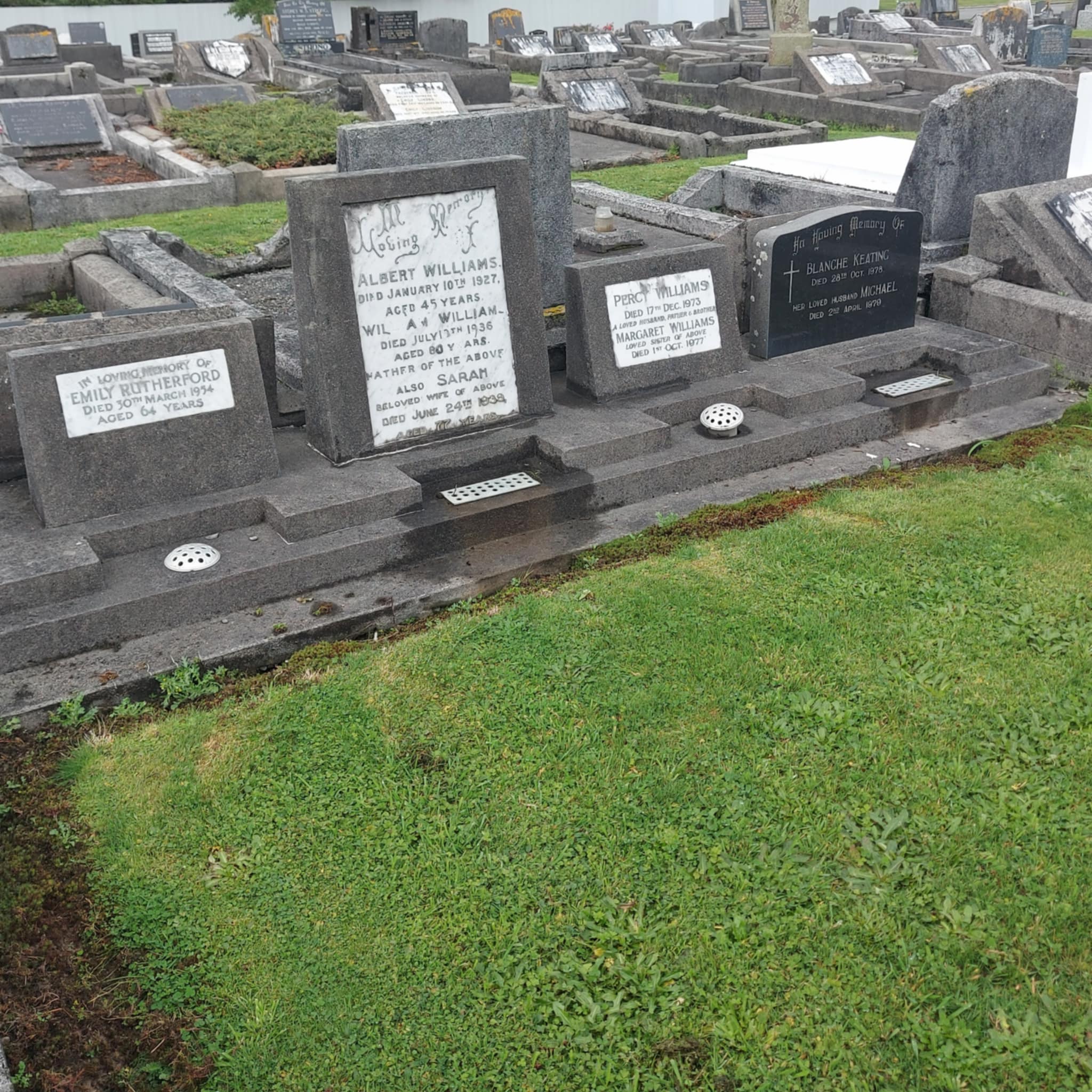
Sarah and William Williams graves in Greymouth - Photography Roselyn Fauth 2025
Next time you pass George Street Timaru, or Larrikins Road, Kumara, spare a thought for what the boy from Timaru got up to.
Strolling past piles of tailings in the Kiwi Gold claims felt like we were stepping back in time. We imagined the operation back then in thick coast bush to find the seams of gold in the second to last gold rush in the country.
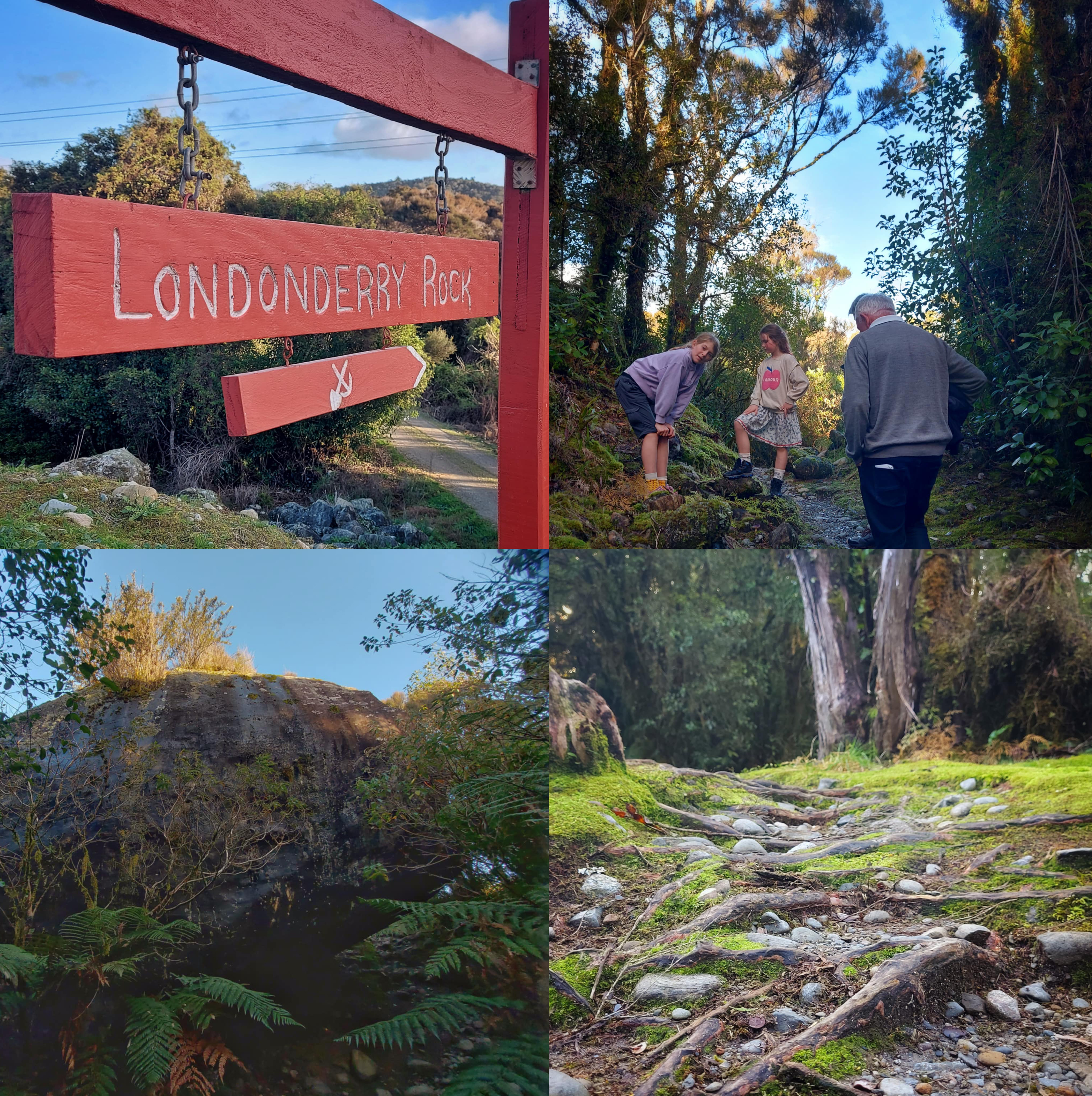
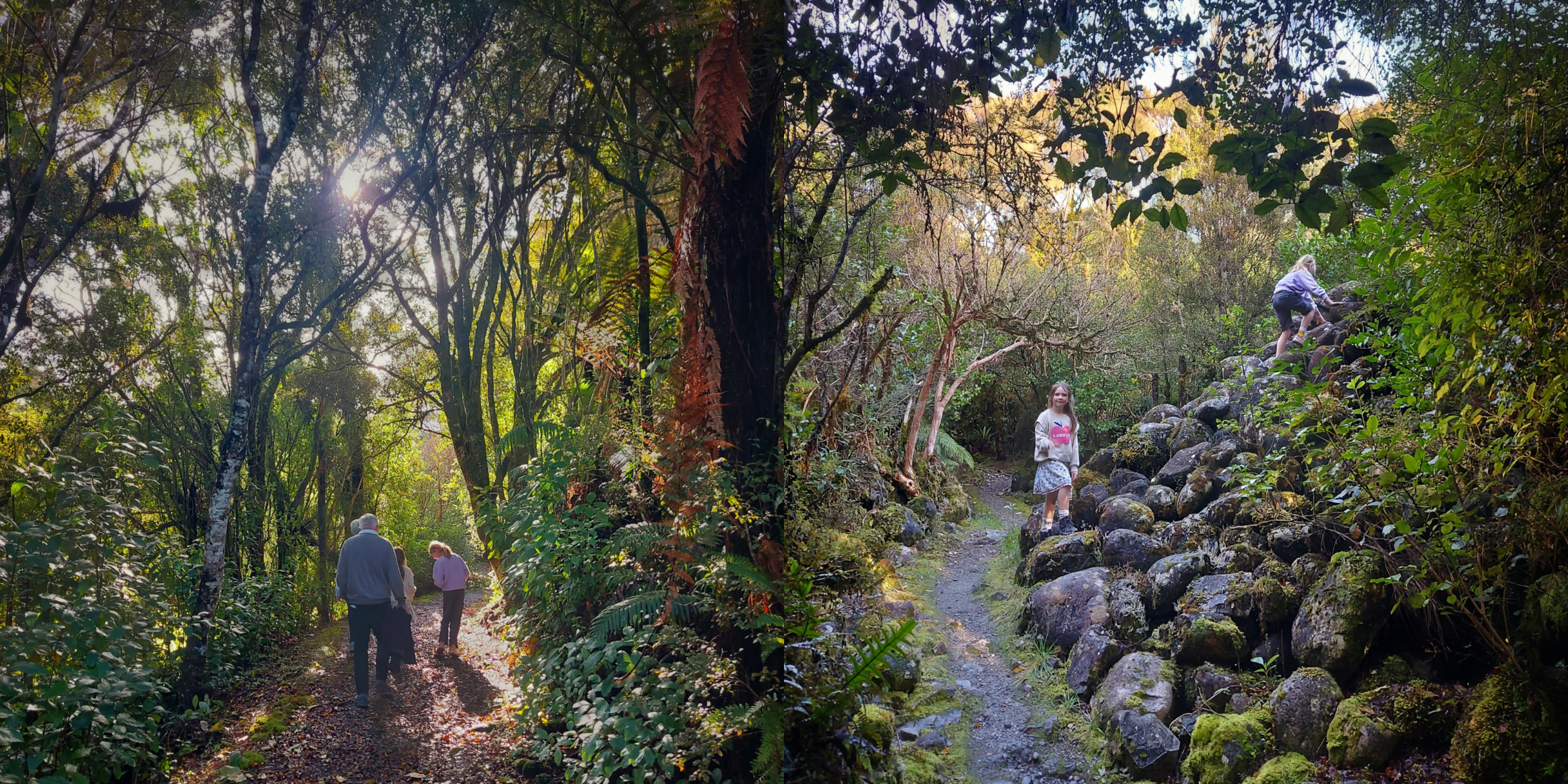
Exploring the bush and tailings on a wander to Londonderry Rock with Chris'parents who live in Greymouth. The walk leads to a giant 'glacial erratic' boulder during the Pleistocene ice age and covered with moranic gravel. It was exposed by sluicing in 1880 when it was loosened and one night it rolled into the claims' headrace. Legend has it that this incident shook the town of Kumara and cause the Post Office clock to stop. 8 meters high and 4,000 tonnes and dislodged by miners while sluicing for gold. You can also see old mining gear left behind from the gold mining days. Miners typically sank shafts deep below the forest roots to reach the thick layers of gravel where gold lay in seams. The excavated earth and gravel were washed through a sluice to separate and catch the gold, while the remaining rock and sediment were discarded in piles known as tailings. - Photography By Roselyn Fauth 2025

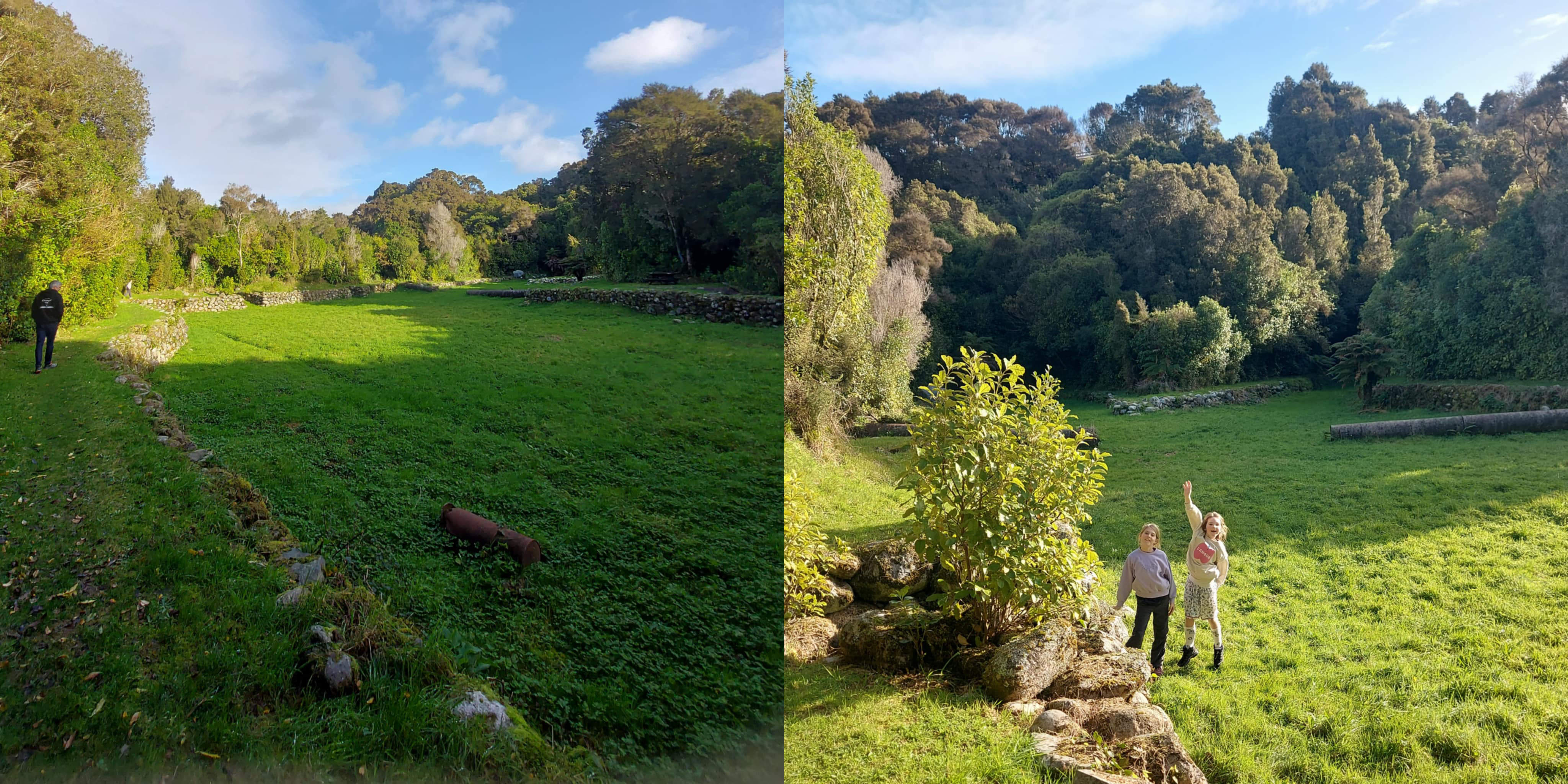
Exploring the historic Kumara swimming baths near Kumara, built during the 1930s Depression using tailings from the town’s gold mining era. The baths were decommissioned in the 1940s. We had a giggle, as we pulled up to the car park a sheepish couple were leaving with towels over their shoulders.. not much swimming is to be had here now!
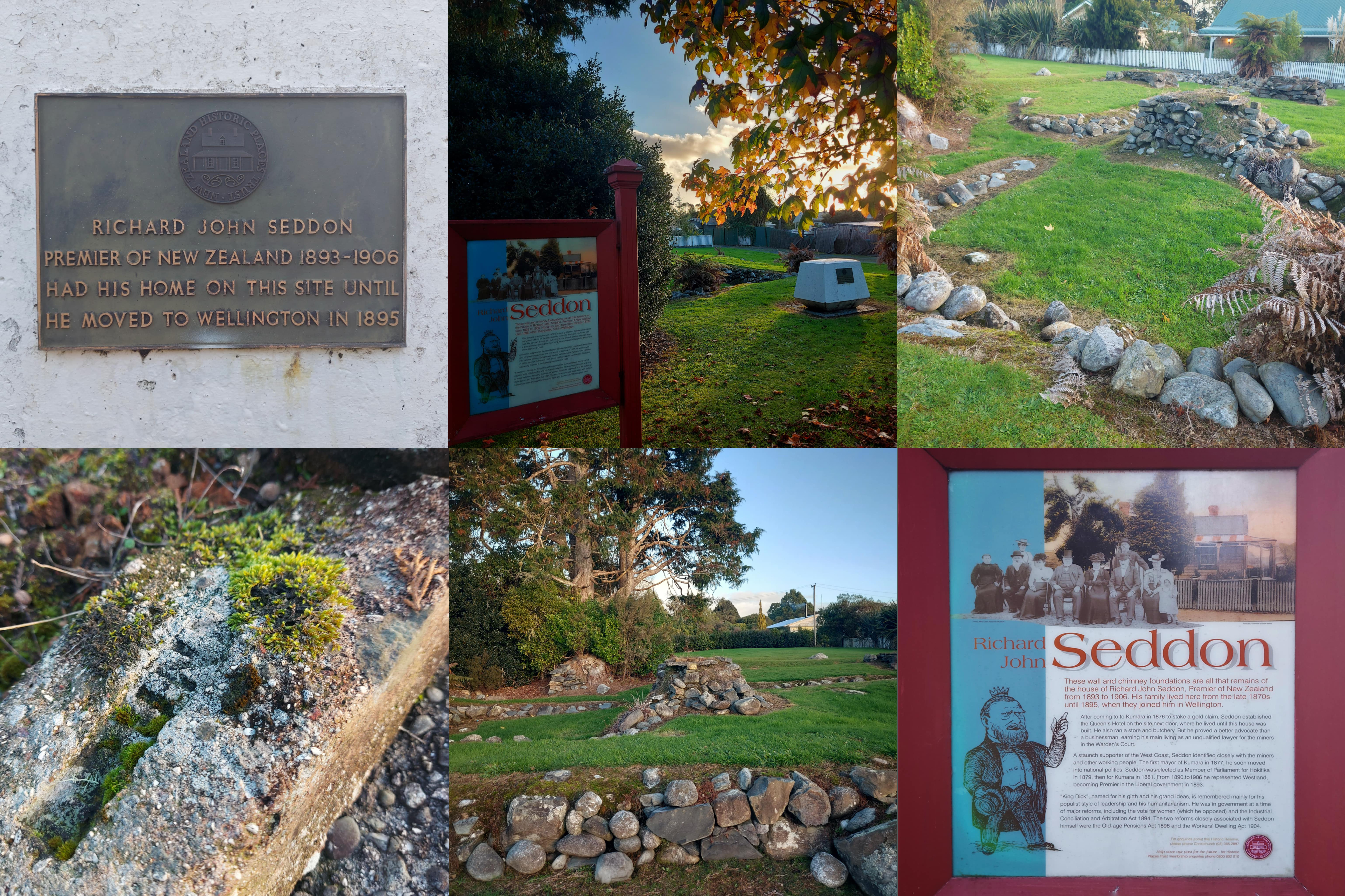
These wall and chimney foundations are all that remains of the house of Richard John Seddon, Premier of New Zealand from 1893 to 1906. His family lived here from the late 1870s until 1895, when they joined him in Wellington.
Incase you wanted to know a bit about Richard Seddon and his roots in politics and the Labour Reform
Richard Seddon remains New Zealand's longest-serving Prime Minister to date, holding office for over 13 years from 1893 until his death in 1906.
Born in England, Richard John Seddon arrived in New Zealand in 1866 and settled in Kumara around 1876 to stake a gold claim. He established the Queen’s Hotel on the site next door to what would become his family home, and ran both a store and a butchery. While not especially successful as a businessman, Seddon found greater success as an advocate for miners, working as an unqualified lawyer in the Warden’s Court.
The discovery of gold near his home (on the terrace opposite what later became his residence) sparked one of the country’s last major gold rushes, transforming Kumara into a lively frontier town. Seddon immersed himself in local civic life. He was elected to the Aarahura Road Board in 1870. 1874 became a member of the Westland Provincial Council. And in 1876 elected to the Westland Country Council. He was elected the first Mayor of Kumara in 1877, quickly rising into national politics. He became Member of Parliament for Hokitika in 1879, then represented Kumara from 1881, and Westland from 1890 to 1906. He was appointed Premier (Prime Minister) in 1893.
Seddon and his family lived in Kumara from the late 1870s until 1895, when they joined him in Wellington. Today, only the chimney and wall foundations of their family home remain on the site.
A staunch member of the Liberal Party, Seddon helped lay the foundation for many social and economic reforms that would later influence the ideals of the Labour Party. Under his leadership, the Liberal government became New Zealand’s first organised political party to champion working-class interests, effectively acting as a precursor to Labour's later platform. His populist leadership style and strong personality earned him the nickname "King Dick", and he was known for both his humanitarianism and grand ideas.
Seddon’s leadership as Premier was defined by pioneering social welfare reforms, historic suffrage achievements, strong labour protections, pro-Empire expansionism, and charismatic, populist leadership. His most notable contributions include:
-
Women’s suffrage (1893): Though initially opposed, Seddon’s government passed the legislation that made New Zealand the first country in the world to grant women the right to vote.
-
Industrial Conciliation and Arbitration Act (1894): Introduced minimum wages, maximum working hours, and mechanisms for resolving industrial disputes—foundational to New Zealand’s reputation as a fair labour nation.
-
Old-age Pensions Act (1898): One of the world’s first state-funded pension schemes, providing vital support to elderly New Zealanders.
-
Workers’ Dwelling Act (1904): Aimed to improve living standards by providing affordable housing for working families.
-
Land reforms: Broke up large estates to encourage small-scale farming and closer settlement.
-
Economic development: Promoted state-owned enterprises, especially in railways and mining, and invested in national infrastructure.
-
Empire and expansion: A fervent supporter of the British Empire, Seddon championed imperial unity, sent troops to the Boer War, and oversaw the annexation of the Cook Islands and Niue in 1901.
Given Kumara's modest population of a few thousand at its peak, and Seddon’s deep community involvement, it is possible that he may have crossed paths with William Williams, who lived and worked in the town during the same era.
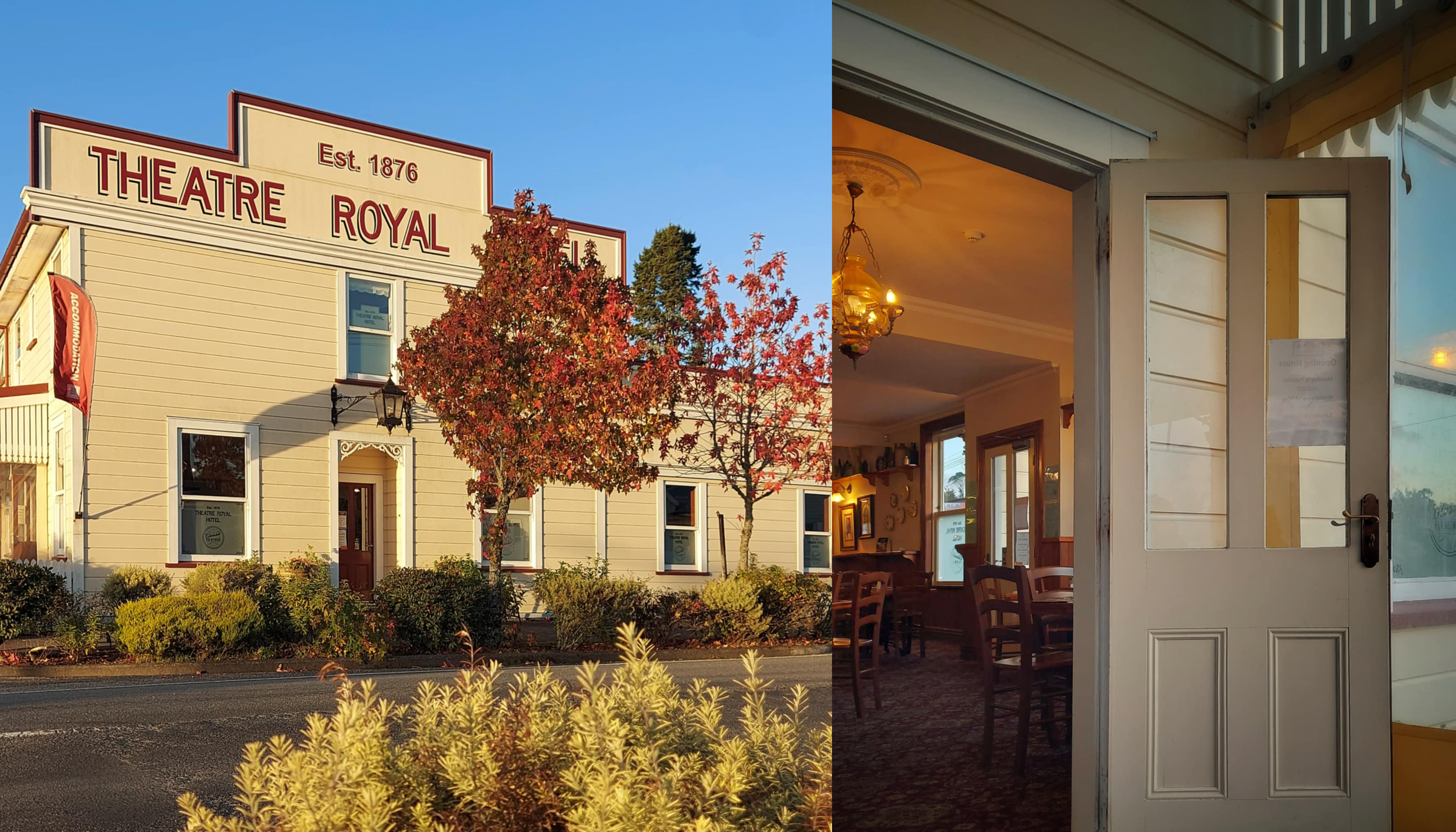
We enjoyed a beer at the beautifully restored Theatre Hotel in Kumara (which has epic wedges by the way). Chris father explained the process of finding gold in the area, and recalled what like would have been like for his relations who had lived in Kumara over the years.
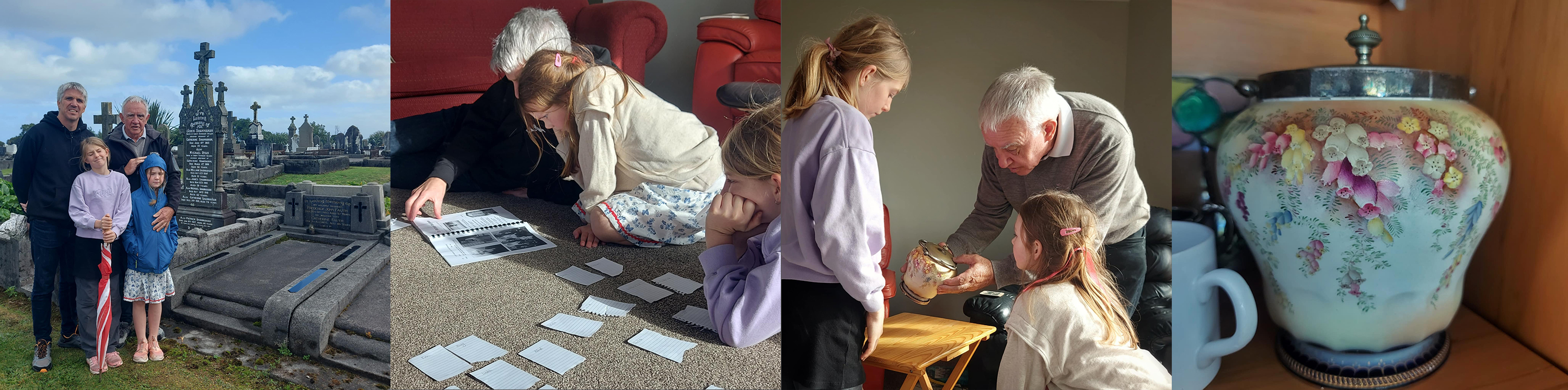
Learning about the Williams family sparked our kids’ interest in exploring their own coastal ancestry. We visited the grave of early descendants, worked together on building a family tree, and discovered a 1901 biscuit jar that had been given to the girls’ great-great-grandparents as a wedding gift. We had fun imagining if our family crossing paths with the Williams family over the years.

Williams father was Samuel Williams, known as Yankie Sam, a whaler who had worked for the Weller Brothers at Caroline Bay and Patiti Point around 1839 to 1841. And then for George Rhodes at Island Bay, Akaroa 1844–1848. Sam becomes a trusted employee and later influenced the Rhodes Brothers to explore South Canterbury who went on to lease “The Levels,” a massive pastoral run extending between the Opihi and Pareora river. 1851 Sam went to the Ballarat goldfields in Victoria, Australia and had a child Rebecca in 1854 with Ann Mahoney (also known as Anne Maury), an Irish immigrant from Cork.
Sam returned to Timaru in 1856 with his wife Ann and their daughter Rebecca to work again for George Rhodes. George Rhodes gifts Sam the old beach cottage at the foot of George Street, which is noted on a plaque on the Timaru Landing Services Building as the first European residence in Timaru. September 22 1856 William Williams was born, the first recorded birth of a European child in the area. His cradle is famously a gin crate. The family converted the daub cottage into a general store and accommodation house, and in 1858 Sam received Timaru’s first publican’s license. Though Williams had been operating as a publican unofficially before receiving his licence. Lodging conditions were basic, often just bare floors or rough bunks with limited food. In 1858, Samuel Williams formally applied for and received a publican’s licence. At that time, only three other licences existed in the Timaru district—held by John Giles (Orari), Joseph Deans (Arowhenua), and Henry Cain—though Williams had been operating as a publican unofficially before receiving his licence.
There were other children born around that time. Elizabeth and George Rhodes' first child George William Wood, was born 1855 at the Levels near Pleasant Point, and died August 9 1859 at Timaru, aged 4 years.
1859 Williams was around 42 years old when the first immigrant ship The Strathallan, the first to sail direct from the UK to Timaru, arrived on January 14. It carried over 120 settlers from the UK. Sam was was one of the first three people, along with Mr. Woollcombe and Captain Cain to row out and greet the ship as it anchored off the coast. Timaru was a pretty small place at the time, and some passengers had huge expectations. One lady on board, wrote in her diary, that if Timaru was a quarter of the size of London, she would be happy. Imagine her surprise on arrival when she discovered there were only 5 houses in sight! A settler’s diary entry from that day noted how immigrant women, sunburned from washing clothes on the beach, went to "Old Sam’s" cottage for relief. Sam's wife, humorously advised them to "take a little inside and rub a little outside."
1860 Sam builds a new Timaru Hotel (funded by George Rhodes), and it becomes a central social hub. November 1860 Ann Williams dies in the doorway of the Timaru Hotel, leaving Sam with two young children. A descendant wrote that her death deeply affected Sam, who had relied on her stability and guidance.
1861 (March 2) – Sam marries Mary Ann Gardiner, a governess and widow, at St. Mary’s Church, Timaru.1862 (Oct 7) – Their daughter Emily Williams is born. Around 1865 Mary Ann left Sam, taking their two-year-old Emily with her out of Timaru. Their marriage was troubled, marked by a 25-year age gap and discord.
1862 – The Timaru Hotel burns down in an act of arson by a disgruntled customer. The Hotel was owned by the Rhodes and Sam owned all the furnishings inside. He lost everything but his accounting books. Sam rebuilds. Sam’s later life is marked by hardship and instability. He appears in court several times involving theft and unruly patrons. Despite support from the Rhodes family, he struggles with drinking and financial issues.
By 1864 there were around 400 people here, and the first wool bales were sailing direct from Timaru to London. On June 11, 1864, an ambitious 20-year-old Yorkshireman, Alfred George Horton, ran the first copies of the newspaper off a printing hand press at the Timaru home of former goldminer and whaler, Sam “Yankie” Williams. That first eight-page issue was published as a weekly, but the paper soon became a daily — one of the oldest daily newspapers in New Zealand. It followed soon after The Press (weekly from 1861), The New Zealand Herald (1863), and the Otago Daily Times (1861), which claims the title of the country’s oldest daily.
In 1864 David Clarkson and Richard Turnbull built a store over the road from the Timaru Hotel. They were the first to export flour from Timaru to the UK.
On August 2, 1864, Williams successfully pursued a partial debt claim against W.K. Samuels in the Timaru court for whiskey and a loan. He was awarded £1 17s 3d. On September 2, 1864, Williams was again defrauded by Doran, who provided a second false cheque while lodging at his hotel. Doran was convicted and sentenced to 12 months’ imprisonment.
In 1864, his former boss, and friend George Rhodes, returned to Purau to help out with Sheep Dipping season and spent a few days up to his waist in the freezing dip. Tragically, George caught a chill from the dip and died aged 47. He died 13 years after moving the first flock of sheep to Timaru with his brother Robert in 1851, helped by several men (which I think could have included Samuel Williams), from Banks Peninsula to the uninhabited Timaru area, and built a very small 20ft long cottage at the Timaru sea side in 1851 now George Street. His death spelt the end of the Rhodes brothers being in business together and the end of a special friendship with Sam. The Levels and Purau were sold with Robert moving his family to the estate of Elmwood in Christchurch, now the suburb of Elmwood. The Levels was purchased by a former Rhodes employee, Mr Orbell. (From 1865 the station was managed by Donald McLean, under the general management of WS Davison of the New Zealand and Australian Land Company. Charles Orbell then managed the property from 1876 until 1904, when it was acquired by the government and broken up in to smaller farm lots. Orbell, who was chairman of the Levels County Council, bought the homestead block and lived there until his death in 1925. Orbell’s son held the property in the 1940s, around the time when Acland published his history of the Canterbury runs. In 1946 the Levels cottage between Timaru and Pleasant Point was given to the South Canterbury Historical Society and it was subsequently restored in time to mark the centenary of ‘The Levels’ station.) Elizabeth Rhodes was one of the first European women to settle in South Canterbury. In 1954 she rode down with her husband, George Rhodes on a seven day journey that included crossing rivers becore there were bridges. George and Elizabeth moved into a small cottage that sat on Timaru’s shoreline, and after a short time, which is the house the Williams family moved into when George and Elizabeth moved to The Levels Station and lived in a basic slab hut while they built their home.
When George died in 1864, Elizabeth purchased Linwood House which stood behind the present Timaru District Council chambers. In 1867 Elizabeth married Arthur Perry, a barrister from Tasmania who had commenced a law practice in Timaru. They remained at Linwood until 1873 when they purchased Beverley from Henry Le Cren. This was a large house on eight hectares of land at the junction of Wai-iti Rd and the Great North Road, now Highway 1. It was to become a garden of note in the district. I think the property was purchased by David Clarkson (D.C) Turnbull. The land around the Beveley Estate was subdivided and many homes in the neighbourhood were designed by David Clarkson Turnbulls architect brother James Turnbull. The house was used by returned service men and the base of the RSA for many years.
1865 he sells the hotel to John Melton (the framed sale document used to hang on the Timaru Library wall) he then moved with his children to run hotels at Birdling’s Flat and Hotel Wellington in Christchurch.

Timaru Landmark Club Hotel Closes Doors (01 Jul 1970). Aoraki Heritage Collection, accessed 21/05/2025, https://aorakiheritage.recollect.co.nz/nodes/view/591

Photograph of Flockton Well near the corner of George St and the Great North Road (Stafford St), between April and December 1868. It is viewed looking along George St to the west. The original wooden Bank of New Zealand building is visible on the corner (centre of image), with Clarkson and Turnbull across the road (left of centre) and the Club Hotel and Flockton Well in the foreground at the left-hand side of the image. There is a man standing on the well and two boys in front of it. The Russell Ritchie and Co. building is on the right corner. The photograph is mounted on a card backing with the photographers' details and "View Up George St., Timaru." handwritten on lower edge. There are also handwritten labels on the top and lower edges of the mount (with small arrows pointing to the appropriate site) that identify the buildings. - nzmuseums.co.nz/3359/flockton-well-corner-of-george-st-and-the-great-north-road South Canterbury Museum

Timaru, 1875, Dunedin, by Burton Brothers, Alfred Burton. Te Papa (C.014371)
About a dozen of Timaru's roads are named after The Rhodes family has lots of family.
- Arthur Street - Arthur Edgar Gravenor Rhodes (1859 - 1922) a son of George Rhodes (1816 - 1864)
- Barnard Street - William Barnard Rhodes (1807 - 1878) husband of Sarah Anne Moorhouse (1835 - )
- Bidwill Street - Jessy Bidwill (1866 - 1937) married Robert Heaton Rhodes (1857 - 1918) a son of George Rhodes (1816 - 1864)
- Elizabeth Street - Elizabeth Wood [later Perry] (1835 - 1890) married George Rhodes (1816 - 1864)
- George Street - George Rhodes (1816 - 1864) a son of William (1781 - 1869) and Theodosia Maria [Heaton] (1785 - 1830)
- Heaton Street - Theodosia Maria Heaton (1785 - 1830), married William Rhodes (1781 - 1869)
- Latter Street - Sophia Circuit Latter (1833 - 1906 ) married Robert Heaton Rhodes (1815 - 1884) a son of William (1781 - 1869) and Theodosia Maria [Heaton] (1785 - 1830)
- Rhodes Street - named after the family surname
- Sarah Street - Sarah Anne Moorhouse (1835 - 1914) wife of William Barnard Rhodes (1807 - 1878) a son of William (1781 - 1869) and Theodosia Maria (1785 - 1830)
- Sefton Street - Maiden name of Sarah Anne Moorhouse’s (1835 - 1914) paternal grandmother
- Sophia Street - Sophia Circuit Latter (1833 - 1906) married Robert Heaton Rhodes (1815 - 1884) a son of William (1781 - 1869) and Theodosia Maria [Heaton] (1785 - 1830)
- Theodosia Street -Theodosia Maria Heaton (1785 - 1830), married William Rhodes (1781 - 1869)
- Sourced from Christopher Templeton
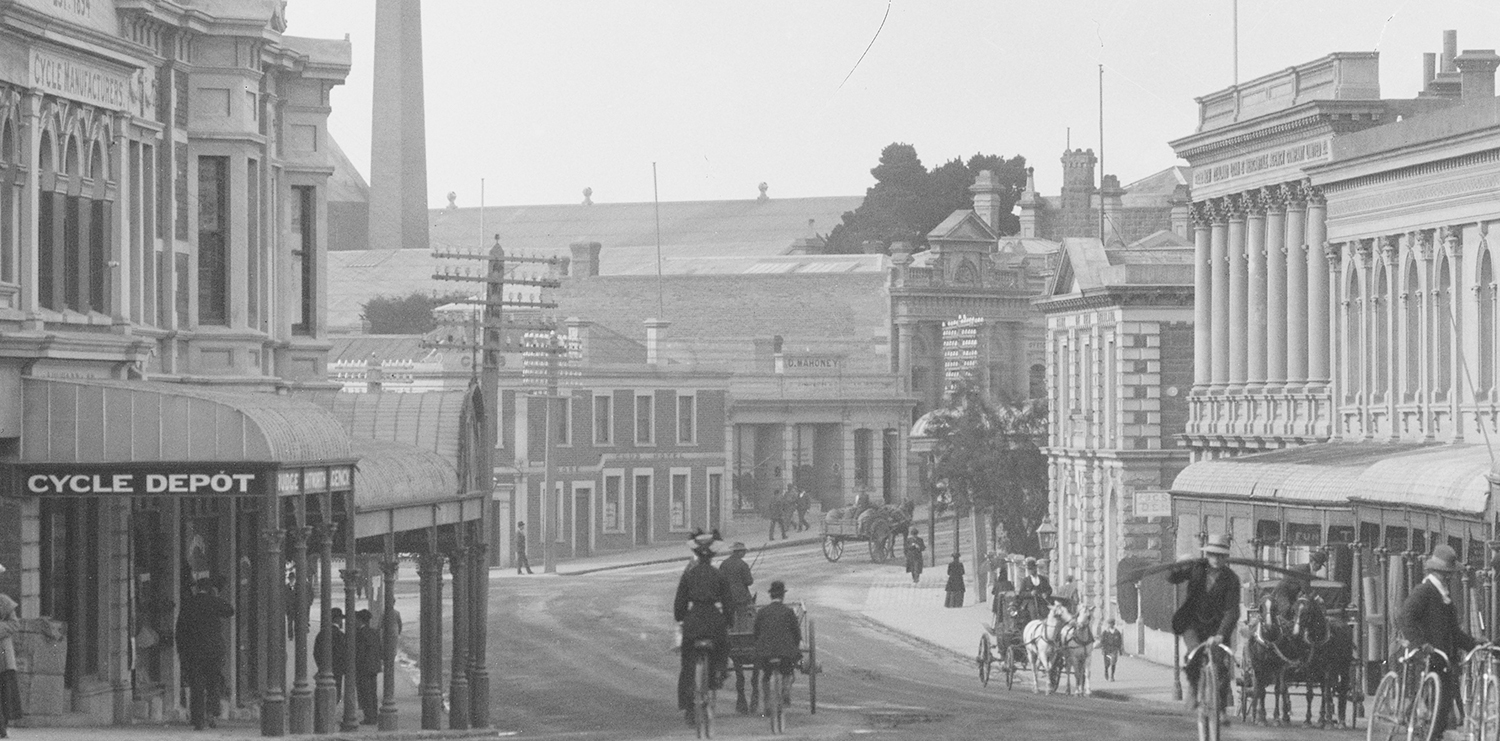
Looking down Stafford Street to George St intersection, Club Hotel and Bank of New Zealand on the Corner, Timaru, New Zealand, by Muir & Moodie. Te Papa (C.014724)

The Club Hotels neighbourhood in 1874. The Williams Cottage is gone the Timaru Landing Service Building we know today is called Cains Landing Service. Over the Road from the Club Hotel is Gabities Corner, now the Oxford, The Post Office and Timaru Herald and Criterion Hotel. On the adjacent corner was The Bank of New Zealand. And over the road on George Street was Russel Richie & Co (The branch from Dunedin, operated by George Gray Russell, provided loans to runholders, facilitated wool exports, acted as a shipping agent, and managed affairs on behalf of absentee landowners.).
June 291883, Samuel Williams died in Timaru, aged 66. A bluestone monument was erected by his friends to honor him as the oldest resident of Timaru.
Williams sister Rebecca married George William Hobbs, a blacksmith and farrier. Together they have six children. Rebecca died in 1896, aged 42, and is buried at Linwood Cemetery, Christchurch. We went to find her grave, but while her plot is noted on a map, there is no headstone there.
Two years after Williams mother had died in 1860, a devistating fire broke out at 2am of March 7 1862 destroyed the Timaru Hotel operated by his father Samuel Williams. 15 people were sleeping inside at the time, who survived with nothing but the clothes on their backs. Sam's entire investment and personal property were destroyed except for his account books. He heroically prioritised the safety of his guests, ensuring everyone escaped, despite sacrificing any chance to rescue his own possessions. The fire appeared to originate from a small unused parlour at the rear of the building. Although the hotel structure was insured (under ownership of the Rhodes brothers), the furniture, which was owned by Sam, was not.
Suspicion fell on Hugh Williams, a man who had issued threats against Sam the previous evening, reportedly saying he would “blow him to blazes.” Hugh was arrested after giving a vague account of sleeping under a tussock during the night of the fire. At the coroner’s inquest, multiple witnesses confirmed the origin of the fire and Hugh’s threatening behaviour. After extensive testimony, the jury concluded that the fire was deliberately set and declared that, in their opinion, Hugh Williams was responsible. He was reported in the newspaper that Hugh was sentenced to death in the trial. The two remaining chimneys stood as bleak monuments to the destruction, a haunting image of a man who had poured his life into building a place of hospitality, only to watch it vanish in flames.
William would have be around six years old at the time.
Children of Samuel Williams and Ann Manry
Rebecca WILLIAMS Born: 1854 in Ballarat, Australia (?) - Died: February 13, 1896, Christchurch, New Zealand
William WILLIAMS Born: September 22, 1856, Timaru, New Zealand. Died: July 10, 1936, Greymouth, New Zealand Married: Sarah Ann SHIMPLETON (Born: May 31, 1862 in Tasmania, Australia (?) Died: June 23, 1939, Greymouth, New Zealand. They Married: December 24, 1879, Kumara, West Coast, New Zealand
Williams half sister was Emily WILLIAMS, Born: October 07, 1862, Timaru, New Zealand. Died: July 23, 1942, Public Hospital, Gore, New Zealand.She married Arthur James GIBB April 12, 1888, All Saints Church, Dunedin. Emily's mother was Mary Ann GARDINER. Born: 1845 in England? (Surrey). Died: January 17, 1888, Dunedin, New Zealand. Married: March 02, 1861, St Mary’s Church, Timaru, NZ

Tony Rippin at South Canterbury Museum working with Roselyn Fauth to triangulate peoples burials around the time ann passed to see if there is a pattern. The process threw a few questions and therories, but nothing to hang our hat on.
Our Whale History Hunt has led us on all kinds of history finds. Medinella spotted a piece of whale bone in the surf at Patiti Point.

Medinella Fauth with a piece of whale bone found at Patiti Point - Photo Roselyn Fauth

Medinella took he find to the South Canterbury Museum to see if it was infact from a whale.

Whalebone Corner: Corner of Taiko, Claremont and Fairview Roads, west of Timaru. This intersection is known as 'Whalebones Corner'. Ever thought, if I stuck some whale bones near my house, it would make it easier to find? Worn by weather for over 100 years, you can see the remnants of four whale bones which were brought out from the whaling station on Caroline Bay about 1870. Mr John Machintoch, who built the house on the farm Kingsborough about the tome instructed John Webster to collect the bones on a dray and to place them a the intersection so the visitors could be easily directed to Kingsborough. Since then, this intersection has always been known as The Whalebones Corner. (Take care is stopping here and park well away from the intersection). - Photo Roselyn Fauth

With what we learned, we added a few "Wuhoo's" to the Caroline Bay Playground, including a barrel of whale oil as shipwreck cargo. - Photo Roselyn Fauth
One barrel is a nod to the first known shipment of whale oil that was at Caroline Bay waiting to be collected. The other barrel is a nod to Timaru's first shipwreck the Prince Consort. William Williams, the first European born in Timaru, was the son of Samuel William, also known as "Yankie Sam," a whaler who had joined a whaling gang in the area in 1839. In 1886, Samuel Williams returned to Timaru to work for Rhodes, where he ran a small accommodation house and became the town's first publican. An interesting piece of local history is that his son's cradle was made from a gin crate. "70 tun was ready to be collected at Timaru station". A tun of oil is by volume, 1 tun = 8 barrels. A wine tun is 252 gallons.
After all the hunting with help of the Timaru District Council and the South Canterbury though... we still can't work out where Ann, William and Rebecca's mother - the first to mother a European baby in Timaru is.

Looking out to the Timaru Cemetery, where our hunt for history began. This has been a fantastic read to check my research has been correct. Thank you to The South Canterbuy Musuem, Timaru District Cemetery team, the Hokitika Musuem and my father in law who lives on the Coast, Paul Fauth for helping me on the hunt for history about Flash Billy, the Larrikin, and first European kid from Timaru.
