

Next time you're in town... see if you can spy a plaque, for the 1851 hut that was built for the Rhodes, and transformed for a home for the Williams family - Timaru's first European permanent residents...
Before the Port of Timaru was constructed, the shore on George Street would have looked quite different. A steam fed the sea here and the high tide line was near whey there the rail line is today. A three-walled daub hut was built on the beach here in 1851, by pastoralist George Rhodes and his brothers. This was the site of an abandoned whaling station. They used the area as an anchorage to help establish their huge Levels station.
Samuel “Yankie Sam” Williams sailed to New Zealand on the Ship Caroline to hunt whales for the Weller Brothers at Timaru's Patiti Point and Caroline Bay. The tri-pots at the South Canterbury Museum, Caroline Bay and Patiti Point are all that is left from those sea shanty singing whalers. When the Wellers went bankrupt, Sam worked for Rhodes Brothers at Banks Peninsula. He moved to Ballarat, Australia for the gold rush and returned to Timaru around 1854 or 1856 with his Irish partner/wife Ann Mahoney and their daughter Rebecca (born in Ballarat 1854). George Rhodes offered them this lonely beach cottage to live in.
This daub hut, made from clay, straw and timber, originally housed George Rhodes and then his wife Elizabeth when the married in 1854. When the Rhodes moved out to The Levels near Pleasant Point, Sam and Ann moved in, becoming Timaru’s first permanent European family.
On 22 September 1856, history was made again in the cottage by the sea, William Williams was born... the first recorded birth of a European child in Timaru. His cradle was a gin crate. Shortly after, Archdeacon Harper visited Timaru and christened William in the cottage, noting the warmth of the family and the ruggedness of East Coast life by the sea.
Sam and Ann added a lean-to onto the hut, with bunk beds, and began offering food and shelter to those passing through. The daub cottage became Timaru’s first pub and general store, and Sam received the town’s first official publican’s licence in 1858, although he had been operating well before the paperwork caught up.
Lodging was pretty basic back in those days. The cottage was reported to have a bare floor, with simple meals and sturdy conversation. It was the heart of early European Timaru at the time, a place to gather, share news, and find some support and comfort for new immigrants.
In 1860, Sam built the first Timaru Hotel (funded by Rhodes), relocating the business from the cottage to what is now the corner of George and Stafford Streets. Tragedy struck later that year when Ann collapsed in the doorway of their new hotel and died, leaving Sam to raise their young children alone. He remarried the children's governess and they had a child together, but she did a runner to Hokitika.
Almost two years to the day the Hotel opened, it burned down at 2m in the morning by arson - a disgruntled patron who didn't like the price Sam charged for beer. Everyone made it out safetly, the building, owned by the Rhodes was insured, but sam was not and as he owned the chattels inside, he lost everyone bar a few accounting books.
The beach cottage remained for another decade. When the Williams family moved out, it was occupied by Captain Scotte, Rhodes' business agent. In 1867, it changed hands again, and by 1872 the cottage was demolished for commercial development at the landing service building site, its materials and memories pushed aside as the town grew.
Today, a plaque on the Timaru Landing Services Building marks the site where this story started. On this site, the earth beneath the asphalt lies the legacy of Timaru’s first European home, and the first families to call it theirs.
Next time you are there, look to the railway line, imagine hearing the sea when it rolled to shore, the Williams looking out, the conversations, hard graft and the laughter of their children playing.
Then head to Caroline Bay and find the juniper berries in the CPlay playground... a quiet tribute to the gin-crate cradle that held one of Timaru’s founding European sons.

I can't imagine how they crossed these rivers before they were bridged. - Photography By Geoff Cloake
Early European Settlement in Timaru
-
European settlement began with a whaling station at Patiti Point established by the Weller Brothers of Otago.
-
From the 1840s, pastoralists like the Rhodes Brothers took up land, including The Levels sheep station.
-
In 1853, William, Robert, and George Rhodes surveyed a settlement behind Caroline Bay called “Rhodes Town”.
-
By 1856, the town included an accommodation house, woolshed, and hotel on the beach.
-
The Canterbury Provincial Government established a separate township immediately south called “Government Town”.
-
In 1859, the steamship Strathallan arrived from England with around 120 immigrants.
-
By 1868, Rhodes Town and Government Town merged, creating a larger municipal area that absorbed surrounding rural communities.
George Rhodes’ Hut
-
In 1851, George Rhodes built Timaru’s first European house on the beach near the foot of George Street.
-
The hut measured 20 feet (6.1 m) with a steeply pitched roof and was initially a home for Rhodes and his wife.
-
A lean-to was added to provide more space for the family.
-
By 1857, Rhodes leased the hut to Samuel Williams, an American whaler working for him.
-
Williams received a publican’s licence in 1858 and ran the Timaru Hotel from the hut.
-
He relocated to new premises in 1860, which burnt down in 1862, leading to the hotel’s relocation to Great South Road (now Stafford Street).
-
Rhodes’ original hut remained until about 1873, when it was demolished.
Landing Service Building
-
In 1857, the Rhodes Brothers transferred their landing service to Henry John Le Cren and Captain Henry Cain.
-
By 1864, the Provincial Government took over and began charging fees, which led to dissatisfaction among local merchants and runholders.
-
In 1867, the Timaru Landing and Shipping Company was formed to compete and leased the Government service in 1868, operating at the foot of George Street.
-
The company operated two launching ways, two 36-foot boats, and a few sheds.
-
They purchased adjacent land (Section 10) in June 1869 to expand.
-
The company collapsed in 1870, and Captain Cain bought the plant and lease for £975.
-
Peter Daniel McRae acquired Section 10 and built the Landing Service Building (McRae’s Stone Store) in 1870.
Construction and Use of the Building
-
The stone building measured 75 ft x 35 ft (22.9 m x 10.7 m), 22 ft (6.7 m) high, with three arched boat entrances and a hipped roof.
-
It had a right-of-way (Turnball Street) for drays to deliver goods to the upper floor.
-
Boats were hauled along a cable initially by manual capstan, later by steam engines.
-
The building was leased to Julius Mendelson (1870–1872), then to Richard Turnball (from November 1872).
Impact of the Railway and Modifications
-
The arrival of the railway in 1875 disrupted operations as it was built on reclaimed foreshore land.
-
Boats had to be hauled over railway lines to reach the sea.
-
McRae sold the business to the New Zealand Loan and Mercantile Agency Company in 1875.
-
They expanded the building by adding two hip-roofed bays with a railway siding through the centre.
-
Construction of the artificial harbour began in 1878 and was completed by 1886, ending the need for a landing service.
Later Use and Preservation
-
The building remained in use for wool and grain storage until 1984.
-
By 1925, large two-storey warehouses were added to the north, west, and south sides.
-
The building was occupied by Dalgety & Company and the Loan and Mercantile Agency, which merged in 1961.
-
In 1984, the Timaru City Council purchased the building; it was under threat of demolition.
-
The NZ Historic Places Trust placed a protection order to save it.
-
The Timaru Civic Trust was formed, and the building was gifted to them (1988–1989) along with a long-term land lease.
-
The building was reopened in 1997, repurposed for community events and now includes the Information Centre and Te Ana Ngāi Tahu Māori Rock Art Centre.
-
It formerly housed the lifeboat Alexandra, imported in 1864.
-
In 1993, a two-storey toilet block and stairwell were added at the rear of the building.


This illustration is by Geoff Cloake. He overlaid surveys and maps to show the location of the Rhodes' 1851 cottage in relation to the Timarui Landing Services Building today.

Retrolens arial photography survey of the George and Turnbull Street Corner 26 2 1958 - Cropped Image

Retrolens arial photography survey of the George and Turnbull Street Corner 23 5 1938 - Cropped Image

Shore change from 1851 compared to 1958. Amazing how far the shore has built out since the cottage was built by the shore in 1851. This railway survey is over a 1958 arial survey photograph.

Photograph of the foot of George Street, Timaru, c.1868, showing the Timaru Landing and Shipping Co.shed (centre) and Rhodes' hut to the left South Canterbury Museum 2000/210.095.
1868 Photograph of the foot of George Street, Timaru, circa 1868. It was built in 1851 by George Rhodes and his employees. It was the only habitation between Lake Ellesmere and the Waitaki River at the time. The cottage was a simple structure with battened sides, a clay-plastered exterior, and a thatched tussock roof, located near present-day George Street. In 1857, Archdeacon Harper visited Timaru during his journey from Christchurch to Moeraki and was warmly received by Samuel Williams, his wife, and son. A commemorative plaque was placed on the site in 1955. Harper's letters from September 1857 mention encountering an old whaler (Williams) living in a hut with his family near the sea coast. Williams shared whaling stories with Harper during this visit; his wife provided directions for Harper's journey to Waimate. The building is pictured in the centre is a landing service building (either the Timaru Landing and Shipping Company or the George Street Landing Service), while Rhodes' original cottage is to the left.

Here you can see the boat launch at the foot of George Street, the Landings Service Building and beside, in the center the Rhodes cottage. Landing Services Building and Rhodes' hut at the foot of George Street, c.1870 photograph believed to be by William Ferrier (University of Otago Hocken Digital Collection C/N E6970/9). Section from Hocken Snapshop hocken.recollect.co.nz/24023

First edition of the Timaru Herald was printed in the Williams kitchen on George Street - June II 1864 - Vol 1 No 1 I haven't been able to confirm if it was the kitchen of the Hotel or the cottage. But the cottage was still standing at the time the edition was printed.

Medinella Fauth points to the plaque on the Timaru Landing Services Building - Photo Roselyn Fauth

When the Williams family vacated the cottage to move into the Timaru Hotel, it was occupied by Captain Scotte, the Rhodes’ business agent. In 1867, it passed into the hands of S. S. Griffin, who held it until 1872, when it was sold for fourteen pounds and demolished to make way for a commercial building.

Timaru Landing Services Building has a plaque on the wall for the first European House in Timaru. Samuel Williams lived there with his family.

Hall-Jones, Frederick George., Early Timaru: some historical records of the pre-settlement period, annotated and analysed.. Aoraki Heritage Collection, accessed 01/03/2025, https://aorakiheritage.recollect.co.nz/nodes/view/161


FDM-0690-G-TimaruFromTheAir-Caroline Bay harbour and town-DougMill-air transport and survey business from a hangar at Hobsonville Point between 1927-1937- Auckland Libraries Heritage Collections FDM-0690-G

Photograph of Flockton Well near the corner of George St and the Great North Road (Stafford St), between April and December 1868. It is viewed looking along George St to the west. The original wooden Bank of New Zealand building is visible on the corner (centre of image), with Clarkson and Turnbull across the road (left of centre) and the Club Hotel and Flockton Well in the foreground at the left-hand side of the image. There is a man standing on the well and two boys in front of it. The Russell Ritchie and Co. building is on the right corner. The photograph is mounted on a card backing with the photographers' details and "View Up George St., Timaru." handwritten on lower edge. There are also handwritten labels on the top and lower edges of the mount (with small arrows pointing to the appropriate site) that identify the buildings. - nzmuseums.co.nz/3359/flockton-well-corner-of-george-st-and-the-great-north-road South Canterbury Museum

Timaru, 1875, Dunedin, by Burton Brothers, Alfred Burton. Te Papa (C.014371)

The Club Hotels neighbourhood in 1874. The Williams Cottage is gone the Timaru Landing Service Building we know today is called Cains Landing Service. Over the Road from the Club Hotel is Gabities Corner, now the Oxford, The Post Office and Timaru Herald and Criterion Hotel. On the adjacent corner was The Bank of New Zealand. And over the road on George Street was Russel Richie & Co (The branch from Dunedin, operated by George Gray Russell, provided loans to runholders, facilitated wool exports, acted as a shipping agent, and managed affairs on behalf of absentee landowners.).
Timeline: The Levels, Rhodes Hut, Williams Cottage and the Landing Service Building
1840s
Whaling station established at Patiti Point by the Weller Brothers of Otago.
Samuel “Yankie Sam” Williams arrived in New Zealand aboard the Caroline to whale in the Timaru district.
Late 1850 – 1851
George, William and Robert Rhodes applied for land between the Opihi and Pareora Rivers.
1851
George Rhodes built a three walled daub hut on the beach at the foot of George Street, Timaru, on the site of an abandoned whaling station.
It was used as an anchorage base supporting the establishment of The Levels station.
January 1852
‘The Levels’ station was stocked with sheep shipped from Banks Peninsula.
1853
The Rhodes brothers surveyed a settlement behind Caroline Bay called “Rhodes Town”.
May 1854
George Rhodes married Elizabeth Wood.
A slab cottage was built at The Levels, replacing the original V hut.
Around 1854 or 1856 Samuel Williams returned from Ballarat with Ann Mahoney and their daughter Rebecca. George Rhodes offered the beach hut as a home.
1856
A larger house was erected at The Levels.
On 22 September, William Williams was born in the George Street cottage, the first recorded European birth in Timaru. His cradle was a gin crate.
1857
Rhodes transferred the landing service to Henry Le Cren and Captain Henry Cain.
Williams was leasing the hut and offering accommodation there.
1858
Samuel Williams received Timaru’s first official publican’s licence.
The cottage operated as Timaru’s first pub and general store.
1859
The Strathallan arrived with around 120 immigrants.
1860
Samuel Williams built the first Timaru Hotel at the corner of George and Stafford Streets, funded by Rhodes.
Ann Williams died later that year after collapsing in the doorway of the new hotel.
June 1864
George Rhodes died at Purau, Banks Peninsula.
The first edition of the Timaru Herald was printed on 11 June 1864 in the Williams kitchen on George Street (the cottage was still standing).
1865
Most of The Levels station was sold to Matthew Holmes.
Donald McLean managed the station under W S Davison.
1867
The beach cottage passed into the hands of S S Griffin after occupation by Captain Scotte, Rhodes’ agent.
The Timaru Landing and Shipping Company formed and later leased the government landing service.
1868
Rhodes Town and Government Town merged into one municipal area.
Photographs show the Rhodes hut still standing near landing service sheds.
March 1869
A council bylaw stipulated masonry construction in the central business district following the December 1868 fire that destroyed around 30 buildings.
June 1869
The Timaru Landing and Shipping Company purchased adjacent land (Section 10) to expand.
1870
Peter Daniel McRae built the first stage of the stone store at 2 George Street as a grain store (the first stage of the building now commonly known as the Landing Service Building).
The building was designed so drays could offload grain at first floor level from the bank behind, and grain could be transferred to boats at the waterfront.
The Timaru Landing and Shipping Company collapsed, and Captain Cain purchased the plant and lease.
1870 – 1873
McRae appears to have leased the store to Julius Mendelson of Temuka, who remained in possession when it was advertised for sale or lease in November 1872 and again in November 1873.
1872
A further larger house was built at The Levels.
The Rhodes hut was sold for £14 and later demolished to make way for commercial development (often dated to about 1873).
1875
The New Zealand Loan and Mercantile Agency Company had taken over McRae’s grain store by winter 1875.
The railway reached Timaru and disrupted foreshore operations as it was built on reclaimed land, requiring boats to be hauled across rails to reach the sea.
1875 – 1876
Major enlargement of the stone store by the NZ Loan and Mercantile Agency Company, tripling the original building size by adding two rear hip roofed structures.
The 1876 addition was designed by F J Wilson (Francis John Wilson), an early Timaru architect associated with rebuilding after the 1868 fire.
The enlarged building accommodated rails through the centre and sidings servicing wool and grain stores.
1876 – 1904
Charles Orbell managed The Levels.
1878 – 1886
Construction of the artificial harbour removed the need for the traditional landing service model.
1904
The Levels was acquired by the government and subdivided into smaller farm lots.
Orbell bought the homestead block.
1925
Charles Orbell died.
By this period, large warehousing had grown around the three part stone building, with Dalgety and Co stores to the north and west and NZ Loan and Mercantile Agency stores to the south.
1940s
Orbell’s son held the homestead block.
Acland published his history of the Canterbury runs.
1946
The Levels cottage was given to the South Canterbury Historical Society and restored.
1950
A Canterbury centennial plaque was mounted on the east wall of the stone store, marking the site of the first house in Timaru built by George Rhodes.
1960
The Levels cottage and its immediate setting were gazetted as a private historic reserve.
1961
The NZ Loan and Mercantile Agency Company and Dalgety and Co merged.
1984
The stone stores were sold to Timaru City Council and used as warehousing until this point.
The building was threatened with demolition.
11 February 1985
A Heritage Order was placed over the building.
1990s
The Timaru Civic Trust conserved the building with community support.
c.1995
Hip roofed extension added to the middle bay on the south elevation.
1997
The building reopened and was repurposed for community events and visitor uses.
c.1993
A two storey toilet block and stairwell were added at the rear of the building.
c.2014
Southern staircase addition constructed.
9 July 2018
Timaru District Council Historic Heritage Item Record Form completed for the former McRae’s Stone Store, noting:
• Address: 2 George Street, Timaru
• Date of construction: 1870 and 1875–76
• Style: Industrial vernacular
• Materials: Timaru bluestone (basalt), brick, timber, corrugated metal
• Former uses: McRae’s Stone Store, NZ Loan and Mercantile Agency Co, Dalgety and Co stores
• Plaque on east wall marking the first house site
Present Day
The plaza and interpretation around the building recognise the George Street shoreline story, Captain Cain, and Timaru’s landing service history.
Heritage New Zealand Pouhere Taonga manages The Levels cottage reserve.
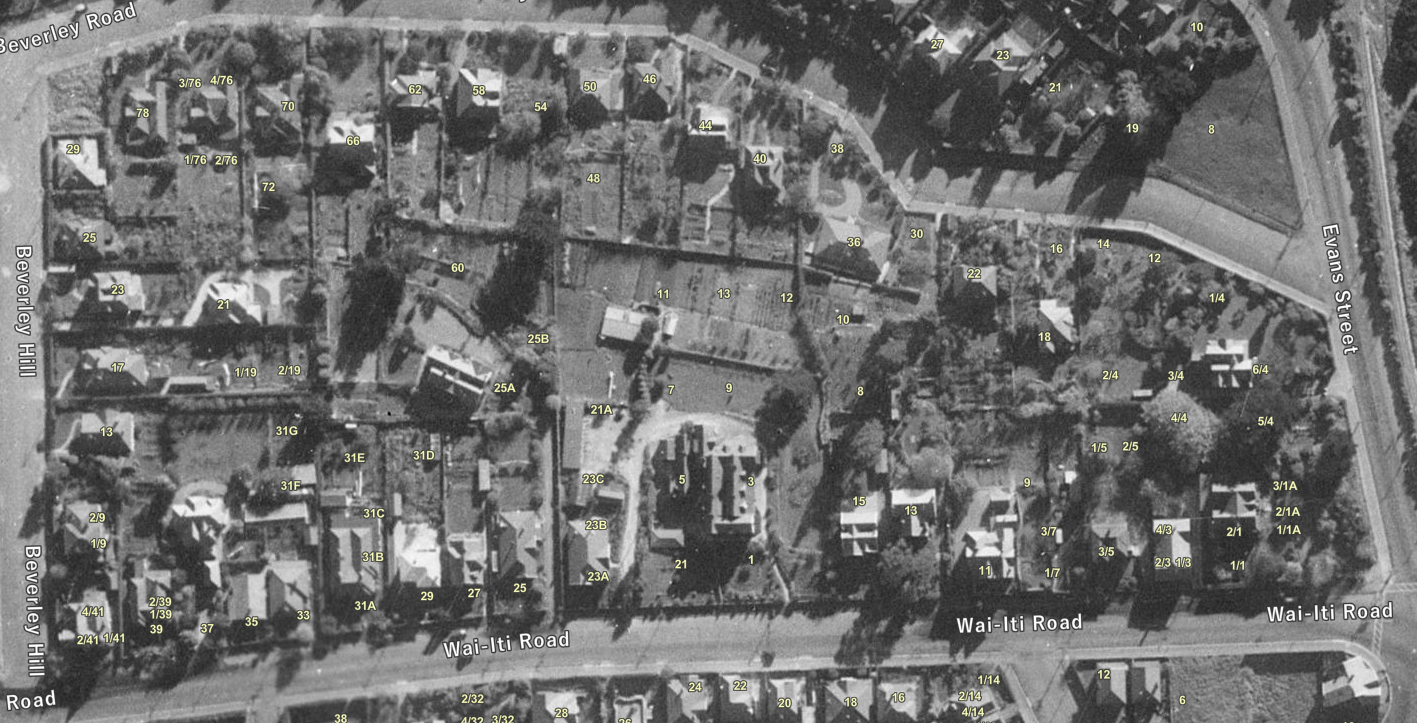
Beverley Estate and what was at one point George Knowles garden wai-iti Rd in 1935-1939 - Canterbury Maps https://propertysearch.canterburymaps.govt.nz/property?propertyPoint=1460223.906875195,5082670.342805202