
By Roselyn Fauth
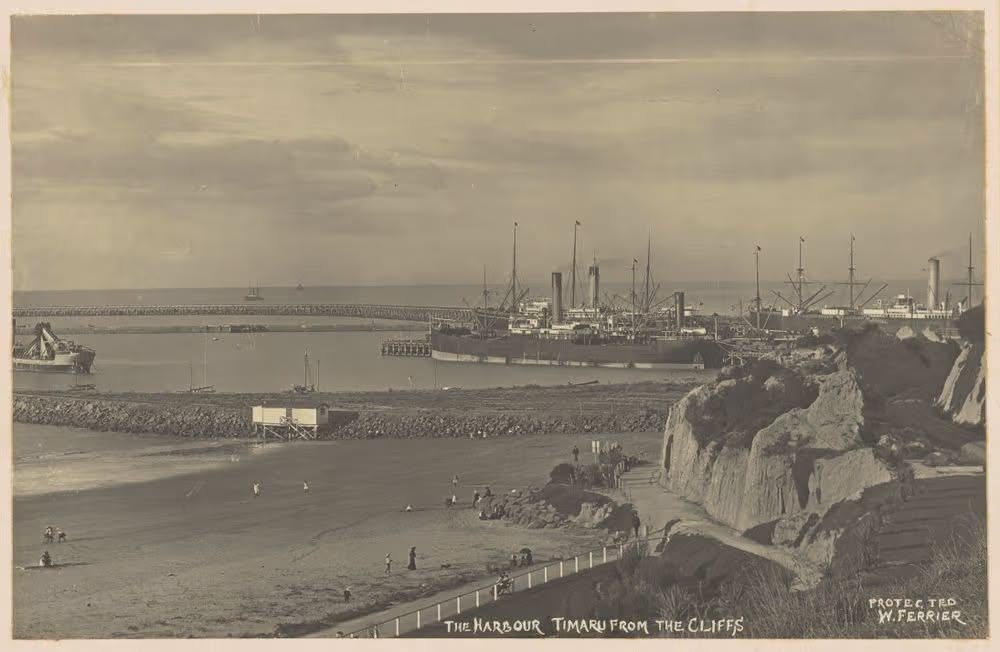
The Harbour from the Cliffs Timaru c 1909 Timaru by William Ferrier Te Papa O 051452
I thought I knew Caroline Bay reasonably well. Then, while hunting through Aoraki Heritage Recollect, I found one of those newspaper clipping that a librarian had saved and later shared on Aoraki Recollect... The headline was pretty blunt: “Council Had To Be Pushed Into Developing Foreshore.” The article was published in The Timaru Herald on 17 January 1962, when early members of the Caroline Bay Association were looking back during the association’s golden jubilee celebrations. It is full of memory: some civic pride, some frustration, some humour, and a suspect little bit of “we told you so”.
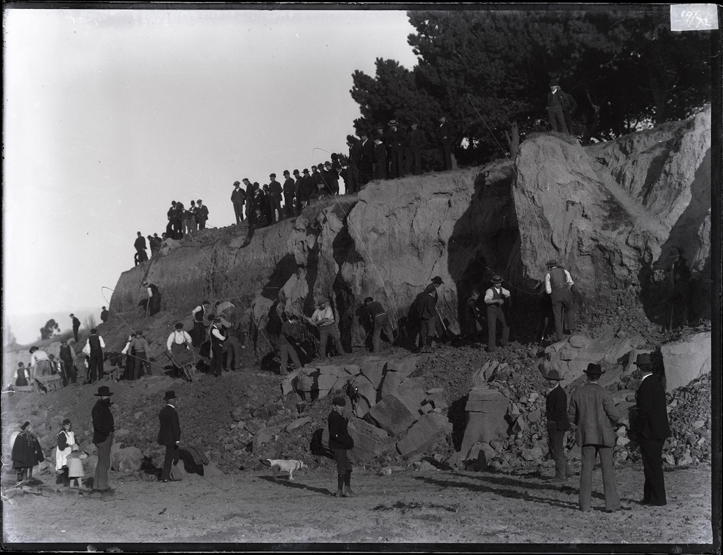
Working bee, 1897. Supported by ordinary citizens, these working bees transformed the area and provided the basis for James Craigie’s municipal improvements. Unknown photographer, South Canterbury Museum, 0488.
The 1962 clipping is about the making of Caroline Bay as a council-and-community seaside resort, but I am mindful that it is not the beginning of the coastline’s history. This place sits within much older mana whenua histories. Timaru District is within the takiwā of Kāi Tahu, and Kāti Huirapa, represented by Te Rūnanga o Arowhenua, hold mana whenua here.
So this blog is really about one later layer: how the Bay was reshaped into the public resort Timaru knows today... most of us arrive at Caroline Bay as if it has always been there, but the Bay we know is a made landscape.
After Timaru’s artificial harbour was built, currents helped create a sandy beach below the cliffs.
In 1902, the borough council leased the new foreshore from the harbour board and began turning it into a seaside resort.
The harbour impacted the coast. Sand gathered. The railway had to be protected. Rock was carted in. Clay was cut away. Spoil was covered. Soil and planting followed. Only later do we get the more familiar things — seats, baths, paths, swings, tennis courts, rotundas, tea rooms and crowds.
The 1962 article gives us a very human glimpse of the struggle behind it. Mr C. W. Wood, a foundation member of the Caroline Bay Association, remembered local businessmen wanting the Bay made more attractive. The harbour board wanted action too. But, according to Wood, the borough council “wouldn’t move”, and deputations were turned down.
Then James Craigie became mayor. Wood remembered Craigie as a “wily man” who knew how to lobby before meetings. Eventually the council applied to the Government for a grant to begin the work.
Public places are not usually created by one beautiful plan. They are pushed into being by meetings, pressure, personalities, money, persistence and people who keep asking.
The early work was not glamorous by the sound of it... George Stumbles was remembered as taking one of the first contracts to cut away the cliffs to the railway line. Working bees helped remove clay from the cliffs. Rock came from local quarries to protect the railway line where the cliffs were crumbling. Spoil was covered with soil. Planting followed. A caretaker was appointed. A cottage was built.
Then, slowly, over time, the Bay became social. There were bathing machines pulled by horses. Bathers were expected to be covered from neck to knee. Sunday bathing was frowned upon. Children used swings and roundabouts. Hundreds of people promenaded on Sunday evenings.
Jane Donald’s research on Caroline Bay looks at this wider transformation: a stretch of sand with a few bathing machines becoming something much closer to an English-style seaside resort. It was not just scenery. It was local politics, tourism, voluntary effort, public promotion, fundraising and civic imagination all tangled together. I met Jane when she was working on her thesis. I was in the thick of the CPlay project with a small team of volunteers. We researched the history of the people and place, and it inspired the design of the playground. It was great to chat with her and to share what I had learned.
LOCAL BODY POLITICS TIMARU BOROUGH COUNCIL AND CAROLINE BAY Jane Donald https://phanza.org.nz/wp-content/uploads/2024/09/Jane-Donald-Local-Body-Politics.pdf Caroline Bay was not a natural sandy resort waiting to be discovered. It was accidentally created by Timaru’s harbour works, then shaped by decades of argument, regulation, community labour and civic ambition. The Timaru Harbour Board controlled the foreshore, the Borough Council wanted authority over it, and locals pushed both bodies to turn the new beach into a public playground. Along the way, Caroline Bay became a stage for changing ideas about bathing, modesty, Sunday recreation, sunbathing and seaside leisure. Its development owed as much to citizens, working bees and groups such as the Caroline Bay Association as it did to council planning.
The Caroline Bay Association, formed in 1911, became a huge part of that story. Its purpose was to promote Caroline Bay and Timaru, and to provide family entertainment during the Christmas and New Year holidays. That is where so much of the carnival tradition comes in — the Bay not only as a beach, but as a place where the town gathered.
That is what public places do when they work realy well, they become so familiar that the effort behind them disappears... and perhaps that is why this clipping stayed with me. It made me realise I had been looking at the Bay mostly as scenery, when I should also have been seeing labour.
Next time you walk there, look for the layers: the older mana whenua histories, the working harbour, the sand that gathered, the clay cliffs that were cut back, the quarry rock carted into place, the railway line that needed protecting, the spoil covered with soil, the willows and gardens planted, the meetings that must have dragged on, the private gifts, the working bees, and the people who thought Timaru deserved something better. The Bay was not made by one heroic person, or one tidy council plan. It was made in layers — by coast, history, harbour works, politics, memory, argument, money, shovels, planting and care. I like that thought. Next time I walk at Caroline Bay, I think I will see it a little differently. Not less beautiful. More so.
Timeline:
1830s–1840s Shore whaling stations operated briefly around Timaru, but the coast remained exposed and difficult to work from.
1851 George and Robert Rhodes established a landing service at Timaru, helping the township begin to develop.
1865 Timaru became a municipality.
1867–1868 Timaru became a borough under the Municipal Corporations Act 1867. Early newspaper commentary suggested civic work would be relatively simple, but this optimism proved misplaced.
1876 The Timaru Harbour Board was established. Its main job was to build harbour works to make shipping safer on the exposed coast.
Late 1870s–1880s Harbour works began changing the coastline. Shingle built up south of the harbour, while sand began accumulating to the north. The harbour works accidentally helped create the sandy Caroline Bay.
By 1889 People were already swimming from the new beach and the North Mole. Complaints soon followed about men bathing without proper clothing.
1890 After dispute between the Harbour Board and Borough Council, the council leased part of Caroline Bay from the Harbour Board for bathing purposes. This marked the beginning of the council’s formal role in managing the Bay as a public recreation area.
1891 There were complaints about men behaving badly near women bathers, showing how the beach had become a public stage for debates about gender, modesty and behaviour.
1894 Frederick Marchant argued that Caroline Bay had enormous potential as a playground and health resort, but the council initially rejected improvement proposals.
1897 Community working bees helped cut back the cliffs and form terraces. This was an important early example of citizens physically shaping the Bay.
1899 Three young men were prosecuted over inadequate bathing dress. The council responded by making bathing costume rules more specific.
1903 A lease-in-perpetuity was negotiated, giving the council more security at Caroline Bay. This helped enable major improvement works under Mayor James Craigie.
1905 The Caroline Bay tearooms opened as part of Craigie’s improvements, alongside work to reduce the cliffs and create better public access.
1906 Timaru introduced stricter bathing costume rules, requiring neck-to-knee costumes for men and women.
1907 The council dealt with complaints about men near the women’s bathing shed. Although mixed bathing was still technically restricted, it was becoming accepted in practice.
1911 The Harbour Board agreed to allow the North Mole to become a promenade. Around this time, George Cray and others pushed for more ambitious development of the Bay.
1911–1912 The Caroline Bay Association was formed. It helped turn the North Mole into a promenade, developed the piazza, laid tennis courts, planned a pavilion and supported summer entertainments.
1912 Sunbathing became a contested issue. The council tried to manage it by providing an enclosed sunbathing area.
1913 The council took direct control of bathing facilities and estimated it needed hundreds of bathing costumes and towels for hire. Sunday bathing also became a recurring controversy.
1915 A group of male sunbathers protested by lying on the open beach, objecting to the fenced sunbathing area being too small.
1916 A by-law made it clear that bathing costumes were to be used for bathing and moving between the sea and sheds, not for lounging about on the beach.
1916–1929 Bathing facilities became profitable for the council, with costume and towel hire producing steady income.
1919 Children’s swings at the Bay, previously locked on Sundays, were allowed to be used on Sundays.
1923–1929 Under Mayor George Wallace, the council took a more positive view of investing in Caroline Bay as both a local amenity and a visitor attraction.
1924 A dispute flared between the Borough Council and Harbour Board over rates on reclaimed land. The Harbour Board threatened to alter the Caroline Bay lease, but the matter was dropped.
1925 The long-running Sunday bathing issue was finally resolved, allowing more normal use of the bathing facilities on Sundays.
1927 Bathing-facility income reached one of its high points.
1928 Around 23,000 visitors came to Caroline Bay on organised day excursions, showing how significant the Bay had become as a resort.
1929 The council called for tenders for 100 dozen cotton one-piece bathing costumes.
1933 Timaru’s bathing costume rules moved back towards a broader standard: people had to be dressed so that the body was not indecently or offensively exposed.
1934 The sunbathing restriction was repealed. A by-law amendment also allowed people to change in motor vehicles, as long as they were screened from public view.
1938–1939 Income from bathing facilities had fallen, likely reflecting changing habits, including more people changing in cars and owning their own swimwear.
1950s–1960s Caroline Bay reached a mature resort phase, symbolised by events such as the Miss Caroline Bay beauty pageants.
1962 Twenty-eight acres of Caroline Bay were converted to freehold and transferred to Timaru City Council.
Late 20th century The Bay declined as holiday habits changed and people travelled further afield. The continuing build-up of sand also changed the relationship between the town and the shoreline.
1997 A new piazza was built to reconnect the town with the now more distant shoreline, echoing the function of the earlier 1912 piazza.
2000s–2020s Historical photographs, landscaping, boardwalks and interpretation helped reframe Caroline Bay through its history.
2023–2024 CPlay opened, drawing on maritime heritage, mana whenua stories, European harbour history, lifesaving, shipwrecks, tuna, waka, rock art, navigation and local place names. Like earlier Bay improvements, it was largely driven by community effort, with the council taking ownership once built.
Sources and further reading
Main source
Timaru Herald, “Council Had to Be Pushed Into Developing Foreshore: Pioneers of Bay Association Recall Struggles of 1880s,” 17 January 1962. Aoraki Heritage Collection, accessed 30/06/2026.
https://aorakiheritage.recollect.co.nz/nodes/view/361
Caroline Bay and harbour development
NZ History, “Caroline Bay.”
https://nzhistory.govt.nz/keyword/caroline-bay
Te Ara — The Encyclopedia of New Zealand, “South Canterbury places — Timaru.”
https://teara.govt.nz/en/south-canterbury-places/page-6
Caroline Bay Association
Aoraki Heritage Collection, “Caroline Bay Association.”
https://aorakiheritage.recollect.co.nz/nodes/view/215
Jane Donald research
Jane Donald, “Shaping a Seaside Resort: The Development of Caroline Bay 1890–1939,” PhD thesis, Te Herenga Waka—Victoria University of Wellington.
https://openaccess.wgtn.ac.nz/articles/thesis/Shaping_a_Seaside_Resort_the_Development_of_Caroline_Bay_1890_-_1939/25658463
PHANZA, “New article by Jane Donald.”
https://phanza.org.nz/new-zealand-journal-of-public-history-new-article-by-jane-donald/
Jane Donald, “Local Body Politics: Timaru Borough Council and Caroline Bay,” New Zealand Journal of Public History.
https://phanza.org.nz/wp-content/uploads/2024/09/Jane-Donald-Local-Body-Politics.pdf
Mana whenua context
Timaru District Council, “Report on Sites and Areas of Significance to Māori,” Timaru District Plan Review.
https://www.timaru.govt.nz/__data/assets/pdf_file/0004/677263/AECL-2020-Report-on-sites-and-areas-of-significance-to-Maori.pdf
Te Rūnanga o Arowhenua / Arowhenua Marae.
https://arowhenua.org/
Te Rūnanga o Arowhenua, “Whakapapa — Resources.”
https://arowhenua.org/resources
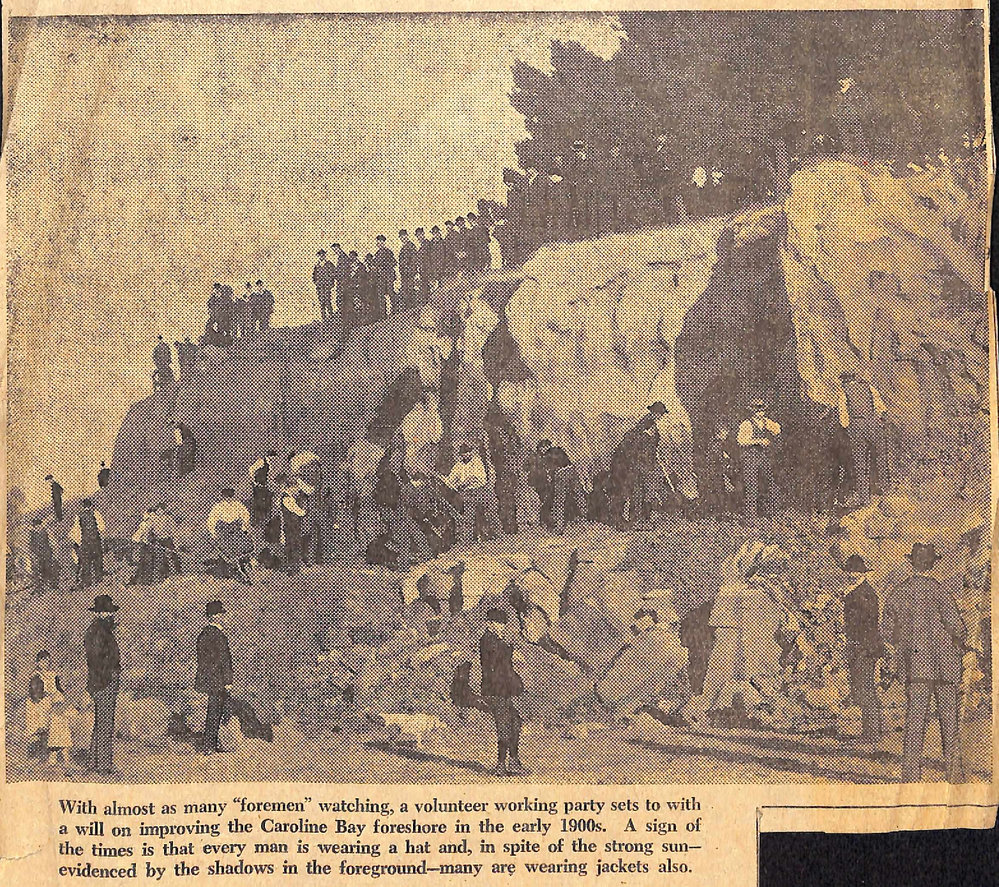
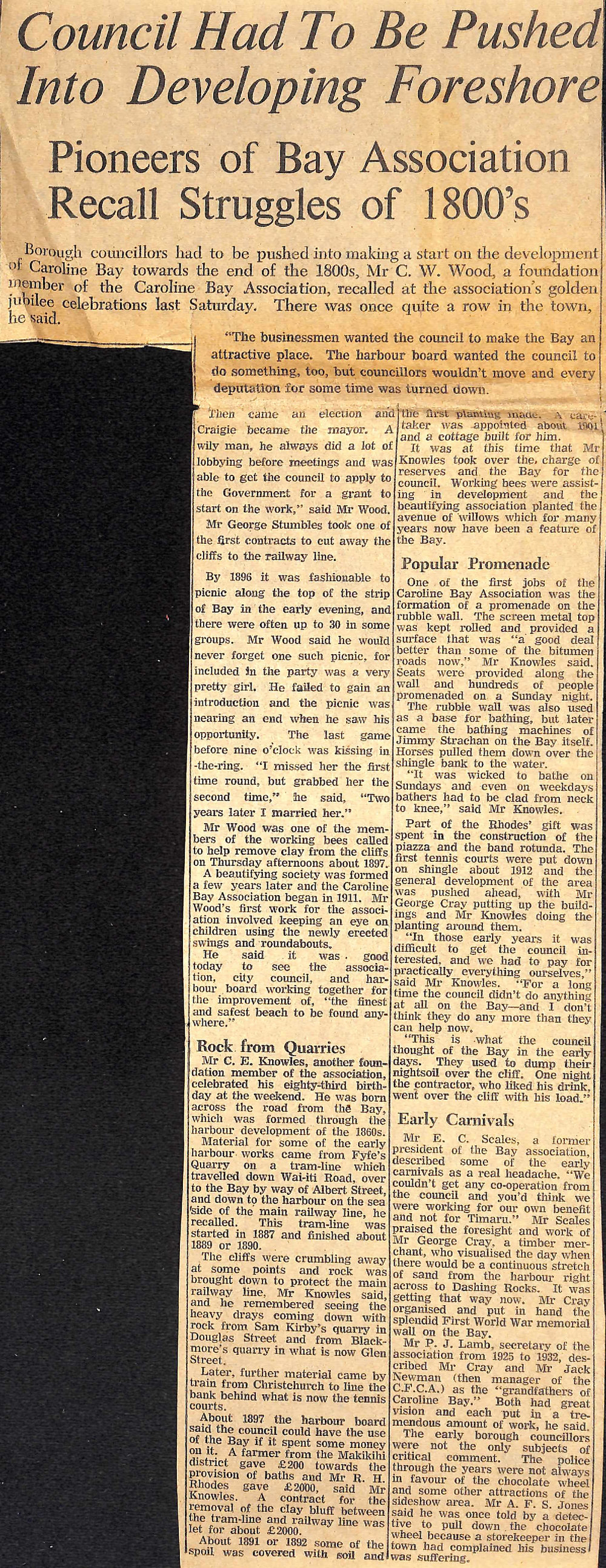
Council Had to Be Pushed Into Developing Foreshore: Pioneers of Bay Association Recall Struggles of 1880s (17 Jan 1962). Aoraki Heritage Collection, accessed 30/06/2026, https://aorakiheritage.recollect.co.nz/nodes/view/361