
By Roselyn Fauth
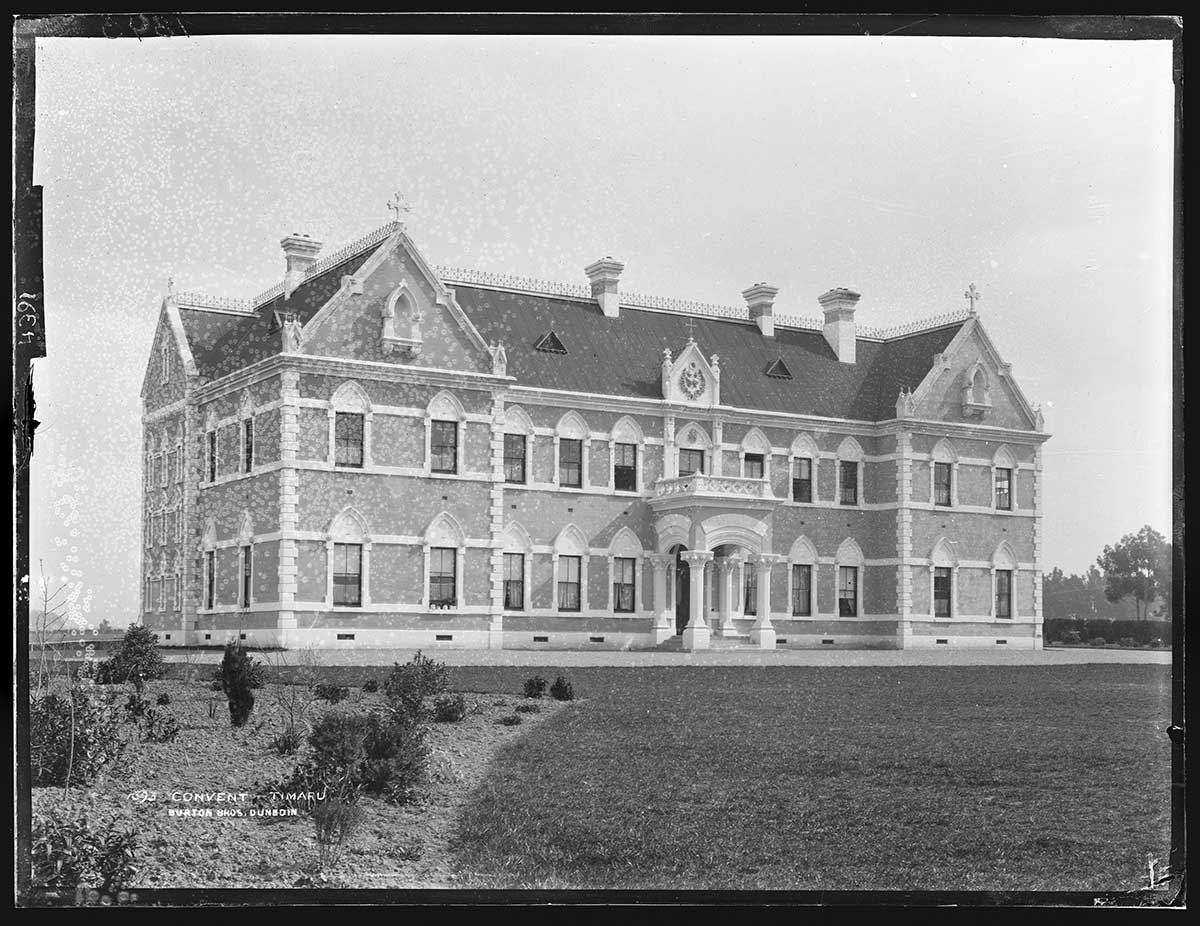
This historic photograph shows the Convent, Timaru, photographed by Burton Brothers. The convent became the base for the Sacred Heart Sisters’ education work, later passed to the Sisters of Mercy, and helps connect the early Catholic school story to Sacred Heart Girls’ College, Mercy College and Roncalli. Image: Convent, Timaru, New Zealand, Burton Brothers, Te Papa Tongarewa, C.014391. The foundation stone of the Convent of the Sacred Heart, Timaru, dated 13 February 1880. Maurice de Harven Duval was the architect. He was a French or Belgian architect who practised in Timaru from about 1877 to 1895, and note that he undertook a considerable amount of work for the Catholic Church in Canterbury.
The Fence, the Pope and the Hidden School Map of Timaru
How did a Timaru school end up named after an Italian sharecropper’s son — and what does a corrugated iron fence have to do with it? The hunt for Roncarlli's history starts with a clue... its fence
Because before Roncalli was one co-educational Catholic school, there were two schools sitting side by side: Mercy College for girls and St Patrick’s High School for boys.
And according to Aoraki Heritage, the Girls and Boys were separated by a corrugated iron fence. The partition, gave two schools, two traditions, two histories. On one side was the girls’ school story: Sacred Heart College, later Mercy College. On the other was the boys’ school story: St Patrick’s High School.— but one Catholic community.
Then, in 1982, those two stories came together to form Roncalli College, named for Angelo Giuseppe Roncalli, the son of Italian sharecroppers who became Pope John XXIII.
But Roncalli College did not appear from nowhere... to understand how that fence got there and then came down, we have to follow a much older map: from Craigie Avenue to Browne Street, from convent classrooms to boys’ schools, from Sacred Heart Sisters to Sisters of Mercy, from the 1877 Education Act to the Catholic community that decided education mattered enough that they would invest and build their own.
Catholic education in Timaru was not one simple institution. It was a system. It had separate paths for girls and boys. It had different religious communities involved. It had buildings, borders, routines, traditions and expectations.
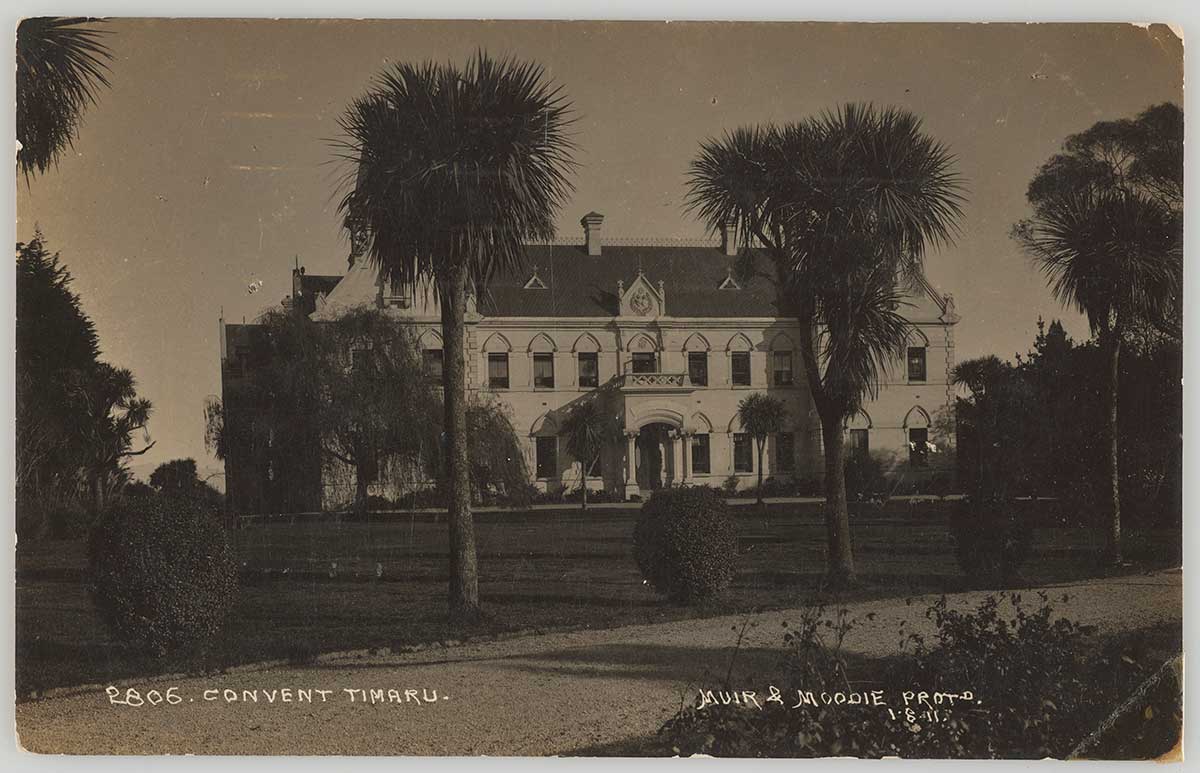
During the depression the Sister of Sacred Heart consolidated and closed the convent. It was reopened in 1936. 1938 St Patrick's High School for boys opened next to the Sacred Heart Convent separated by a tin fence. The convent that was built in 1880 was demolished in 1984 and is now the site of Roncalli College. Timaru., circa 1904, by Muir & Moodie, Burton Brothers. Te Papa (PS.003238) No Known Copyright Restrictions.
The Italian name
Roncalli is not a local Timaru name... it does not sound like a street from early South Canterbury, or a settler family, or a benefactor over the front door... Roncalli's name is linked to the Vatican.
According to the Vatican biography, Angelo Giuseppe Roncalli was born on 25 November 1881 at Sotto il Monte, near Bergamo in Italy. His family were sharecroppers. Angelo Roncalli was a child from a farming family in northern Italy.
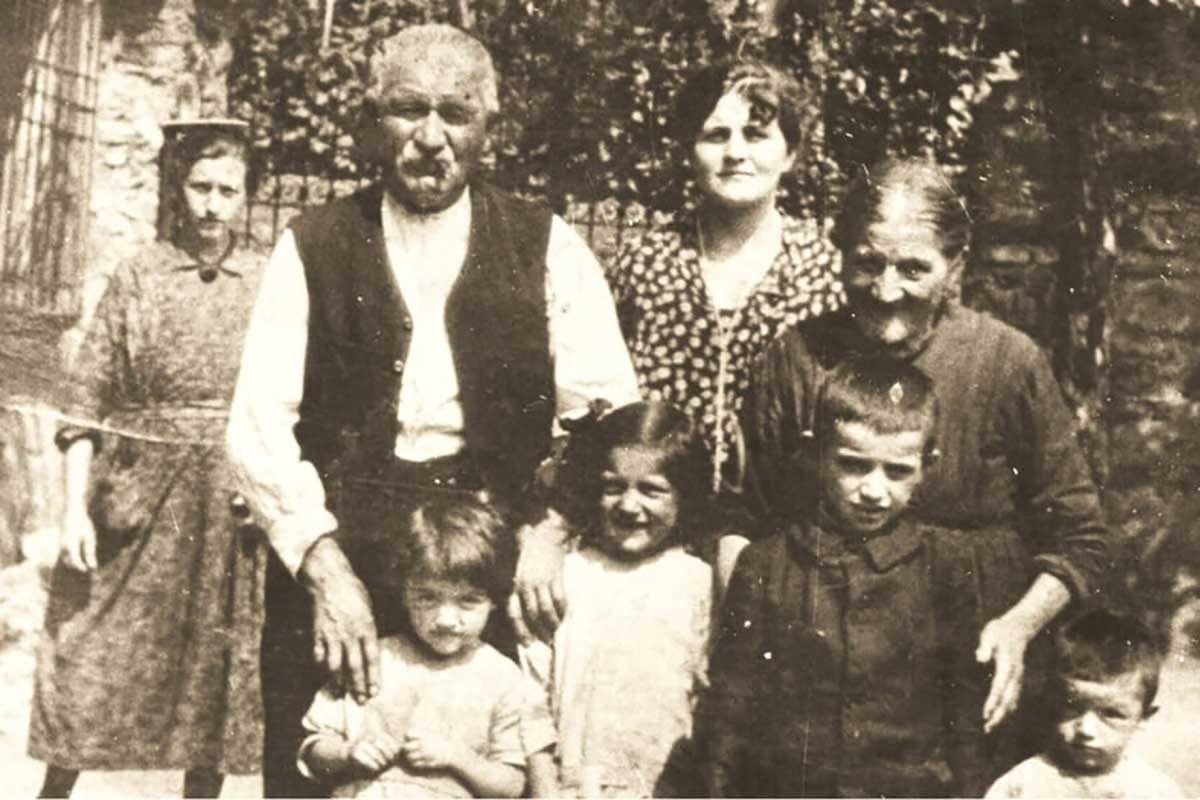
Roncalli's family ic 1890 Unknown author - https://www.solfano.it/canicatti/giovanni_XXIII.html La vita militare di Papa Giovanni XXIII Adolfo Zamboni
He was ordained a priest in 1904. During the First World War, the Vatican biography says he served first as a sergeant medic and later as a military chaplain. In 1953 he became Cardinal Patriarch of Venice. In 1958 he was elected pope and took the name John XXIII.
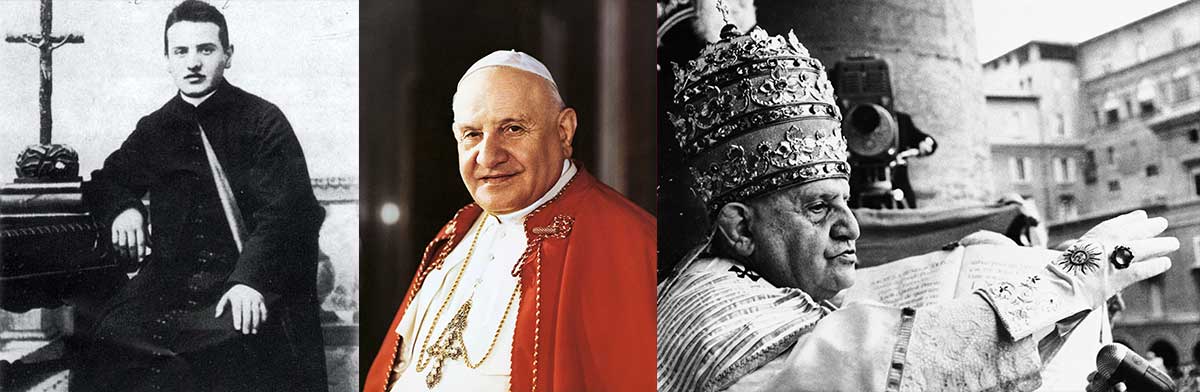
Roncalli College is a Catholic secondary school in Timaru, New Zealand. It was named after Pope John XXIII, whose birth name was Angelo Giuseppe Roncalli. Elected to the Papacy in 1958.
LEFT: The young priest Roncalli Unknown author - http://www.donbosco.es/Santoral/imagenes/2306.jpg
CENTER: Portrait of John XXIII (1881 – 1963) StJohnXXIIICommunity.com
RIGHT: Pope John XXIII's coronation on 4 November 1958. He was crowned wearing the 1877 Palatine Tiara. https://commons.wikimedia.org/wiki/File
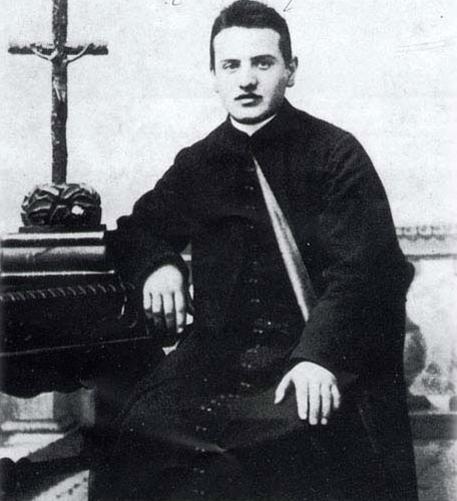
He is remembered especially for calling the Second Vatican Council, which opened in 1962. That council became one of the most important Catholic events of the twentieth century, associated with renewal, dialogue and the Church’s engagement with the modern world.
So when Timaru’s co-educational Catholic college was named Roncalli, it was not just choosing a pleasant Italian name... it was linking the school to a pope remembered for warmth, humility, renewal and openness.
"Consult not your fears but your hopes and your dreams. Think not about your frustrations, but about your unfulfilled potential. Concern yourself not with what you tried and failed in, but with what it is still possible for you to do." - ST POPE JOHN XXIII"
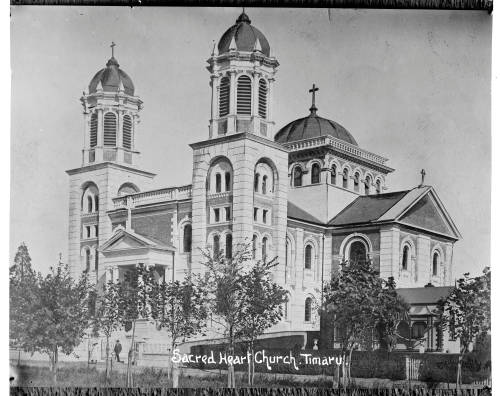
Sacred Heart Church, Craigie Avenue, Timaru. Image: Auckland Libraries via DigitalNZ, no known copyright restrictions.
Before Roncalli, before Mercy, before St Pat’s
To see the beginning of this school, we have to go back to colonial Timaru.
I found an Aoraki Heritage record describing the Strathallan as the first immigrant ship to bring settlers directly from Britain to Timaru. It arrived in 1859. This ship brought 110 immigrants from the UK to our shore.
For a bit of context. Christchurch was founded as a Anglican colony, and the Scotts were setting themselves up in Dunedin. Timaru was slap bang in the middle.
According to the Christchurch Catholic Diocesan Archives, the first Sacred Heart church on Craigie Avenue opened on 25 October 1874 and was completed in 1877. Sacred Heart Basilica’s own history says the present basilica is the third church built on the Craigie Avenue property.
So before the basilica we see today, there was already a Catholic worshipping community on Craigie Avenue, and very soon, that community was thinking about schools.
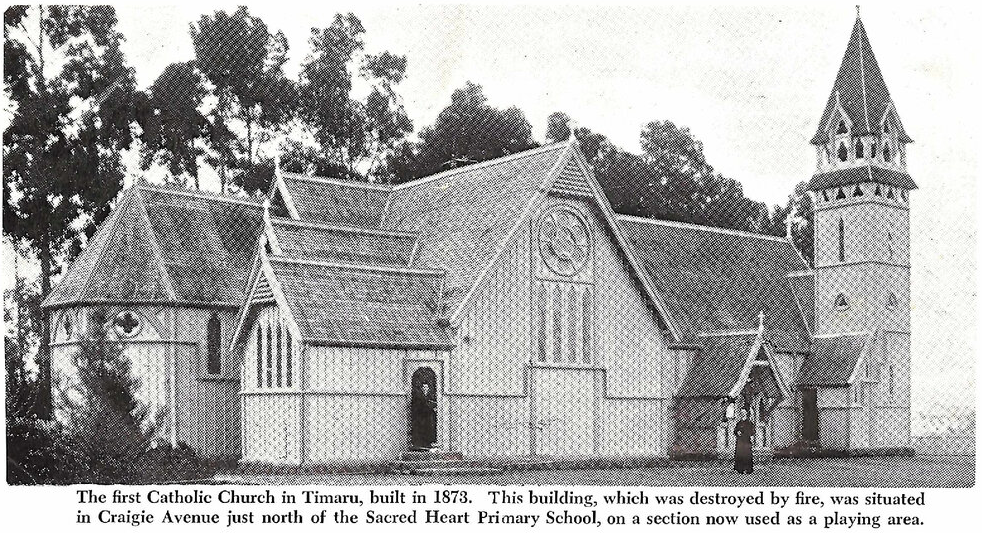
The first Catholic Church in Timaru (30 Sep 1961). Aoraki Heritage Collection, accessed 28/06/2026, https://aorakiheritage.recollect.co.nz/nodes/view/4107 The church was built by Father Jean-Baptiste Chatainger.
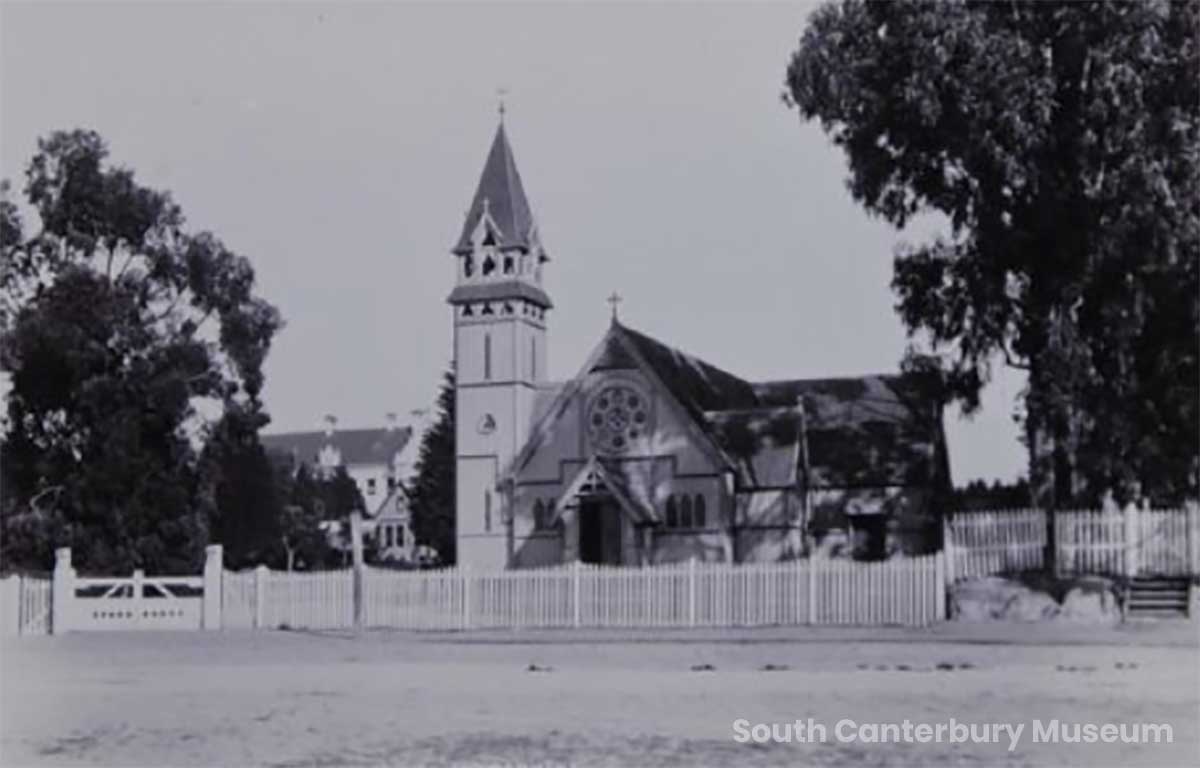
041-The-Roman-Catholic-Church-and-convent-1887-1889 South Canterbury Museum 3867
The law that changed the school map
According to NZHistory, the Education Act 1877 established free, compulsory and secular education for Pākehā New Zealand children.
For Catholic families, state education might be free and compulsory, but it did not provide a Catholic education. If Catholic communities wanted their children educated within their own faith tradition, they had to organise and support their own schools.
That meant buildings... teachers, and of course a need for funding. It meant parish effort, religious orders, community loyalty and long-term commitment.
This is what makes the Timaru story bigger than a list of school names. Catholic education here was a community response to a national system. It was local people asking: if the state will not provide the kind of education we want, how will we build it ourselves?
The 1879 clue in Papers Past
The first public clue I found is in Papers Past. On 16 October 1879, the South Canterbury Times published an article titled “Timaru Catholic Schools”. The report said new Catholic schools had been under construction on the Town Belt and were attracting attention from passers-by.
Sacred Heart School’s own public history records that the first Sacred Heart Parish School opened on 3 November 1879, before the Sacred Heart Sisters came. It also notes that although the school had both boys and girls, they were not taught together in those days. Bishop Redwood asked for plans to be drawn up for a boys’ school on Browne Street and a girls’ school on Craigie Avenue.
That makes 1879 a crucial year. Catholic education in Timaru was not simply a later convent story. It was not simply a Roncalli story. The separate paths for girls and boys were already beginning to appear before the Sacred Heart Sisters fully established their Timaru convent-school work in 1880.
A small newspaper item becomes a doorway, and it helps us imagine people walking past the new buildings, looking at what was going up, and wondering what this Catholic school map would become.
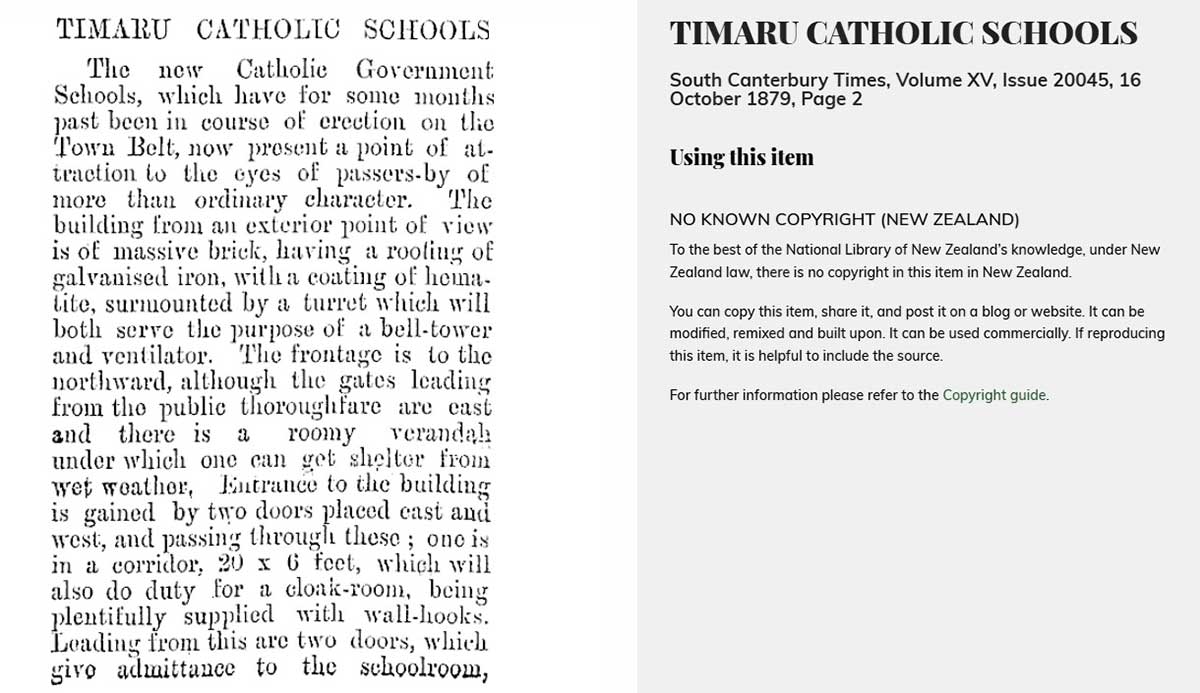
TIMARU CATHOLIC SCHOOLS South Canterbury Times, Volume XV, Issue 20045, 16 October 1879, Page 2 https://paperspast.natlib.govt.nz/newspapers/SCANT18791016.2.13
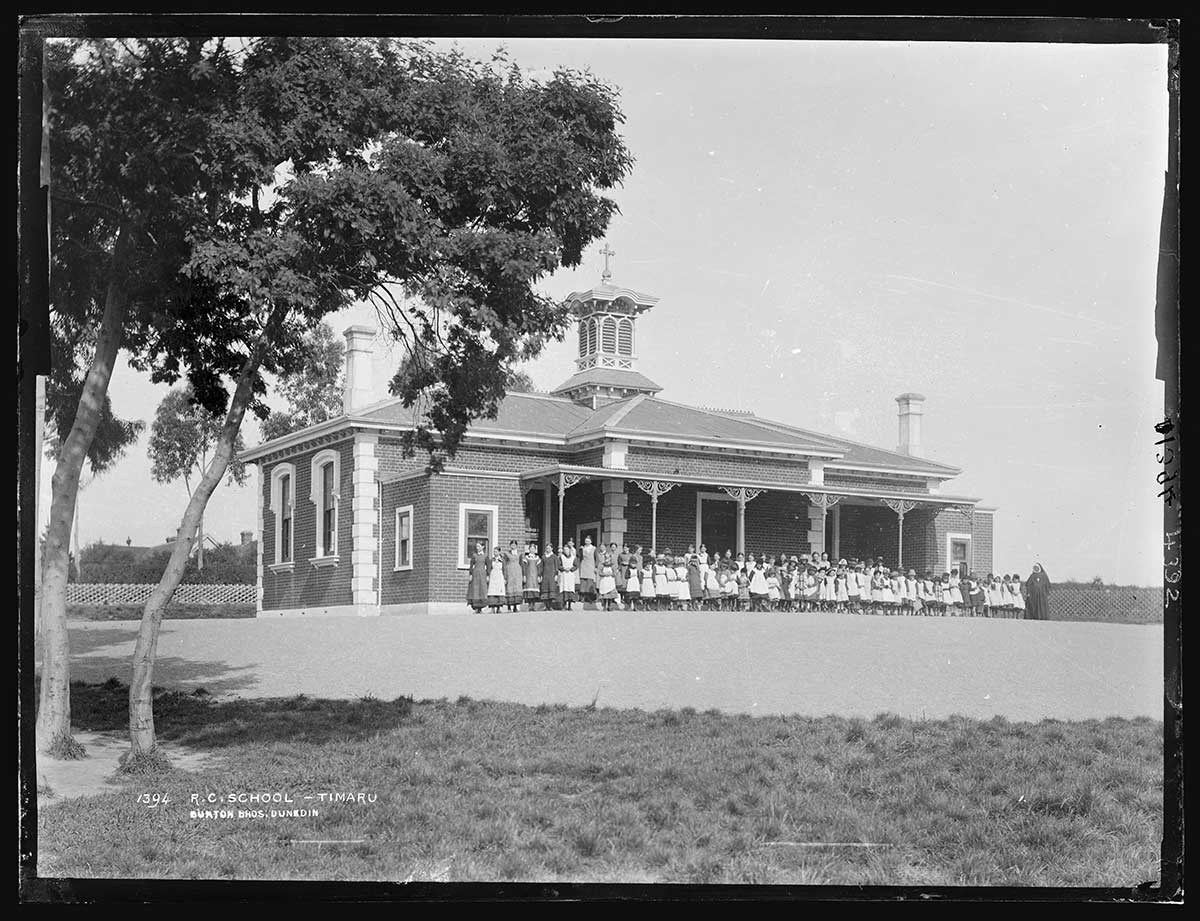
Roman Catholic School, Timaru, New Zealand, by Burton Brothers. Te Papa (C.014392) the school opened on the corner of the Town Belt now Cragie Ave and Browne St. a separate Boys school was built in 1881. Fathers Chatigner and Goutenoire wrote to various Orders of nuns requesting they come to Timaru to set up a Convent/Catholic High School. The Sacred Coeur Headquarters in France received the request and said yes. There were some sisters in Kansas who needed a new mission as a fire had destroyed a Catholic Jesuit College. Goutenoire was a priest in Louisiana and was nursed back to health from Yellow Fever by Mother Susanne Boudreau. In 1880 six nuns arrived from the USA to Timaru by train. The sisters slept the night at the Sacred Heart school until accomodation was arranged. The foundation stone for the convent was raised in February and by September the convent was open. In 1891 the Marist brothers arrived and started a Boys Intermediate. 1969 Sacred Heart Girls College changed its name to Mercy College. 1982 Roncalli College opened, named after the Pop John XXIII who was elected papacy in 1958. Their Coat of arms motto was "To see truth and peace." four parts of their shield reflect the history of the college, the tower is from Pope John's own coat-of-arms. A book representing the holy Scriptures, the cross which is the Mercy Symbool and the A M (Ave Maria) is the Marist Symbol.
The Sacred Heart Sisters arrive
In 1880, according to Mercy Schools, the Sisters of the Society of the Sacred Heart of Jesus had lived and worked in Timaru since 1880. They took over teaching at Sacred Heart Parish School and soon opened a boarding school within their large new convent.
Sacred Heart School’s own history adds a useful detail: when the Sisters first arrived, the convent had not yet been built, so for a while they lived in part of the school.
In the New Zealand Tablet of 13 February 1880, the record placed beneath the foundation stone described the Timaru building as the “first Convent of the Society of the Sacred Heart of Jesus in Australasia”.
I don’t think this means Timaru had the first Catholic convent of any kind. It means this contemporary Catholic source described it as the first convent of this particular order, the Society of the Sacred Heart of Jesus, in Australasia.
Timaru was not just receiving a small local school. It was becoming part of an international Catholic education network, led by women religious who had come here to teach.
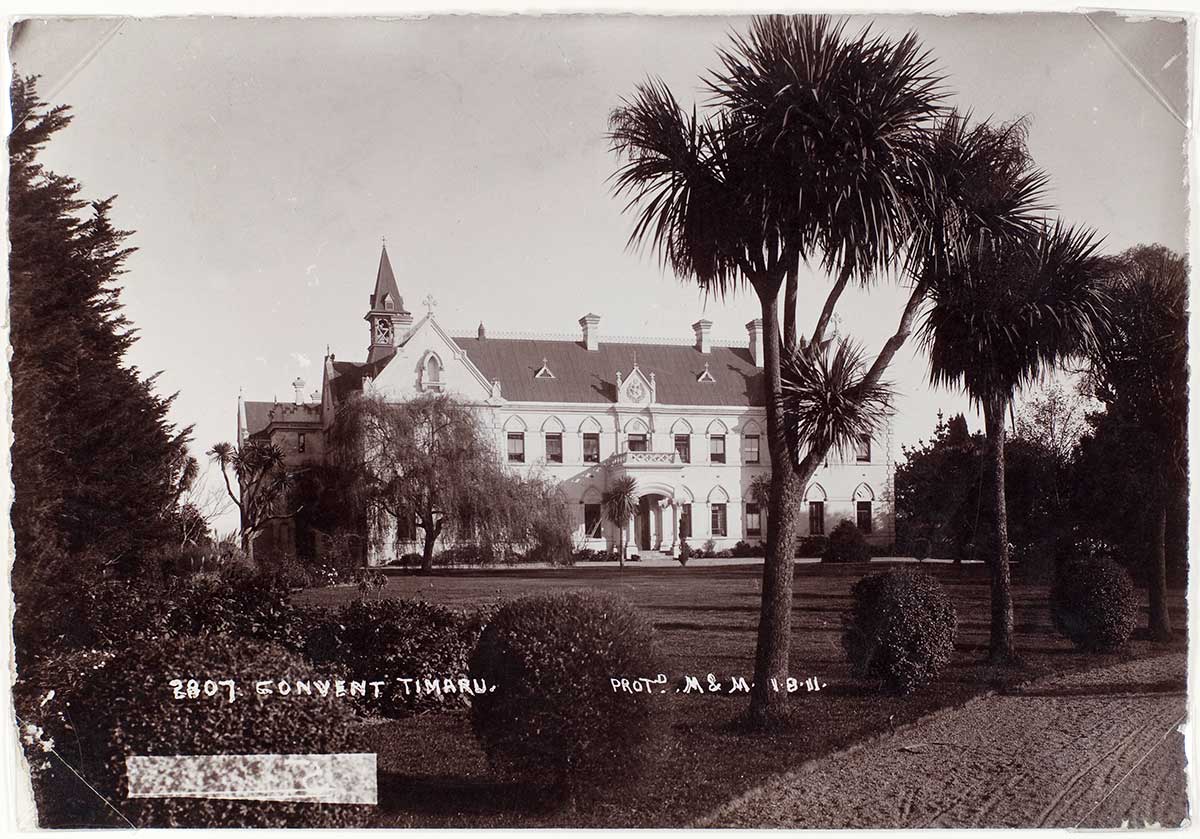
Convent, Timaru, 1911, Timaru, by Muir & Moodie. Te Papa (O.001825). The Convent of the Sacred Heart, Timaru, photographed in the early twentieth century. The convent was the hinge of the story: home to the Sisters, base for girls’ education, and later the place where the Sisters of Mercy continued the work. Image: Te Papa, no known copyright restrictions. Roncalli College was created by merging St. Patrick's High School and Mercy College in 1981. Roncalli is now on the site, and most of the buildings are remnants from the days of the single-sex schools.
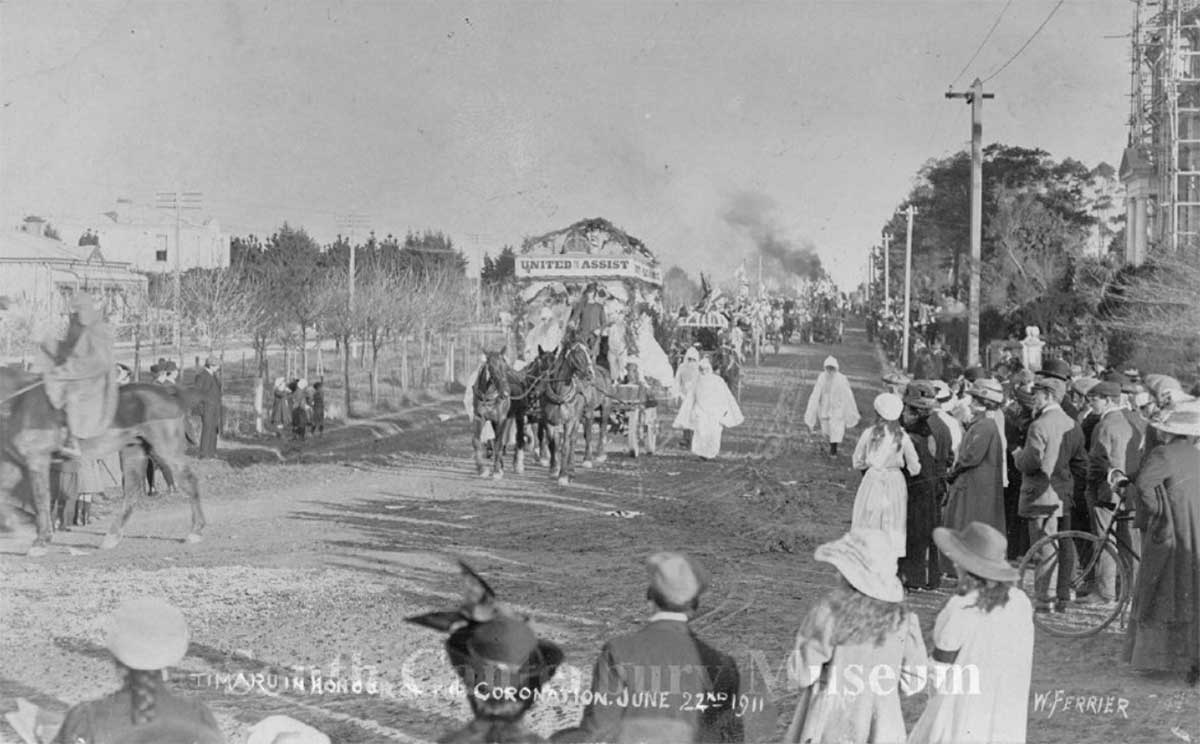
Timaru's coronation procession for George V, pictured on Craigie Avenue on 22 June 1911. Shows the Druids float led by a black-coated Druid on horseback, followed by white-coated members on a horse-drawn float. On the right can be seen the Basilica with the scaffolding still up. South Canterbury Museum 1486 https://timdc.pastperfectonline.com/Photo/347700F3-180A-4808-8BA3-141632070788
This story could easily become a list of institutions.
Sacred Heart Parish School.
Sacred Heart Convent.
Marist Brothers School.
Sacred Heart Girls’ College.
St Patrick’s High School.
Mercy College.
Roncalli College.
St Joseph’s.
St Mary’s.
But we know its not the institutions that teach children... it is the people who do.
According to the Society of the Sacred Heart, Saint Madeleine Sophie Barat founded the Society in France in 1800. The order became closely associated with education, especially the education of girls.
According to the Sisters of Mercy, Catherine McAuley founded the Sisters of Mercy in Dublin in 1831. Their work became associated with care for the poor, the sick and those who were educationally disadvantaged.
Neither Madeleine Sophie Barat nor Catherine McAuley lived in Timaru, but their ideas travelled.
First came the Sacred Heart Sisters. Later came the Sisters of Mercy. Between them, women religious shaped generations of Catholic education in Timaru.
According to Mercy Schools, the Sisters taught music and speech, visited families, and prayed for the people of Timaru.
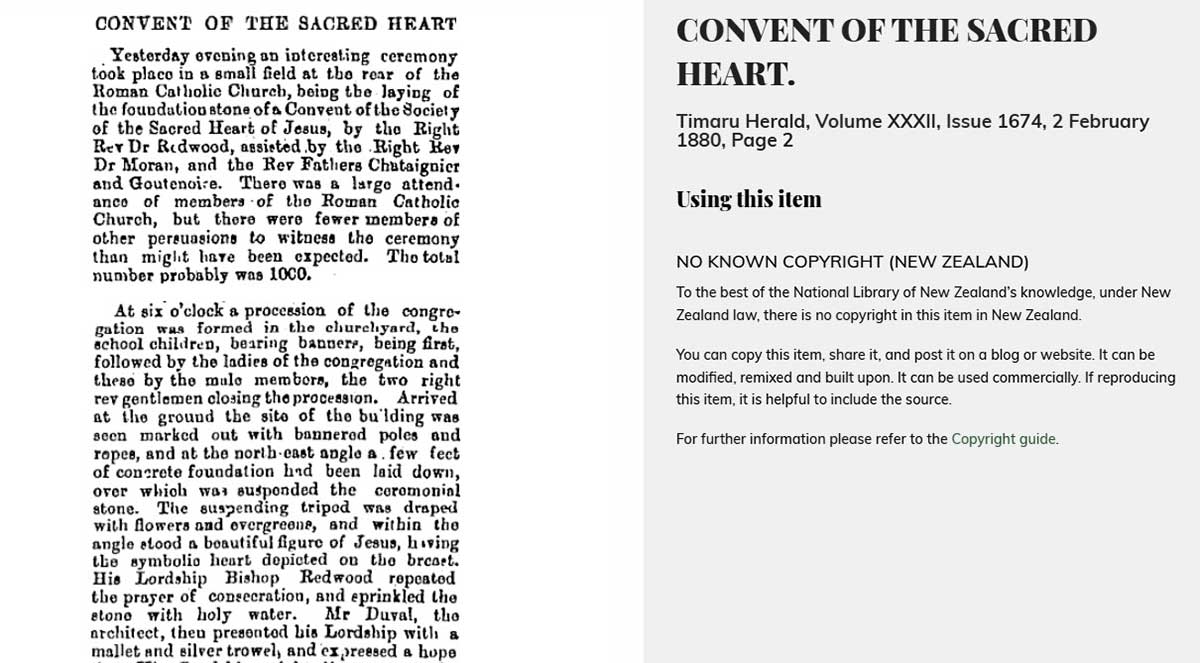
https://paperspast.natlib.govt.nz/periodicals/NZT18800213.2.32
The school map spreads
Aoraki Heritage records that the original Sacred Heart Parish School was run by the Sisters of the Society of the Sacred Heart of Jesus from their arrival in Timaru in 1880. It describes the school as a primary school for girls and junior boys.
Older boys, Aoraki Heritage says, were taught at the Marist Brothers School on Browne Street. This is where the Catholic education story becomes a map... a few tabs open in my mind, imaging Craigie Avenue with its church-convent-school heart. Browne Street carrying the boys’ school story... and then later, Timaru North would add St Joseph’s and St Mary’s.
I got in a little mess when nutting out this timeline. Some public records point to Catholic boys’ education from the early 1880s, while other material points to the Marist Brothers’ formal role a little later. A little bit more of a history hunt to unravel here, but that is for another day.
1935: a handover in hard times
The next major turn came during the Depression years.
According to Mercy Schools, by 1935 circumstances had changed, and the Sacred Heart nuns decided it was time to leave Timaru. The Sisters of Mercy were asked whether they would take their place, and they bought the large convent at the end of 1935.
The Sacred Heart Sisters had shaped the first long chapter. From 1935 onward, the Sisters of Mercy became central to Catholic education in Timaru.
According to Mercy Schools, Sacred Heart Girls’ College opened in 1936, with classrooms in the convent, and that became the girls’ secondary school thread.
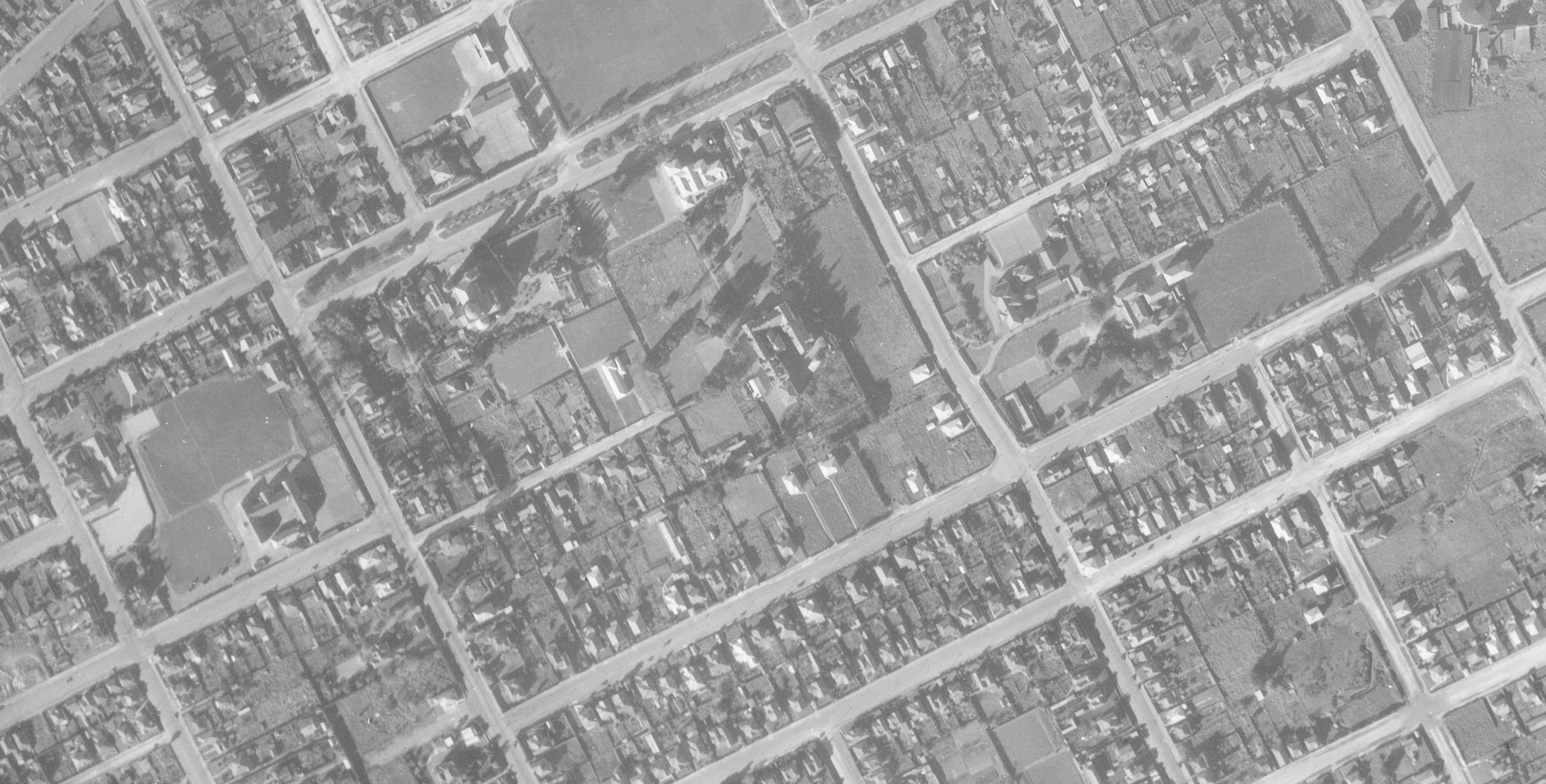
1936 - Retrolens - Timaru Main School on the Left, The Basillica center and then Timaru Girls' High School on the Left.
St Patrick’s and the boys’ school thread
The boys’ secondary school thread belongs with St Patrick’s High School. I found a DigitalNZ record for Timaru Catholic Secondary Schools: Golden Jubilee, 1937–1987. Its description says the book covers St Patrick’s High School, 1938; Mercy College, 1936; and Roncalli College, 1982.
St. Patrick's was the local high school for Catholic boys, run by the Marist order, and Mercy College was the local Catholic school for girls, run by the Mercy sisters, from their convent, which was situated on what is now the rugby field, also known as the Thunder Dome.
The schools were separated by the "Iron Curtain" or "Brown Curtain", a corrugated iron fence that ran the length of the boundary between the two schools, which kept the boys and girls separated. The penalties for being on the wrong side of the fence were rather severe; any boy caught on the wrong side of the fence without a valid reason was invariably caned.[
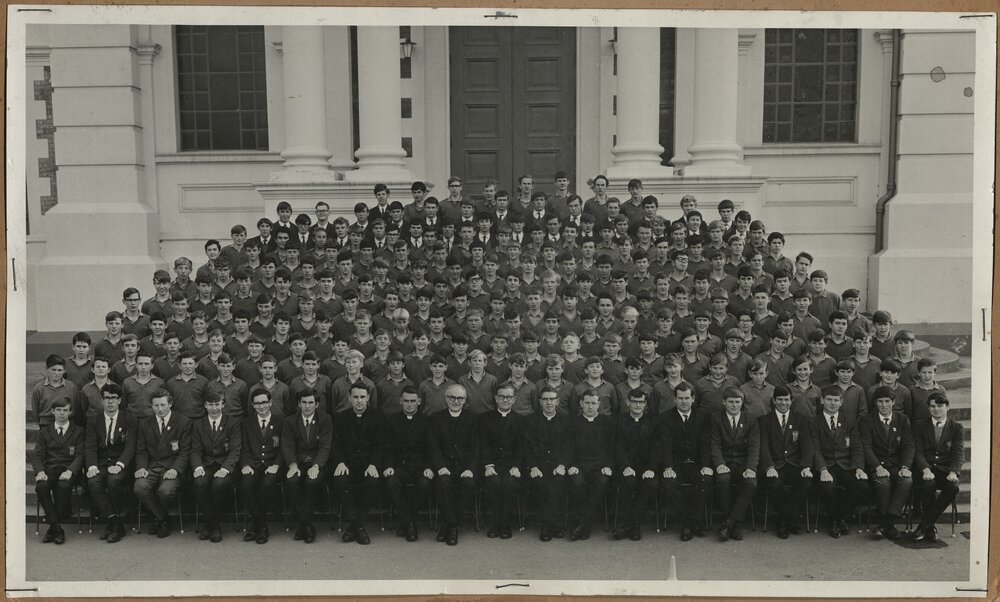
1969 St Patrick's High School students on the front steps of the Sacred Heart Basilica Timaru. Aoraki Heritage Collection, https://aorakiheritage.recollect.co.nz/nodes/view/8375 Roncalli College archive, permission required. The Marist Brothers arrived in 1891 and started an Intermedia Boys school. In 1982 the school amalgamated. The school celebrated their Golden Jubilee of Mercy and St Pats celebrating their combined Catholic Secondary Schools Jubilee with a tree planting in 1987. By 1993 The school had 20 Full-time and 16 part0time teachers and a roll of 355. In 1994 according to a book produced on the occasion of the 25th jubilee of Roncalli College. 75% of the income went into learning resources.
Back to the fence
Now the fence makes sense... by the mid-twentieth century, Catholic secondary education in Timaru had two neighbouring strands: the girls’ school story and the boys’ school story.
Aoraki Heritage records that Sacred Heart College changed its name to Mercy College in 1969. It also records that the original single-sex schools were separated by a corrugated iron fence along the boundary.
Girls on one side. Boys on the other. Two schools, two traditions, one Catholic community.
And that fence was the physical expression of how the system worked at the time until the system changed again.
The schools were separated by the "Iron Curtain" or "Brown Curtain", a corrugated iron fence that ran the length of the boundary between the two schools, which kept the boys and girls separated. The penalties for being on the wrong side of the fence were rather severe; any boy caught on the wrong side of the fence without a valid reason was invariably caned.[citation needed]
In the last days of St. Pats and Mercy, the pupils from St. Pats were instructed by the rector to tear down the fence as a prelude to amalgamation. The event was photographed and featured in the Timaru Herald newspaper.
In October 2007, Roncalli College celebrated its 25th Jubilee.
1982: the map folds together
According to Roncalli College’s own public history, Roncalli College was formed in 1982 following the amalgamation of St Patrick’s High School and Mercy College. The college takes its name from the family name of St Pope John XXIII, Angelo Giuseppe Roncalli.
Mercy Schools records the same turning point: in 1982, Mercy College merged with St Patrick’s Boys’ High School to become Roncalli College.
This was the moment when more than a century of Catholic education in Timaru folded together: the parish school of 1879, the Sacred Heart Sisters from 1880, the convent classrooms, the boarding school, the boys’ school, the Mercy Sisters, St Patrick’s, Mercy College, and a Catholic community that kept adapting as the town and the Church changed.
Look again
So next time you pass Sacred Heart Basilica, look again... Yes, the church is the landmark... but around it sits another story.
There was a school in the public record by 1879. There were Sacred Heart Sisters from 1880. There were girls and younger boys in one school world, older boys in another. There was a convent. There were classrooms. There were boarders. There were Sisters of Mercy. There was St Patrick’s. There was Mercy College. There was a corrugated iron fence.
And then there was Roncalli, a Timaru school named after an Italian sharecropper’s son who became Pope.
A college formed when two local Catholic school stories came together.
The basilica might be the building we notice first... but the fence is the clue.
The 1880 foundation-stone report for the Convent of the Sacred Heart shows how ambitious the Timaru building was intended to be. Designed by M. de H. Duval, it was described as an Italian-Gothic or Anglo-Italian stone convent, with blue stone walls, white stone dressings, Gothic portico, balcony, gables, crosses and cast-iron roof cresting. At two storeys high, with long wings forming a quadrangle, it was planned to include chapels, dormitories, classrooms, dining rooms, kitchen, infirmary and bathrooms — a major piece of Catholic built heritage in South Canterbury.
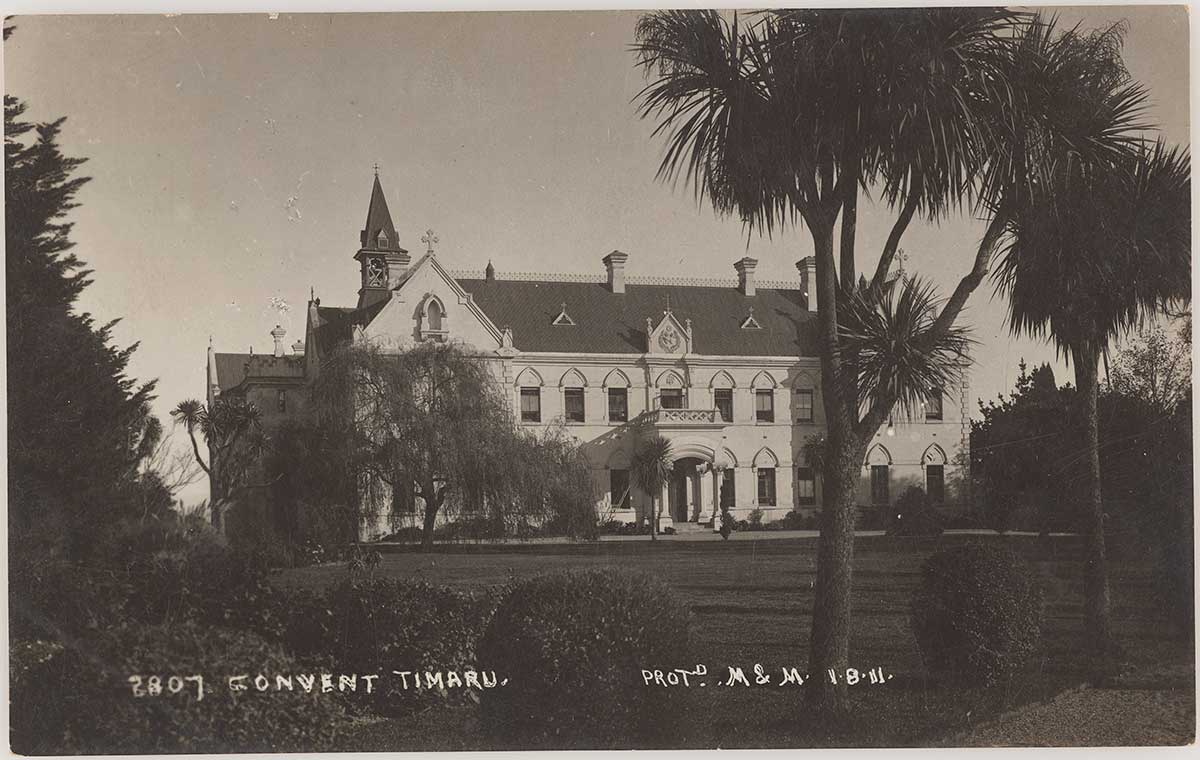
Convent Timaru, 01 August 1911, Dunedin, by Muir & Moodie. Te Papa (PS.002966)
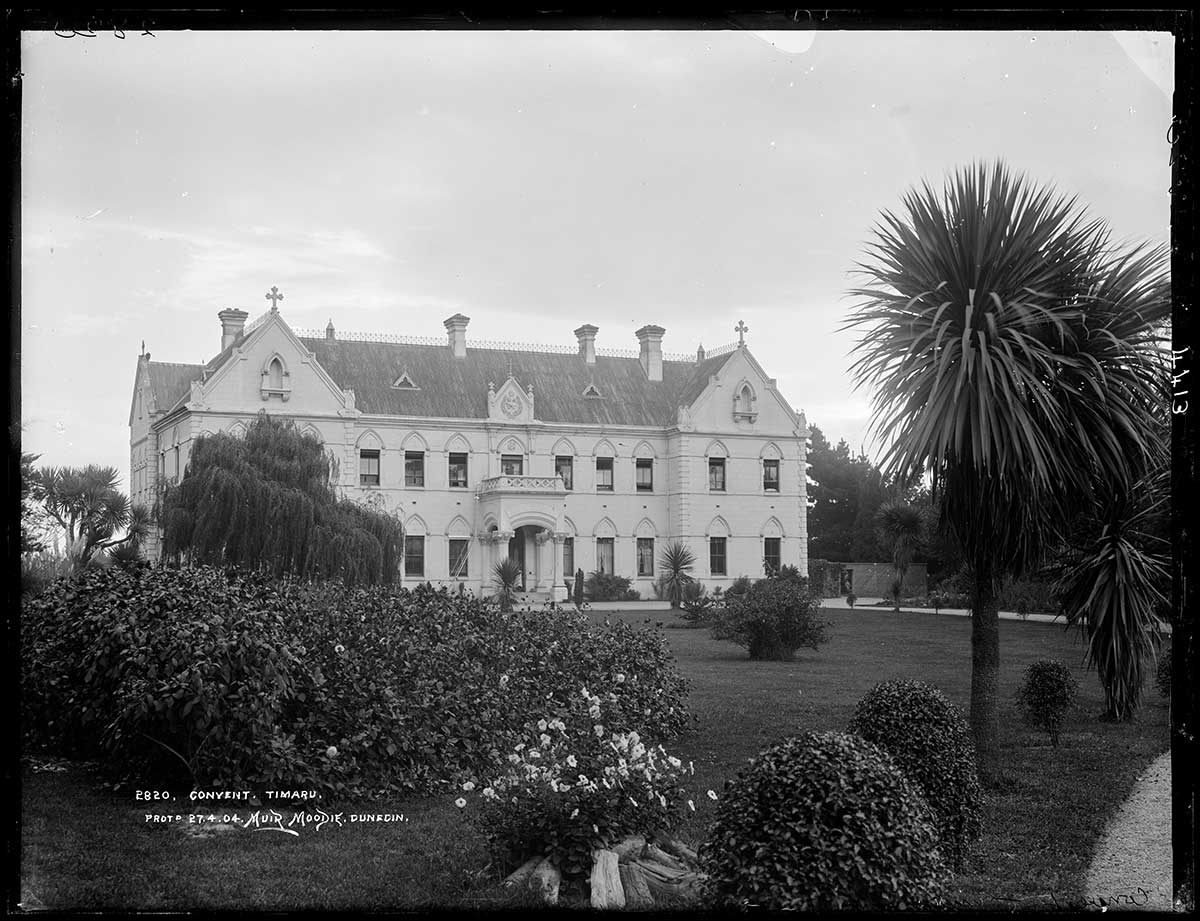
Convent, Timaru, circa 1904, Dunedin, by Muir & Moodie. Te Papa (C.014413)
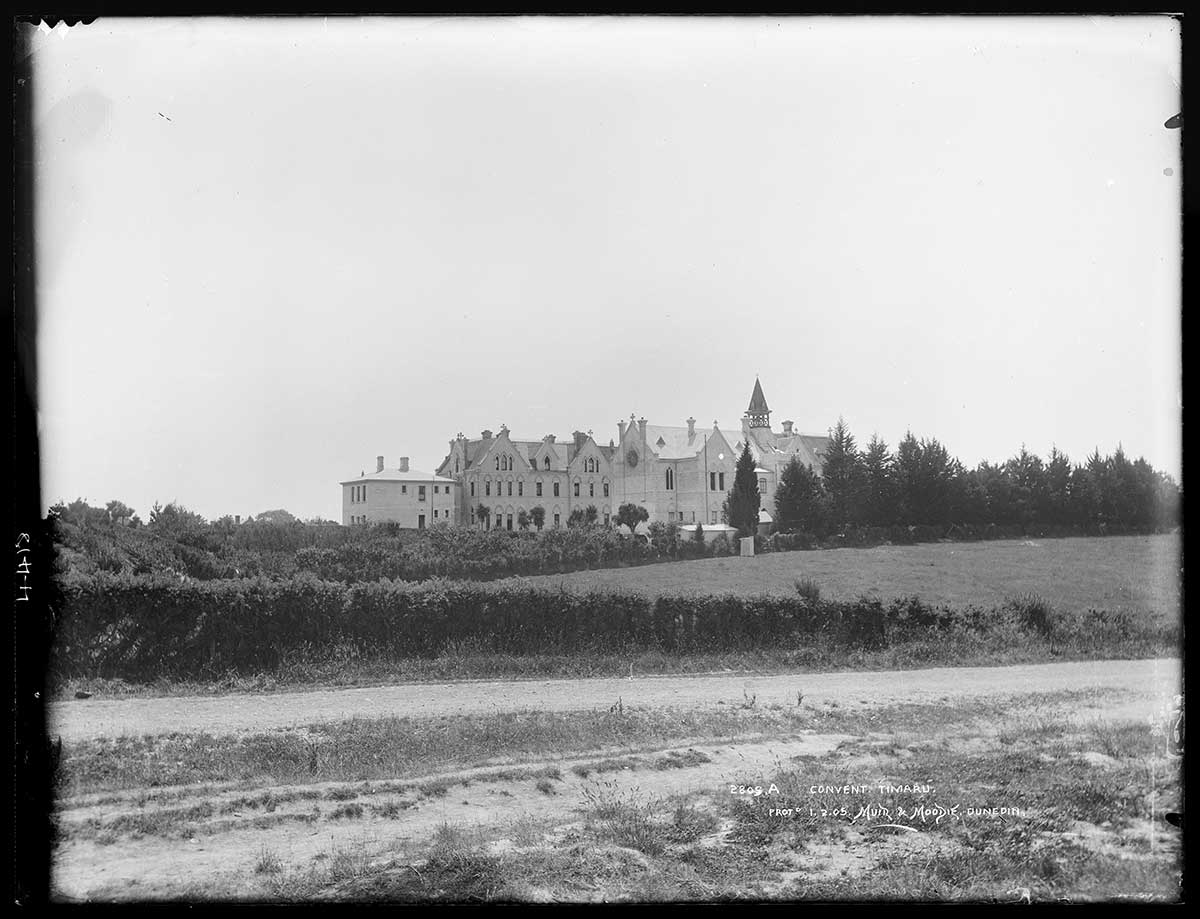
Convent, Timaru, New Zealand, by Muir & Moodie. Te Papa (C.014418)
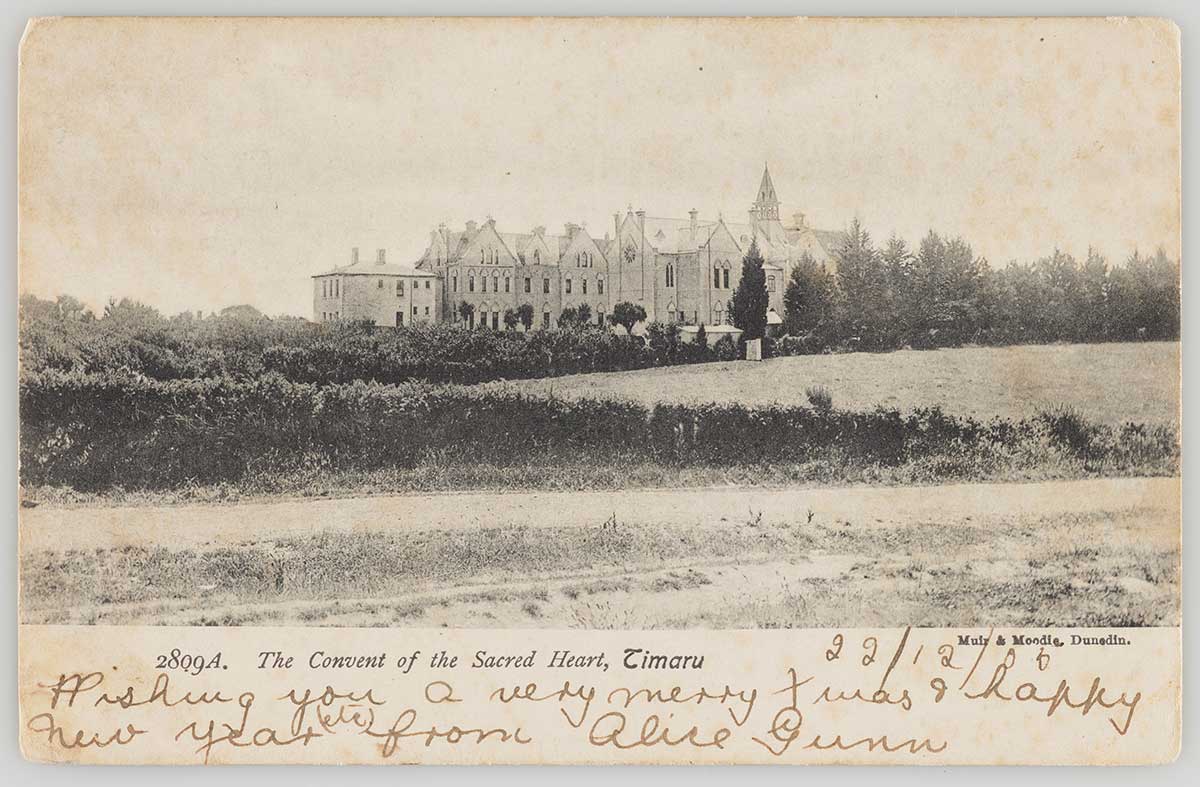
The Convent of the Sacred Heart, Timaru, 1905, Timaru, by Muir & Moodie. Purchased 1998 with New Zealand Lottery Grants Board funds. Te Papa (PS.001040).
A Timaru Herald tender notice from 4 October 1899 invited tenders for the “erection of additions to the Convent of the Sacred Heart, Timaru”, with plans and specifications available at an office in Church Street. That supports the idea that the convent complex was expanded after the original 1880 building.
Side Quest: How does St. Vianney’s fit into the Catholic story
St. Vianney’s Timaru Trust connects back to 1835. Suzanne Aubert was born in Lyon, France, and at the age of 25 she accepted an invitation to become a missionary travelling to Auckland. In 1892 Suzanne was appointed Mother Superior of the newly established Daughters of Our Lady of Compassion, later to be known as the Sisters of Compassion. In 1907 the Sisters opened the Home of Compassion in Wellington’s Island Bay. 45 years later on 14 December 1952 the Sisters established a new rest home on Morgans Road, Timaru to accommodate disabled women and elderly people. They named the building the "St Vianney's Home of Compassion" in honour of the relationship Suzanne Aubert had with Saint Jean Vianney in Lyon.
CONVENT OF THE SACRED HEART, TIMARU.
A DOCUMENT, of which the following is a copy, was placed in a cavity beneath the foundation stone :—
“This foundation stone of the first Convent of the Society of the Sacred Heart of Jesus in Australasia, was solemnly laid in Timaru, in the Province of Canterbury and Colony of New Zealand, by the Right Reverend Francis Redwood, S.M., Lord Bishop of Wellington, assisted by the Right Reverend Patrick Moran, Lord Bishop of Dunedin, and the Reverend Fathers Chataigner and Goutenoire, S.M., pastors of Timaru, in the presence of a large concourse of people, on the first day of February, A.D. 1880, in the third year of the Pontificate of Leo XIII., Victoria being Queen of England and Empress of India, and Sir Hercules Robinson Governor of New Zealand. The Reverend Mother Adèle Lehon was then Superior-General of the Society of the Sacred Heart, the Reverend Mother Susannah Boudreau Superior Vicar, Mother Mary Rachel Sharman first local Superior, and her companions Mother C. Sullivan, Mother H. Main, Mother J. Bauduy, and Sister M. Hefferman.”
The building when completed will form the largest and most imposing structure in South Canterbury. It will be of two lofty storeys, the height from the ground line to the ridge of the roof being 49ft. 6in. The main façade, presented to the east, is 121ft. long and the lateral façades of the two wings are each 134ft. long. The style may be described as Italian-Gothic or Anglo-Italian, and the material to be used, blue stone with white stone dressings, will lend itself readily to the production of a good effect. The front façade is rendered handsome and symmetrical by the gables of the wings being run out six feet beyond the general line of the front, and by a Gothic portico over the main entrance. Above the portico is a balcony on which a window opens, and this is surmounted by a handsome pediment, in the tympanum of which are disposed the symbolic Sacred Hearts, surrounded by a floral wreath. The lateral façades, each 134ft. long, are alike in appearance, and are each relieved by two projecting gables at one-third from the angles of building. The windows are square, with pediments, except in the gable walls of the lateral façades, where they are of different forms in order to give still further variety to these elevations. The pediment over the main entrance and the various gables are surmounted by crosses, and the ridge of the roof is crowned by an ornamental cast iron cresting.
Entering the building at a flight of steps under the portico leads into a vestibule 10ft. wide and 25ft. long. On each side of the vestibule is a reception room 25ft. by 16ft., and two smaller ones 25ft. by 14ft. At the south end of the main front is a temporary chapel 34 feet long and 25 feet wide, and at the opposite end a large reception room 31 feet by 25 feet. Passing from this room along the northern wing we find in succession the pupils’ refectory, 36ft. by 25ft.; the nuns’ dining room, 25ft. by 15ft.; a storeroom or pantry, 25ft. by 12ft.; and a kitchen, 25ft. by 15ft. In the southern wing are four rooms intended for the use of the ladies of the convent. At the end of each wing is a large staircase leading to the upper floor, and behind these are mezzanina floors, on which are situated ten bathrooms and other conveniences. In the centre of the main front on the chamber floor is an infirmary, the window of which opens upon the balcony of the portico. Southward of this is a pupils’ dormitory, 50ft. by 25ft., well lighted, and supplied with two fireplaces. Adjoining the infirmary on the other side is a nuns’ dormitory, 25ft. by 16ft., next to which come two class-rooms, 31ft. by 25ft., then a school-room 56ft. by 25ft., and at the end of the wing another classroom 25ft. by 24ft. In the southern wing are apartments for the ladies of the convent. All the rooms on each floor open into corridors, 8ft. wide, running all round the inner side of the quadrangle formed by the building. The rooms on the ground floor are all 16ft. high, and on the chamber floor 14ft. high from floor to ceiling. The cost of the portion of the building described, and which is to be carried out at once, will be about £5000. The cost of the complete structure will be about £10,000. Three hundred and fifty pounds were placed upon the stone at the collection made at its laying. Mr. M. de H. Duval is the architect.