

This is the Canterbury Farmers’ Co-operative Association’s grain and wool store in Heaton Street, Timaru, in 1899. The building was next to the main trunk railway line from Christchurch to Bluff – a vital link between wool and grain stores and the ports. Hugh Stringleman, Stock and station agencies – Farmers’ co-operatives, Te Ara – the Encyclopedia of New Zealand, https://teara.govt.nz/en/photograph/17387/canterbury-farmers-co-operative-association-store (accessed 30 June 2026).
Most of us know Farmers as a shop... but in Timaru, the Farmers story began with grain, wool, hard seasons, railway sidings, port access, storage sheds, and South Canterbury farmers trying to gain more control over what happened after their produce left the farm. I came to this while researching John Jackson — coal merchant, timber merchant, landowner, and one of early Timaru’s busy business figures. His name keeps turning up in the town’s early commercial history. This time, it appeared in the story of the Canterbury Farmers’ Co-operative Association, usually known as the C.F.C.A.
The connection was land...
In 1881, the new Association leased land from Jackson in the Heaton Street–Beach Road area for a grain and wool store. Jackson was not a founder of Farmers, and his land was not the Association’s first site. But the lease places him inside a wider story about how Timaru handled the produce of the surrounding district.
The C.F.C.A. was formed in Timaru in late 1880, at a time when South Canterbury farmers were under real pressure. They could grow grain and produce wool, but once those goods left the farm, much of the control passed to others. Storage, transport, sales, credit, buyers, agents and access to markets all mattered.
New Zealand had come through the borrowing and public works years associated with Julius Vogel. Railways, roads and immigration had opened districts up, but the economy was vulnerable. Wool prices, grain prices and overseas markets could make or break a season. Before refrigerated export changed the meat and dairy industries, farmers relied heavily on produce that could survive long journeys: wool, skins, tallow, wheat, timber and gold.
The C.F.C.A. was a practical response to a difficult decade.
In 1880, Thornhill Cooper, a farmer from Fairlie Creek, called for farmers to work together. A meeting was held at the Grosvenor Hotel in Timaru on 17 July 1880. About 40 farmers, landowners and others interested in agriculture attended. The issue was not vague. Farmers wanted better control over the movement, sale and value of what they produced.
William Postlethwaite became the first chairman. Early names included Joshua Page, John Hayhurst, John Talbot, Charles Bourn, John Bradshaw, John Buckle, D. McLaren and John E. Goodwin. When the Association was formally established, others were added, including John Kelland Jr, William Barker Howell, John Campbell, John Scott Rutherford, Andrew Cleland, Michael Studholme and William Upton Slack.
The Association was registered in January 1881. Its first manager-secretary was James Watkins, who came from Dunedin. The first office was in Maclean and Stewart’s buildings in Stafford Street, and the Association also bought Henry Green’s grain store in Cain’s Terrace.
Then it needed more land near the railway and port.
A special committee looked at Jackson’s half-acre in the Heaton Street–Beach Road area. Jackson would not accept the first offer, so the Association leased the land instead, with a right to purchase later. Excavations for a grain and wool store began that year.
That small transaction shows how closely Timaru’s early commercial worlds overlapped. Jackson’s business interests included land, coal, timber, shipping and beach trade. The C.F.C.A.’s interests were grain, wool, co-operation, storage and market access. Heaton Street brought those worlds together.
The surviving former C.F.C.A. Wool and Grain Stores at 1 Heaton Street show what that system became.
They were built later than the Jackson lease, in two main stages: 1888–89 and 1892. The design was by F. W. Marchant for Meason & Marchant. George Williams built the first stage, and Frank Palliser was contractor for the 1892 work.
The Timaru District Council heritage form describes the style as Industrial classicism, which is a useful phrase. This was a working wool and grain store, but it was not treated as a plain shed. Its east-facing elevations have temple-front facades, full-height pilasters, arched openings, first-floor arcading, stone keystones and circular vents in the gable ends. The materials included brick, concrete, ironbark, red pine, bluestone and corrugated metal.
That frontage matters. It gave a practical industrial building a formal public face. It also suggests confidence. The C.F.C.A. was not hiding its work at the back of town. It was building large, permanent-looking stores beside one of Timaru’s most important transport routes.
The location mattered too. The stores stood on the north side of Heaton Street, immediately beside the railway line, with the port to the north-east. Grain and wool could come in from the district, be stored, handled, sold and moved on. Heaton Street was part of the working route between farm, rail, port and market.
That is what makes the building more than a handsome survivor. It helps show how South Canterbury’s rural economy shaped Timaru’s townscape. Grain and wool did not just belong on farms. They needed offices, stores, railway access, port access, merchants, agents and workers. The C.F.C.A. stores were part of the route from farm to railway, railway to port, and port to wider markets.
By 1899, photographs show the C.F.C.A. grain and wool stores beside the main trunk railway line from Christchurch to Bluff. That railway connection was central to how the business worked.
The stores were also part of a wider railway-side industrial precinct. Along this strip were mills, grain stores, produce buildings and port-related businesses, including the former Timaru Milling Company mill, Belford Flour Mills, Evans Atlas Flour Milling Company buildings, J. R. Bruce’s Dominion Roller Flour Mills and Biscuit Factory, and Peter McRae’s stone grain store, also known as the Timaru Landing Service building. Read together, these buildings show how much of Timaru’s built heritage was shaped by the movement of rural produce.
Jackson’s land gave the new co-operative one of its early footholds in the Heaton Street–Beach Road area. By 1882, Sections 4 and 5 were in C.F.C.A. possession. The 1892 stage was built on the site of a former coal yard, another reminder of how closely Timaru’s industrial and commercial uses overlapped.
The site also has archaeological interest. The building predates 1900, and the 1875 map shows earlier buildings on Section 5 before the existing wool and grain stores were built.
The speed of change is worth noting.
In 1880, farmers met to discuss co-operation.
In 1881, the Association had offices, stores, staff, leases and a plan.
By 1899, the C.F.C.A. had major grain and wool stores beside the railway, linking South Canterbury farms to rail, port and market.
That is the real story behind Farmers in Timaru. It did not begin with shop counters. It began with producers trying to solve a problem: how to keep more control over what happened after their grain and wool left the farm.
John Jackson’s part was not central, but it was connected. His land appears at a key moment, when the new co-operative needed practical ground close to Timaru’s transport links.
The story of Farmers in Timaru is not only a business history. It is a built-history story about how farming, land, rail, port and architecture met in one working part of town.
And the building that survives at 1 Heaton Street helps us see the bigger shape of early Timaru: farms feeding stores, stores feeding the railway, the railway feeding the port, and the port linking South Canterbury to wider markets.
Source note
This story draws on Eulla Williamson’s *Farmers in Business, 1880–1980: One Hundred Years of Trading by the Canterbury Farmers’ Co-operative Association Limited, Timaru and Branches*; Timaru District Council’s heritage assessment for the former Canterbury Farmers’ Co-operative Association Wool and Grain Stores at 1 Heaton Street; Papers Past reports on the early farmers’ co-operative movement; Te Ara’s image record for the 1899 Heaton Street store; and the Aoraki Heritage Collection’s C.F.C.A. material. Further land-title research would help confirm exactly how John Jackson’s 1881 lease relates to the later surviving Heaton Street buildings.
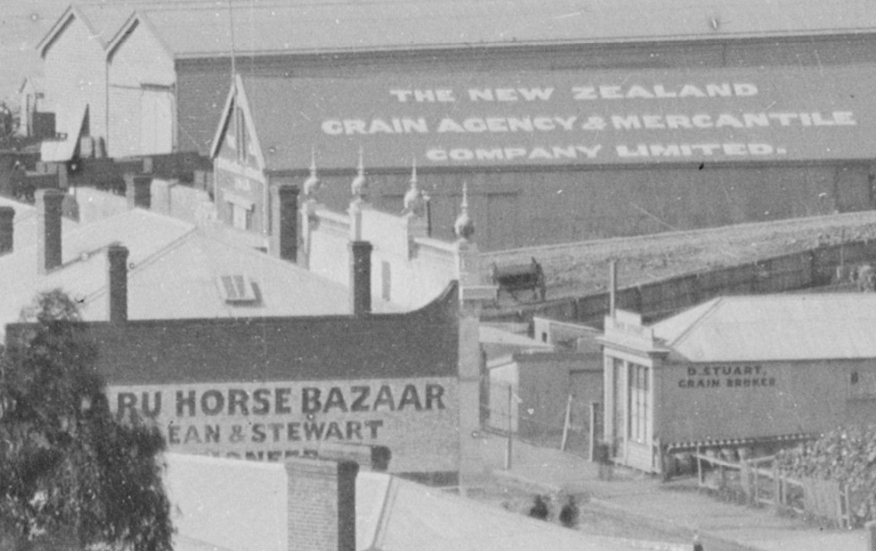
Section of a photo Photo taken by the Burton Brothers on Strathallan Street. Te Papa the building at the left is the Horse Bazar and part of its construction includes bluestone
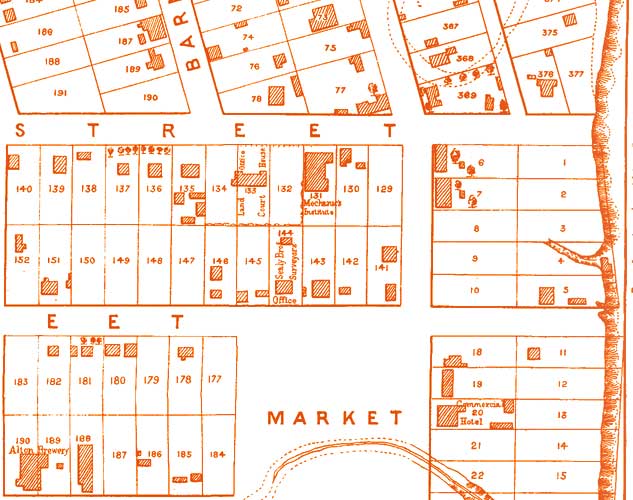
.
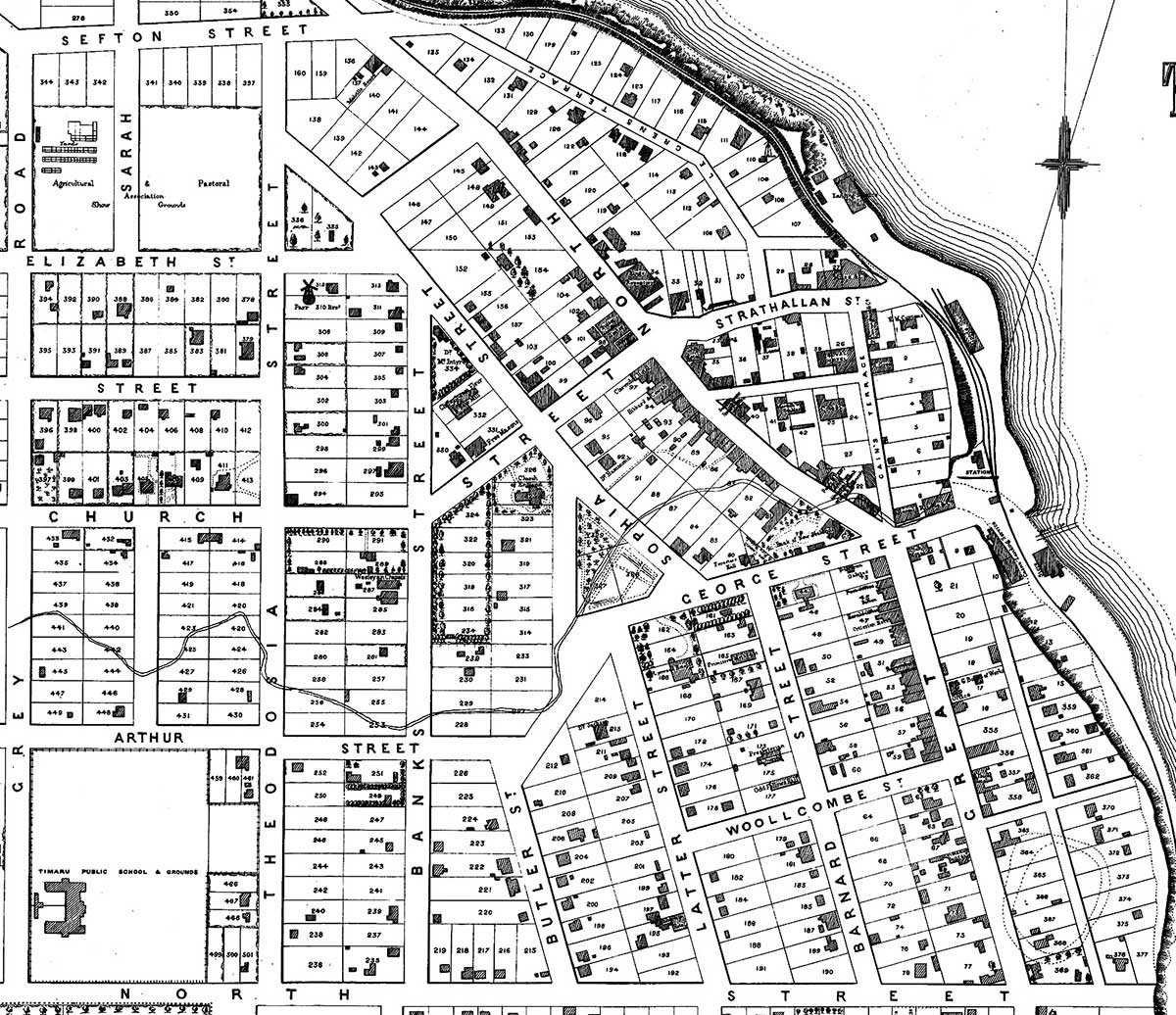
Plan of Timaru Townships, Canterbury, N.Z., 1875. Scale 3 chains to an inch. Lithographed at the Lyttelton Times Office, Christchurch, N.Z. - Courtesy of the Timaru District Council
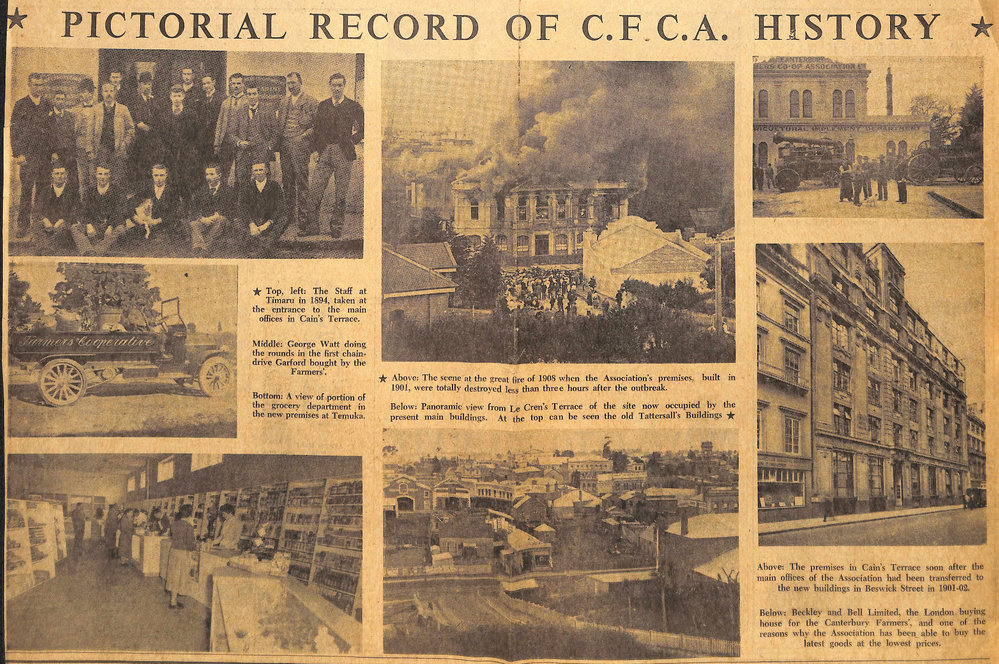
Pictorial Record of CFCA History (17 Oct 1956). Aoraki Heritage Collection, accessed 29/06/2026, https://aorakiheritage.recollect.co.nz/nodes/view/459

Constructed in 1915, this photo was taken a year later, 1916. Exterior view of the Grosvenor Hotel, Timaru, c 1916, photographed by Frederick George Radcliffe. Timaru. F.G.R. 5553 - National Library 1/2-006876-G & hocken.recollect.co.nz/52786 No known copyright or other restrictions on use exist in this image.

Original wooden Grosvenor that got burnt down in fire. Circa 1875 - Picture of Grosvenor Hotel, Timaru
Timeline: C.F.C.A., John Jackson and the Heaton Street Stores
1869
Julius Vogel proposes large-scale borrowing for public works and immigration. This matters because railways, roads and migration helped open districts like South Canterbury, but the boom was also debt-dependent.
1874
Wool prices fall, showing how exposed New Zealand’s rural economy was to overseas commodity prices.
1875
A map of Timaru shows earlier buildings on Section 5, before the surviving C.F.C.A. wool and grain stores were built. This is important archaeological context for the 1 Heaton Street site.
1877–78
Belford Flour Mills is built nearby, adding to the wider railway-side grain and milling precinct.
1879
Wool prices fall sharply. Rural pressure increases, helping explain why farmers began looking for co-operative solutions.
17 July 1880
A meeting is held at the Grosvenor Hotel in Timaru after Thornhill Cooper of Fairlie Creek calls for farmers to work together. About 40 farmers, landowners and others interested in agriculture attend. This becomes the key organising moment behind the Canterbury Farmers’ Co-operative Association.
Late 1880
The Canterbury Farmers’ Co-operative Association is established in Timaru. The Timaru District Council heritage form describes it as the first farmers’ association of its kind in New Zealand.
January 1881
The C.F.C.A. is registered. James Watkins, from Dunedin, becomes the first manager-secretary.
1881
The Association’s first office is in Maclean and Stewart’s buildings in Stafford Street.
1881
The Association buys Henry Green’s grain store in Cain’s Terrace, giving the new co-operative practical warehouse and storage capacity.
1881
The C.F.C.A. looks for more storage land near the railway and port. A special committee considers John Jackson’s half-acre in the Heaton Street–Beach Road area.
1881
Jackson does not accept the first offer, so the Association leases the land, with a right to purchase later. Excavations for a grain and wool store begin. This is the key Jackson/C.F.C.A. connection, but it should not be confused with ownership of the later surviving 1 Heaton Street stores unless land-title research proves that link.
1881–82
The former Timaru Milling Company mill is built nearby, another part of the railway-side industrial precinct.
By 1882
Sections 4 and 5 are in C.F.C.A. possession. This helps connect the land parcels to the later heritage site, though the exact title sequence still deserves checking.
1888–89
The first stage of the surviving former C.F.C.A. Wool and Grain Stores at 1 Heaton Street is built. It is designed by F. W. Marchant for Meason & Marchant, with George Williams as builder.
1888–89
The building is designed in the style described by the Timaru District Council heritage form as Industrial classicism. This explains the grand public face of a working grain and wool store: temple-front facades, full-height pilasters, arched openings, first-floor arcading, keystones and gable vents.
1890
The C.F.C.A. and the New Zealand Farmers’ Co-operative Association of Christchurch establish an insurance company, showing the co-operative expanding beyond storage and sales into broader farmer services.
1892
The second stage of the Heaton Street stores is built, with Frank Palliser as contractor.
1892
The second stage is built on the site of a former coal yard. This is useful because it links back to Timaru’s overlapping coal, land, rail and storage worlds. I would not call it Jackson’s coal yard unless that is proven.
1899
Photographs show the C.F.C.A. grain and wool stores beside the main trunk railway line from Christchurch to Bluff. This is strong visual evidence of the farm–rail–port system.
1903
The Cyclopedia of New Zealand: Canterbury Provincial District is published. This is a useful period source for business and biographical context.
1909
A photograph later used in the Timaru District Council heritage form shows the setting of the Heaton Street stores.
1912
Meason & Marchant design a new Timaru Boys’ High School building in North Street, helping place Marchant within Timaru’s wider architectural history.
1912–14
Hall & Marchant are responsible for the Carnegie Library in Fairlie.
1914
F. W. Marchant registers as an architect, although he had already been active earlier as a civil engineer and designer of major works.
1917
F. W. Marchant dies. His obituary notes his engineering work, including the Opihi ferroconcrete bridge.
1924
Nine major regional farmers’ co-operatives form a federation, showing the co-operative movement becoming more regionally organised.
1924–25
J. R. Bruce’s Dominion Roller Flour Mills and Biscuit Factory develops nearby, adding another layer to the railway-side industrial precinct.
Late 20th century
Amalgamations reduce the number of farmers’ co-operatives nationally. The C.F.C.A. remains one of seven for a time.
1980
Eulla Williamson’s centennial history, Farmers in Business, 1880–1980, is published.
1990s
Part of the former Heaton Street stores is occupied by a fitness club, showing adaptive reuse of the industrial heritage building.
2008
The Timaru District Council heritage form notes that all but one of the regional co-operatives nationwide had ceased to trade by this time.
Today
The former C.F.C.A. Wool and Grain Stores survive at 1 Heaton Street as a Category A local heritage item. The building remains a major industrial heritage landmark beside the railway.
1. Timaru District Council — Historic Heritage Assessment: former Canterbury Farmers’ Co-operative Association Wool and Grain Stores, 1 Heaton Street
Best source for the built-heritage details: construction dates, architect/designer/builder, Industrial classicism, materials, setting, significance, railway-side industrial precinct, archaeological note, and Heritage Category A.
https://www.timaru.govt.nz/__data/assets/pdf_file/0009/673911/Historic-Heritage-Assessment-Report-HHI89-Former-Canterbury-Farmers-Co-operative-Association-Wool-and-Grain-Stores-Category-A-NEW.pdf
2. Te Ara — “Canterbury Farmers’ Co-operative Association store”
Best source for the 1899 Heaton Street image and the statement that the store stood beside the main trunk railway line from Christchurch to Bluff, a vital link between wool/grain stores and the ports.
https://teara.govt.nz/en/photograph/17387/canterbury-farmers-co-operative-association-store
3. Hugh Stringleman, Te Ara — “Stock and station agencies: Farmers’ co-operatives”
Good wider context for farmers’ co-operatives and stock and station agencies.
https://teara.govt.nz/en/stock-and-station-agencies/page-3
4. Eulla Williamson — Farmers in Business, 1880–1980: One Hundred Years of Trading by the Canterbury Farmers’ Co-operative Association Limited, Timaru and Branches
Best source for the C.F.C.A. centennial history. The Internet Archive listing identifies the author, title, publication date and subject details.
https://archive.org/details/farmers-in-business-1880-1980
5. Papers Past — Timaru Herald, “Co-operation by Farmers”, 12 August 1880
Best newspaper source for Thornhill Cooper, the 17 July 1880 Grosvenor Hotel meeting, the approximate attendance of 40 farmers/landowners/others, and the problem of middlemen/charges affecting farmers’ profits.
https://paperspast.natlib.govt.nz/newspapers/THD18800812.2.43
6. Papers Past — South Canterbury Times, 14 June 1881, note on Henry Green’s premises
Useful source for the Association purchasing Henry Green’s premises opposite the Royal Hotel for £4,600.
https://paperspast.natlib.govt.nz/newspapers/SCANT18810614.2.19
7. Aoraki Heritage Collection — “Pictorial Record of CFCA History”, Timaru Herald, 17 October 1956
Useful local clipping source for C.F.C.A. history and imagery.
https://aorakiheritage.recollect.co.nz/nodes/view/459
8. Aoraki Heritage Collection — “CFCA Looks Back on 75 Years 1881–1956 / Head Office Executives and Members of Staff with 25 Years Service or More”, Timaru Herald, 17 October 1956
Useful for the 75-year retrospective and staff/organisation context.
https://aorakiheritage.recollect.co.nz/nodes/view/457
9. Aoraki Heritage Collection — “Canterbury Farmers Co-Operative Association” organisation record
Useful summary source identifying C.F.C.A./The Farmers and noting its Timaru foundation.
https://aorakiheritage.recollect.co.nz/nodes/view/218
10. DigitalNZ — “Canterbury Farmers’ Co-operative Association store”
Alternative access point for the Te Ara/PGG Wrightson image record.
https://digitalnz.org/records/31912510
11. Your compiled working notes / uploaded draft
Includes the Jackson connection, Te Ara image note, source notes, and your draft framing. This is useful as your working research file, but the Jackson lease should still be checked back to Williamson and/or land titles before being over-stated.
Useful supporting newspaper links
12. Papers Past — Timaru Herald, 4 January 1899, C.F.C.A. wool sale notice
Useful because it refers to the Heaton Street siding, supporting the railway/store connection.
https://paperspast.natlib.govt.nz/newspapers/THD18990104.2.25.4
13. Papers Past — Timaru Herald, 31 May 1892, C.F.C.A. grain ships for London notice
Useful for the export-market point: grain ships for London, chartered by the Association.
https://paperspast.natlib.govt.nz/newspapers/THD18920531.2.2.2
14. Papers Past — Timaru Herald, 19 September 1904, C.F.C.A. annual meeting
Useful later context for the Association’s continuing shareholder/business structure.
https://paperspast.natlib.govt.nz/newspapers/THD19040919.2.33
15. Papers Past — Timaru Herald, 18 June 1894, C.F.C.A. extraordinary meeting at Cain’s Terrace warehouse
Useful for Cain’s Terrace warehouse context.
https://paperspast.natlib.govt.nz/newspapers/THD18940618.2.21
Further reference trail listed in the Timaru District Council heritage form
The Council heritage form lists these newspaper references as part of its evidence base. I have not opened each individual article yet, so I would treat these as a next research checklist, not as fully checked citations. The Council form itself lists them on its references page.
Timaru Herald references listed by Council:
26 October 1880, pp. 2 & 3
25 November 1880, p. 4
13 December 1880, p. 2
14 June 1881, p. 2
23 March 1882, pp. 2 & 4
2 December 1882, p. 2
19 November 1888, p. 4
29 November 1888, p. 2
13 October 1891, p. 4
18 July 1908, p. 7
7 March 1917, p. 6
30 January 2017
Papers Past Timaru Herald landing page:
https://paperspast.natlib.govt.nz/newspapers/timaru-herald
South Canterbury Times references listed by Council:
25 October 1880, p. 2
14 June 1881, p. 3
19 August 1881, p. 3
22 March 1882, p. 3
28 August 1888, p. 3
22 September 1888, p. 2
24 September 1888, p. 3
9 July 1892, p. 3
19 September 1899, p. 2
Papers Past newspapers search page:
https://paperspast.natlib.govt.nz/newspapers
South Canterbury Times title info:
https://www.nznewspapers.org/newspapers/2519/
Temuka Leader references listed by Council:
17 October 1882, p. 3
20 November 1888, p. 2
24 November 1891, p. 2
17 December 1892, p. 2
Papers Past Temuka Leader landing page:
https://paperspast.natlib.govt.nz/newspapers/temuka-leader
Other newspaper references listed by Council:
Press, 23 November 1891, p. 6
https://paperspast.natlib.govt.nz/newspapers/press
Otago Witness, 13 February 1890, p. 6
https://paperspast.natlib.govt.nz/newspapers/otago-witness
Lyttelton Times, 24 June 1890, p. 6
https://paperspast.natlib.govt.nz/newspapers/lyttelton-times
Colonist, 14 May 1904, p. 4
https://paperspast.natlib.govt.nz/newspapers/colonist
Ashburton Guardian, 28 August 1890, p. 3
https://paperspast.natlib.govt.nz/newspapers/ashburton-guardian
Poverty Bay Herald, 10 March 1914, p. 3
https://paperspast.natlib.govt.nz/newspapers/poverty-bay-herald
Manawatu Times, 7 March 1917, p. 5
https://paperspast.natlib.govt.nz/newspapers/manawatu-times
Extra source worth adding if you use Marchant / Palliser detail
Cyclopedia of New Zealand — Canterbury Provincial District, 1903
Listed in the Council heritage form as a reference. Useful for checking period biographies/business context.
https://nzetc.victoria.ac.nz/tm/scholarly/tei-Cyc03Cycl.html