
By Roselyn Fauth
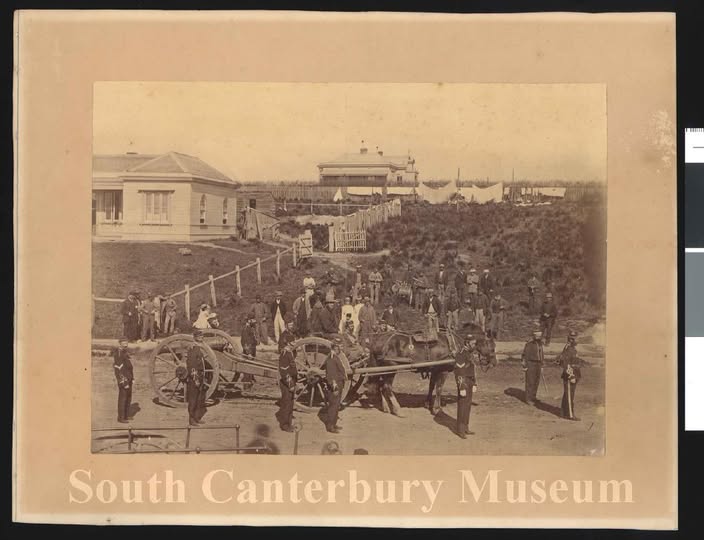
The image depicts the gun carriage with uniformed men (Timaru Volunteer Artillery) standing in what appears to be parade positions. A handful of onlookers stand on a gradual slope in the background. Beyond the crowd, two houses also appear, as does the day's washing draped over a long fence and what appears to be a makeshift clothesline. A note in black felt on the glass above the print reads "Timaru Artillery Stafford Street c1870s-90s." Bears the label of J Moore (carver, guilder and picture framer of Gloucester) on the verso. South Canterbury Museum 1612E
I started with an old photograph from the South Canterbury Museum collection... at first glance it looked like a military group of men in uniform with a horse and a gun carriage. A small crowd stood once on the slope behind to be part of the photo. You can spy a few houses, the washing is hanging over fences. Then I looked again... The museum catalogue identifies the image as Timaru Naval Artillery, catalogue number 1612E. The description says it shows members of the Timaru Artillery with a cannon and ammunition carriage hitched to a single horse, probably taken in the 1870s or early 1880s. A note on the glass reads: “Timaru Artillery Stafford Street c1870s-90s.” That was enough to start a proper history hunt into volunteer defence, public ceremony, domestic life, and the changing shape of the town...
The first thing to rule out was the idea that it might show an Armistice or First World War parade. It almost certainly does not. The photo is an albumen print, a 19th century photographic process. The street scene also feels much earlier than 1918. There are no motor vehicles, no dense commercial frontage, no large civic crowd, no flags or decorations that would suggest a peace celebration. Instead, it shows a still-open, partly domestic edge of town.
The date range in the museum record, 1870 to 1890, is sensible. But the clues point more tightly to the late 1870s or early 1880s.
The gun is one of the most important clues. At first glance, someone suggested it might be a Whitworth gun. But when you look closely, the long projection at the front appears more likely to be part of the limber or draught arrangement, rather than the barrel. The actual gun looks short, heavy and low. That fits much better with a howitzer.
Timaru’s newspapers give us a very useful trail. In 1868, there were moves to revive the Timaru Artillery Volunteers, and a 24 pound howitzer in Christchurch was reported as being available for the company’s use. By 1877, the Timaru Artillery were taking a howitzer to LeCren’s Gully to fire a royal salute for Queen Victoria’s birthday. In 1883, C Battery was still using a 24 lb howitzer and a 24 lb garrison gun at Patiti Point. By 1885, the Timaru Herald described the 24 pounder howitzer as almost entirely obsolete, but still familiar locally, having been on issue to C Battery for several years.
So the gun in the photograph is probably not just any cannon... it may well be Timaru’s old 24 pound howitzer, the same sort of piece used for drill, salutes and local artillery practice.
This was not modern coastal defence in the way we might imagine it now. It was part of the volunteer movement, when local men trained in military skills at a time when colonial settlements were anxious about defence and self-reliance. The gun was practical, ceremonial and symbolic. It could be used for live firing, but it was also part of how a young town performed loyalty, readiness and civic order.
The unit name needs care. The museum title says Timaru Naval Artillery, but the evidence may point more safely to Timaru Artillery Volunteers or C Battery, depending on the final date.
Timaru’s artillery story began earlier than the “Naval Artillery” title suggests. The Timaru Artillery Volunteers were formed in the 1860s. Later, C Battery became part of the New Zealand Regiment of Volunteer Artillery. By the mid 1880s, Timaru Naval Artillery and C Battery were being listed as separate volunteer corps. That means the museum title may be a later label, or a broader local-memory label, rather than the exact unit name at the moment the photograph was taken.
For now, the safest wording is this: Timaru Artillery Volunteers or C Battery, later catalogued as Timaru Naval Artillery.
The next big question is place.
A very good suggestion was that the photograph was taken on Stafford Street, looking up towards LeCren’s Terrace, around the area near where the Noel Leeming store is today. I would not publish that exact modern location as fact yet, but the theory is strong.
The land rises behind the road. There are houses and fences on the slope. The main road in the foreground is wide enough for the horse, gun and men to assemble. It feels like the northern part of early Stafford Street, or more correctly at the time, the Great North Road. Stafford Street was not renamed from Great North Road until 1889, so if the photograph is earlier than that, the “Stafford Street” note must have been added later or written using the later name.
The LeCren’s Terrace clue became much stronger when another little piece of the puzzle appeared. In 1881, newspaper notices refer to an Artillery Hall, or Old Artillery Hall, on LeCren’s Terrace. That is a very important detail. It places artillery activity right in the geography suggested by the photograph.
That does not prove the large building in the background is the Artillery Hall. It does not prove the exact camera position. But it means the photograph is not randomly “somewhere on Stafford Street”. It may show the artillery close to their own drill or meeting place, near the edge where the main road met the terrace above.
The houses in the background are just as interesting as the gun.
The house on the left looks like a respectable timber dwelling, not a rough hut. It has a hipped roof and what appear to be refined sash windows on the side. Behind it, another larger building sits higher on the slope. Fences run across the land, and washing is draped over a fence or line.
That washing is a wonderful detail. It reminds us that while the volunteers were making a public military display in the foreground, ordinary household life was going on just behind them. Someone had washed clothes. Someone had pegged or draped them out to dry. Children and onlookers had gathered. The town was watching, but the town was also living.
This is why old photographs are so valuable. The subject is the artillery, but the background tells us about the place.
This part of Timaru had not yet become the fully built-up commercial street that later generations knew. It was still a place of houses, open ground, fences, tracks, informal access ways and domestic edges. The photograph catches Stafford Street, or Great North Road, before the street was completely absorbed into the denser town centre.
There are people in the photograph we cannot yet name. That is important to say. We can name likely officers and local artillery figures from the newspaper record, including Lieutenant Wardle, Captain Jackson, Corporal Goodwyn and later Captain or Major Hamersley. But we cannot point to a face in this image and say who it is without more evidence.
There may also be band members on the hill. The Timaru Artillery Band certainly existed, and by 1881 it was connected with the Artillery Hall on LeCren’s Terrace. But I cannot see instruments clearly enough in the image to say the men on the slope are definitely the band. For now, they remain onlookers, volunteers, or possibly band members.
That is the discipline of a good history hunt. We follow clues, but we do not force them to say more than they can.
So what is this photograph of? My best working answer is:
Timaru Artillery Volunteers or C Battery with a horse-drawn 24 pound howitzer and limber, probably on Great North Road, later Stafford Street, near LeCren’s Terrace, Timaru, around 1877 to 1883.
The museum’s catalogue title, Timaru Naval Artillery, may still be connected to the image, especially if the date proves to be later. But at this stage, the howitzer evidence, the LeCren’s Gully references, and the C Battery newspaper reports make Timaru Artillery Volunteers or C Battery the safer identification.
What I love about this photograph is that it brings several Timaru stories together in one frame.
It shows the early volunteer defence movement.
It shows the old artillery equipment used for salutes, drills and training.
It shows the northern edge of the town before Stafford Street became more densely commercial.
It shows houses and washing and fences.
It shows people gathering on a slope to watch something happen in the street below.
And it gives us another way to read the town.
Next time you are near the north end of Stafford Street, look up towards LeCren’s Terrace and Bay Hill. Try to imagine the road before the shops, signs and traffic. Imagine the horse standing in the street, the men in uniform, the gun carriage, the spectators on the slope, and someone’s washing drying behind the crowd.
That is the magic of a photograph like this. It does not give us every answer. But it gives us enough to start looking.
And once you start looking, Timaru changes shape.