
By Roselyn Fauth
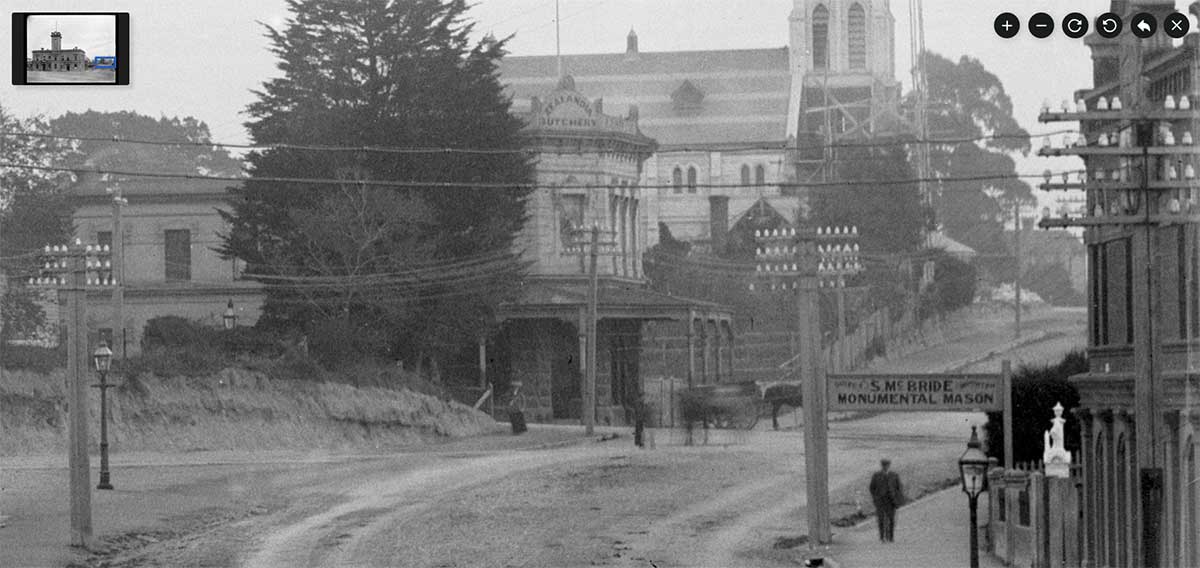
Screen shot zooming into a photo to see the detail - Post Office, Timaru, 8.54am, Timaru, by Muir & Moodie. Te Papa (C.014680) https://collections.tepapa.govt.nz/object/24118?page=1&rtp=1&ros=1&asr=1&assoc=all&mb=c
I was looking at an old Te Papa photograph of Timaru when I zoomed in and saw something I had not noticed before... not the clock tower, churchers or the even the street itself... a sign. On a building in the photograph was the word: "Zealandia butchery". I had come across an old bill head a few years ago, and struggled to work out where the shop used to be. Now finally I had another piece to the history puzzle. So I pulled out my research and now I could piece it together with more confidence.
This blog has became a story about a working corner of Timaru, about meat and horses, local farms feeding the town, and about the moment when motor cars began to disturb a world still powered by hooves.
From Church Street to Zealandia
The earliest thread I found begins in 1878, when Peacock and Geaney advertised that they had purchased the butchery business of W. Chisnall and were opening the West End Butchery in Church Street. Their advertisement gives us a glimpse of a very practical business. They sold meat, of course, but also small goods, with smoking and curing done on the premises. This was not simply a shop counter. It was part of Timaru’s food system.
By Christmas 1879, Peacock and Geaney were confident enough to turn meat into theatre. They advertised their butcheries in Church Street and North Street as being decorated and illuminated “in the real London style”. They invited people to inspect the display.
That is such a lovely window into town life before supermarkets and plastic trays. The butcher’s shop was a place to look as well as buy. A fine display of beef, mutton, lamb, poultry and small goods was local abundance made visible. It was South Canterbury farming brought into town and placed in the window.
This was a shop, a dwelling, and stables
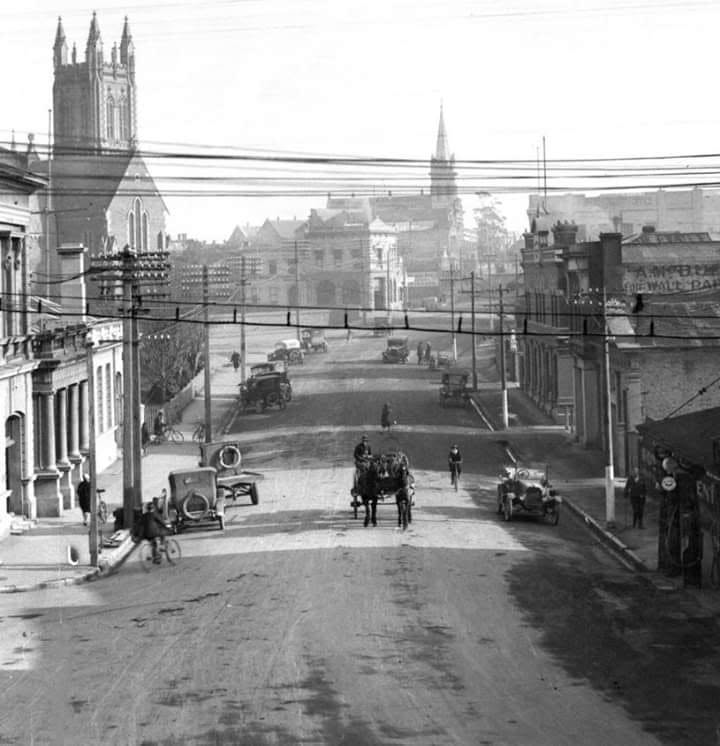
By 1882, the Zealandia Butchery builting was designed by the architect was Maurice de Harven Duval. The shop was designed to be the public face for its customers for the daily business of feeding households, why out the back they could do the knarly work with carcuses from local farms.
In my history hunt, I learned that there used to be stables here. Before vans, before refrigerated trucks and online orders, the butcher’s horse was essential to move meat to customers. So when we look at that old photograph and see “Zealandia”, we should not imagine only a shopfront. We should imagine a whole working place behind it to help feed a town.
The stables appear dramatically in 1884, when fire destroyed Peacock and Geaney’s Zealandia Butchery stables. Oats and other material were lost, but the horses were saved because someone had the presence of mind to get them out.
The name Zealandia is interesting.
Today when I think of that name, I think of our contenant, and a animal sancturary in Wellington. Zealandia was often used as a symbolic figure for New Zealand, a local version of Britannia. To call a butchery “Zealandia” I guess gave it a confident, respectable, national-sounding identity.
An 1893 billhead for Peacock and Geaney’s Zealandia Butchery survives in the Hocken Collections. That is a precious piece of evidence: a business name, a visual identity, a fragment of everyday trade that somehow made it through. It tells us this shop was not just remembered in newspaper notices. It had a printed identity. It billed customers. It kept accounts. It was part of the ordinary paperwork of a growing town.

This shop, dwelling, and stables were built for Messrs Peacock and Geaney (Zealandia Butchery) on the corner of Church and Sophia Streets in Timaru. The architect was M. de H. Duval who designed many buildings in Timaru's CBD, and South Canterbury Catholic churches. This is a billhead from 1893 from the Thomas and Hardy-Johnston families: Papers - ourheritage.ac.nz | OUR Heritage, accessed July 20, 2021, https://otago.ourheritage.ac.nz/items/show/6107. Rumour has it that when Cecil Wood whipped past in his motor car, it gave the butcher's horse a fright and meat spilled everywhere and the butcher came running out threatening to chop up Cecil's car!
Farm to shop window
The later newspaper mentions show Zealandia Butchery as a place where local meat was displayed with pride. In 1895, the first lamb of the season was shown at Zealandia Butchery, from Mr Brookland’s farm at Pareora. In 1899, H. Geaney and Co. drew attention to a meat display that included beef from G. H. Rhodes’ Claremont estate.
By 1904, H. Geaney and Co., described as having long carried on Zealandia Butchery, announced that J. M. Halbert had taken over the business. The following year, Halbert sold Zealandia Butchery to T. McWhirter and Sons.
The timing is interesting. Around this period, Timaru was moving into the age of the municipal abattoir and more regulated meat inspection. The old world of the butcher’s shop and stables was still there, but public health, inspection and modern supply systems were becoming more important.
So Zealandia sits in a beautiful transition point, in a horse-and-cart town. But it also lived into the age of regulation, inspection, abattoirs and sanitary language.
Cecil Wood and the butcher’s horse
And then there is Cecil Wood... oh I love this meeting of history and fun facts. Cecil Walkden Wood was one of South Canterbury’s great early motoring inventors. He built engines, motor cycles and one of New Zealand’s earliest locally made petrol cars on Stafford Street. There is even a South Canterbury Museum photograph of Wood and John Grandi sitting in a motor car built by Wood in Sophia Street around 1903.
A later motoring account tells a brilliant story about Wood being stopped by a constable outside a butcher’s shop. The butcher, furious because the motor car had frightened his horse, came out with a cleaver and threatened to chop the car to pieces. Wood had to push the vehicle home. Until I can lay my hands on that article again, I can't prove the frightened horse was Zealandia’s horse, but I am pretty sure that is how I remembered it.
I like how this story is a segway from the butcher and his stables, to the other... Cecil Wood, his noisy petrol engine invention, the future arriving before everyone was open to the idea.
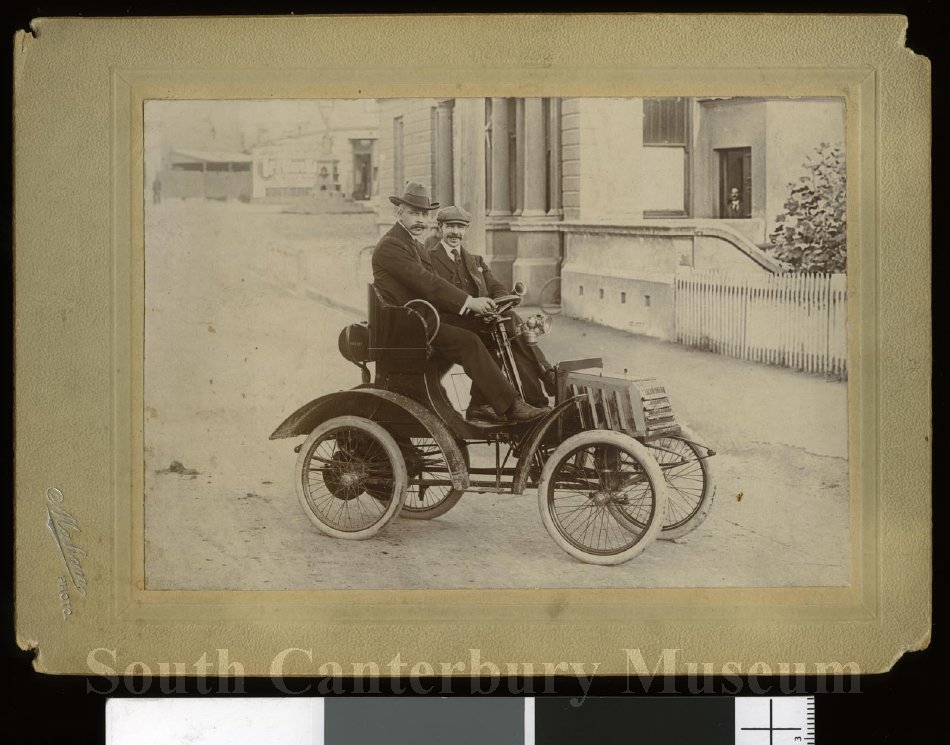
Cecil Wood, and passenger John Grandi, sitting in a motor car built by himself in Sophia Street, possibly his first four 4 wheeled motor car, circa 1903. Handwritten on verso "Cecil Wood c1902 Presby[?] Mr J Irvine Supreme Dairy" (possibly donated by Mr Irvine). A newspaper cutting taped to verso of mount reads: "Motor Car built and run in Timaru by Cecil W. Wood, 1901-02, Engine on rear Axle, Surface carburetta, wooden Mudguards, made and bent by J. Jackson and Co. Body by late J. J. Grandi (cost of body in 1902, 6 pounds)" The photographers name is stamped in silver on lower left side. South Canterbury Museum 1374
Why this sign matters in the detail of a Te Papa photograph
Zealandia - a sign I nearly missed. It led from a zoomed-in detail to a butchery, from a butchery to a building, from a building to stables, from stables to horses, from horses to fire, from fire to food supply, from food supply to farms, and from horses to Cecil Wood’s motor car rattling into the new century.
This is the joy of local history... it is not always the grand building that starts the hunt, sometimes it is a sign in the background... a clue hiding inside a photograph.
The butcher’s window is lit for Christmas. The horses shift in the stables. Pareora lamb and Claremont beef arrive in town. Smoke and sawdust sit behind the shop. A billhead is folded into an account. A motor car coughs into Sophia Street. Somewhere, a horse shies. Somewhere, a butcher reaches for his cleaver.
And one old sign, spotted by zooming into a photograph, brings the whole corner back to life.
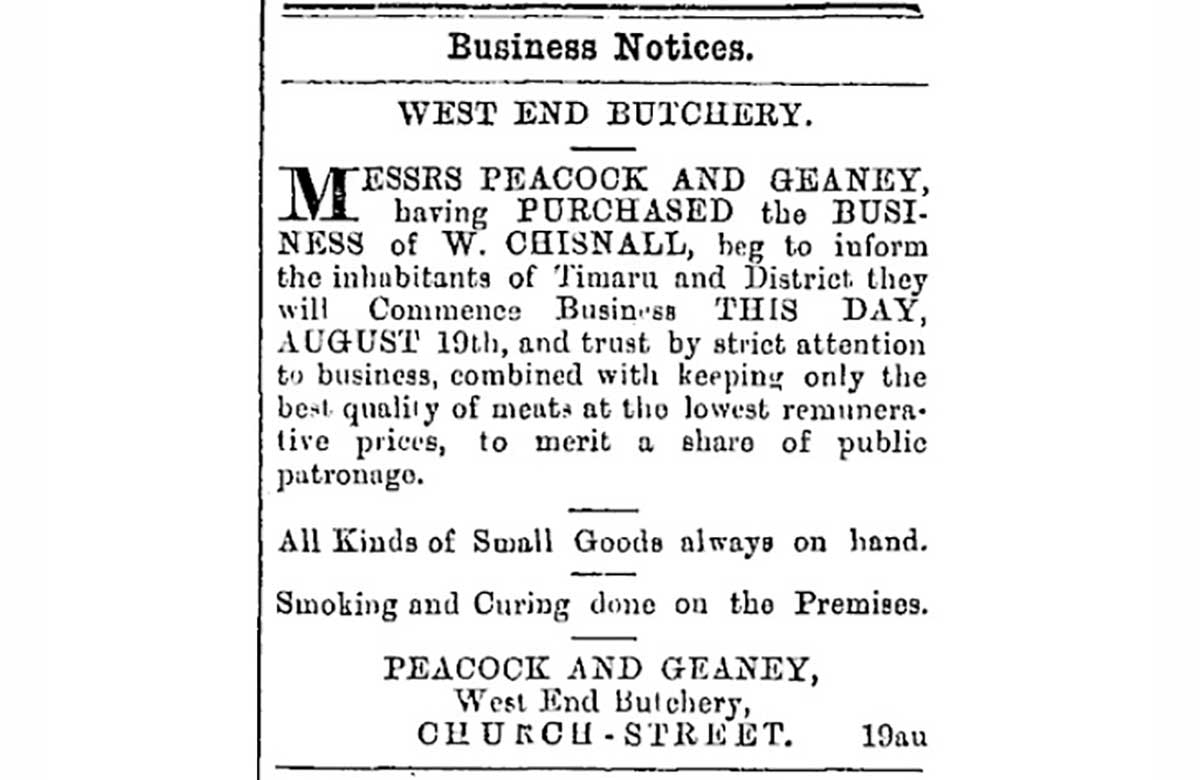
Timaru Herald Volume XXIX Issue 1238 7 September 1878 Page 1
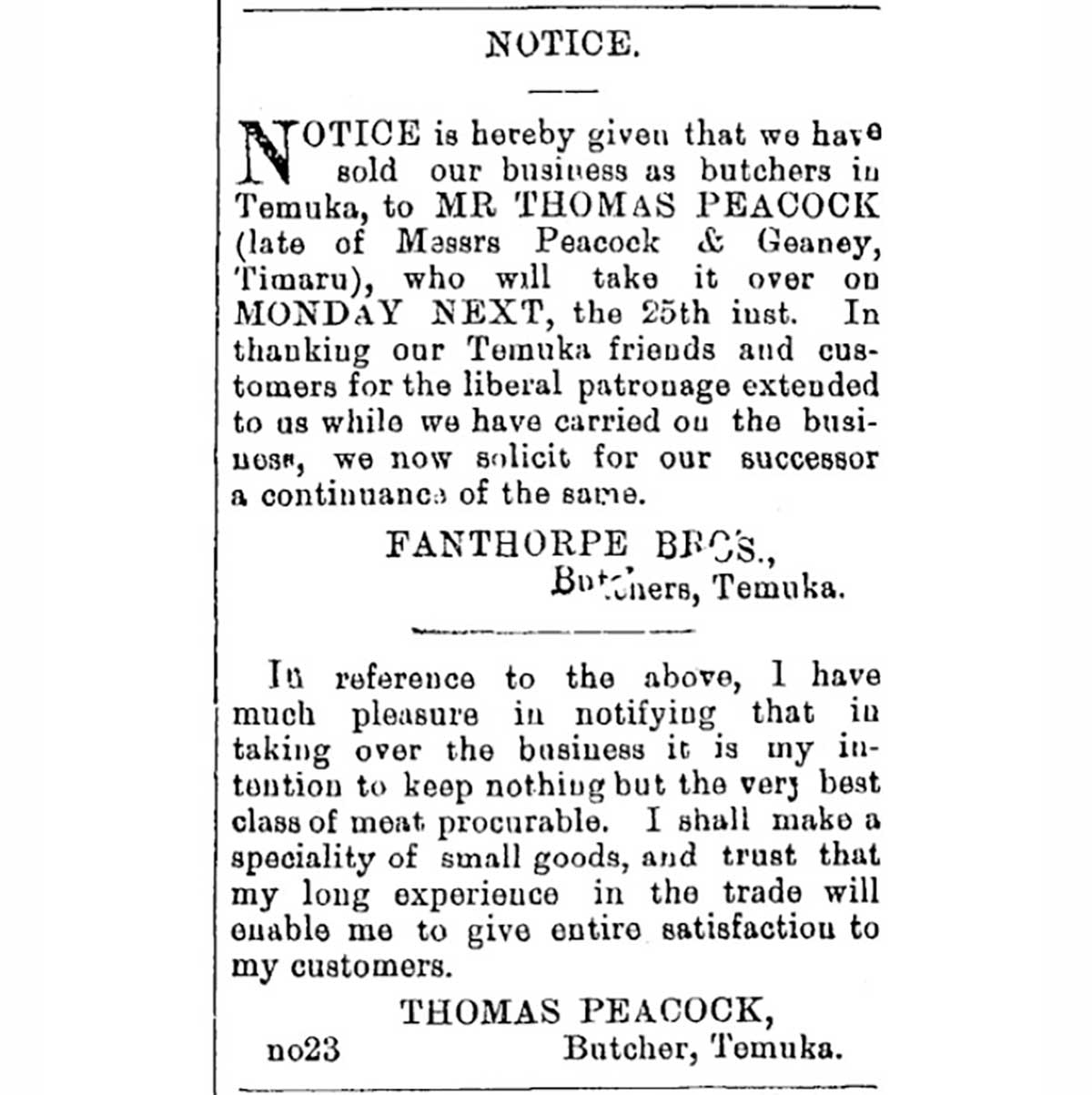
Temuka Leader Issue 2914 2 January 1896 Page 1