
By Roselyn Fauth
The parade was for a king, but the King was nowhere to be seen. On 22 June 1911, while George V and Queen Mary were being crowned in Westminster Abbey, Timaru filled its streets with flags, horses, bands, fire brigades, shopkeepers, schoolchildren, friendly societies and decorated floats. Stafford Street became the town’s stage. A triumphal arch carried the King’s portrait, businesses dressed their buildings in bunting, and crowds gathered to watch the procession pass.
It looks like a photograph of a royal visit... but is not...
The royal family was on the other side of the world. What the camera captured was Timaru using a distant coronation to present a picture of itself. Who was chosen to lead? Who marched? Who watched from the footpath? Whose stories were placed on display, and whose names were left out? The King may be missing, but the photograph is full of clues about who Timaru thought it was in 1911.
Timaru goes on parade
The official procession programme was published in the Timaru Herald on 21 June 1911.
Participants were instructed to gather in several streets near the Troopers’ Memorial. Committeemen were appointed to organise each section before it joined the procession.
The programme listed dozens of groups, including army and navy veterans, St John Ambulance, the mayor and mayoress, borough councillors, fire brigades, bands, waterside workers, newspapers, businesses and friendly societies.
There was also a separately listed Māori contingent.
Schoolchildren took part in the wider celebrations. Contemporary reports said they would receive coronation medals and salute the King. Cadets from outside Timaru were brought into town by train.
The programme also included an open-air religious service, entertainment for children and an evening torchlight procession.
The coronation provided the occasion, but almost everything the crowd saw belonged to Timaru.
Before the mayor came the lifeboat
Near the front of the procession was the lifeboat Alexandra, carrying men described as the “Heroes of the Wrecks”.
In the published order, the lifeboat appeared immediately before the mayor and mayoress.
The Alexandra was associated with the rescue efforts during the storm of 14 May 1882, when several ships were placed in danger off Timaru.
The Benvenue and City of Perth were driven towards the shore. Seven men drowned during attempts to secure another anchor for the City of Perth, and two others died afterwards. The City of Perth was eventually refloated, but the Benvenue was lost.
The disaster became one of Timaru’s best-known maritime stories. A memorial was erected during the 1880s to commemorate the dead and recognise the rescue efforts.
Twenty-nine years later, the Alexandra was mounted on a wheeled platform and pulled through Timaru by four horses.
One surviving photograph shows it travelling along Craigie Avenue and turning into North Street. Another shows it heading north along Theodosia Street.
A lifeboat travelling through town must have been an unusual sight, but it was more than spectacle. It placed a local story of danger, loss and rescue near the front of a procession organised for a distant monarch.
Who represented Timaru?
The parade programme reads like a directory of public life in 1911.
Local government, commerce, industry, emergency services, military organisations, bands, newspapers and friendly societies were all given a place.
The Hibernians, Oddfellows, Foresters and Druids were among those represented. These organisations provided fellowship and practical support to members during illness, death and financial hardship.
Before the development of a comprehensive welfare system, friendly societies could play an important role in helping families through difficult periods.
Their presence in the parade shows that Timaru was represented not only by elected officials and businesses, but also by voluntary organisations.
The procession was still an edited version of the town.
Someone decided who would lead, who would follow and which groups would be named.
Women in the crowd
Women and girls are prominent in the surviving photographs.
They fill the footpaths in large hats and long dresses. Children stand between them, while people lean forward for a better view of the horses and floats.
Women were highly visible in the crowd, but far less visible in the official procession programme.
New Zealand women had been able to vote in parliamentary elections since 1893, but they could not stand for Parliament until 1919. Most named civic, military and commercial representatives in the 1911 programme were men.
The photographs and the programme therefore show two different kinds of participation.
One records the people who occupied the streets.
The other records those formally chosen to represent the town.
Māori participation
The published procession order included a Māori contingent, but the surviving searchable text does not name its members or explain their contribution.
That confirms Māori participation, but leaves important questions unanswered.
Who took part? Where were they from? What did they wear or carry? How were they presented to the crowd?
The brief entry reminds us that a programme can record someone’s presence without preserving their story.
Stafford Street dressed for a king
Photographs taken by Timaru photographer William Ferrier show Stafford Street decorated for the coronation.
Flags and bunting crossed the road. A triumphal arch bearing a portrait of George V stood over the street. Floats gathered near Thomson’s department store before joining the procession.
There is a small historical trap here.
Thomson’s building was already known as the Coronation Buildings, but it had been named for the coronation of Edward VII in 1902, not George V in 1911.
By 1911, Stafford Street was Timaru’s principal commercial centre. Its substantial shops, offices and hotels reflected the growth of the port town and the agricultural district surrounding it.
For coronation day, those buildings became part of the performance.
The decorated street presented Timaru as established, prosperous and confident.
Horses, bullocks and motorcars
The surviving photographs show several forms of transport taking part.
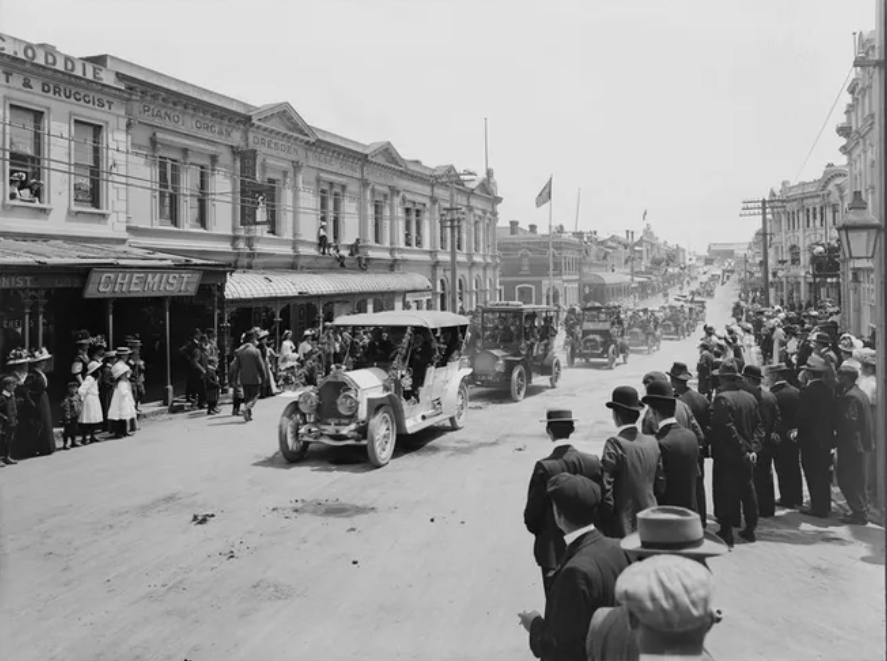
There were horse-drawn carriages and fire appliances, a bullock wagon, the Alexandra mounted on wheels and a group of motorcars.
Flags and bunting hung among telephone and telegraph wires.
The parade caught Timaru at a point of change. Horses and bullocks were still part of ordinary working life, but motor vehicles, electricity and modern communications were becoming increasingly visible.
Old and new moved along the same streets.
What the photographs cannot tell us
The Alexander Turnbull Library holds a striking photograph of four light-coloured horses drawing a carriage through a crowded Timaru commercial street.
The catalogue identifies the event as the coronation parade, but it does not name the street or the people inside the carriage.
Although Stafford Street is confirmed in other photographs from the celebration, the exact location of this particular image has not been established.
It may eventually be identified by comparing shopfronts, street gradients, maps, business directories and other photographs.
Until then, it should be described simply as an unidentified commercial street in Timaru.
The photographer is also unnamed, although the negative was created by someone employed or contracted by Christchurch newspaper The Press.
Not every gap needs to be filled with a guess.
What would our parade look like?
More than a century later, the photographs turn the question back towards us.
Who would represent Timaru today?
Would mana whenua lead or be given a separate place in the programme?
Which migrant communities, volunteers, workers, artists, teachers, carers, health professionals, sports clubs and environmental groups would be included?
Who would march?
Who would watch?
Who would be missing?
There is no single correct answer. Any modern procession would be an edited portrait, just as the 1911 parade was.
That is why these photographs matter.
They show more than a coronation celebration. They record the people and organisations Timaru chose to place in public view.
Old photographs are often described as windows into the past.
These work just as well as mirrors.
The King is absent, but Timaru is everywhere.
Image credit
Crowds gather to watch Timaru’s parade celebrating the coronation of George V, 1911. Photograph by an unidentified photographer employed or contracted by The Press. Alexander Turnbull Library, Wellington, New Zealand. Ref: 1/1-008620-G.
Sources
Alexander Turnbull Library, “Crowds gather to watch the parade, led by a horse-drawn carriage, Timaru, to celebrate the coronation of George V”, Ref. 1/1-008620-G:
https://natlib.govt.nz/records/29942057
Timaru Herald, 21 June 1911, coronation procession programme and arrangements:
https://paperspast.natlib.govt.nz/newspapers/THD19110621.2.2.5
https://paperspast.natlib.govt.nz/newspapers/THD19110621.2.32
South Canterbury Museum and DigitalNZ, coronation procession photographs, including the Alexandra:
https://digitalnz.org/records/42256472
https://digitalnz.org/records/45967977
https://digitalnz.org/records/42256160
https://digitalnz.org/records/42256162
Heritage New Zealand Pouhere Taonga, Benvenue Memorial:
https://www.heritage.org.nz/list-details/2045/2045
Timaru District Council, Stafford Street Historic Heritage Area assessment:
https://www.timaru.govt.nz/__data/assets/pdf_file/0006/674034/Historic-Heritage-Historic-Heritage-Area-Assessment-Report-HHA1-Stafford-Street-Historic-Heritage-Area.pdf
Timaru District Council, Thomson’s Coronation Buildings heritage assessment:
https://www.timaru.govt.nz/__data/assets/pdf_file/0006/673872/Historic-Heritage-Assessment-Report-HHI49-Coronation-Buildings-Category-A.pdf
New Zealand History, women become eligible to stand for Parliament:
https://nzhistory.govt.nz/page/women-can-stand-parliament
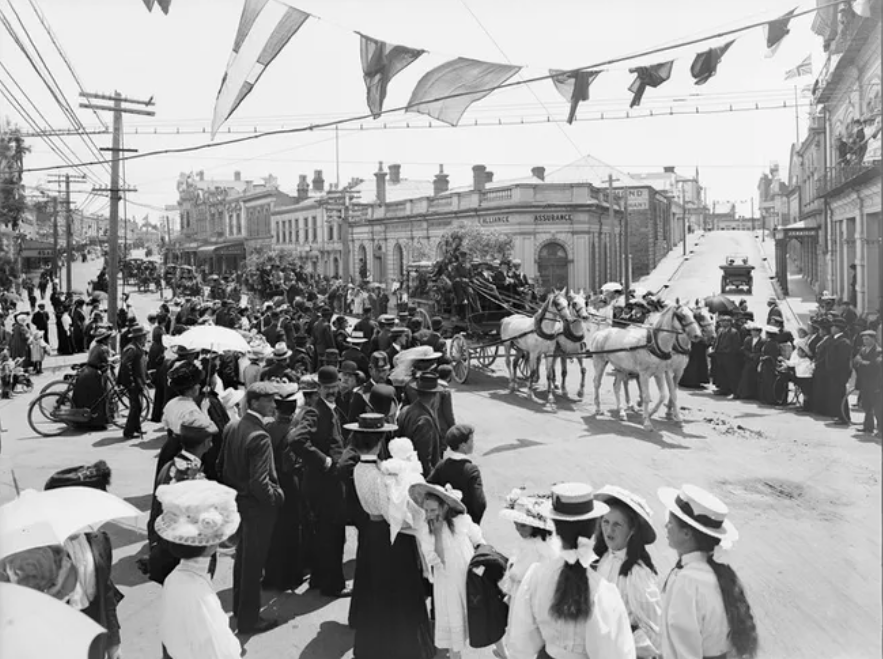
Crowds gather to watch the parade, led by a horse-drawn carriage on a street lined with commercial buildings, Timaru, to celebrate the coronation of George V. The Press (Newspaper) :Negatives. Ref: 1/1-008620-G. Alexander Turnbull Library, Wellington, New Zealand. /records/29942057
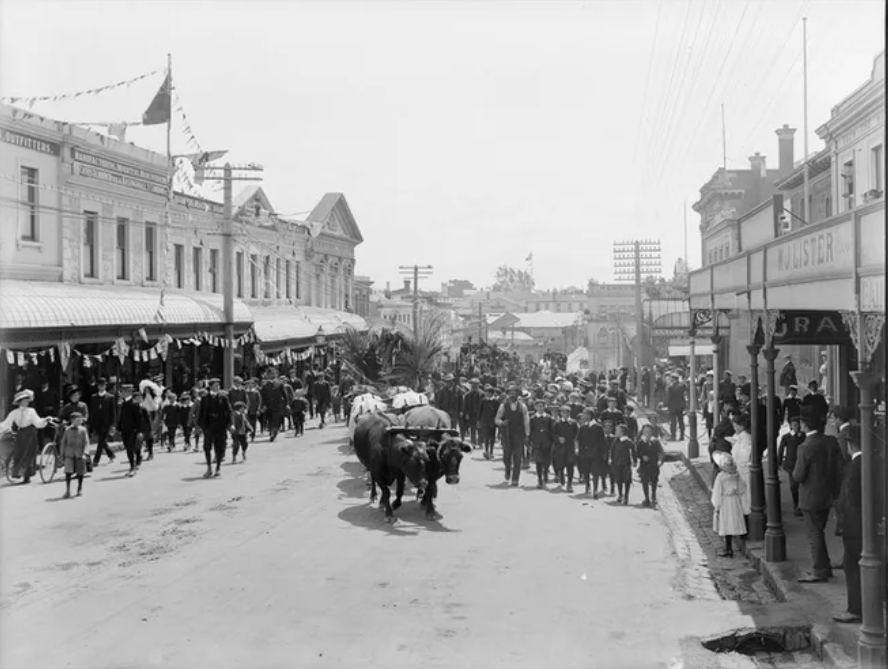
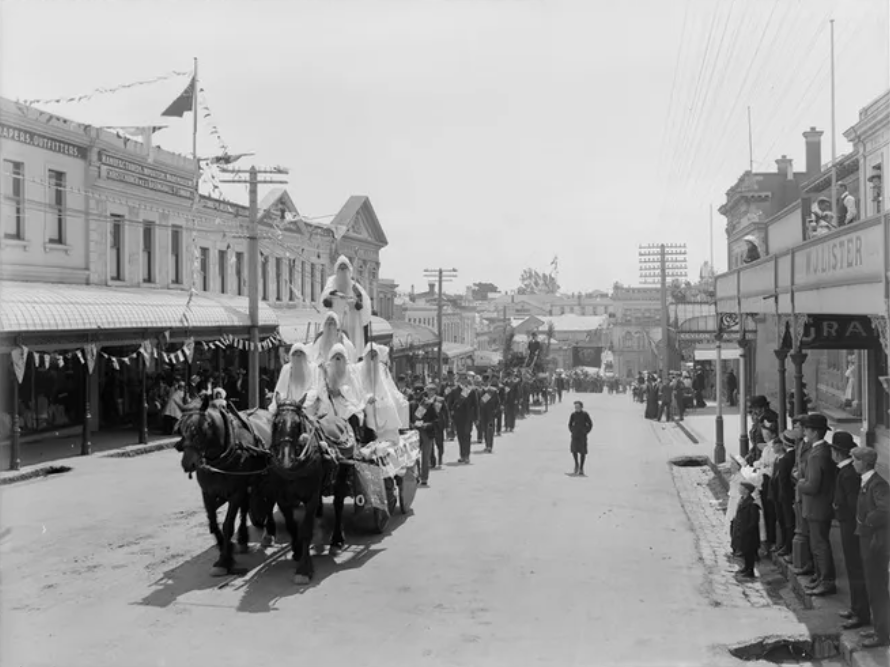
Crowds gather to watch the parade, led by a horse-drawn carriage with a group of unidentified men dressed in white robes and beards on a street lined with commercial buildings, Timaru, to celebrate the coronation of George V. The Press (Newspaper) : Negatives. Ref: 1/1-008625-G. Alexander Turnbull Library, Wellington, New Zealand. /records/29947461
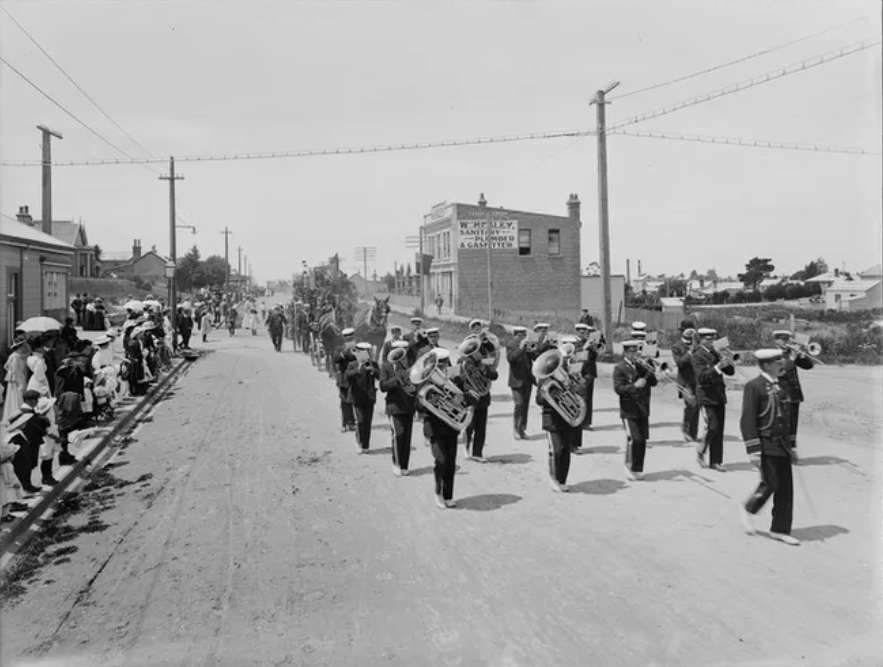
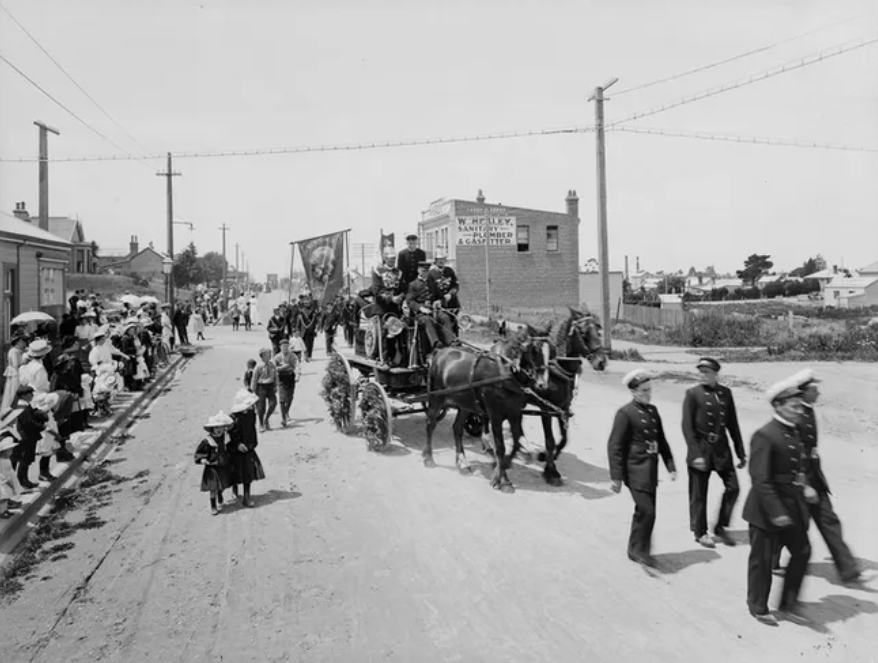
Timaru Voluntary Fire Brigade on a horse-drawn cart in the parade, on an unidentified street which includes the business premises of W Healey Sanitary plumber and gasfitter, Timaru, to celebrate the coronation of George V. The Press (Newspaper) :Negatives. Ref: 1/1-008623-G. Alexander Turnbull Library, Wellington, New Zealand. /records/29948559
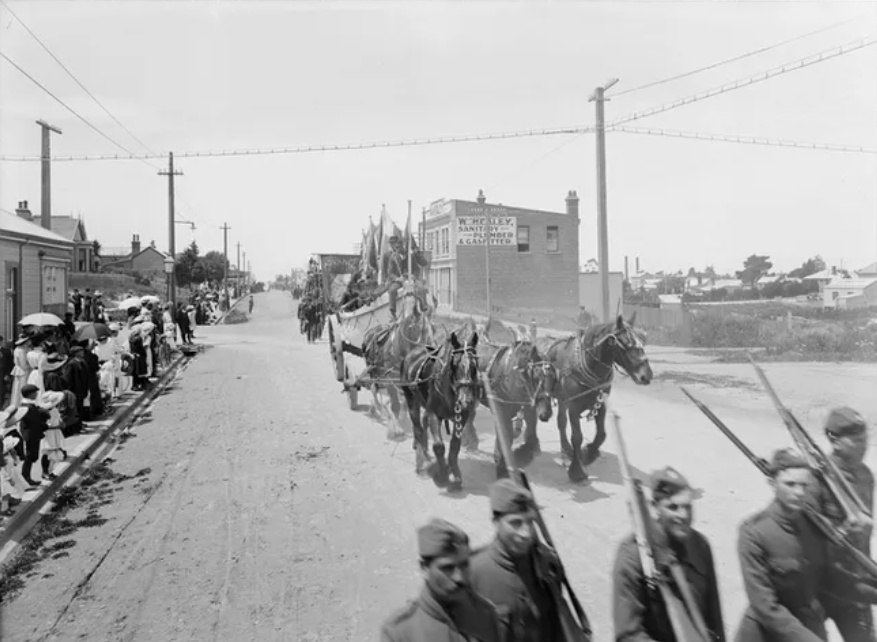
A team of horses pulling a cart with a boat full of men in the parade, led by soldiers carrying firearms, on an unidentified street which includes the business premises of W Healey Sanitary plumber and gasfitter, Timaru, to celebrate the coronation of George V. The Press (Newspaper) :Negatives. Ref: 1/1-008619-G. Alexander Turnbull Library, Wellington, New Zealand. /records/29940694
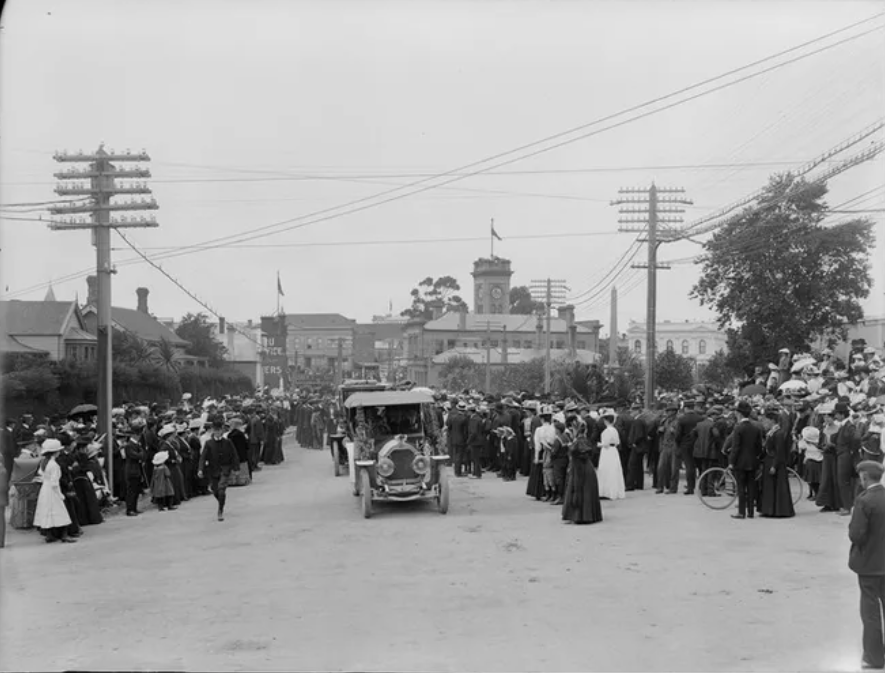
Crowds gather to watch motor cars in the parade, on an unidentified street, Timaru, with the clock tower in the background, to celebrate the coronation of George V. The Press (Newspaper) : Negatives. Ref: 1/1-008624-G. Alexander Turnbull Library, Wellington, New Zealand. /records/29943474