
By Roselyn Fauth
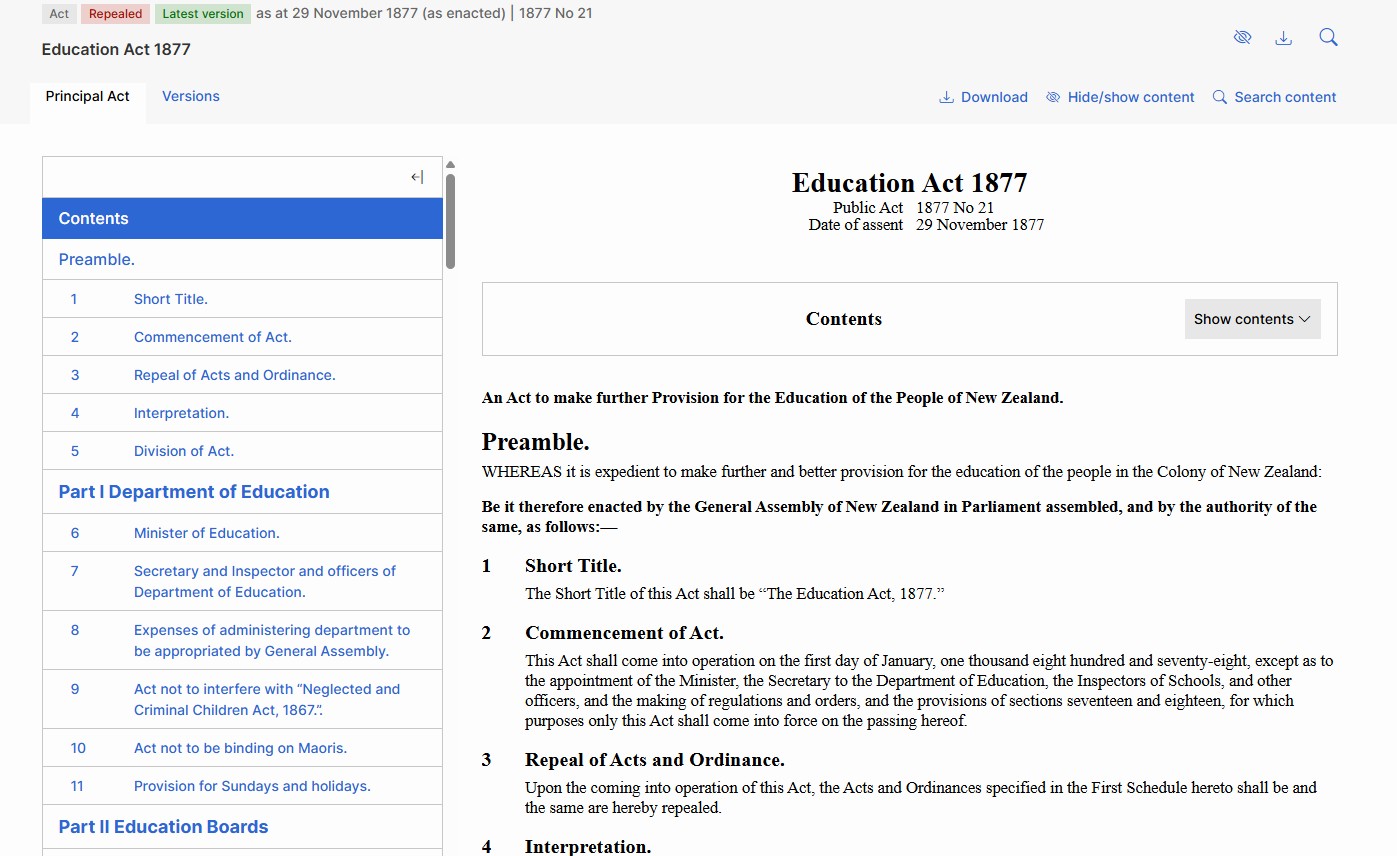
In 1877, New Zealand passed a law that could change a child’s life — if that child lived within two miles, about 3.22 kilometres, of a school by the nearest road.
That small detail turns the Education Act 1877 from what many of us would assume was a dry piece of legislation into something interesting. It takes us away from Parliament and into school committees, teachers, schoolrooms and children walking towards a classroom...
The Act is often remembered as free, compulsory and secular. But while the short list might seem simple, and real lesson that I have learned on today's history hunt, is that public education is much more complicated and only works when access, governance, buildings, families, communities and even the roads.. all line up.
The Education Act 1877 did not make schooling equally compulsory for every child in New Zealand, and it did not automatically force attendance in every district. Intestingly though from what I have read, it doesn't seem to have applied to Māori in the same way either.
What it did was create a national framework for public schooling after the provincial system ended. It set up a Department of Education, education districts, education boards, school districts, school committees, inspections, public-school rules, teacher systems, grants, school funds, school buildings, district high schools and attendance powers.
For South Canterbury, that mattered, because the Act created an Education District of South Canterbury, defined around the Counties of Geraldine and Waimate, including the boroughs within them. A year later, the Timaru High School Act 1878 made special provision for a high school at Timaru, within that South Canterbury education district.
So this is not just a Wellington law story, it is a South Canterbury story.
The Act enabled public education, and in its roll out, I wonder if people who were supporting the building of schools, realised they were also building South Canterbury.
Before 1877 educaiton was a patchwork of schooling, and the Education Act 1877 did not arrive in an empty landscape.
Before national public schooling, Some children had good access. Some had irregular access. Some had none. Here in South Canterbury, we already had schools before the Act.
A South Canterbury schools list records Timaru Grammar School from 1859 to 1874, first in Barnard Street and then Browne Street, and identifies it as the forerunner of Timaru Main School. It also notes that in the late 1860s and early 1870s there were nine small private schools in Timaru.
Timaru Main School opened in 1874. Washdyke School and Pareora West School are also listed from 1874. Temuka School is listed from 1866, Geraldine School from 1867, Pleasant Point Primary School from 1868, Winchester School from 1870, Peel Forest School from 1870, Waihi Bush School from 1872, Milford School from 1873, Hilton School from 1875, Pleasant Valley School from 1875, and Otaio School from 1876.
So the Act did not invent the idea that communities needed schools. Families, churches, local committees and districts had already been trying to educate children in whatever ways were available.
But the Act changed the structure. It moved education into a national public system. It created a hierarchy of responsibility, from Parliament and the Minister of Education down to education boards, school committees, teachers, parents and children.
That makes it an excellent civics story as well as a heritage story.
How the system worked
The Education Act 1877 created a Department of Education under a Minister of Education. The Governor could appoint the Minister, a Secretary to the Department, Inspectors of Schools, clerks and other officers.
The Act divided the colony into education districts. Each district had an Education Board. A board was not just an informal group. It was a corporate body that could hold land, manage funds, appoint officers and teachers, establish and maintain public schools, define school districts, support school libraries, establish scholarships and district high schools, and administer public money.
Under the boards sat school districts and school committees. Each school district was to have a School Committee of seven householders. The word “householder” mattered. It included adult male or female people who occupied, owned, rented or used a dwelling or building in the district, and also parents or guardians responsible for children.
That is a small but important civic detail, because the school committee system gave local people a formal role in public education. Householders met. They elected committees. They considered boundaries. Ten householders could petition for a new school district. Committees could recommend teachers, help manage school buildings, raise or receive funds, and deal with local matters under the supervision of the Board.
This was local democracy, but limited local democracy. It was not universal voting as we know it today. It sat inside the property, gender, race and colonial assumptions of the time. But it still created a public mechanism through which communities could argue, petition, organise and act.
That is one reason schools became community anchors. They were not just places where children sat at desks. They were places where adults practised governance.
What “free” meant
Public primary schooling under the Act was free in the sense that no fees were payable at public schools, except where the Act allowed fees for district high schools. Evening schools could also charge fees for older pupils, so “free education” did not mean all education was free.
The basic public-school curriculum was free. Higher education was different. District high schools could teach Latin and Greek classics, French and other modern languages, mathematics and science, but pupils could be charged fees for that higher education.
That distinction matters for Timaru because it shows why the 1878 push for a high school was not only about buildings or prestige. It was about access to the next layer of education — the layer that could shape work, status, careers and future opportunities.
What “compulsory” meant
The compulsory part of the Act is where the story becomes most interesting. Section 89 said that the parent or guardian of every child aged not less than seven and not more than thirteen had to send the child to school if the child lived within two miles, measured according to the nearest road, from a public school within a school district. The child had to attend for at least one half of the period in each year during which the school was usually open.
So the Act did not simply say every child had to attend school every day.
Age, distance, roads, the amount of attendance mattered. A child could be exempted if they were receiving efficient or regular instruction elsewhere, or attending a private school or other educational institution not supported by Board grants. A child could be exempted because of sickness, danger of infection, infirmity, unavoidable cause, an insufficiently passable road, or because they had reached the prescribed standard.
It was interesting to read in the Act, that there was another important limit too. Sections 89 to 93, the compulsory attendance clauses, only came into force in a school district if a majority of that district’s School Committee voted for them to be enforced. I think that this is a crucial detail, and it reminds us that compulsion was not just a national command, it required local committee action.
That gives us a much richer civic story. Parliament created the law. The Act created boards and committees. But local people had to decide whether to use some of the law’s strongest powers.
What “secular” meant
The Act required teaching in public schools to be entirely secular. School buildings could be used outside school hours on terms set by the committee, but public-school teaching itself was to be secular.
For supporters of a non-denominational state system, secular schooling could look like fairness and progress. For Catholic families and other religious communities, it created a different problem: if the state school was secular, how would religious instruction fit into a child’s education?
South Canterbury’s later school map shows that Catholic education remained a major part of local life. In Timaru city, the South Canterbury schools list records Sacred Heart Primary School from 1879, Timaru Marist Brothers School from 1881, St Patricks High School from 1938 to 1981, Mercy College from 1936 to 1981, and Roncalli College from 1982 as an amalgamation of Mercy and St Patricks.
Across the district, the list also includes St Joseph’s Catholic School at Temuka from 1883, St Josephs Catholic School at Kerrytown from 1883 to 1946, St Josephs Catholic School at Pleasant Point from 1928, St Patrick’s Catholic School at Waimate from 1880, St Joseph’s Catholic School at Morven from 1917 to 1954, All Hallowes Catholic School at Geraldine from 1945 to 1973, and St Joseph’s Catholic School at Fairlie from 1939.
So the public system did not replace every other kind of schooling. It existed alongside Catholic schools, convent schools, private schools, Māori schools, household schools and later technical and secondary schools.
Māori and the limits of the Act
The Act was not binding on Māori, although Māori parents could send their children to public schools under it. I need to spend more time understanding this, espcially around the Treaty, but I think thi meant free, compulsory and secular did not mean equal compulsory schooling for every child in New Zealand. Māori children were not compelled under the 1877 Act. I assume Māori education had its own separate and complicated history involving mission schooling, Native/Māori schools, government policy, land, language, assimilation, whānau choices, local agency and resistance.
For South Canterbury, this opens an important side quest. The South Canterbury schools list includes Tarahaoa, Arowhenua Maori School, from 1895. It also records a published history called “70th Jubilee of the Arowhenua Maori School 1895–1965”. Any fuller account of schooling in South Canterbury needs mana whenua perspectives, Arowhenua sources, school records, whānau memory and care with language. It is not enough to tell the story only through government law.
What children were taught
The Act’s public-school curriculum gives us a window into what adults thought children needed to know. The listed subjects were reading, writing, arithmetic, English grammar and composition, geography, history, elementary science and drawing, object lessons, vocal music, and — for girls — sewing, needlework and the principles of domestic economy.
The Act also required public schools to provide military drill for boys. Physical training could be provided where the Board directed, and where practicable, each school was to have a playground of at least a quarter of an acre.
Reading, writing and arithmetic prepared children for work, trade, accounts, letters, notices and civic life. Geography and history placed them inside a particular colonial worldview. Elementary science, drawing and object lessons suggest practical observation and useful knowledge. Vocal music reminds us that school life was not only silent desk work.
But sewing and domestic economy for girls, and military drill for boys, show the gendered expectations written into public schooling. Girls were included, but the system still imagined their futures differently from boys. Boys were pupils, but also future workers, citizens and defenders of empire.
South Canterbury becomes an education district
The Act’s Second Schedule created the Education District of South Canterbury: the Counties of Geraldine and Waimate, including boroughs within them, and this was the local administrative turning point. South Canterbury was no longer only a cluster of local school efforts. It was part of a statutory education district, with a board, powers, duties, funds, meetings, officers, committees, schoolhouses, reports and public accountability.
In 1878, the new machinery began to move. Newspapers show the South Canterbury Board of Education meeting in Timaru, handling teachers, school sites, high-school proposals, funding, tenders, buildings and district petitions.
The Act was no longer just a law, it is a room full of local men reading letters, moving motions, arguing about high schools, discussing money, appointing teachers, considering school sites, and responding to petitions from communities who wanted schools of their own.
The named men around that early Board table — including H. Belfield, E. H. Tate, W. B. Howell, Postlethwaite, Rev. G. Barclay and Rev. W. Gillies — need deeper biographical research. Newspaper OCR can misread names, so the original image should be checked before we publish each spelling as final. But even before we know every detail of their lives, their role is clear: they were part of the local machinery that turned national education law into South Canterbury decisions.
Within a year of the Education Act 1877, Timaru had its own High School Act.
The Timaru High School Act 1878 said it was expedient and desirable to make special provision for the establishment and management of a high school within the Education District of South Canterbury, at Timaru, in the County of Geraldine.
Timaru pushing beyond basic public primary schooling into secondary ambition. Education was a civic project, not just a classroom matter.
The Timaru High School Board was to include the Mayor of Timaru, nominees from the Geraldine and Waimate County Councils, two members appointed by the Governor, and two elected annually by the South Canterbury Education Board. It was a formal corporate body. It could hold land, sue and be sued, manage property, keep accounts, be audited, and report to the Minister.
The South Canterbury schools list records Timaru Boys High School and Timaru Girls High School from 1880. It also lists later published histories for both schools, including “Schoolroom and Playing Field, Timaru Boys High School 1880–1980”, “Timaru Girls High School Chronicle 1880–1930”, “Timaru Girls High School 1880–1955”, and “Lively Retrospect – Timaru Girls High School 1880–1980”.
That is the long tail of the 1878 Act.
Law became school, school became archive, and the archive helped shape a schools identity.
Once you start looking, the South Canterbury school map fills quickly.
- In Timaru city: Timaru Main, Gleniti, Timaru South, Waimataitai, Timaru West, Marchwiel, Grantlea, Highfield, Catholic schools, technical education, boys’ and girls’ high schools, Craighead, Mountainview and others.
- Close to Timaru: Washdyke, Pareora West, Claremont, Fairview, Kingsdown, Pareora East and Salisbury.
- North of Timaru: Temuka, Milford, Rangitata Island, Orari, Winchester, Geraldine, Peel Forest, Woodbury, Pleasant Valley, Hilton, Arowhenua Māori School and many others.
- Around Pleasant Point: Pleasant Point Primary, Pleasant Point District High, Lower Waitohi Flat, Opihi, Hazelburn, Sutherlands, Cave, Cannington, Tycho, Rangitira Valley, Upper Waitohi Flat, Totara Valley and more.
- West of Albury and into Fairlie and Mackenzie Country: Albury, Fairlie, Fairlie High, Burkes Pass, Kimbell, Lake Tekapo, Lake Pukaki and many small rural schools.
- In Waimate County: Waimate Main, Otaio, Makikihi, Hunter, Hook, Morven, Waituna Creek, St Andrews, Ikawai, Waimate District High, Waimate High, St Patrick’s Catholic School and many more.
Some of these schools are still remembered through buildings. Some through class photos. Some through reunion booklets. Some through school rolls. Some through honour boards. Some through old newspaper reports. Some through family stories.
The head of this blog for me, is how schools can be community anchors, the heart of a community.
So, while people thought they were building schools, they were also building communities. A child might pass through a school for only a few years, but the school stayed. It gathered generations. It became a place where families met, where teachers became local figures, where committees argued and fundraised, where concerts were held, where prizes were awarded, where inspectors visited, where old pupils returned, where honour boards recorded names, and where a district could see its past and future in the same yard.
Schools are places where communities practised caring about the next generation. The Education Act 1877 gave South Canterbury a structure. Local people gave it life.
Then and now: does the two-mile rule still exist?
The two-mile rule does not exist today in the same way.
Modern New Zealand law requires school enrolment and attendance much more broadly than the 1877 Act did. Parents and legal guardians are required to enrol children when they turn six and make sure they attend school every day the school is open until they are at least sixteen, unless a lawful exemption or arrangement applies.
Distance still matters, but in different ways.
For ordinary school transport assistance, the Ministry of Education uses distance thresholds from the closest state or state-integrated school the student can enrol at. For Years 1–8, the threshold is at least 3.2 kilometres. For Years 9–13, it is at least 4.8 kilometres. Students must also meet other criteria, including lack of public transport options.
That 3.2 kilometres is close to the old two miles. In 1877, the distance helped define whether the compulsory attendance clause applied. Today, the 3.2 kilometre figure helps decide eligibility for school transport assistance.
There is also a modern long-distance boarding allowance system for secondary students. The Access Barrier Boarding Allowance is for Years 9–13 students who live too far from the nearest appropriate state, state-integrated school or kura to reasonably travel daily. The main barriers considered include approximately 50 kilometres to the nearest appropriate school, approximately 15 kilometres to the closest school transport service, and travel longer than 45 minutes one way.
So yes — distance still matters... but it matters differently.
In 1877, distance helped decide whether compulsion reached a child, today, distance helps decide what support a family may be able to access.
Why this is a governance and civics story
This story is useful for students because it shows how government decisions become everyday life.
- A Parliament passed the Act.
- A Minister and Department administered it.
- Education districts were created.
- Boards were elected and incorporated.
- School districts were formed.
- Householders elected committees.
- Committees could petition, recommend, manage and vote.
- Boards appointed teachers, handled funds, established schools and responded to local needs.
- Parents were given duties.
- Children were placed inside — or outside — the law.
A law can promise education, but a community still has to care
This story matters because it reminds us that opportunity is not created by law alone. It has to be made reachable. The Education Act 1877 helped create a national public-school system, but a law on paper did not automatically put every child in a classroom. A child still had to live close enough. A road still had to be passable. A family still had to be able to spare them from work at home. A local School Committee still had to decide whether to enforce attendance. A teacher still had to be appointed. A school still had to be built.
The Education Act 1877 is not just a law about schools, it is a law about access.It asks who could reach a school, who had to attend, who was excluded, who paid, what children were taught, who governed, and how public buildings became part of community life. For South Canterbury, it gives us a way to connect legislation to place.
The Act created the Education District of South Canterbury. The Timaru High School Act 1878 pushed local higher education forward. The South Canterbury Board of Education turned policy into local decisions. Timaru Main, Washdyke, Pareora West, Temuka, Geraldine, Pleasant Point, Fairlie, Waimate and many smaller schools turned those decisions into classrooms.
Some of those classrooms are gone, some survive. If the bricks and mortar have been removed, there are ususally photographs that survive. There are school rolls, reunion books, honour boards and family stories. Together they remind us that schools are places where a community gathers around its children. The memories last long after the children had left.