
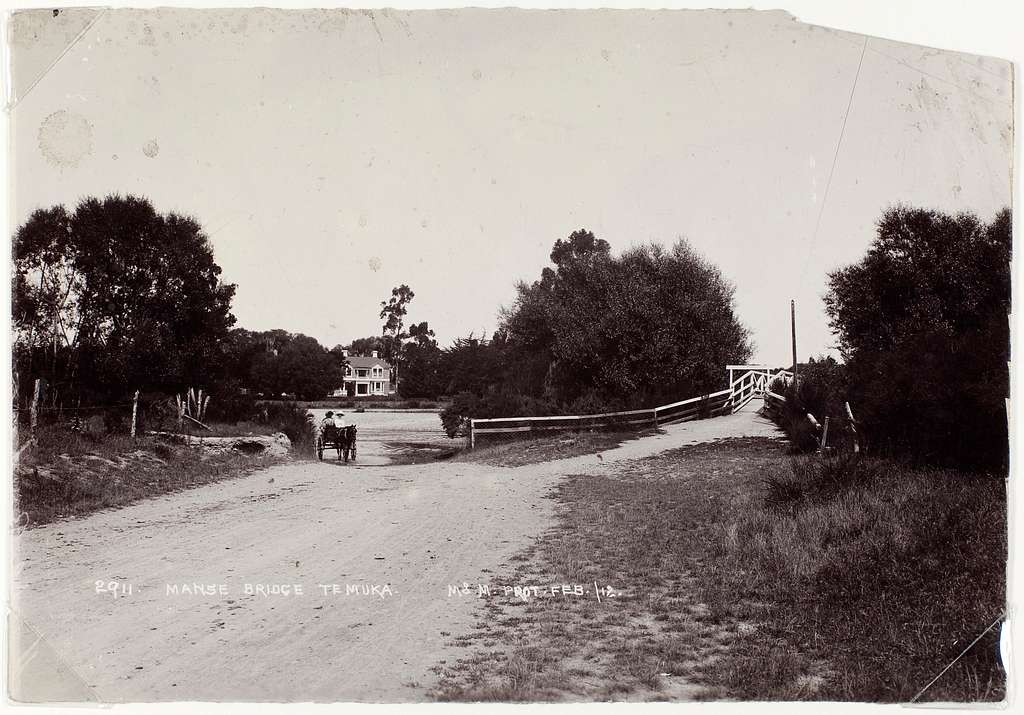
Manse Bridge, Temuka, 1912, Temuka, by Muir & Moodie. Te Papa (O.001800) ‘The New Presbyterian Manse at Temuka’ reported on in the Otago Witness 2 August 1911 p48. The Rev Charles McDonald was the first resident of the manse.
In November 1887, a man leading his horse across a footbridge over the Temuka River had a rather frightening experience. The horse lost its footing, fell into the water, landed on its back and became tangled in submerged wire. Fortunately, after a desperate struggle, it managed to free itself. The Temuka Leader reported the narrow escape on 24 November 1887. It is one of the earliest accounts I found of the crossing near Temuka's Presbyterian manse...
I came across the story while following up on Karen Rolleston's 2019 Civic Trust column about the Guild Memorial Presbyterian Sunday School Hall in Hally Terrace.
I wondered whether another building connected to the hall might provide a new heritage story. That led me to the former Presbyterian manse on Waitohi Temuka Road, and from there to the nearby bridge. As it turns out, they have more in common than I expected.
According to Timaru District Council's heritage assessment, the first manse was built beside the Temuka River in 1880. It was replaced in 1910–11 by the handsome two-storey brick villa that still stands at 99 Waitohi Temuka Road.
Designed by prominent Timaru architect James S. Turnbull and built by W. Baird & Sons, the house has decorative plasterwork, bay windows and a balcony. Turnbull also designed the Guild Memorial Hall, which opened in December 1916.
The old manse even gave its name to the nearby crossing.
By 1901, Manse Bridge was already a familiar landmark. The Temuka Leader described its river views as a favourite subject for artists, although the writer was less impressed by the kerosene tins, broken crockery and scrap iron being dumped in the riverbed. Concerns about litter spoiling a beautiful place are clearly nothing new!
A historic photograph catalogued as Manse Bridge, Temuka, attributed to photographers Muir & Moodie and dated 1912, is also associated with Te Papa's photographic collection. It offers a glimpse of the crossing before the arrival of the substantial traffic bridge.
As transport changed, so did expectations of the crossing. On 6 June 1906, The Timaru Herald reported that 70 ratepayers had petitioned for a light-traffic bridge at Manse Ford.
Seven years later, on 4 June 1913, the Herald reported the Temuka Road Board considering bridge designs suitable for light traffic, drays and even traction engines. No action was taken at that meeting.
Meanwhile, the river could be a formidable neighbour. During the February 1936 floods, water broke through between the Manse crossing and Temuka's main traffic bridge, sweeping across Waitohi Road and flooding land near Arowhenua Hall.
A major improvement finally came in the late 1930s. In June 1938, the Otago Daily Times reported plans for a new traffic bridge to replace the footbridge at Manse Crossing, with £4,000 provided for in the highways programme. Later that year, the government authorised Geraldine County Council to raise a £2,400 loan for the work.
The 1940 Public Works Statement confirmed that the completed bridge had ten spans of 40 feet, a total span length of approximately 122 metres, and had opened to traffic.
While I have yet to establish how much of that structure survives today, Manse Bridge remains an important crossing and a familiar landmark on the Temuka River.
What began as a search for a connection to Karen's Sunday School Hall column turned into a journey through the district's transport, flood and architectural history.
Next time you cross Manse Bridge, spare a thought for the old footbridge, the determined horse, the people who campaigned for a better crossing, and the minister's house that gave the place its name.
I have learned on this history hunt that a familiar place can sometimes offer a lot more history than a name can let on.
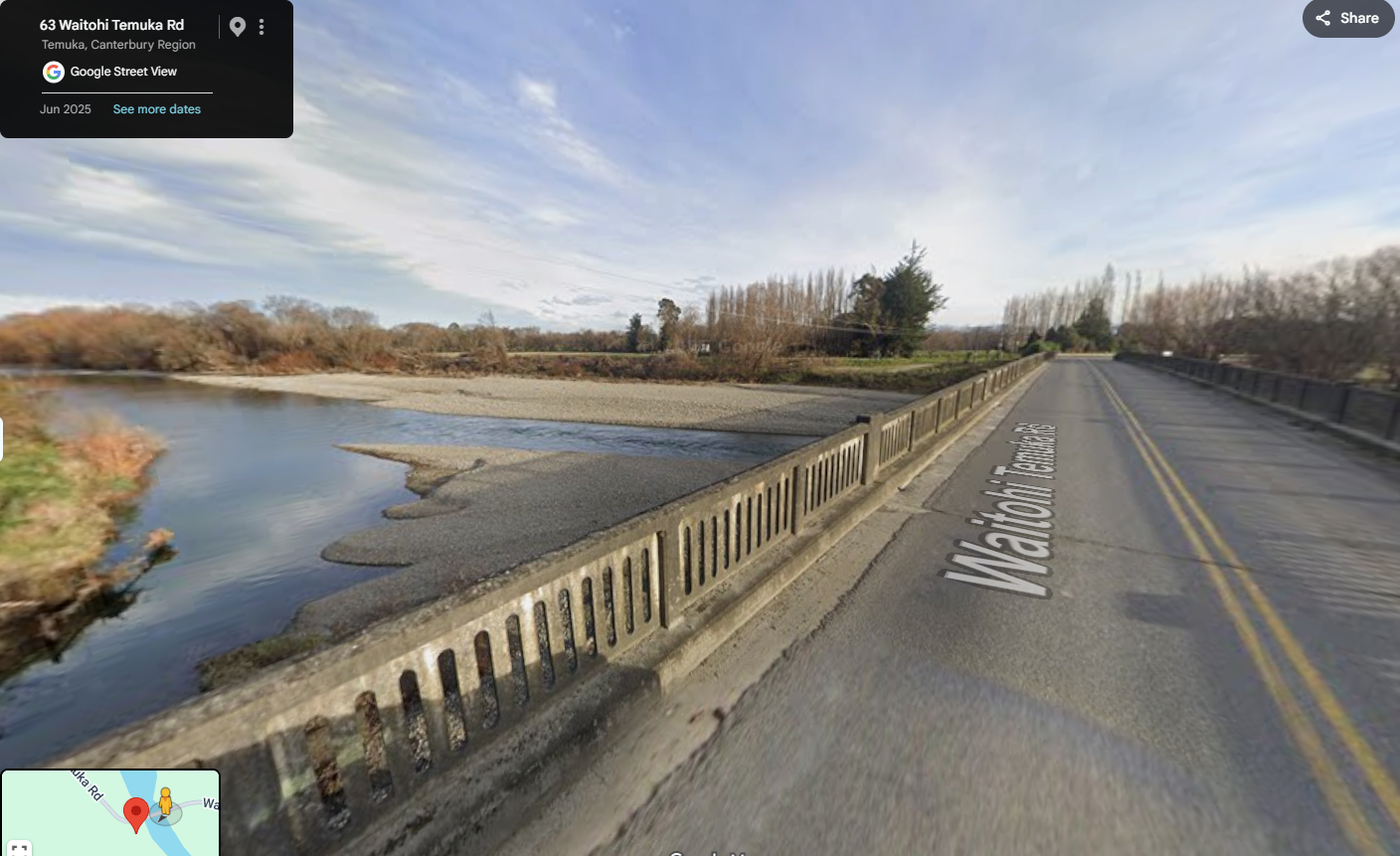
Reinforced concrete was widely used in New Zealand bridge construction by the 1930s. Manse Bridge = Google Maps - 1938–40 Major reconstruction. Geraldine County Council obtained authorisation for a £2,400 loan in 1938. The 1940 Public Works Statement records a completed bridge with ten 40-foot spans, approximately 122 metres altogether. https://gazette.howison.co.nz/nzg/1938/issue/76/page/2208 report on bridge replacement is here: https://www.timaru.govt.nz/__data/assets/pdf_file/0019/20782/765225-Final_Timaru_District_Council_Long_Term_Plan_2012_22_Full.pdf 2012 Another replacement or upgrade proposed. Timaru District Council's 2012–22 Long Term Plan specifically identifies Manse Bridge for structural renewal. The national transport programme also lists a $1.5 million Manse Bridge renewal/upgrade proposal, but gives it reserve funding priority.
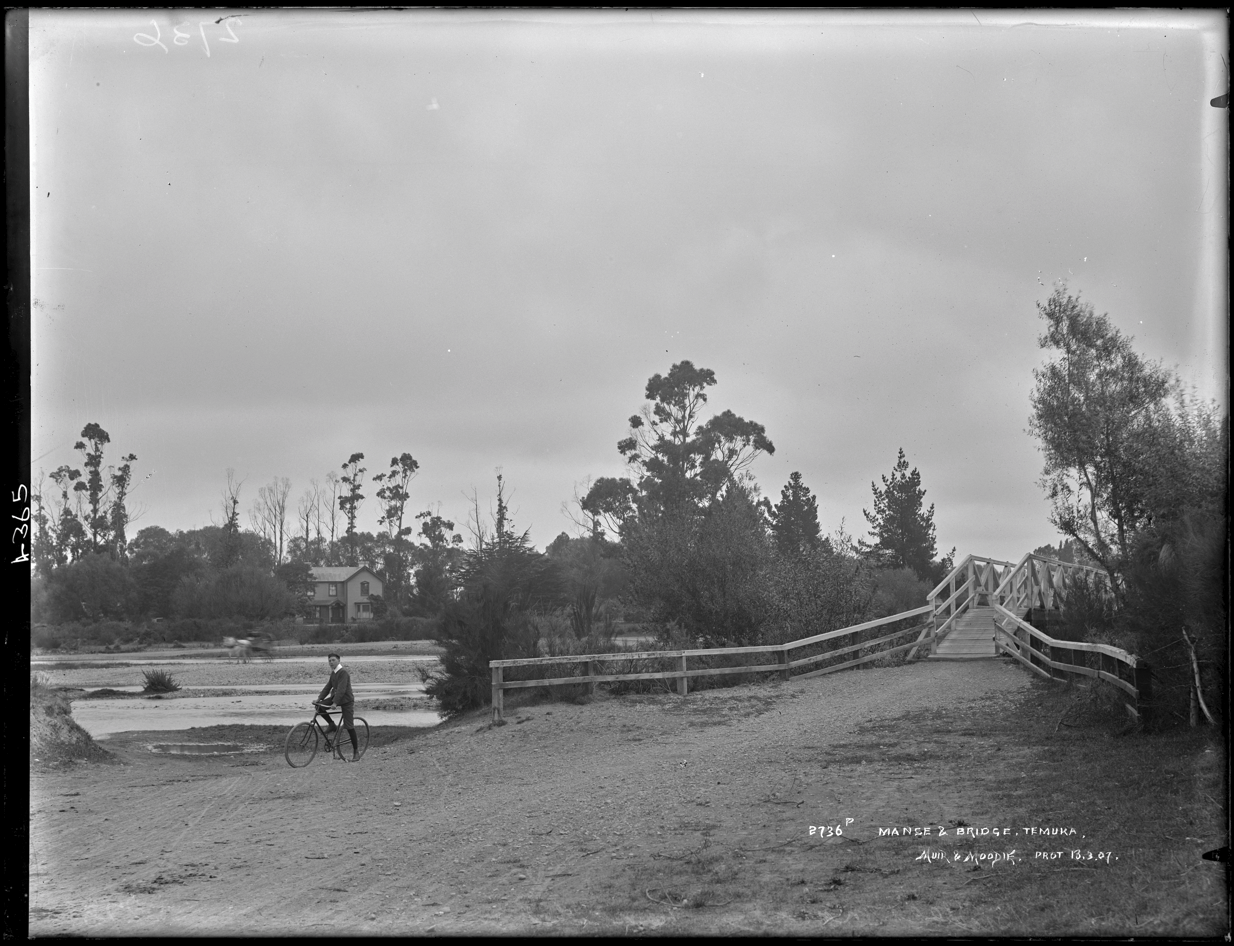
Manse and bridge, Temuka, circa 1907, Dunedin, by Muir & Moodie. Te Papa (C.014365) - Muir & Moodie's historic photograph records Manse Bridge before the substantial road bridge was constructed.
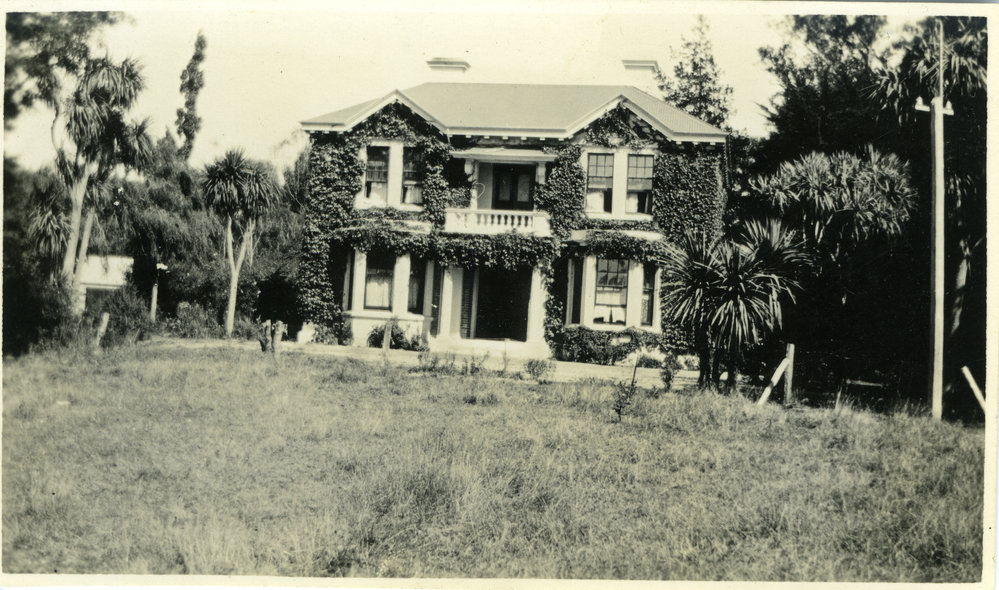
Temuka Church Manse covered in ivy 1928 34051 - 99 Waitohi Temuka Road, Temuka. https://digitalnz.org/records/46056825
"An Italianate villa by JS Turnbull for Messrs Turnbull & Lusk, architects; W Baird & Sons, contractors. The former Presbyterian manse stands on the south side of Waitohi Temuka Road, west of the Temuka River and close by the Manse Bridge that spans the river. The property is bounded to the south by Raupo Creek. The extent of setting is limited to the immediate garden setting of the former manse, notwithstanding any potential archaeological values that may exist on the property as a whole. The first Temuka Presbyterian church was erected in 1871; eight years later Temuka became a separate parish. A new brick church was built in 1900-1 and in 1910-11 a new manse was erected on the outskirts of the township; the previous manse on the same site (1880) having been sold for removal. The Rev Charles McDonald was the first resident of the manse, which was superseded by a bungalow in the township in 1934. The 1910-11 manse was then sold; it remains in private residential use today.
William Baird & Sons were also responsible for erecting the Jackson Memorial Methodist Sunday School in Timaru in 1907 to JS Turnbull’s design. design by noted local architect JS Turnbull. Timaru-born James Turnbull (1864-1947) trained in Melbourne and then established a practice in Timaru in c.1895. The son of Richard Turnbull, a prominent Timaru businessman and politician, Turnbull also designed Job Brown’s Beehive Stores (1901-2) in Temuka, Chalmers Church (1903-4, heritage item # 38), and a large number of Timaru houses. Turnbull was in partnership with Thomas Lusk (c.1882-1946) until June 1911; he later went into partnership with Percy Watts Rule (c.1920), after which time Percy Rule was the principal designer in the firm. The firm designed St James’ Anglican Church at Franz Josef (1928-31) and Rule was awarded a Gold Medal from the NZ Institute of Architects for his design of the Surgical Wing at Timaru Hospital (1936-40) in 1939. The former manse retains a high level of exterior authenticity and was credited to Turnbull alone at the time of its construction."
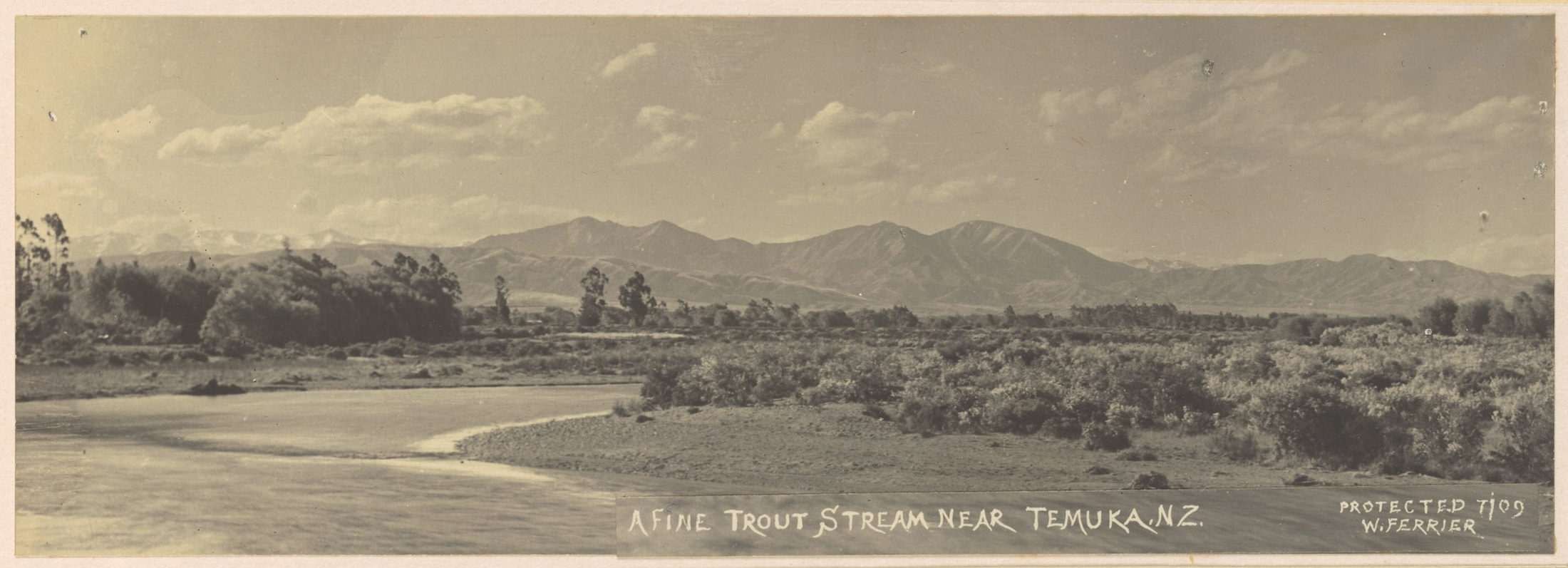
Temuka c1910 a fine trout stream near Temuka Te Papa 2242327
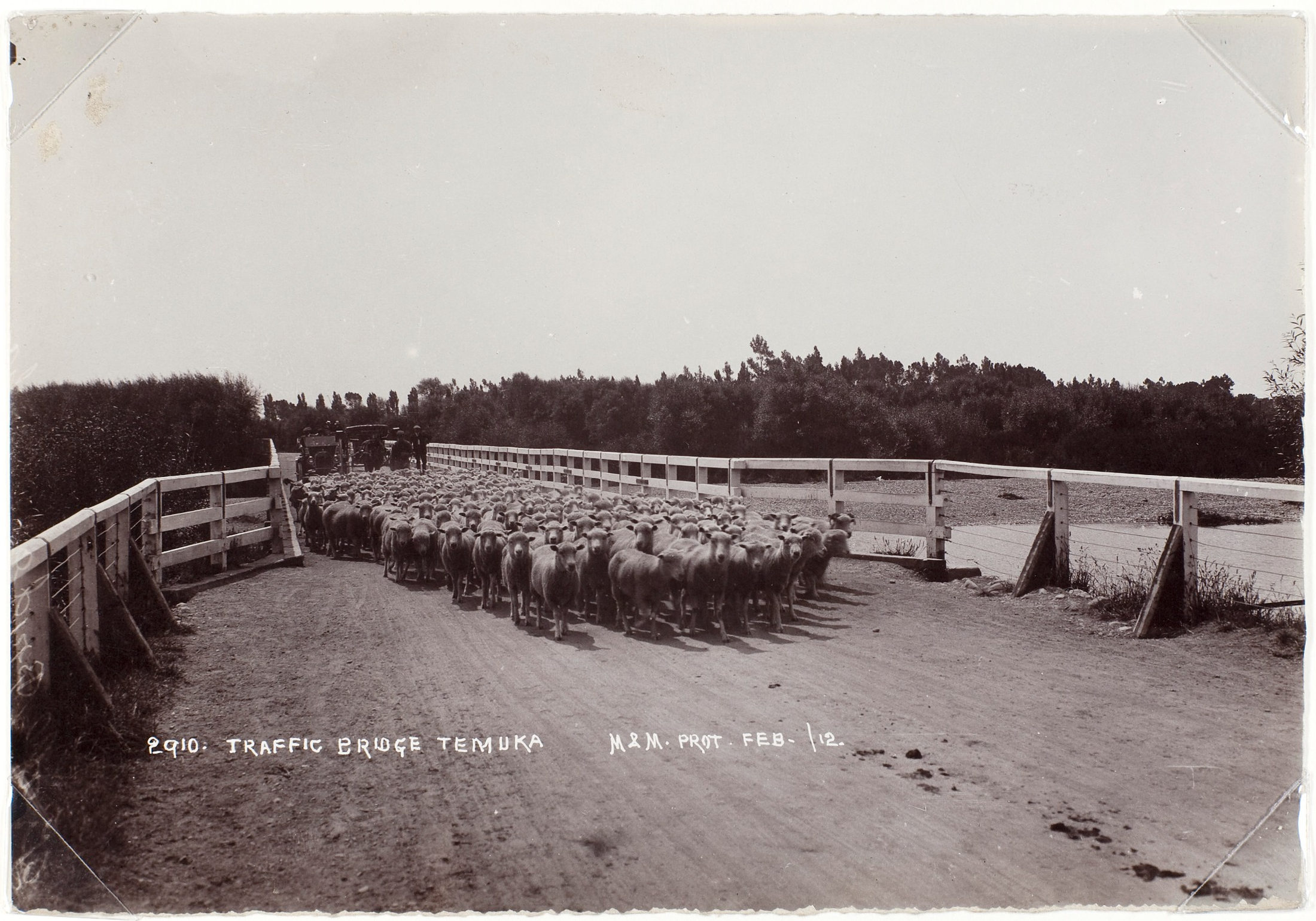
Temuka 1912 traffic bridge Te Papa 216895
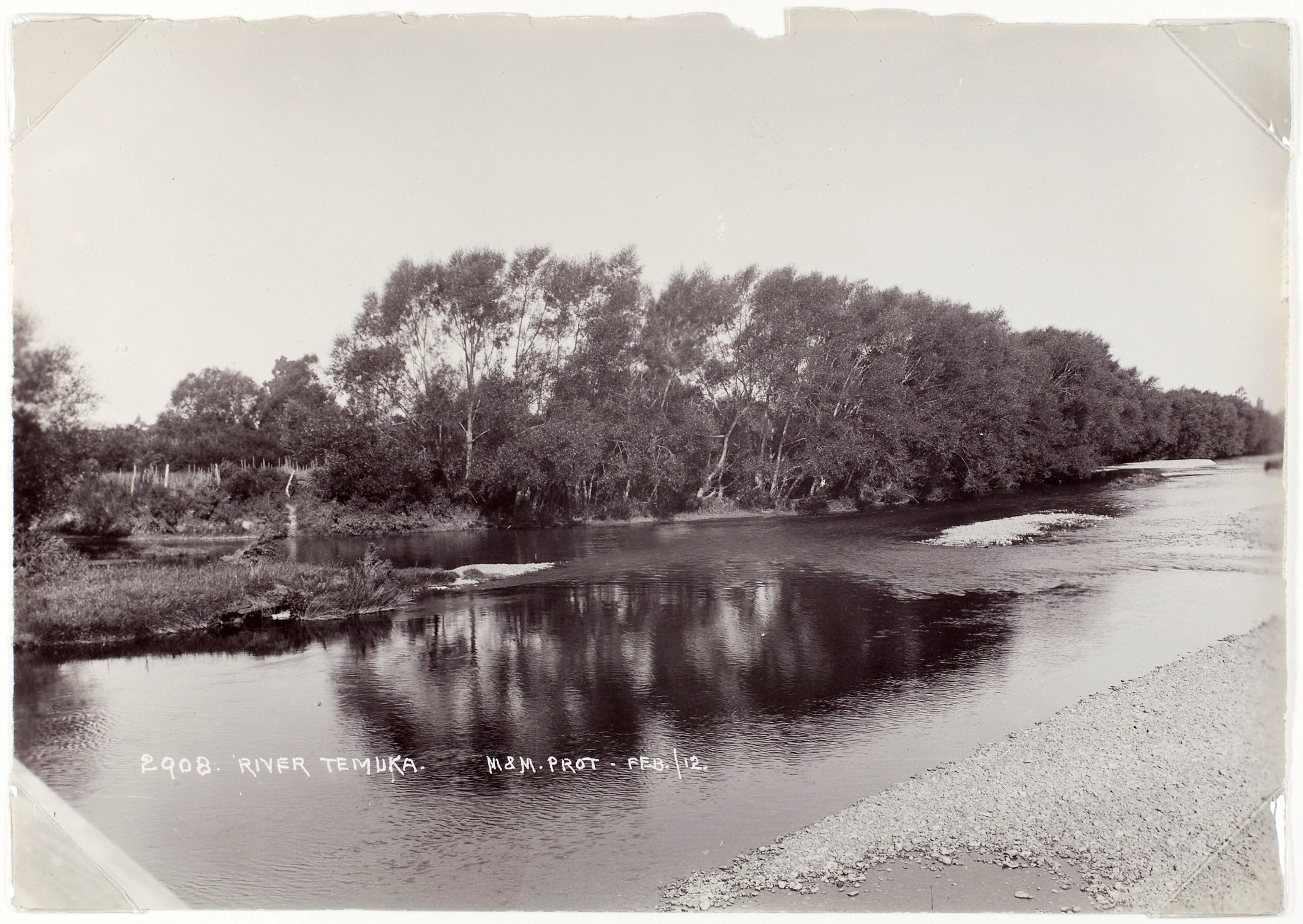
Temuka River 1912 Te Papa 216892
Side Quest 1: Two horses and a troublesome river
Crossing the Temuka River wasn't always straightforward, especially if you had a horse.
In November 1887, the Temuka Leader reported how a horse being led across the footbridge near the Presbyterian manse lost its footing and toppled into the river. It landed on its back, became tangled in submerged wire and narrowly escaped drowning.
Less than two years later, another traveller had a frightening experience at almost the same spot.
On 17 September 1889, The Press reported that a man attempting to ford the river near Manse Bridge was swept from his horse and forced to swim ashore.
The newspaper explained that two fords were commonly used during dry weather, but the upper crossing was particularly treacherous after rain, when the riverbed could be scoured away.
These incidents provide a glimpse of travel before the convenience of a substantial road bridge. Even a familiar crossing could become dangerous when the river was running high.
Side Quest 2: The Temuka artist and a missing painting
Somewhere, there may still be a painting of the Temuka River from Manse Bridge, created more than 120 years ago.
On 15 February 1902, the Temuka Leader reported on an illuminated farewell address prepared for Reverend T. Farley, who had recently left Temuka for St Andrews.
Local artist Theo Goy had been commissioned to decorate the address. Using old English lettering, crimson, green and gold ornamentation, he incorporated four illustrations of places associated with the minister's time in Temuka.
There were views of St Saviour's Church, St Peter's Church, the Temuka flour mill and the river as seen from Manse Bridge.
The finished work was framed in oak and displayed in the window of Bates & Co. before being forwarded to Reverend Farley.
I haven't been able to trace the original artwork, but it raises an intriguing possibility. Did it remain in the Farley family, or find its way into a church collection?
What a wonderful thing it would be to rediscover a picture of the crossing painted by someone who knew the river as it was in 1902.
Side Quest 3: The view was lovely. The rubbish wasn't.
In October 1901, somebody in Temuka had clearly had enough of people using the riverbed as a rubbish dump.
The Temuka Leader complained about kerosene tins, scrap iron, broken crockery and old sacking being discarded near the Temuka River.
Some of the rubbish had been dumped so close to the water that the next fresh would probably carry it downstream.
Anglers risked losing their fishing tackle on submerged metal, while the clutter spoiled a river scene that had frequently attracted artists.
The newspaper singled out the view from Manse Bridge, describing its reputation for beauty and expressing concern about what painters might find in the foreground.
The writer suggested that the Borough Council and Road Board should arrange somewhere more suitable for residents to dispose of their unwanted belongings.
It is a remarkably familiar argument. Long before today's conversations about protecting our waterways, local people were asking others to take better care of a place they valued.
The article also tells us something easily overlooked: Manse Bridge was once recognised as a particularly picturesque place from which to appreciate the Temuka River.
Side Quest 4: Seventy signatures and a bridge worth fighting for
In June 1906, seventy Temuka district ratepayers put their names to a petition calling for a light-traffic bridge at Manse Ford.
The petition was presented to the Temuka Road Board by Messrs Wright, Goodall and Langridge. According to the Timaru Herald of 6 June, the Board agreed to strongly recommend the project to Geraldine County Council.
But getting a bridge built was not as simple as gathering signatures.
Seven years later, the Timaru Herald reported that the Road Board was still considering options. Its overseer had investigated bridges suitable for light traffic, drays and traction engines.
The Board took no action at that meeting.
In 1938, the Otago Daily Times reported that £4,000 had been provided in the highways programme to subsidise a traffic bridge, while Temuka Borough Council agreed to contribute £600.
By 1940, the Public Works Statement recorded a completed bridge comprising ten 40-foot spans.
More than thirty years separated that original petition from the new crossing.
It is a reminder that the roads and bridges we rely on often began with local people recognising a problem, gathering support and persuading public authorities to act.
Side Quest 5: Cauliflowers, broccoli and a forgotten nursery
Tucked among the classified advertisements in the Timaru Herald of 3 November 1921 is a small notice offering cauliflower and broccoli plants for sale.
The seller was P. R. Needham, proprietor of Manse Bridge Nursery, Temuka.
The advertisement promoted Blair's Phenomenal late cauliflower and broccoli plants, available in any quantity.
It is only a few lines long, but it reveals another use of the Manse Bridge name, this time associated with a local horticultural business.
Where exactly was the nursery? Did Needham grow his plants on land near the crossing, and how long did the business operate?
Those questions remain unanswered, but the advertisement offers a promising starting point for tracing another piece of Temuka's local history.
Sometimes the smallest newspaper notices lead us towards people and places that have otherwise slipped from memory.
Side Quest 6: When the Temuka River became a torrent
Anyone who has stood beside the Temuka River during a dry summer might find the figures from April 1951 difficult to imagine.
Over several days, torrential rain swept across Canterbury, sending rivers into flood, washing out bridges, blocking roads and isolating communities.
At Manse Bridge, the Temuka River's recorded peak discharge reached approximately 828 cubic metres of water every second.
That's an extraordinary volume passing through a crossing more often associated with the everyday journey between Temuka and the surrounding countryside.
According to NIWA's historical weather-events database, the floods affected roads, railway lines and telephone communications throughout Canterbury.
For people living near the river, the flood was more than an impressive statistic. It disrupted travel, threatened property and demonstrated how quickly familiar landscapes could change.
Today, Manse Bridge remains associated with river monitoring, adding another layer to its history. What began as a place for people to cross the water also helps us understand how the river behaves.
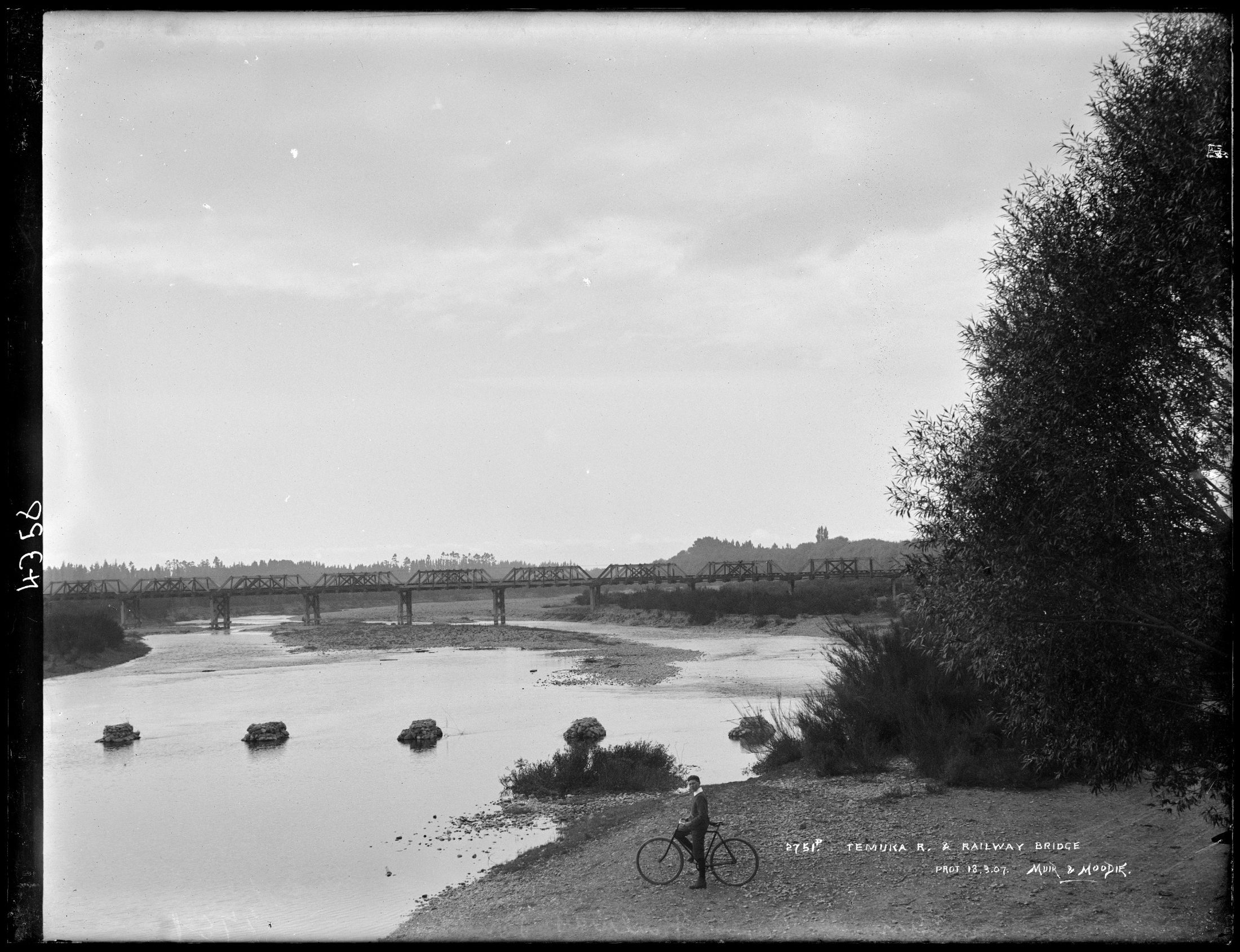 c 1907 Temuka river and railway bridge TePapa 23916
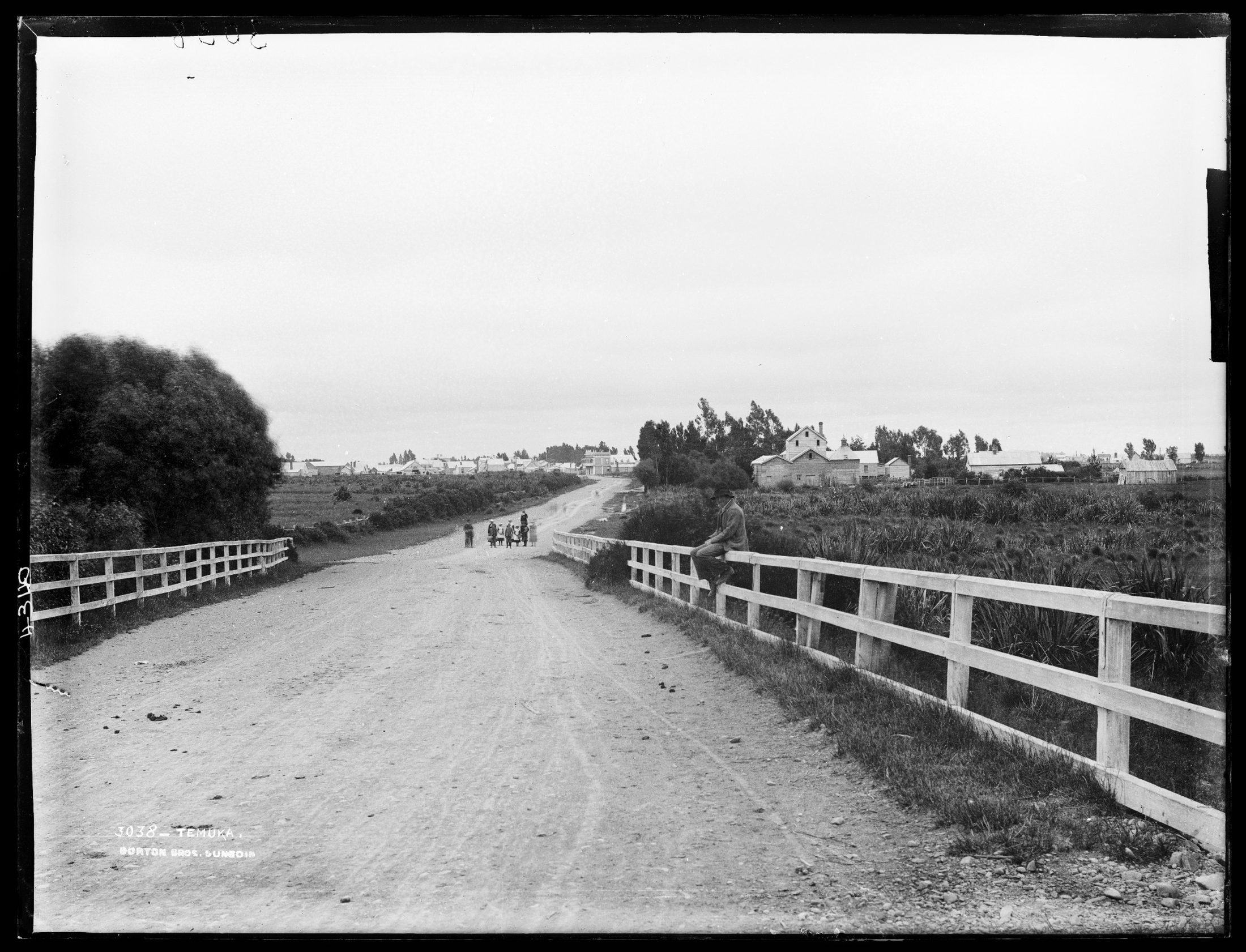
Temuka undated Te Papa 23471
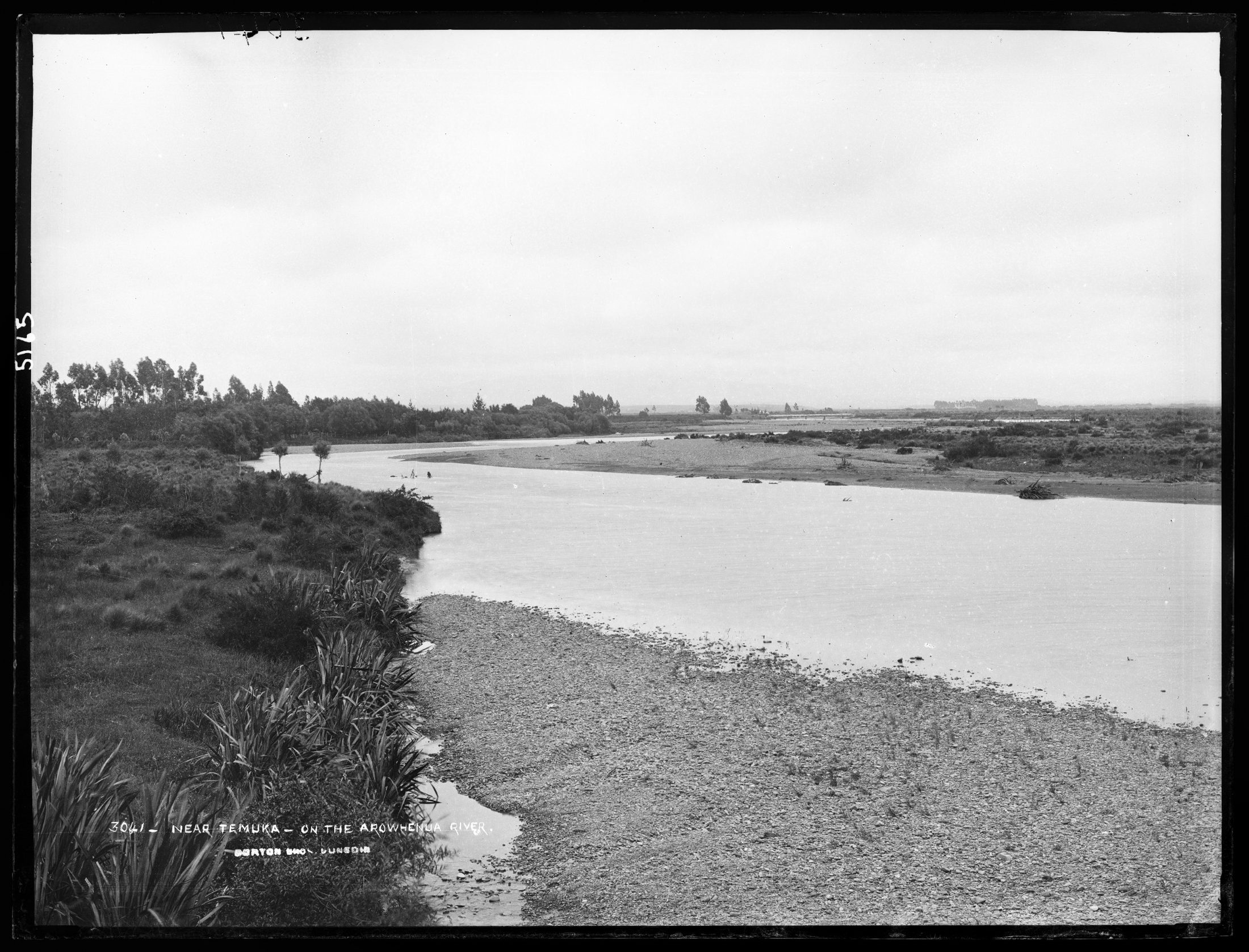
Temuka Undated on the Arowhenua River Te Papa 20033
Original newspaper reports
1. 1882 — Weddings at the original Presbyterian manse. Temuka Leader, 7 January 1882, page 2.
https://paperspast.natlib.govt.nz/newspapers/TEML18820107.2.7
Papers Past
2. 1887 — Horse falls from the footbridge near the manse. Temuka Leader, 24 November 1887, page 2.
https://paperspast.natlib.govt.nz/newspapers/TEML18871124.2.7
Papers Past
3. 1889 — Traveller washed from horse at river ford. The Press, 17 September 1889.
https://paperspast.natlib.govt.nz/newspapers/CHP18890917.2.28
Papers Past
4. 1901 — Rubbish in the riverbed and the picturesque view from Manse Bridge. Temuka Leader, 22 October 1901, page 2.
https://paperspast.natlib.govt.nz/newspapers/TEML19011022.2.15
Papers Past
5. 1902 — Theo Goy's illuminated farewell address, featuring the river from Manse Bridge. Temuka Leader, 15 February 1902, page 2.
https://paperspast.natlib.govt.nz/newspapers/TEML19020215.2.13
Papers Past
6. 1902 — Major flooding in Temuka. Temuka Leader, 25 March 1902.
https://paperspast.natlib.govt.nz/newspapers/TEML19020325.2.12
Papers Past
7. 1906 — Petition from 70 ratepayers for a light-traffic bridge at Manse Ford. Timaru Herald, 6 June 1906, page 5.
https://paperspast.natlib.govt.nz/newspapers/THD19060606.2.19
Papers Past
8. 1907 — Repairs to Manse Bridge commence. Temuka Leader, 26 March 1907.
https://paperspast.natlib.govt.nz/newspapers/TEML19070326.2.16
Papers Past
9. 1913 — Road Board considers a bridge for drays and traction engines. Timaru Herald, 4 June 1913.
https://paperspast.natlib.govt.nz/newspapers/THD19130604.2.17
Papers Past
10. 1915 — James Guild's trustees offer £2,000 for the Sunday School Hall. Lyttelton Times, 17 September 1915.
https://paperspast.natlib.govt.nz/newspapers/LT19150917.2.99
Papers Past
11. 1916 — The Presbyterian congregation reports the Sunday School Hall under construction. Timaru Herald, 26 August 1916.
https://paperspast.natlib.govt.nz/newspapers/THD19160826.2.28
Papers Past
12. 1921 — P. R. Needham's Manse Bridge Nursery advertisement. Timaru Herald, 3 November 1921, page 10.
https://paperspast.natlib.govt.nz/newspapers/THD19211103.2.55.6
Papers Past
13. 1923 — Reverend Charles Macdonald's final Sunday School prizegiving. Temuka Leader, 5 June 1923.
https://paperspast.natlib.govt.nz/newspapers/TEML19230605.2.13
Papers Past
14. 1924 — County bridge staff undertake Manse Bridge repairs. Temuka Leader, 22 January 1924.
https://paperspast.natlib.govt.nz/newspapers/TEML19240122.2.13
Papers Past
15. 1926 — Obituary for Reverend Charles Macdonald. Temuka Leader, 15 April 1926, page 2.
https://paperspast.natlib.govt.nz/newspapers/TEML19260415.2.13
Papers Past
16. 1932 — Fishing at Manse Bridge. North Otago Times, 22 January 1932.
https://paperspast.natlib.govt.nz/newspapers/NOT19320122.2.13
Papers Past
17. 1938 — Funding proposed for a traffic bridge at Manse Crossing. Otago Daily Times, 17 June 1938.
https://paperspast.natlib.govt.nz/newspapers/ODT19380617.2.119
Papers Past
Government, Council and museum records
18. 1938 — Manse Bridge Loan authorisation. New Zealand Gazette, 13 October 1938, page 2208.
https://gazette.howison.co.nz/nzg/1938/issue/76/page/2208
19. 1940 — Public Works Statement. Official confirmation that the new ten-span Manse Bridge was completed and opened to traffic.
https://paperspast.natlib.govt.nz/parliamentary/AJHR1940-I.2.2.3.1
Papers Past
20. 1951 — Canterbury flooding, including the Manse Bridge discharge figure. NIWA Historical Weather Events database.
https://hwe.niwa.co.nz/event/April_1951_Canterbury_Flooding
Earth Sciences New Zealand | NIWA
21. 1936 flood history — Joseph Wade of Epworth. South Canterbury Museum biographical profile. This contains a detailed account of the Temuka River breaking through near the Manse crossing.
https://museum.timaru.govt.nz/explore/scroll/profile?id=2368
South Canterbury Museum
22. Former Presbyterian Manse, 99 Waitohi Temuka Road. Timaru District Council Historic Heritage Assessment HHI83, Category B. Includes physical description, architectural history, the connection to Manse Bridge, and the 1911 photograph.
https://www.timaru.govt.nz/__data/assets/pdf_file/0003/673905/Historic-Heritage-Assessment-Report-HHI83-Former-Presbyterian-Manse-Category-B-NEW.pdf
Timaru District Council
23. Former Guild Memorial Sunday School Hall, 49 Hally Terrace. Timaru District Council Historic Heritage Assessment HHI122, Category B. Confirms its construction in 1916 and architect James S. Turnbull.
https://www.timaru.govt.nz/__data/assets/pdf_file/0006/673944/Historic-Heritage-Assessment-Report-HHI122-Former-Guild-Memorial-Sunday-School-Hall-Presbyterian-Category-B-NEW.pdf
Timaru District Council
24. Karen Rolleston's 2019 Civic Trust column: Presbyterian Sunday School Hall, Temuka. The starting point for the follow-up research.
https://www.timarucivictrust.co.nz/blog/presbyterian-sunday-school-hall-temuka
Civic Trust
25. Historic photographic lead: Manse Bridge, Temuka. Muir & Moodie image listing on PICRYL, with Te Papa named as the collection source. Original museum record still to be confirmed.
https://picryl.com/media/manse-bridge-temuka-ad128a
26. James S. Turnbull — architectural background. WuHoo Timaru's profile of the architect and his buildings.
https://www.wuhootimaru.co.nz/timaru-cbd-architecture-hunt/prominant-architects-of-timaru/627-james-turnbull
James S Turnbull (1864-1947)
Manse Bridge Loan
https://gazette.howison.co.nz/nzg/1938/issue/76/page/2208
HEREAS the Geraldine County Council (hereinafter called “the said local authority”), being desirous of raising the sum of two thousand four hundred pounds (£2,400) by a loan to be known as “Manse Bridge Loan, 1938” (hereinafter called “the said loan”), for the purpose of reconstructing the Manse Bridge on the Temuka River on the Temuka - Pleasant Point Main Highway, has complied with the provisions of the Local Government Loans Board Act, 1926 (hereinafter called “the said Act”), and it is expedient that the precedent consent of the Governor-General in Council as required by the said Act should be given to the raising of the said loan :
Now, therefore, His Excellency the Governor-General of the Dominion of New Zealand, acting by and with the advice and consent of the Executive Council of the said Dominion, and in pursuance and exercise of the powers and authorities conferred on him by section eleven of the said Act, as set out in section twenty-nine of the Finance Act, 1932 (No. 2), and of all other powers and authorities enabling him in this behalf, doth hereby consent to the raising in New Zealand by the said local authority of the said loan for the said purpose up to the amount of two thousand four hundred pounds (£2,400), and in giving such consent doth hereby determine as follows :—
(1) The term which the said loan or any part thereof may be raised shall not exceed twenty-six (26) years.
(2) The rate of interest that may be paid in respect of the said loan or any part thereof shall be such as shall not produce to the lender or lenders a rate or rates exceeding three pounds ten shillings (£3 10s.) per centum per annum.
(3) The said local authority shall, before raising the said loan or any part thereof, make provision for the repayment thereof by establishing a sinking fund under the Local Bodies’ Loans Act, 1926, or under such other statutory enactment as may be applicable, and shall thereafter make payments to such sinking fund at intervals of not more than one year, at a rate or rates per centum which shall be not less than two pounds eight shillings and fivepence (£2 8s. 5d.), such payments to be made in respect of every part of the said loan for the time being so raised and not repaid, the first such payment to be made not later than one year after the first day from which interest to the lender or lenders is computed on the said loan or any part thereof so raised.
(4) The payment of interest and repayment of principal in respect of the said loan shall be made in New Zealand.
(5) No amount payable as either interest or sinking fund in respect of the said loan shall be paid out of loan-money.
(6) The rate payable for brokerage, underwriting, and procurement fees in respect of the raising of the said loan or any part thereof shall not in the aggregate exceed one-half per centum of any amount raised.
(7) No moneys shall be borrowed under this consent after the expiration of two years from the date hereof.
C. A. JEFFERY,
Clerk of the Executive Council.
(T. 49/468/3.)