
By Roselyn Fauth

Timaru's first hospital emerged not from a grand governmental plan, but from the persistent advocacy of civic leaders like Belfield Woollcombe, responding to urgent health needs. Though modest in size and imperfect in location, the 1862 hospital marked the start of organized medical care in the region... a foundation that would grow into the Timaru Hospital we know today.
I just assumed that nursing was a centuries old perfession, in today's deep dive, I have learned it is far more recent and through the work of the community we have saved many lives and improved the standard of care for those who became unwell, and in prevention too...
Belfield Woollcombe, a prominent local official (magistrate, registrar, customs officer, beachmaster, and immigration agent), formally appealed to the Canterbury Provincial Government for hospital facilities. To get up and running, Woollcombe hired a cob house with two rooms and four bedrooms at 16 shillings per week.
Mrs. Simpson, wife of the clerk of works, agreed to serve as nurse for £50 a year. There were four beds, bedding, furniture, cooking gear, crockery which was inspired by the Christchurch hosptal. Dr Edward Butler was the first medical appointment as the Provincial Surgeon in December 1 1862. Woollcombe recommended Butler for the role of medical superintendent of the new hospital. View the photo Aoraki Heritage Record
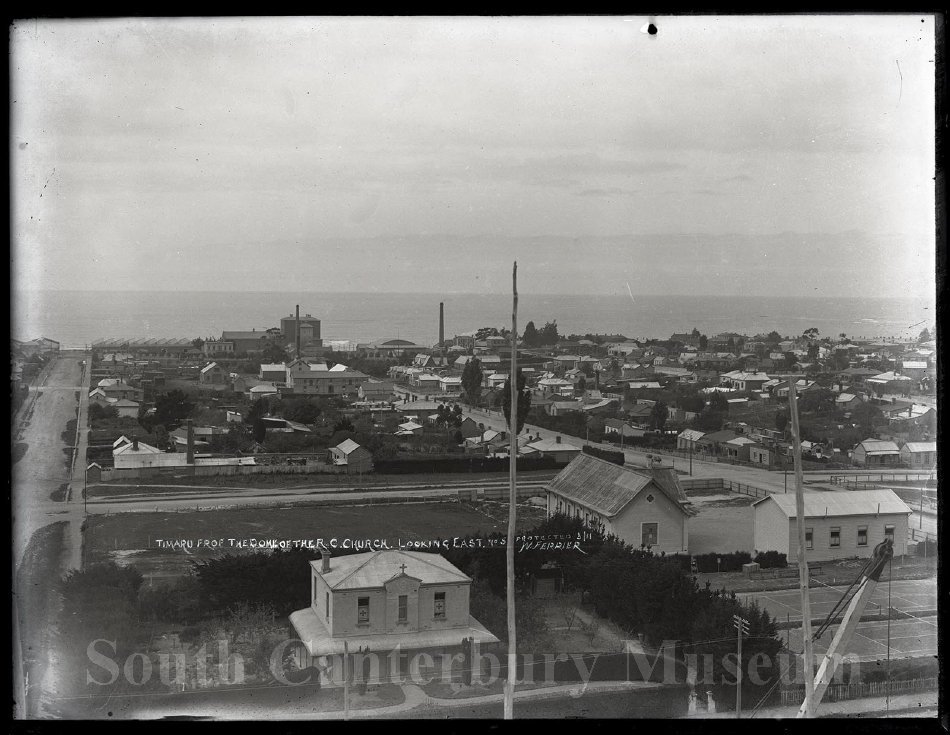
Timaru from the dome of the RC Church looking east No 5 Timaru Breweries John Jackson and Co timber and coal merchants and Evans Atlas and Co Mill. South Canterbury Museum 2477b
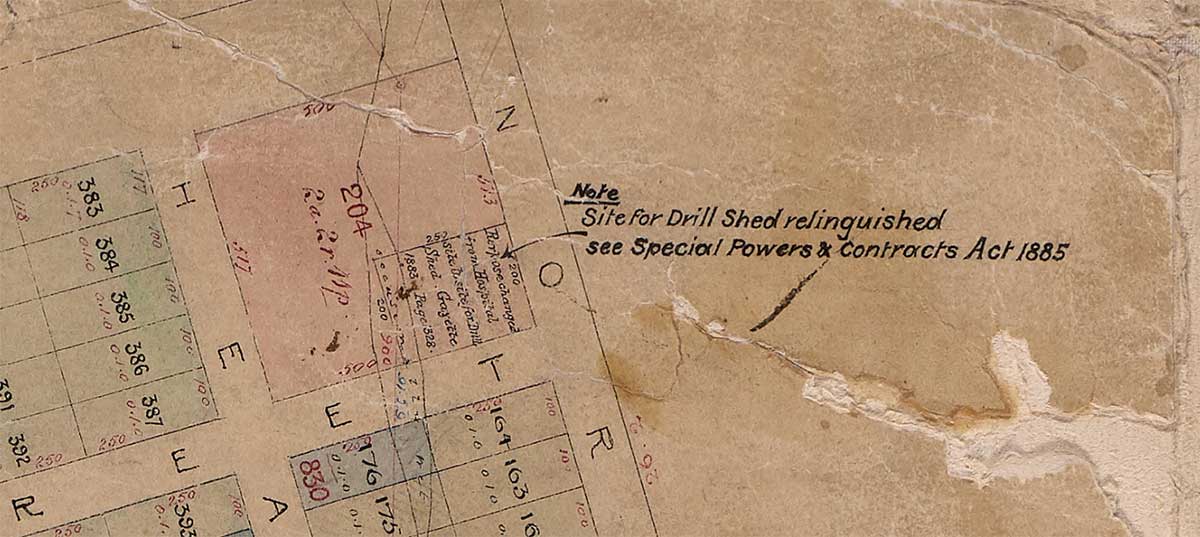
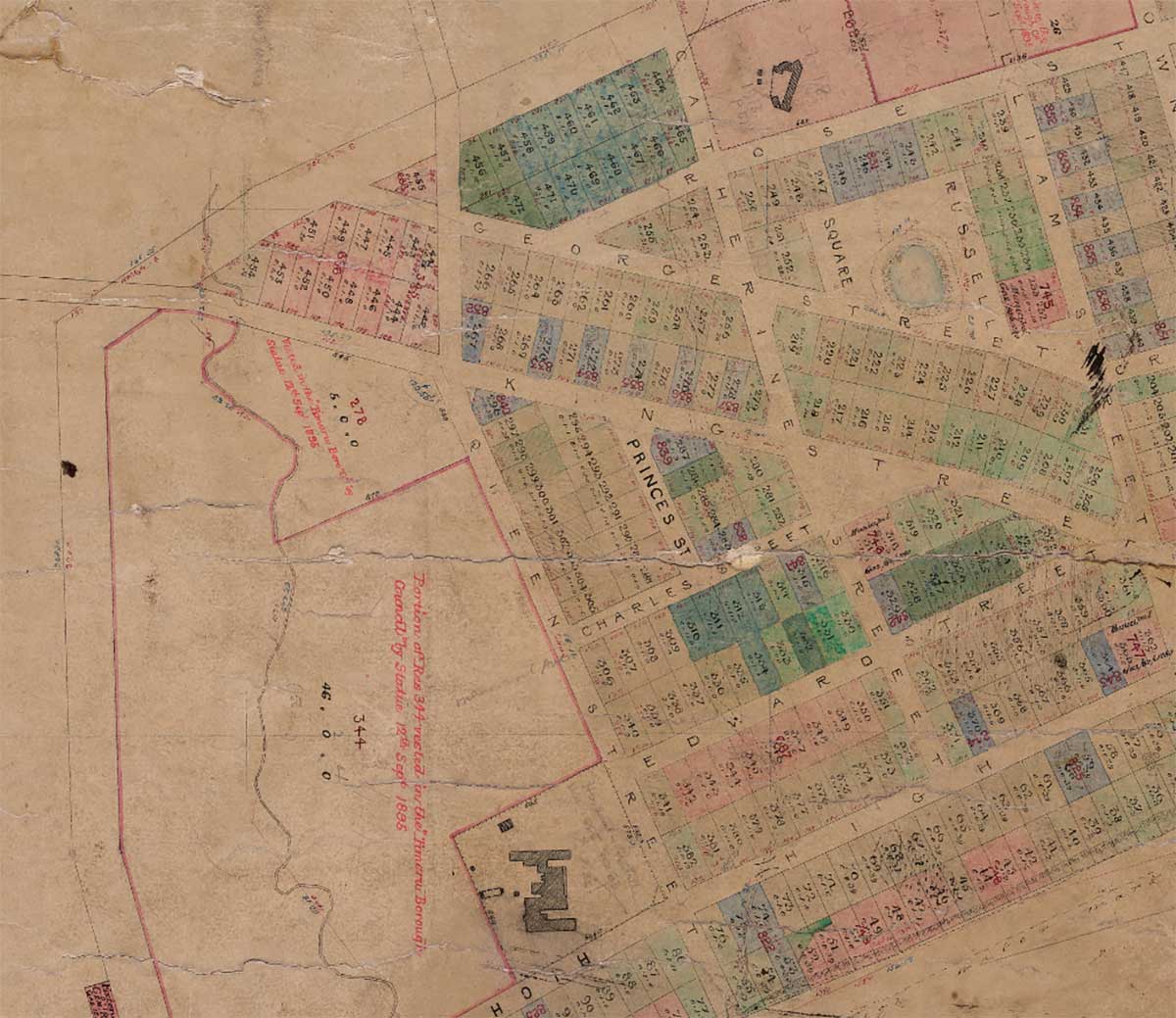
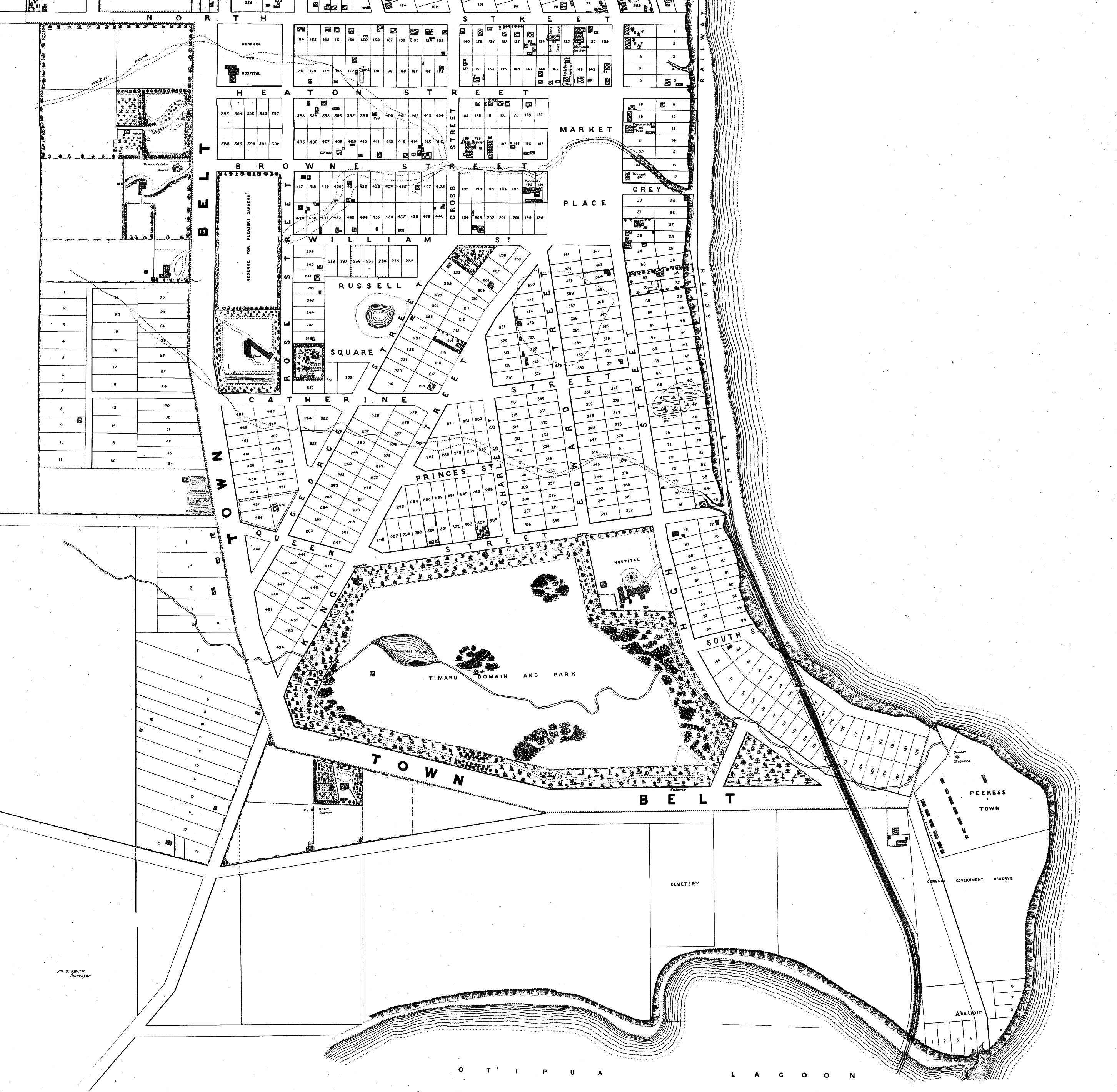
Section of a map from 1860 corner of what is now Cragie Ave, Rose Street and North Street. "Town of Timaru". NZ Heritage Maps Platform, https://maps.recollect.co.nz/nodes/view/331
One of our earliers, if not the first public hospital in Timaru, provided care on a site opposite where the Bascilla is today. This was a couple of blocks north of the local goal. The wooden hospital was built by the Canterbury Provincial Government at the corner of North Street and West Belt. It cost £443. The area was built on the edge of a swampy creek, and concerns over the dampness led to the search for a better site. Local committee formed: Included H. Belfield, T. W. Hall, and J. Beswick. Dr Duncan McLean temporarily took charge after Dr Butler resigned. 1865: Dr Christy appointed by the Provincial Government as the official hospital surgeon at £130/year, plus an additional £100/year as police medical officer.
There were a few scandals reported in the paper, in 1865 Dr Christy was accused of inefficiency and mistreatment, especially involving a German boy patient. A commission of inquiry was launched after public complaints and petitions. Outcome: The investigation exonerated Dr Christy, praised his work, and criticized the hospital’s poor siting in a “hollow” prone to flooding.
The hospital moved to governance, and the Hospital came under the control of the newly formed South Canterbury Hospital and Charitable Aid Board, ending exclusive provincial oversight.
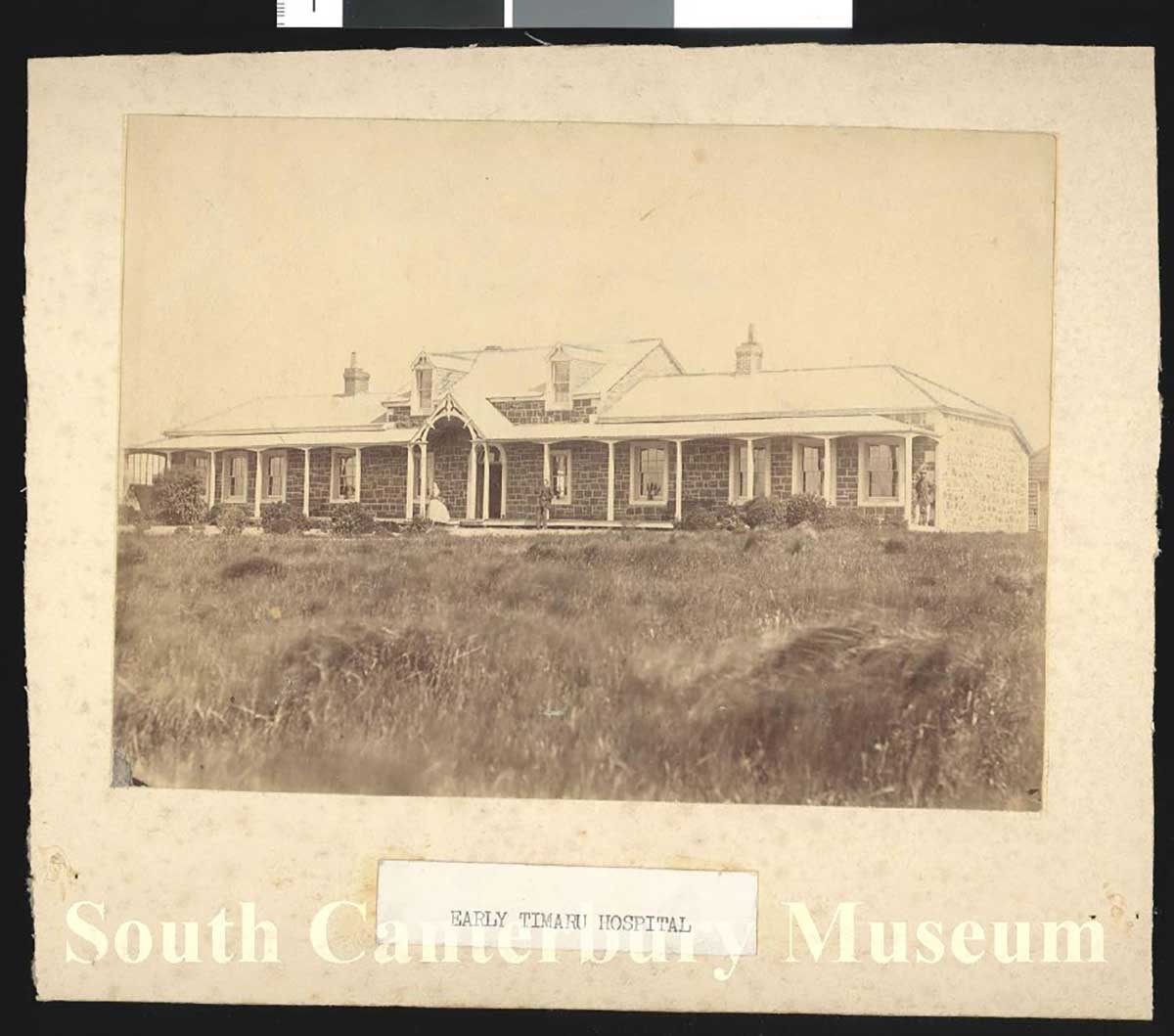
The "Early Timaru Hospital" on Queen Street, Timaru, circa 1870. Depicts the Timaru's second hospital but the first on the Queen Street site. Construction of the bluestone building began in 1869 but the hospital was not occupied until 1870. South Canterbury Museum CN 1116.
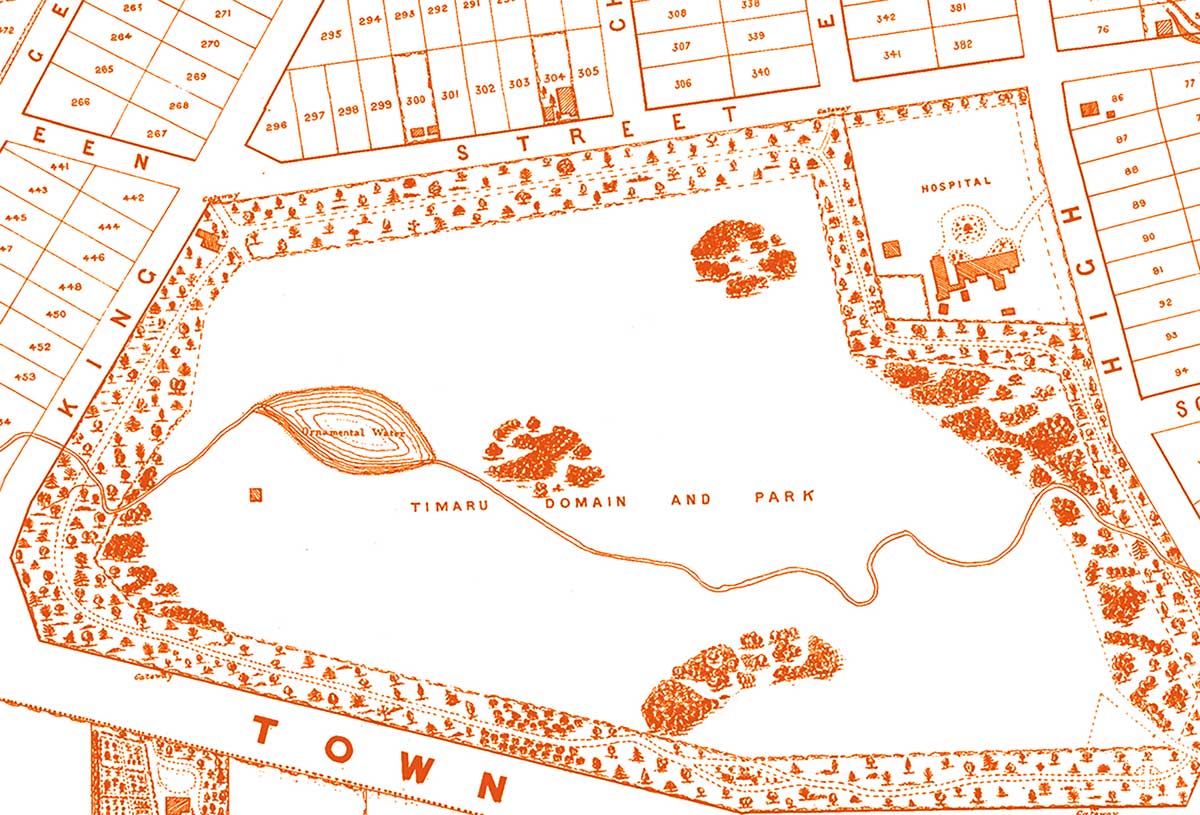
The corner of the reserve for the Timaru Botanic Gardens was carved off for a new hospital.
A portion of land from the Timaru Botanic Gardens was subdivided to establish the current site of Timaru Hospital. This relocation provided patients and visitors with a serene environment conducive to rest and recuperation. timaru.govt.nz+1timaru.govt.nz+1top10.co.nz+2timaru.govt.nz+2wuhootimaru.co.nz+2
The hospital is situated in the Parkside suburb of Timaru, occupying the northeastern corner of the Botanic Gardens. This strategic placement integrates healthcare services with the natural beauty of the gardens, offering a tranquil setting for healing. en.wikipedia.org
The Timaru Botanic Gardens themselves have a rich history, having been established in 1864. Over the years, they have evolved into a space of national significance, recognized for their diverse plant collections and historical features. exploretimaru.co.nz
"The End of an Era, 1964–1989" by Eulla Williamson: This work details the final 25 years of the South Canterbury Hospital Board's administration of Timaru Hospital. timdc.pastperfectonline.com/library/2B993168
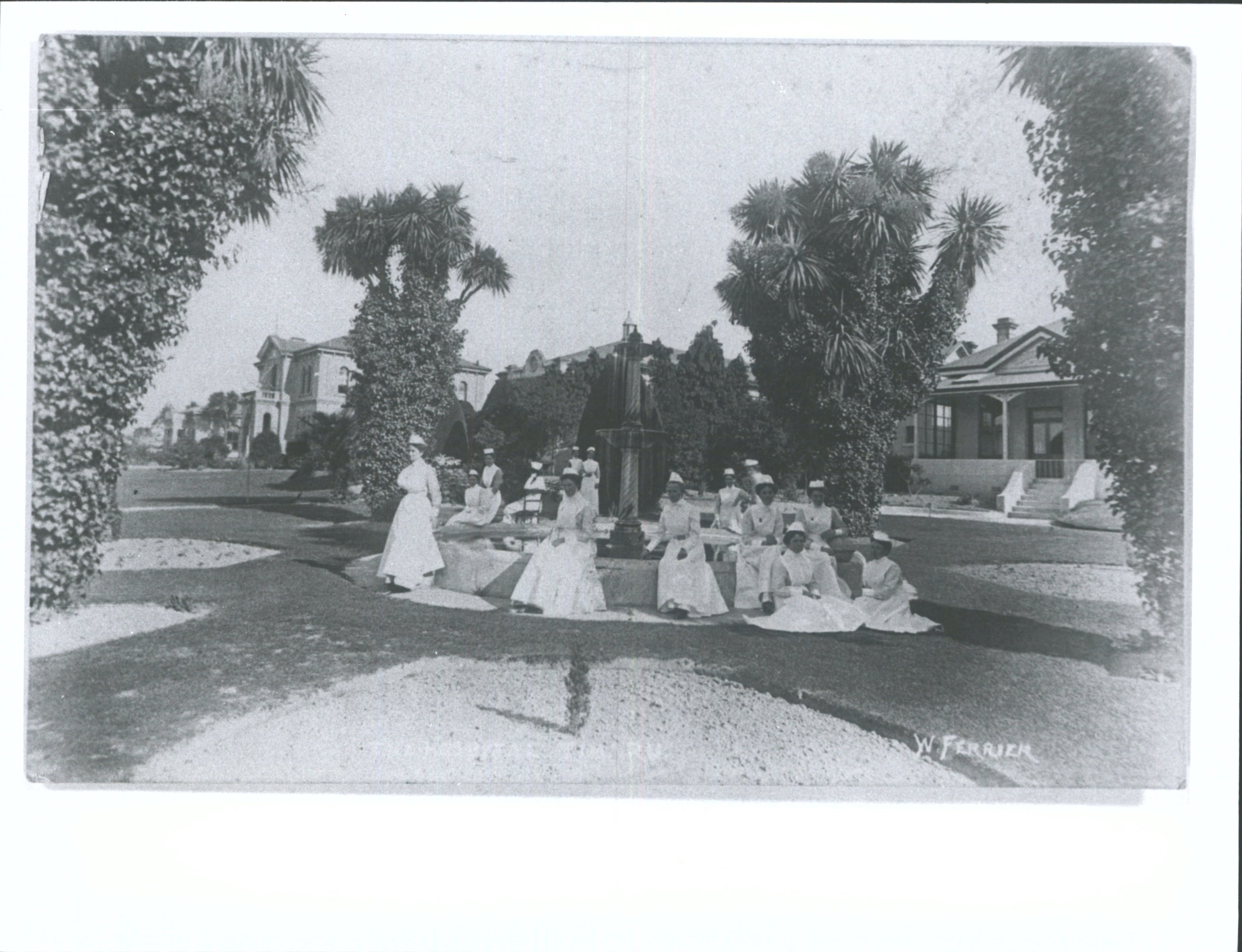
Timaru Hospital & Staff. Hocken Digital Collections, accessed 23/07/2026, https://hocken.recollect.co.nz/nodes/view/23593
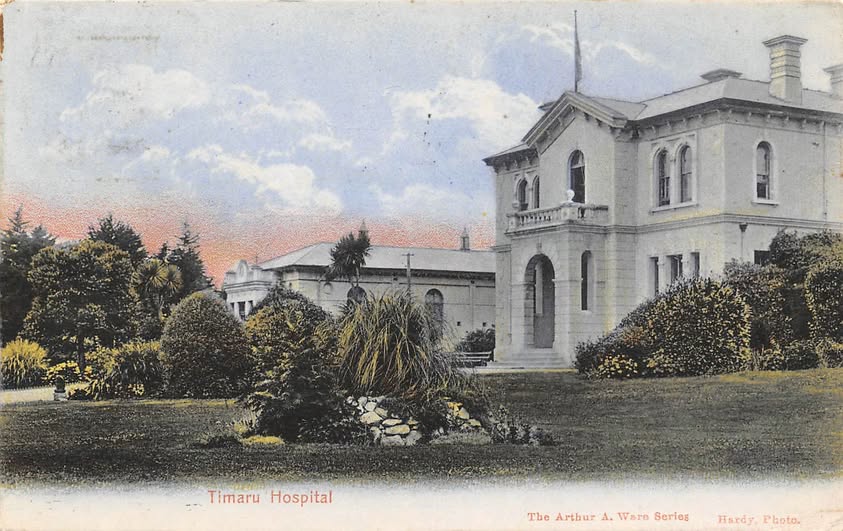
Timaru Hospital South Canterbury New Zealand 1907 postcard Arthur A Ware series
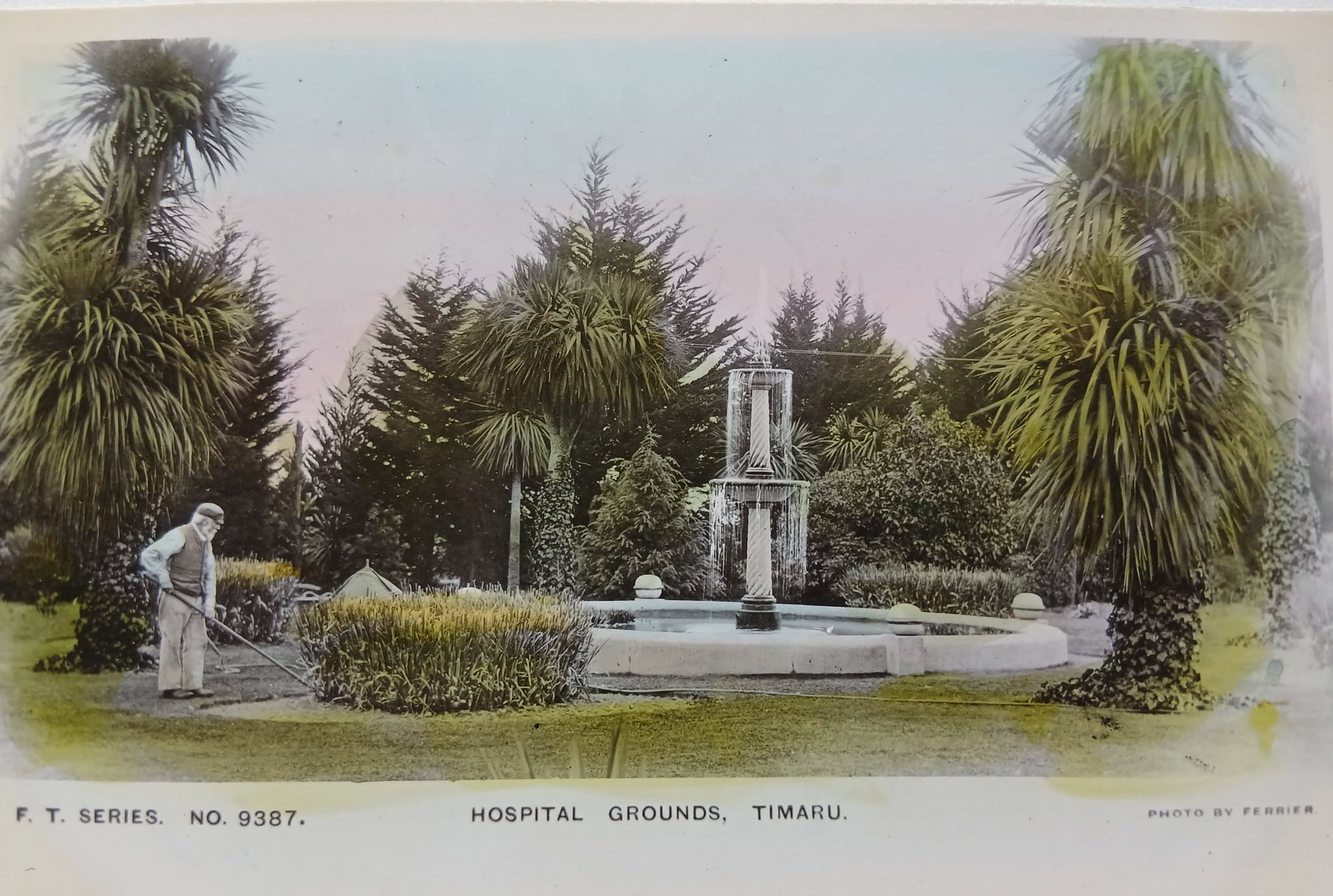
Hospital Grounds Timaru. Photo by Ferrier FT Series No 9387
Around the 1860s–1870s it has been said that prisoners reportedly laid out the Timaru Hospital grounds and built the brick wall on High Street.
Just down the road in Waimate, a Public Hospital was built 1879. It served the Waimate community for 117 years, closing in 1996.
In 1885 The Hospitals and Charitable Institutions Act created hospital districts and district boards. South Canterbury’s district included Geraldine, Mackenzie and Waimate counties, including boroughs. Local reporting stated that the new South Canterbury District Board would manage both Timaru and Waimate Hospitals. The South Canterbury Hospital and Charitable Aid Board was constituted. The Timaru Herald later reported that the old Timaru Hospital Commissioners had retired and the new South Canterbury Hospital and Charitable Aid District Board had taken their place. - https://paperspast.natlib.govt.nz/newspapers/THD19390701.2.81
A History of Timaru Hospital by J.C. McKenzie, which traces the facility’s journey from its early days in 1864 through to the modern era. Get the book from Unicorn Books
In 1964, the hospital celebrated its centenary, marking 100 years of dedicated service. Local newspaper The Timaru Herald covered the milestone, illustrating how the hospital had become a state-of-the-art facility for the wider South Canterbury district. Read the centenary article on Aoraki Heritage
For much of the 20th century, the South Canterbury Hospital Board governed the hospital, guiding its strategic development and public accountability. This era came to a close in 1989, and the transition is beautifully documented in Eulla Williamson’s book The End of an Era, 1964–1989. Browse the title at South Canterbury Museum
The next chapter began in 2001, when the South Canterbury District Health Board (SCDHB) took over. This governance structure remained in place until the health reforms of July 2022, when all DHBs were disbanded and consolidated under Te Whatu Ora (Health New Zealand). Learn more about SCDHB on Wikipedia
Timaru Hospital has been home to trailblazing medical professionals. Among them was Helen Clyde Inglis, a pioneering nurse and activist, who trained and worked there in the early 20th century Read more about Helen Inglis Also notable is Dr. Eily Elaine Gurr, who began her medical career at Timaru Hospital as a house surgeon before advancing into maternity and midwifery. Read more about Dr. Gurr
Timaru’s medical heritage is well preserved thanks to the work of local historians and cultural institutions. Whether you're a curious local, a researcher, or a healthcare professional, you can explore further through these resources: A History of Timaru Hospital. The End of an Era – South Canterbury Museum Library. South Canterbury Museum
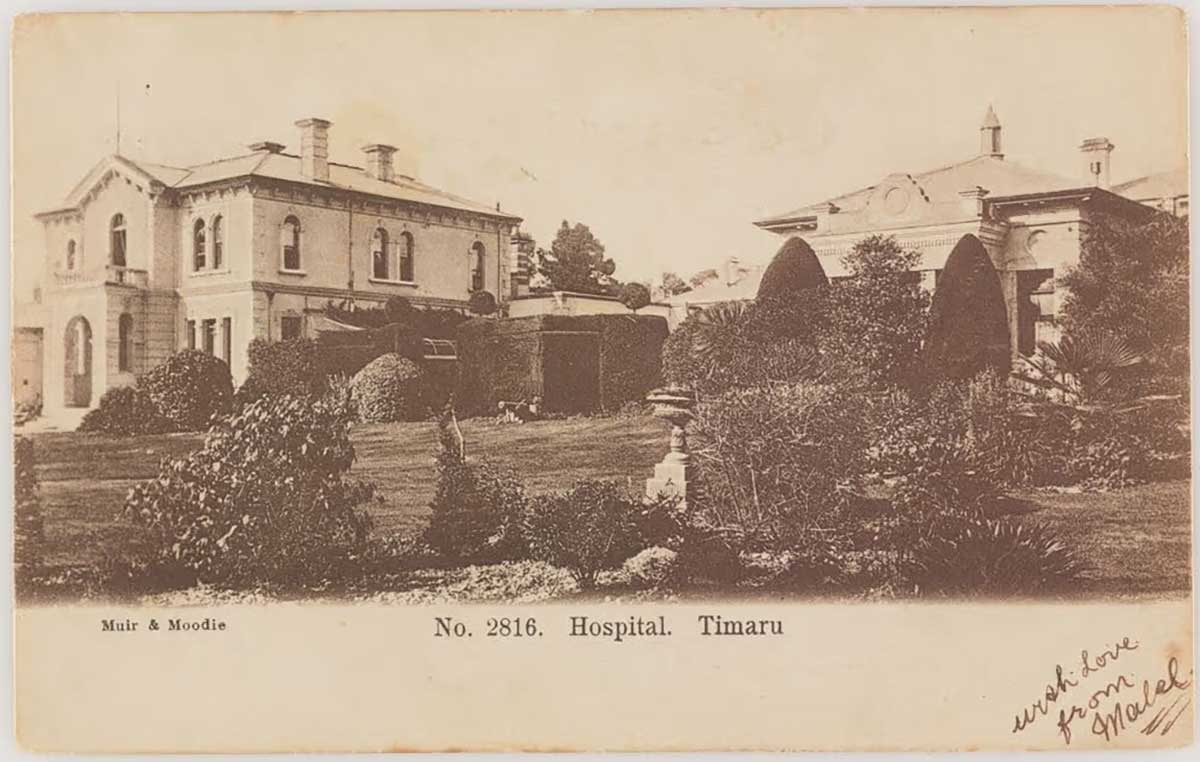
The Hospital, Timaru, N.Z., 1900-1910, Timaru, maker unknown. Gift of Patricia M. Mitchell, 1989. Te Papa (PS.000596)
Sometimes it is easy to forget that Timaru that we know today is still relatively new, and much of establishing the new colony came down to the local community people stepping up to take leadership.
The legacy of people putting in the hard yards teamed with professionals and governance, has provided a higher quality of life in our region.
Probably like many of you, sometimes its not until a trip to A&E that we remember how many of our community are living with illness and physical challenges.
Back in 1850s, there was no government or universal health care here. Most sick people were looked after at home. Influx of immigrants increases hospital demand, and Timaru opened its first hospital in 1862, and that was thanks to the efforts of Belfield Woollcombe, the towns magistrate who moved here in 1858, who found a way to get Government support to make it happen.
The first public hospitals set up in New Zealand were in Wellington and Auckland in 1847, New Plymouth in 1848 and Dunedin and Whanganui in 1851. Christchurch followed in 1862.
Many hospitals were opened in the South Island during the gold rushes of the 1860s.
A wooden hospital was near the Bascilla on the edge of a swampy creek by the Canterbury Provincial Government at the corner of North Street and West Belt. Mrs. Simpson, wife of the clerk of works, agreed to serve as nurse for £50 a year. Dr Edward Butler was the first medical appointment as the Provincial Surgeon in December 1 1862. Local communities like Timaru were said to have a sense of civic pride in their hospitals, which were seen as a symbol of civilisation.
The nursing reform movement led by Florence Nightingale, which originated in Britain in the 1860s, was significant in the transformation of hospitals. It produced a new style of nurse who was efficient, obedient, clean, hard-working and sober. Nursing leaders (matrons) were posted around the British Empire and took ideas about cleanliness and discipline within hospitals with them. Auckland Hospital appointed its first matron in 1865, but it was not until 1883 that the Florence Nightingale-trained matron, Annie Crisp, transformed the hospital environment. She was an English-born nurse who established New Zealand's first school of nursing and served as superintendent of Auckland Hospital in New Zealand. She also established the Winnipeg Children's Hospital in Canada.
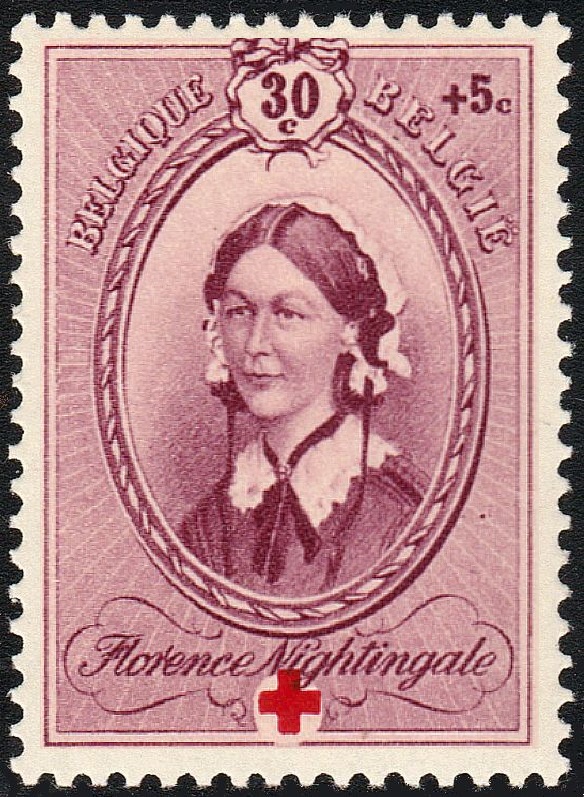
In 1939, Belgium issued a semi-postal stamp in honour of Nightingale in recognition of her work with the Red Cross when in Belgium.
Florence Nightingale was the founder of modern nursing and gave nursing a favourable reputation, and became an icon of Victorian culture, especially in the persona of "The Lady with the Lamp" making rounds of wounded soldiers at night. She is credited with professionalising nursing roles for women. Nightingale wrote Notes on Nursing (1859), The book was the first of its kind ever to be written.. She set up the first nursing school 1860.
Nursing was feminised – the trained male nurses who had previously dominated hospitals now mainly worked in mental hospitals. However, the orderlies who performed physical tasks such as moving patients around remained mostly male. To encourage respectable young women to become nurses, supervised nurses’ homes were set up on hospital premises.
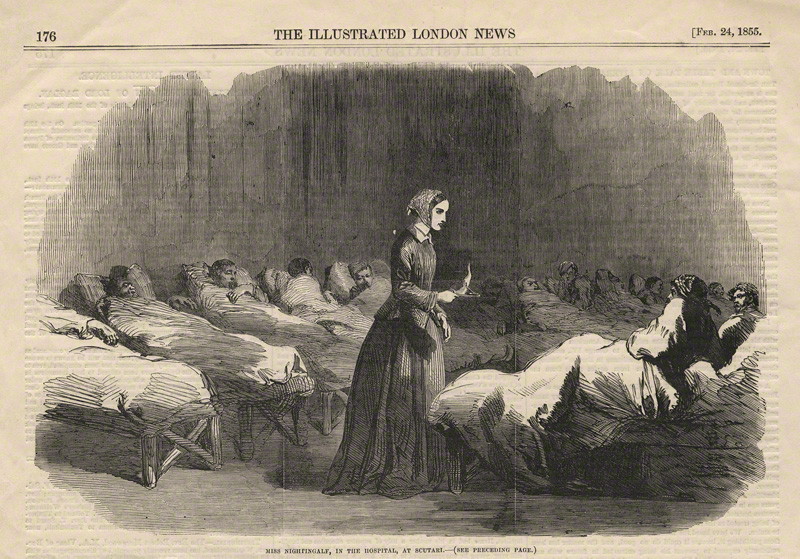
Unknown artist, ILN Staff, after Unidentified contributor to The Illustrated London News - The Illustrated London News, 24 February 1855. Miss Nightingale, in the Hospital, at Scutari. Illustration for The Illustrated London News, 24 February 1855, page 176. original version
The Nurses Registration Act 1901 was the first legislation covering nursing training and registration in the world. This act formalised the hospital-based nature of nurse training through a system of apprenticeship, involving three years of training and a state examination. From the 1970s nurses were trained in tertiary institutions rather than in hospitals.
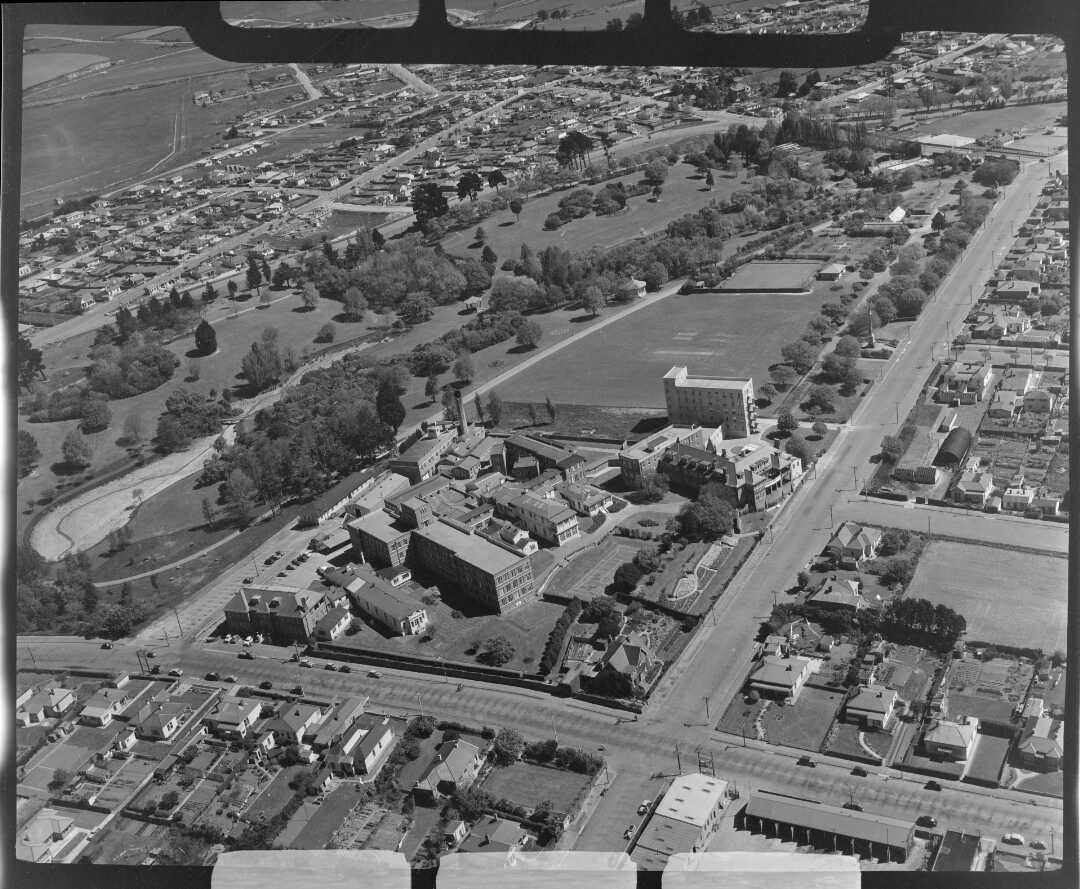
1956 Timaru Hospital - PA-Group-00080 Whites Aviation Ltd Photographs- nlnzimage
From 1885 public hospitals were run by charitable aid trusts.
The repercussions from the 1918 influenza pandemic called for major changes to New Zealand’s existing health law, the Health Act 1900.
This pandemic is estimated to have killed over 9000 New Zealanders during the two waves of the pandemic. Over 800 were soldiers, who died both abroad and in domestic camps, but the vast majority were New Zealand civilians. The Health Department was remodelled in 1920. The Act made wide-ranging changes to health in New Zealand. It gave greater powers to the Board of Health, increased the autonomy of local authorities, and considerably reduced the powers of medical officers of health (formerly the district health officers), who became more like advisors to local authorities. It was created so well that it survived with only minor amendments until it was replaced with the Health Act 1956 (which is still in force today), and which still follows the general outline of the 1920 Act.

A Corner of the Hospital Grounds, Timaru, 1900-1910, Timaru, by Alfred Hardy. Gift of Patricia M. Mitchell, 1989. Te Papa (PS.000598)
Hospital. Timaru, by Muir & Moodie, Burton Brothers. Te Papa (PS.003174)
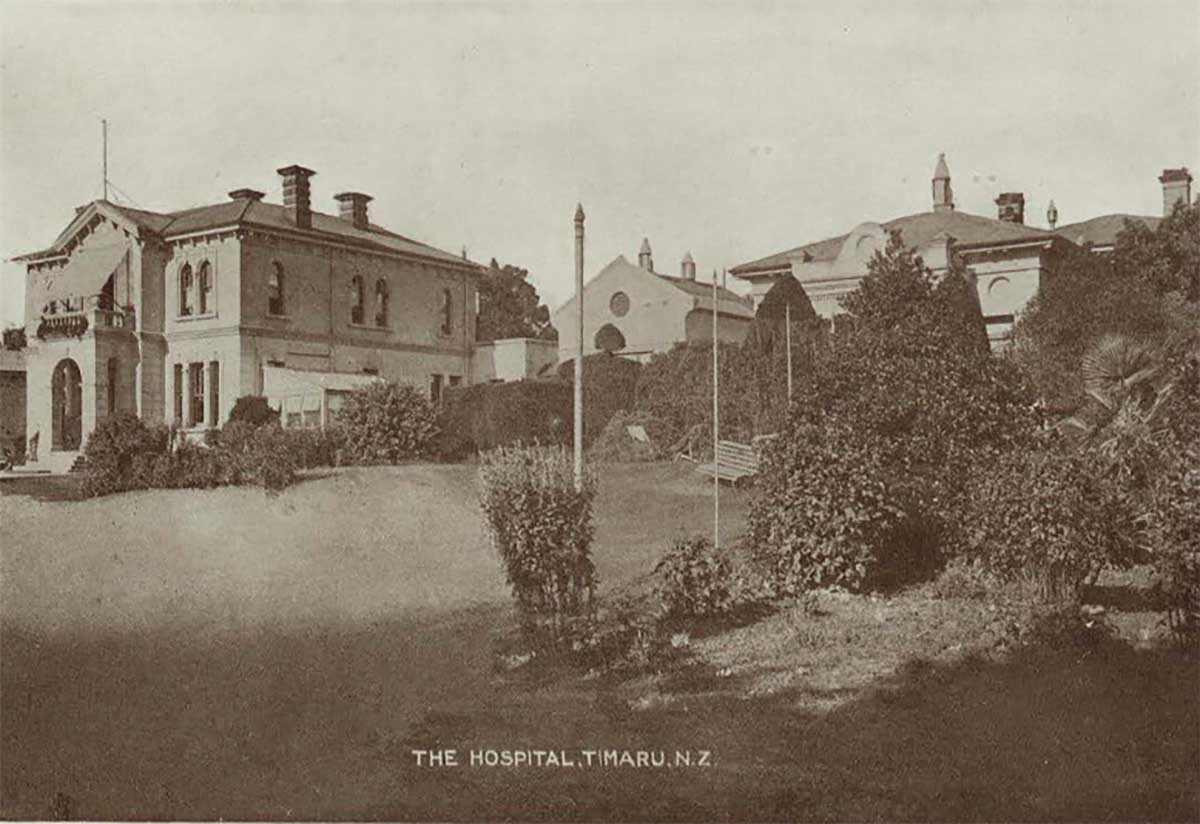
Picturesque Timaru. Aoraki Heritage Collection, accessed 10/05/2026, https://aorakiheritage.recollect.co.nz/nodes/view/8917
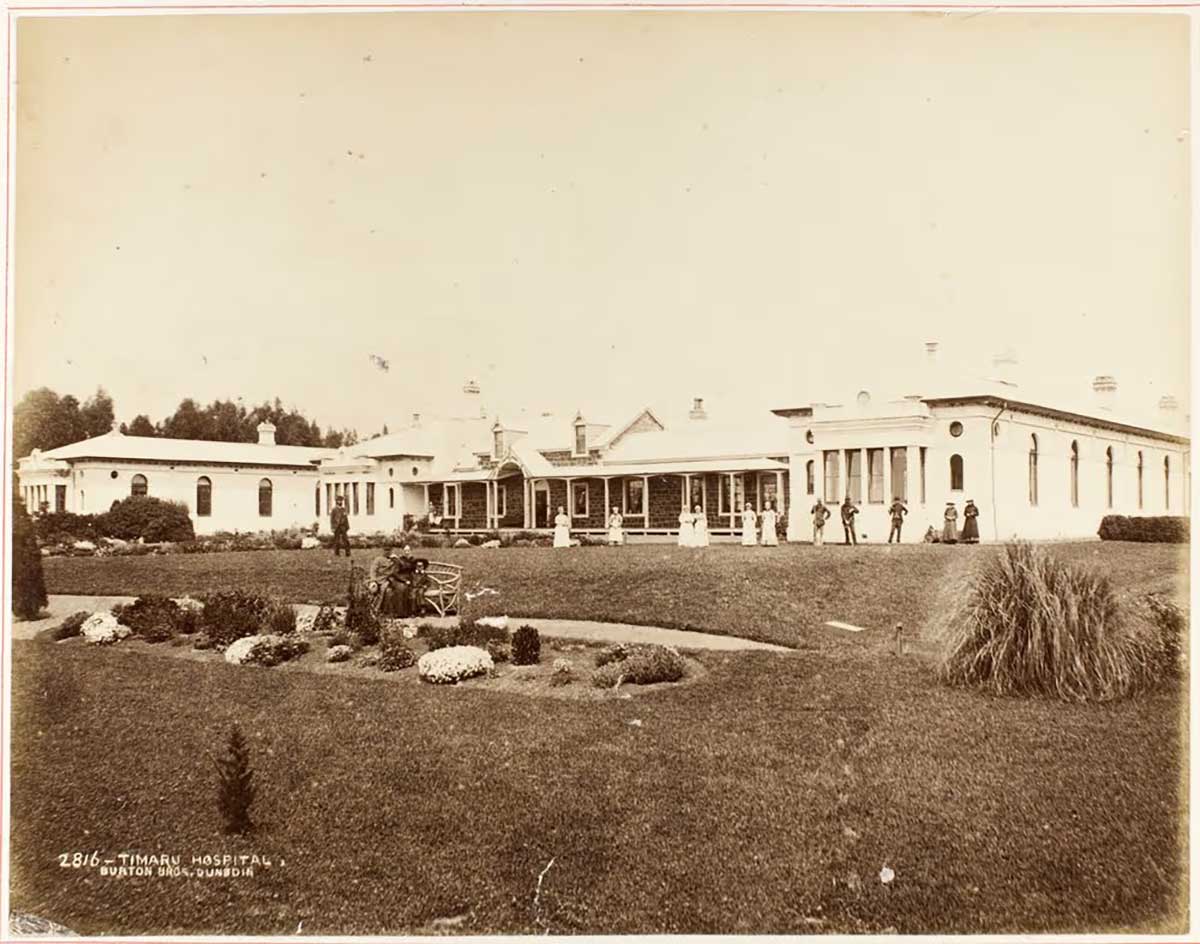
Timaru Hostpital, 1880s, Dunedin, by Burton Brothers. Purchased 1999 with New Zealand Lottery Grants Board funds. Te Papa (O.034094)
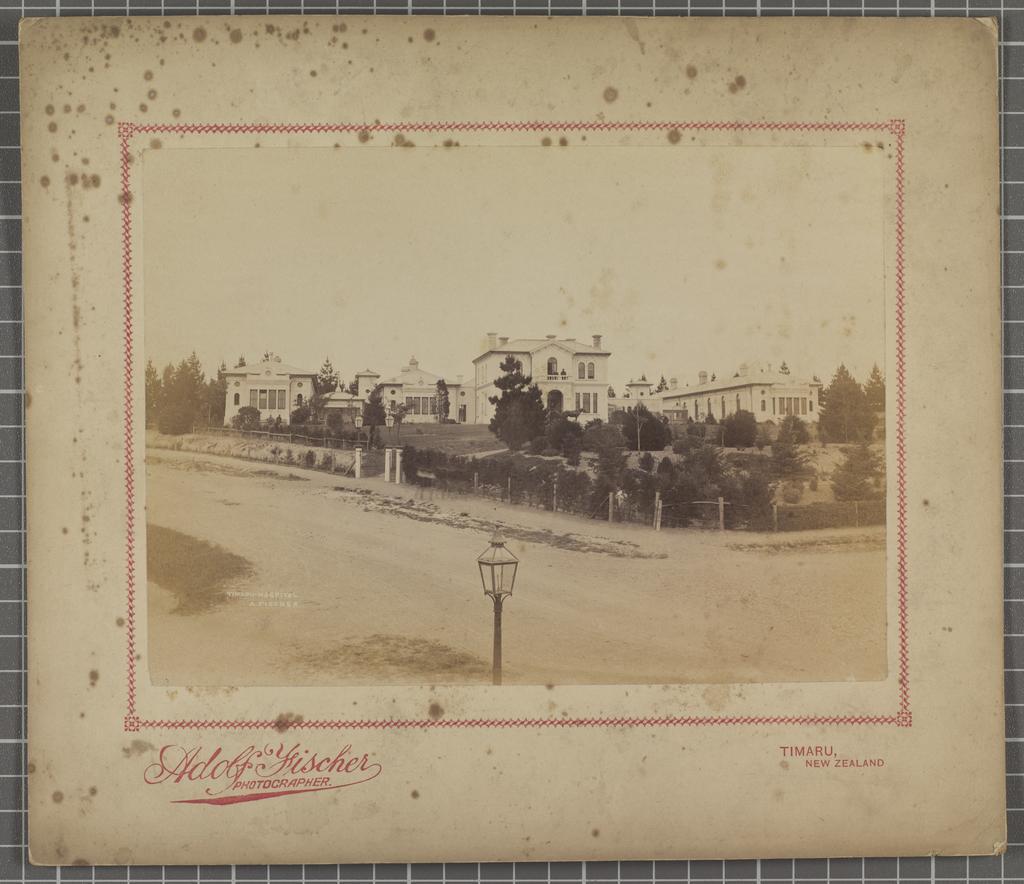 https://hocken.recollect.co.nz/nodes/view/55672">
Fischer, Adolf, Timaru Hospital (1887-1899). Hocken Digital Collections, accessed 04/04/2026, https://hocken.recollect.co.nz/nodes/view/55672
Timaru’s Early Private Hospital Opened 13 July 1912
One of Timaru’s first private hospitals opened on July 13, 1912, by Sister M. S. McArthur in what was then Chester Street. The brick building featured large sun-facing patient rooms and a partial upper floor, and was considered a progressive addition to the town. Sister McArthur, who had previously worked at the Timaru Public Hospital and served as Lady Superintendent of Nurses in Gisborne, was joined by Sister Nixon and Nurse Sumpter. The hospital served private patients for over 20 years and was later complemented by a smaller facility opened by Sister Shanks in Elizabeth Street.
In the early 1930s, a syndicate of local business and professional men formed the Timaru Private Hospital Company Ltd, purchased McArthur’s property, and incorporated her original building into a new facility on Bidwill Street. The Bidwill Private Hospital opened on October 30, 1936, and operated successfully for decades, peaking between 1959 and 1961 with over 8,000 patient-days annually. Following a dip in usage due to expanded public hospital services, it transitioned into the Bidwill Trust Hospital in 1977. The facility remained important for maintaining access to local specialist care, supported by a dedicated team of full- and part-time nurses, theatre staff, and domestic workers.
Transition to Charitable Trust (1977–78) As losses mounted, a charitable trust was formed to prevent closure and preserve services for South Canterbury. The private company had 22,000 shares, including 5,000 owned by medical practitioners. Total assets were valued at $66,000. Contributions to the trust: Medical shareholders gifted $16,000 worth of shares. Other shareholders contributed shares valued at $6,000. The trust purchased remaining shares (approx. $44,000) using an overdraft. Total acquisition cost of land and buildings (Govt. valuation: $150,000) was $28,000.
The hospital was rebuilt in 2001, and redeveloped in 2011, having provided health services to the people of South Canterbury since 1912. With just 15 inpatient beds and a 14 bed day surgery unit, Bidwill is small enough to provide quality personalised care and attention. There are three fully equipped operating theatres. Bidwill is the only private surgical hospital in the South Canterbury region, offering an extensive range of services including general surgery, orthopaedics, ENT, gynaecology, ophthalmology and dental surgery. The hospital is a charitable trust and all profits are invested back into the hospital ensuring that the best equipment and facilities are maintained.
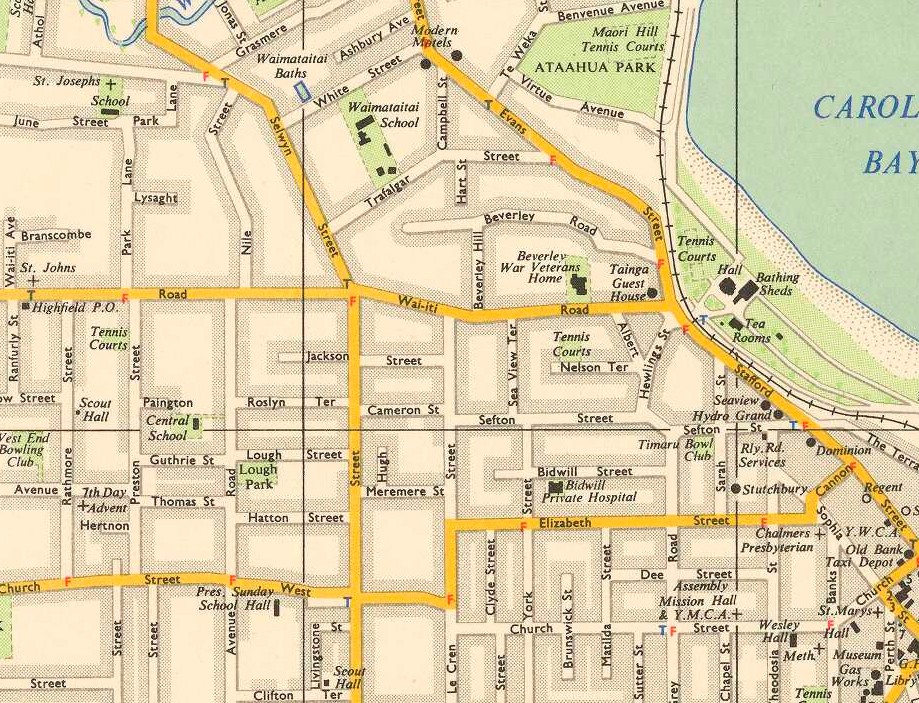
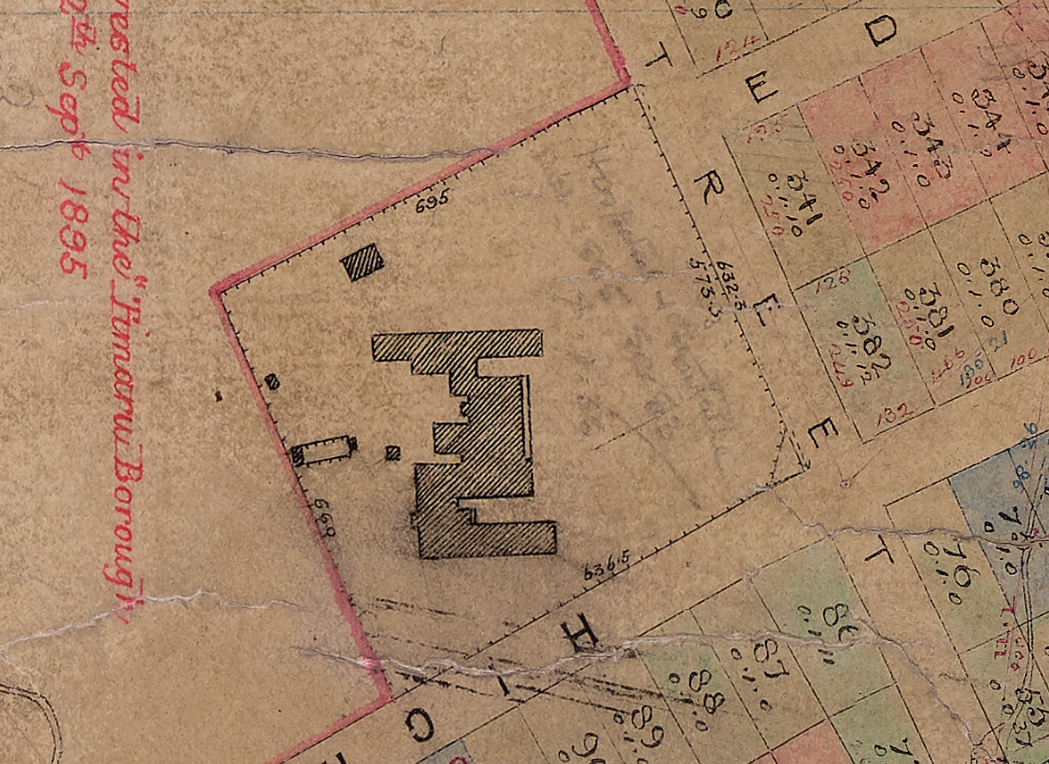
Bidwill Hospital - 1953 - Map of Timaru - Electronic reproduction of Land Information New Zealand original University of Auckland 2013
Fischer, Adolf, Timaru Hospital (1887-1899). Hocken Digital Collections, accessed 04/04/2026, https://hocken.recollect.co.nz/nodes/view/55672
Ettrick Bank Private House for Healing... A Hospital on High Street
On High Street, above the bustle of early Timaru, once stood the residence known as Ettrick Bank. It had belonged to the late John Ballantyne, a name closely tied to retail history in Canterbury. But in August 1899, soon after his death, the house began a new life.
A contemporary newspaper report described Ettrick Bank as a “fine mansion” with beautiful grounds, access to the sea, and, remarkably, what was said to be the only native bush left standing in Timaru. That detail stops you for a moment. In a town already reshaped by roads, rail, shops, houses and harbour works, this property still held a trace of the older landscape.
The house was taken over by Nurses Morrison and Christian, both recently connected with Timaru Hospital. Importantly, the article says they had acquired the tenancy of the house, not that they had bought it. Their plan was to transform this large private home into a modern private hospital for medical, surgical and obstetrical cases.
Nurse Morrison was already well known in the district. She had trained at Timaru Hospital, gained her certificate there, and had served as head nurse during the previous year. Nurse Christian was newer to Timaru, but brought experience from Prince Alfred Hospital in Sydney, where she held certificates in ophthalmic, gynaecological, medical and surgical nursing. This was a time when trained nursing was becoming a recognised profession, the article I cite this from reads almost like a public endorsement.
Ettrick Bank had considerable money spent on it to prepare it for patients. The walls were stripped of wallpaper and finished in sanitary colours. Drainage and ventilation were improved. Baths were disconnected, W.C.s fitted throughout the house, and the latest sanitary measures adopted. New furnishings were supplied through Nurse Christian’s connection with Ballantyne’s.
There were bright general wards for women and men, each with three beds, a separate ward for special surgical cases, private wards, an operating room, a patients’ writing and sitting room, and dining and social rooms.
Ettrick Bank opened to patients from Tuesday 22 August 1899. Before then, the public was invited to inspect the building and meet the nurses. It was presented to Timaru as a desirable new venture, something useful, respectable and worthy of public confidence.
The story of Ettrick Bank is a story about women’s professional work, changing medical care, and the reuse of a gentleman’s residence for community need. It also reminds us how much of old Timaru has disappeared, not only buildings, but gardens, views, and fragments of native bush.
For a short time, Ettrick Bank held all of these things together: sea air, sheltering trees, trained nursing, modern sanitation, and the confidence of two women ready to create something new.
- https://paperspast.natlib.govt.nz/newspapers/SCANT18990818.2.19
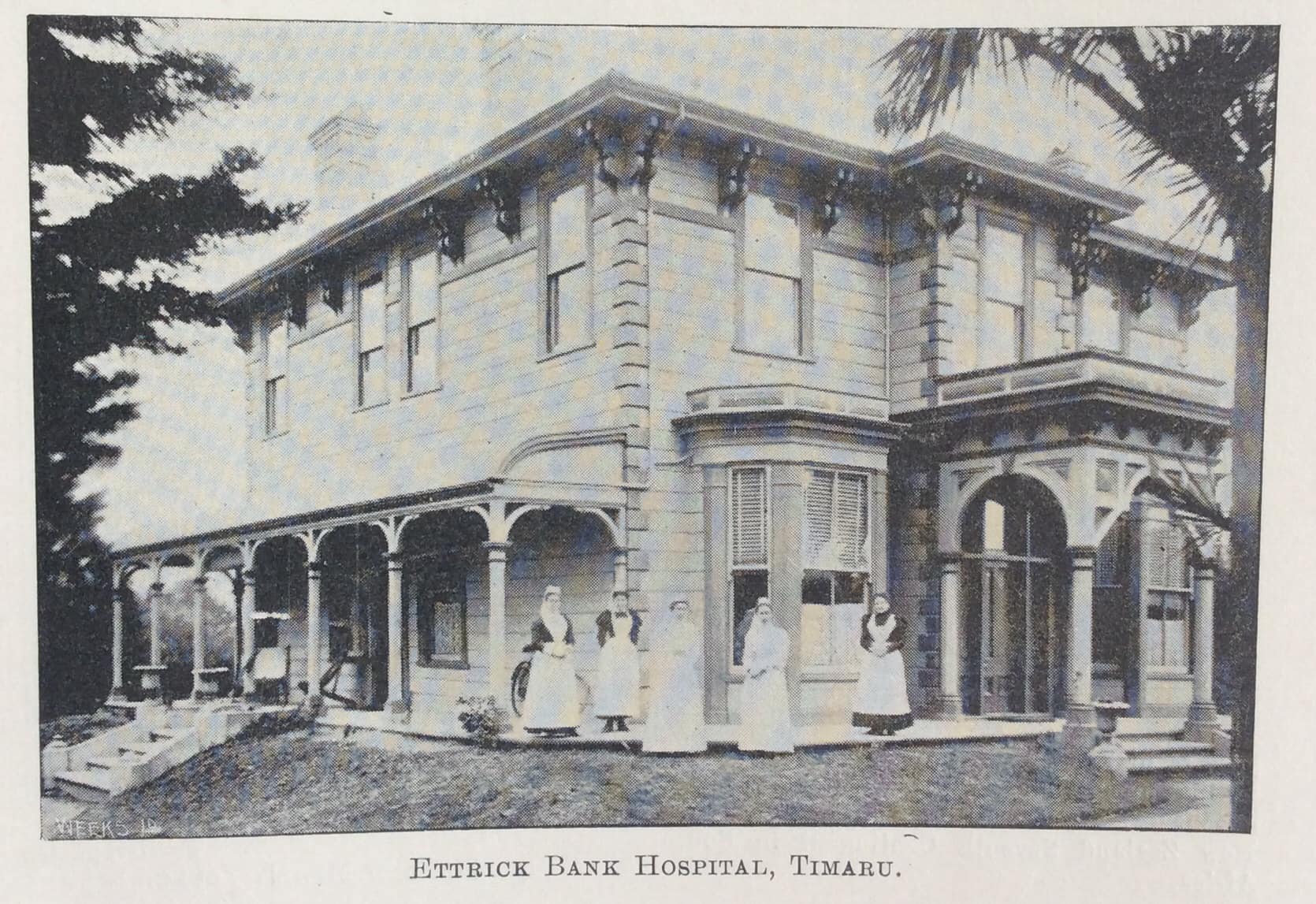
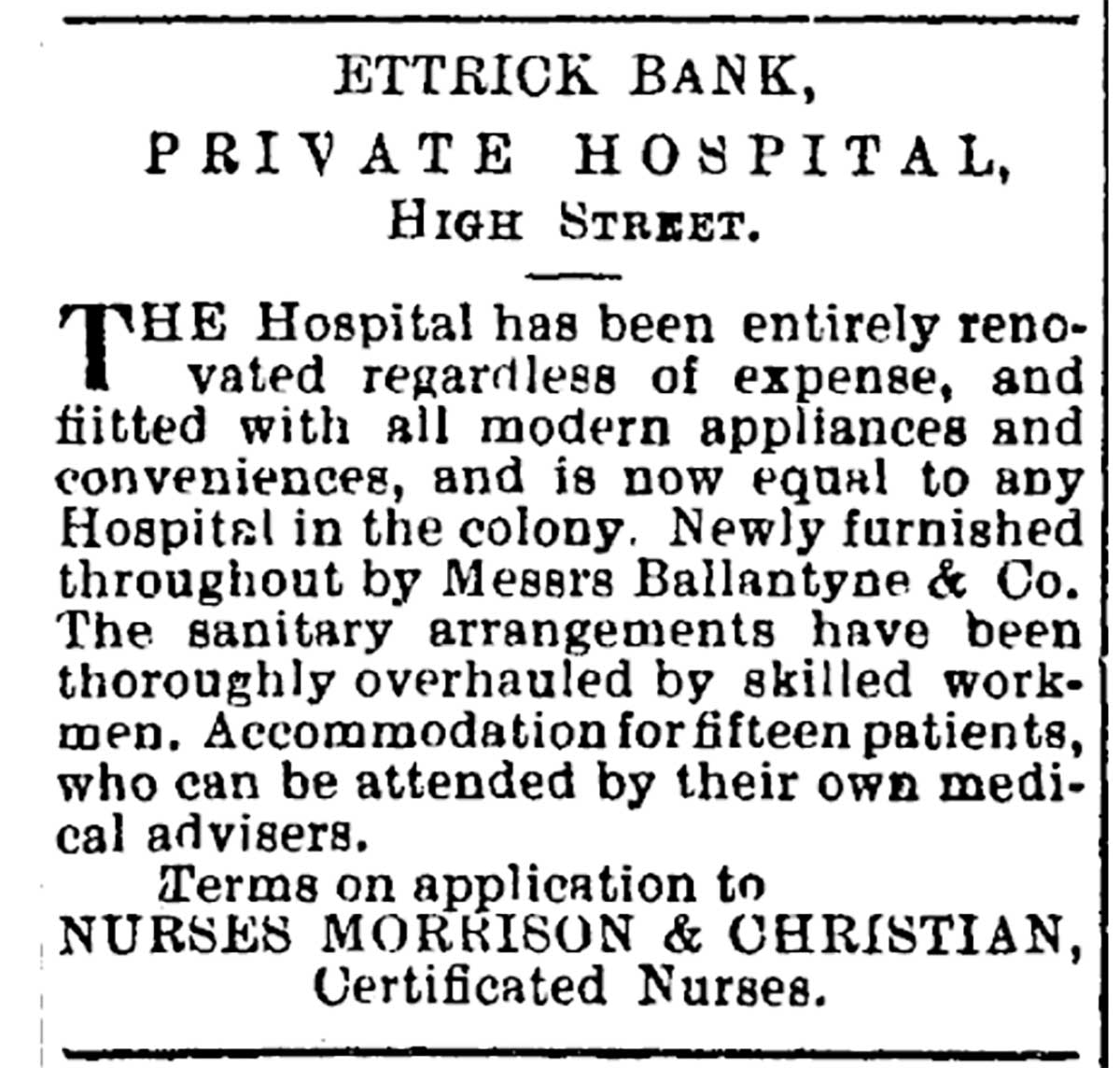
Page 1 Advertisements Column 5
Timaru Herald, Volume LXII, Issue 3048, 5 September 1899, Page 1
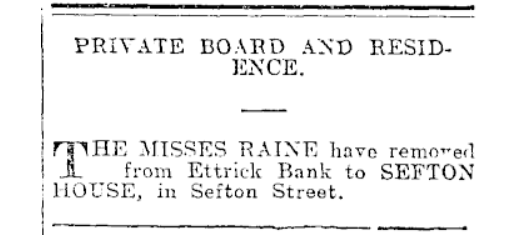
Timaru Herald, Volume XIIIC, Issue 14219, 8 June 1910, Page 1
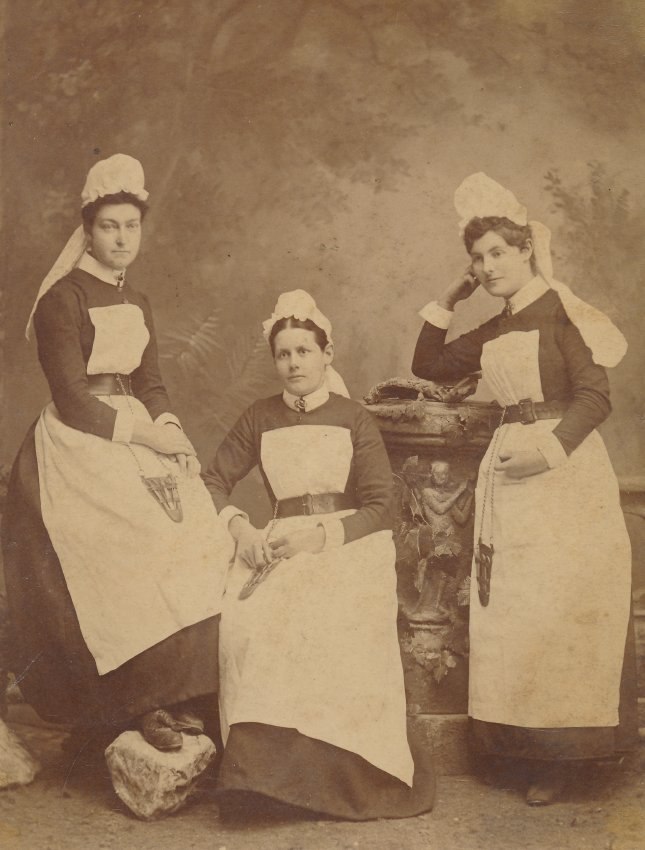
I spied this photo in the Ashburton online photo archive. Lists a nurse who worked in Timaru once. I had seen this photo before, but it didn't have a caption, so its great to have a clue into who some of the people were who have worked at the hospital over the years.
Three nurses in uniform, including Bella Kellahan. Bella Kellahan is pictured on the left with two other nurses. She trained and worked in nursing at Timaru, where she met Watson Hitch. Bella was later recognised as a life member of the Nursing Association. Catalogue number: 04.2005.0142L. Image credit: Ashburton Museum & Historical Society Inc.