
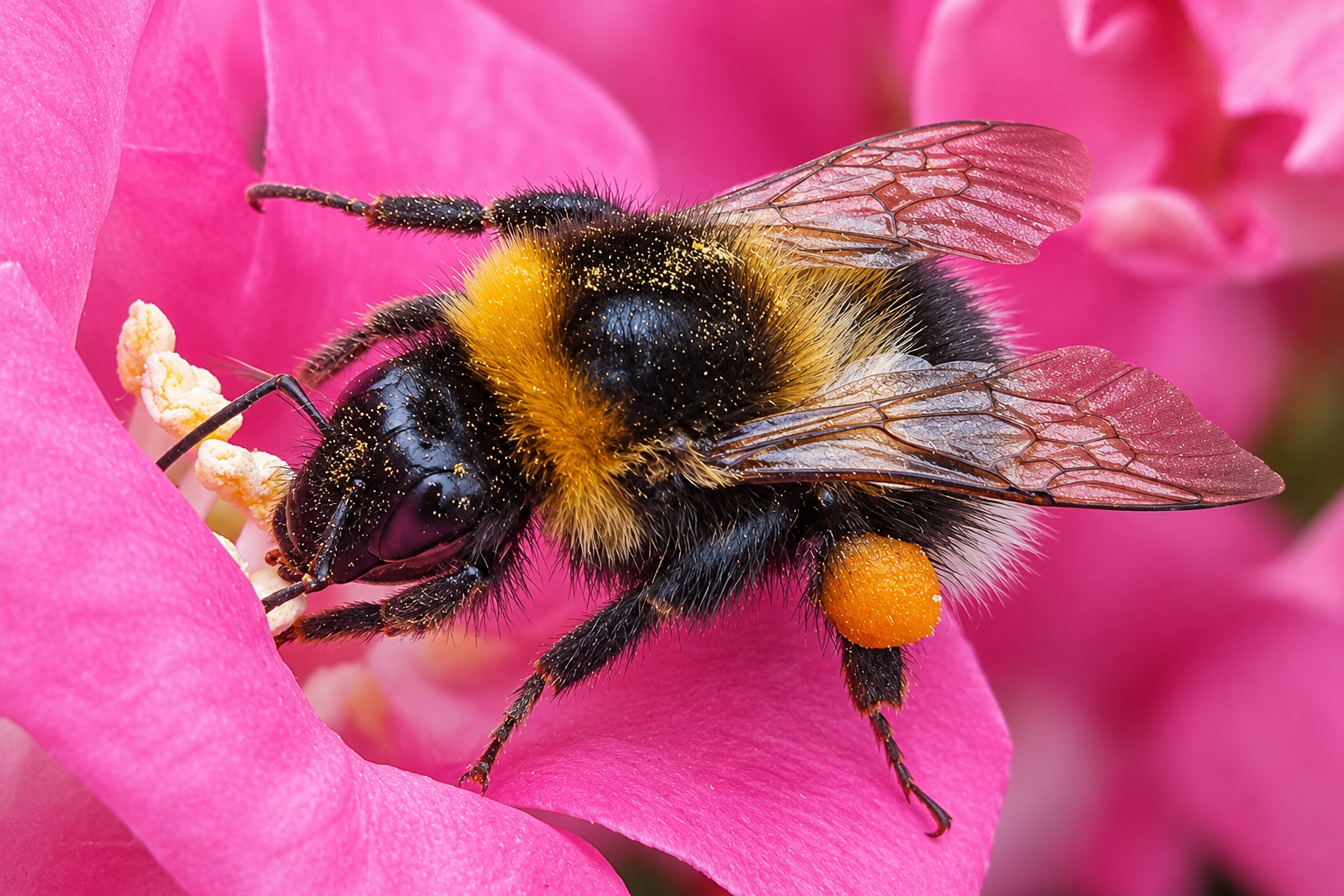
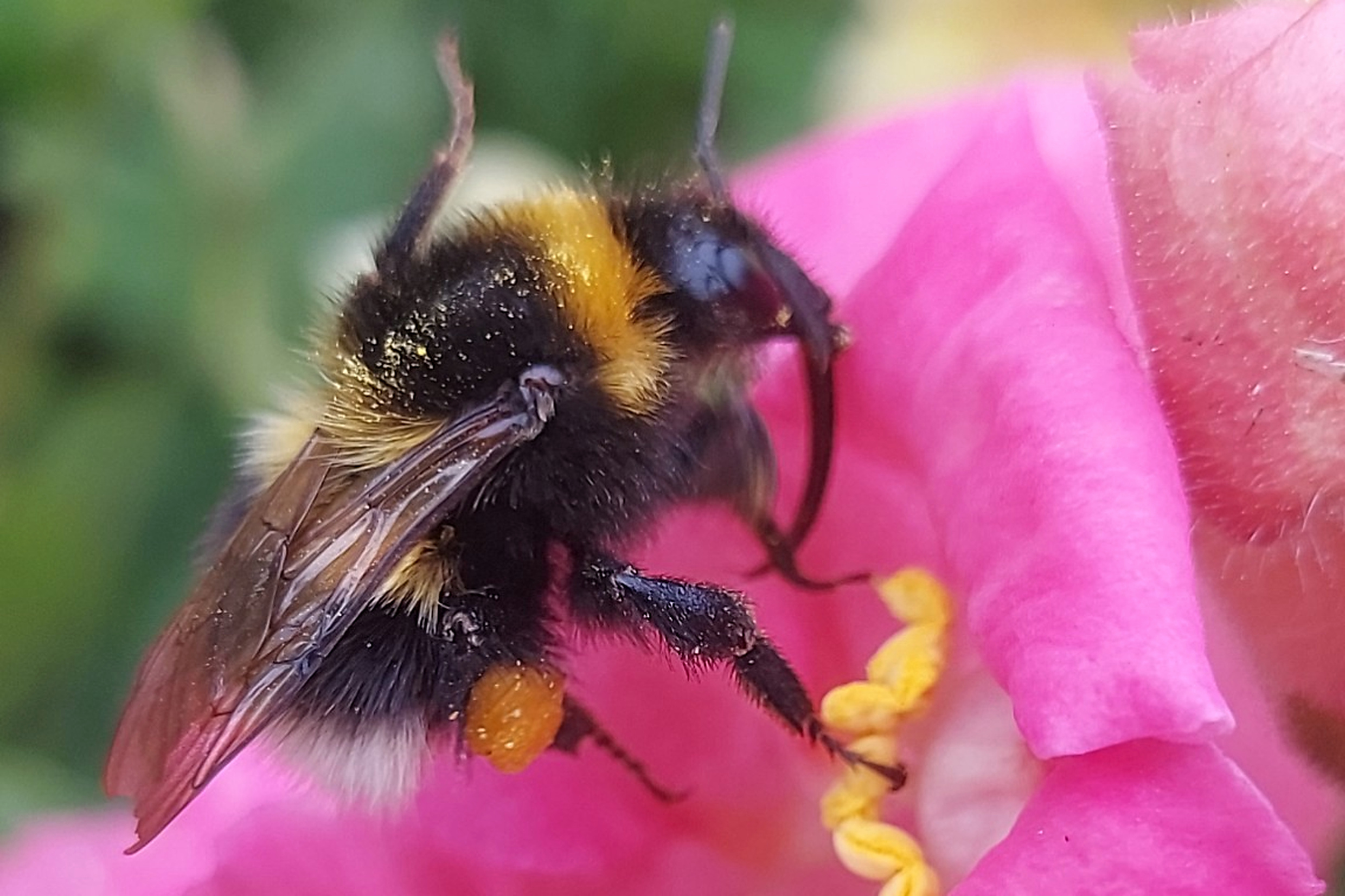
Bumblebee at the Timaru Botanic Gardens - photo roselyn fauth - optimsed with ai
An old government report, two surviving bees, a Timaru mystery and something fascinating to discover in your own garden.
I love bumblebees! We have heaps in our garden, and one of my favourite things to do is film them using the slow-motion setting on my phone... I enjoy watching their furry bodies tremble as they clamber over flowers, their legs gripping the petals while their long tongues reach inside to find nectar. Sometimes you can see little parcels of pollen tucked against their back legs.
You can lose quite a bit of time watching a bumblebee going about its business. While researching pollinators, I came across a fascinating old document online. Published in March 1914 by New Zealand's Department of Agriculture, it was called History of the Humble-Bee in New Zealand: Its Introduction and Results.
Humble-bee? It turns out that's an old name for the bumblebee, associated with the humming noise it makes. The 28-page document was written by Isaac Hopkins, formerly Chief Government Apiarist. It contains records of early experiments, correspondence, observations, illustrations and some surprising connections to Timaru. I started reading. There was quite a story to uncover...
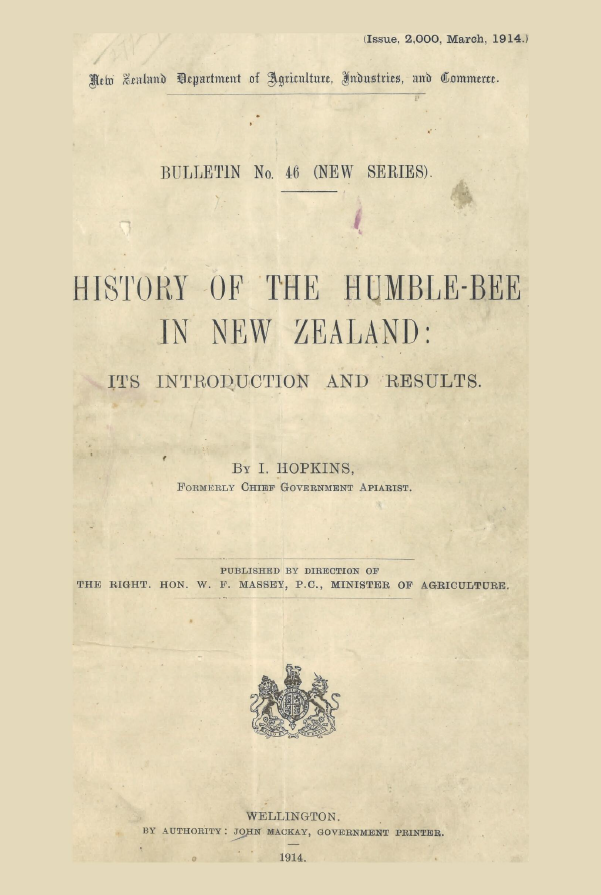
Isaac Hopkins' History of the Humble-Bee in New Zealand (1914). On the right, his opening explanation of why bumblebees were introduced: to help red clover produce seed. Source: New Zealand Department of Agriculture, Bulletin No. 46, title page and printed p. 5. Read the original PDF.
Why did people want bumblebees here?
During the 1800s, settlers were establishing farms across New Zealand, planting European grasses and clovers to feed their livestock. Red clover was particularly useful. Animals could graze it, farmers could cut it for hay, and its roots worked with soil bacteria to make nitrogen available for plant growth.
But farmers had difficulty producing reliable quantities of red-clover seed. They could grow the plants and enjoy paddocks full of flowers, yet relatively few seeds were being produced.
To understand the problem, it helps to take a closer look at a flower.
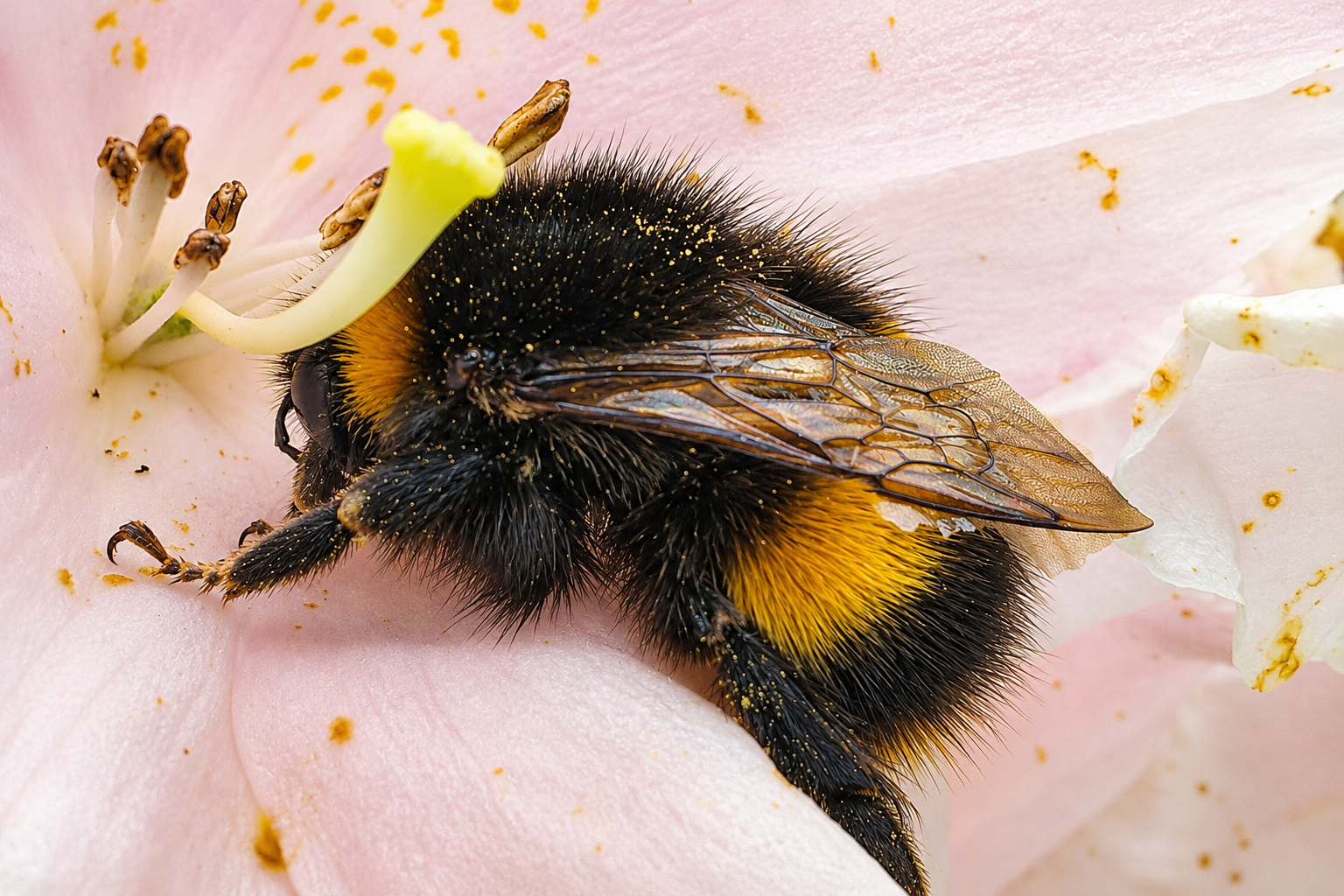
What are the bees collecting from flowers?
Flowers have developed some clever ways of attracting visitors. Two things that bees are particularly interested in are nectar and pollen.
- Nectar is a sugary liquid. Many flowers produce it to attract visiting animals. For a bee, it's an excellent source of energy, providing the fuel needed to fly and forage. Bumblebees reach nectar using a long, flexible mouthpart called a proboscis, which works rather like a drinking straw.
- Pollen is different. It's the fine, often yellow or orange powder produced by the male parts of a flower, called the anthers. Pollen carries the cells needed for plant reproduction. Bees collect pollen because it contains protein and other nutrients. They take much of it back to their nests to feed their developing young, called larvae.
So nectar provides energy, while pollen supplies nutrients needed for growth... now the relationship is interesting because when a bee visits a flower, some loose pollen may stick to the hairs covering its body. As it moves to another flower of the same species, some of that pollen can rub off onto the receptive female part, called the stigma. This transfer is called pollination.
If compatible pollen successfully fertilises the flower, seeds can develop. The bee is looking for food. The plant benefits from its visit. Of course, not every visit results in pollination, and not all plants depend on insects. Some use wind, while others are visited by birds and different animals.
Why did red clover need a different bee?
A red-clover flower head looks like one round pink flower. Look closer and you'll discover dozens of slender little flowers, or florets, packed together. Their nectar is tucked deep inside. Honeybees, which were already present in New Zealand, have relatively short tongues. They can sometimes pollinate red clover, but struggle to reach nectar in its deeper flowers. Some bumblebees have much longer tongues.
British farmers were familiar with these larger, furry insects visiting clover. New Zealand farmers hoped importing them would make local seed production more dependable. The problem was getting live bumblebees from Britain to New Zealand. In the 1800s, that meant a long voyage by ship.
A Timaru woman gives it a go
Contemporary newspapers record an enterprising Mrs Belfield arranging an early shipment. My research suggests she was Emma Leonora Belfield, wife of Herbert Belfield, who was associated with the Timaru Herald. However, the contemporary newspaper account identifies her only as Mrs Belfield, so I would still like to find a record that confirms her first name.
While visiting Britain around 1878, Mrs Belfield approached a beekeeper named Mr Neighbour about sending bumblebees to New Zealand. An agent collected 18 dormant queen bumblebees from nests in Scotland.
They were carefully packed in moss and placed in the ice-house aboard the John Elder, before being transferred at Melbourne to the Arawata for the final journey. Keeping them cool was essential. The queens were supposed to remain asleep, conserving their energy until they reached their new home. Unfortunately, delays proved disastrous.
Of the 18 queens, only two survived.
On Saturday 5 February 1881, the survivors were released into a clover paddock on Mr Bristol's farm near Timaru. A newspaper report reprinting the Timaru Herald account said that they flew briskly away. What became of them remains a mystery. I've yet to find evidence that they established colonies. Nevertheless, someone in Timaru had organised an extraordinary experiment.
The breakthrough came in 1885
Mrs Belfield wasn't the only person attempting to introduce bumblebees. The Canterbury Acclimatisation Society had been trying since the 1870s. Isaac Hopkins, working at Matamata, was also involved in experiments. In February 1884, he received a shipment of 145 bumblebees. Only two survived.
He fed them diluted honey, nursed them overnight and released them the following morning, but later found no indication that they had established themselves. After years of disappointment, the Canterbury Acclimatisation Society finally succeeded in 1885. Two shipments arrived, carrying a total of 542 bees.
Of those, 93 survived.
They were released near Christchurch, including on the Deans estate at Riccarton, and this time their descendants flourished. Hopkins recorded bumblebees at Mount Peel by January 1886, just a year after the successful releases. By early 1887 they were being reported from Timaru and Kaikōura. They continued through the Waitaki basin, Lindis Pass and towards Hāwea. Within five years, bumblebees had spread across much of the eastern South Island.
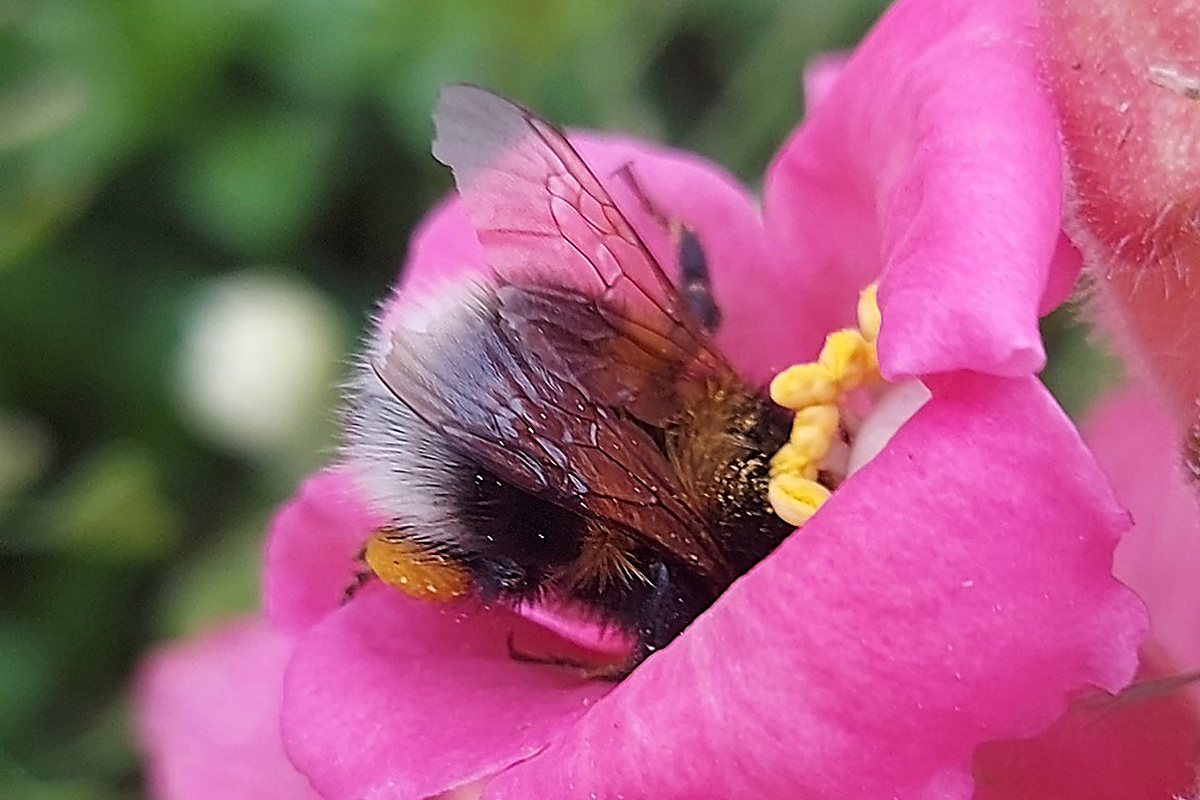
Photo roselyn fauth - optimsed with ai
Did they make a difference to farming?
Farmers certainly thought so. Hopkins collected accounts describing improvements in red-clover seed production, including flower heads that had previously contained very few seeds becoming well filled. A farmer could cut the first growth of clover for hay, then leave the second growth to flower and set seed.
The resulting seed could be harvested, cleaned and sold to establish pasture elsewhere. Seed growing became a valuable industry, with Canterbury and Marlborough both producing commercial crops. Weather, soil, farming practices and other pollinators also influenced the harvest, so we shouldn't attribute every improvement to bumblebees alone. But their arrival helped overcome an important obstacle.
That story is still relevant to South Canterbury, where businesses such as Turnbull Grain & Seed work with the seeds used to establish pastures and agricultural crops. Before a seed can be harvested, cleaned, packaged and sold, a plant has to reproduce.
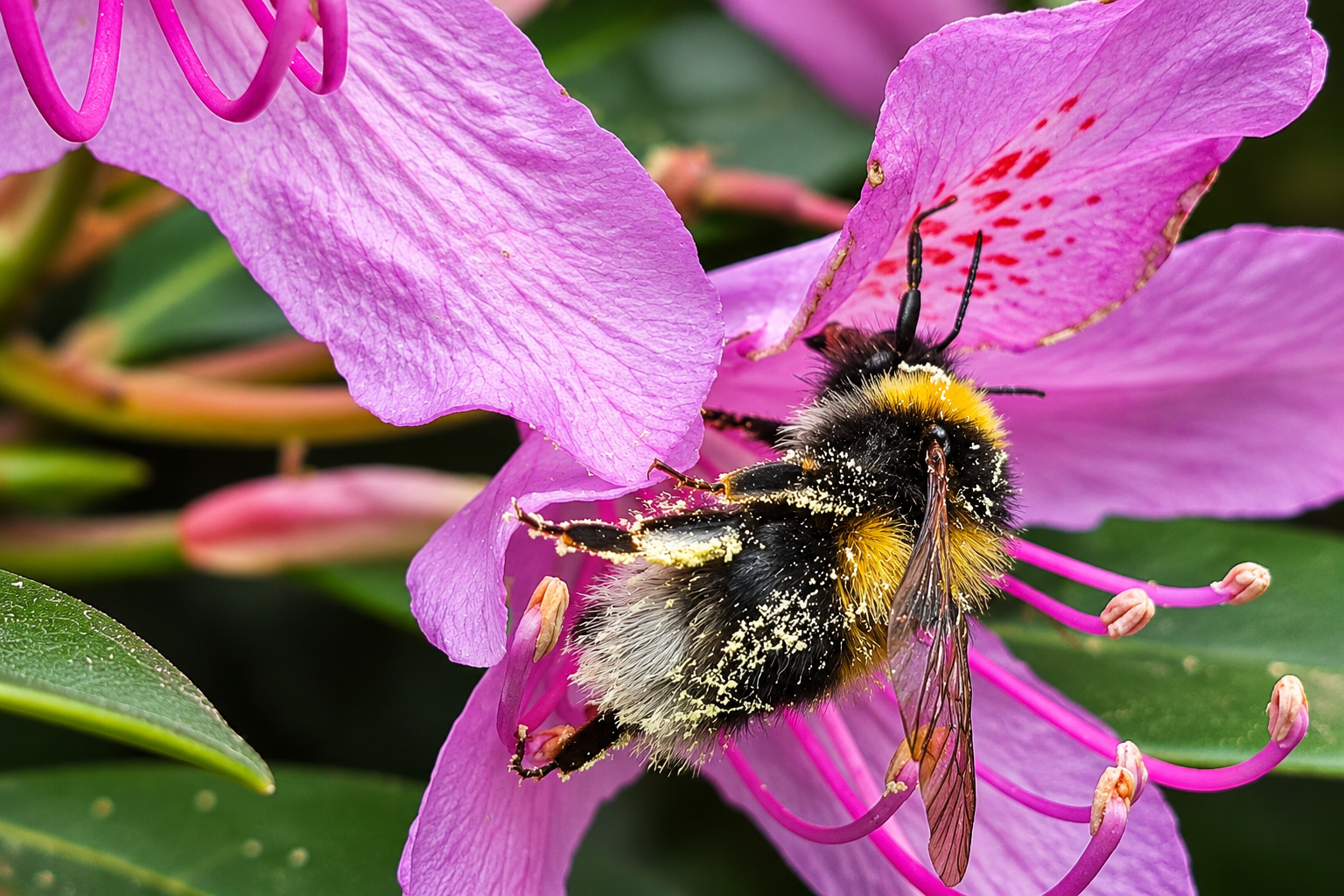
Bumble bee at the Timaru Botanic Gardens - photo roselyn fauth - optimsed with ai
Did you know we have four kinds of bumblebee?
Before reading Hopkins' report, I hadn't paid much attention to the different kinds of bumblebee.
New Zealand has four established species, all originally introduced from Britain. The New Zealand Bumblebee Conservation Trust has a helpful modern identification guide.
- The common bumblebee (Bombus terrestris) is widespread throughout New Zealand. It has a relatively short tongue and is frequently seen in gardens.
- The large garden bumblebee (Bombus ruderatus) has a very long tongue. Its colouring can vary considerably, including individuals that are almost entirely black.
- The garden bumblebee (Bombus hortorum) is another long-tongued species, well suited to visiting flowers with deep tubes.
- The short-haired bumblebee (Bombus subterraneus) is our rarest species, now mainly found in inland areas of the central and southern South Island.
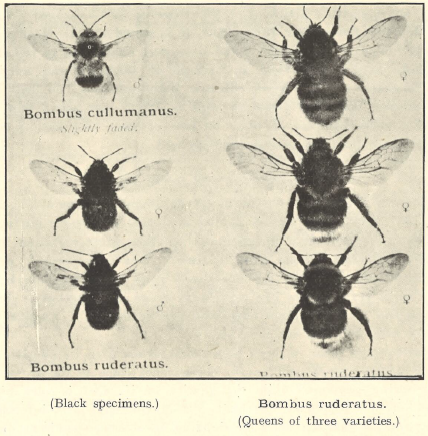
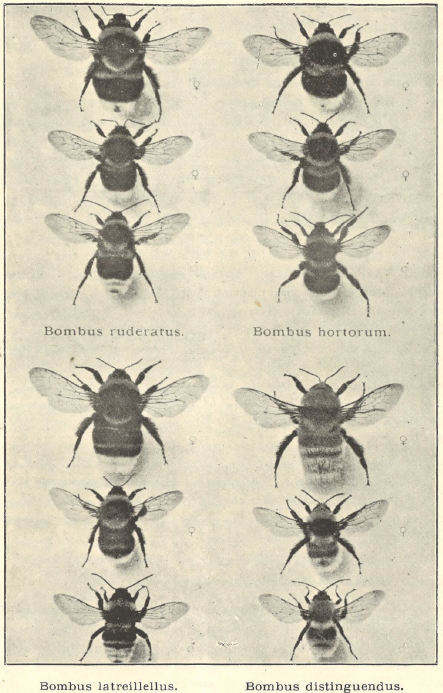
The 1914 publication includes illustrations showing different species, queens, workers and males. Not all the bees pictured were established in New Zealand. Some were included for comparison, while others were being considered for future introduction.
Look at these drawings carefully. Some queens are far larger than the workers and males. Others have quite different markings. Colour alone isn't always enough to identify a bumblebee.
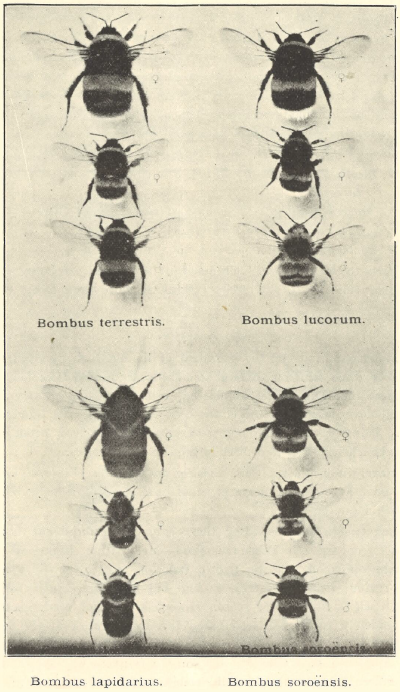
Four bumblebee species pictured in 1914: Bombus terrestris (top left), B. lucorum (top right), B. lapidarius (bottom left) and B. soroensis (bottom right). Only B. terrestris is one of New Zealand's four established species. Historical illustration, not a list of New Zealand species. Source: Hopkins, History of the Humble-Bee in New Zealand (1914), printed p. 11; figures originally reproduced from F. W. L. Sladen with permission of Macmillan & Co.
More of the bees compared in Hopkins' 1914 bulletin: B. ruderatus (top left), B. hortorum (top right), B. latreillellus (bottom left) and B. distinguendus (bottom right). The historical name B. latreillellus relates to the bumblebee now treated as B. subterraneus in New Zealand. B. distinguendus is not one of the four established New Zealand species. Source: Hopkins (1914), printed p. 13; illustrations from F. W. L. Sladen, reproduced by permission.
Not every bumblebee of the same species looks identical. This historical plate shows B. cullumanus (top left), black specimens of B. ruderatus (left), and three colour varieties of B. ruderatus queens (right). B. ruderatus is established in New Zealand; B. cullumanus is included here for historical comparison. Source: Hopkins (1914), printed p. 16; illustrations from F. W. L. Sladen, reproduced by permission.
Can bumblebees really shake pollen out of flowers?
This is one of the things I enjoy investigating with my slow-motion videos.
Bumblebees can vibrate their bodies using powerful flight muscles.
Some flowers, including tomato flowers, hold their pollen tightly. A bumblebee can grip the flower and vibrate, shaking loose the pollen.
Scientists call this buzz pollination.
Not every flower needs this treatment, and not every shaking movement is buzz pollination. Red clover, for example, has a different flower structure.
But next time you see a bumblebee vibrating, it's worth taking a closer look at what it's doing.
Is it collecting pollen? Feeding on nectar? Grooming itself? Or preparing to fly?
A slow-motion recording gives us the chance to examine behaviour that happens far too quickly for our eyes to follow.
There were pollinators here before bumblebees
One of the most revealing details in Hopkins' report comes from naturalist W. W. Smith.
Smith had observed moths visiting red clover and believed that one species, Melanchra composita, had helped pollinate it before bumblebees became established.
He also recognised that honeybees could sometimes pollinate red clover.
These observations challenged the idea that imported bumblebees were the only insects capable of doing the job.
Of course, Aotearoa's native plants were reproducing long before European bees arrived.
Native bees, moths, flies, beetles and birds had their own relationships with flowering plants. Other plants relied on wind.
Introducing bumblebees benefited farming, but also changed the insects visiting our plants, including native flowers and introduced weeds.
Scientists continue studying these relationships today.
There's much more happening among our flowers than we might notice at first glance.
A curious extra illustration: cuckoo bumblebees
Hopkins also illustrated insects then called Psithyrus, the cuckoo bumblebees. Rather than raise their own workers, they exploit the nests of other bumblebees. Hopkins included them as a warning about what could accidentally arrive with further imports, not because these four species were known to be established in New Zealand.
The cuckoo bumblebees Psithyrus rupestris (top left), P. vestalis (top right), P. distinctus (bottom left) and P. barbutellus (bottom right). These are historical comparison illustrations, not evidence of established New Zealand populations. Source: Hopkins (1914), printed p. 19; illustrations from F. W. L. Sladen, reproduced by permission.
The WuHoo: Go on a free bumblebee safari!
You don't need to travel far to explore the natural world. A WuHoo is when curiosity turns something ordinary into free fun. If you have flowers in your garden, or can visit a public park, you already have somewhere to investigate.
Find a flowering plant and spend a little time watching its visitors.
Try using the slow-motion setting on your phone camera. Keep a comfortable distance so you don't disturb the insects.
See what you can discover:
- Watch the tongue. Can you see the bee reaching into the flower for nectar?
- Look at its legs. Are there little clumps of pollen tucked against the back legs?
- Study its body. Can you spot pollen caught in the hairs?
- Notice the movement. Does it crawl, hover, vibrate or brush against the flower?
- Compare the visitors. Are they all the same size or colour? Do they behave differently?
- Try another day. What happens when it's cooler, windier or cloudy?
Children could make a little record of their discoveries, drawing the flowers, counting their visitors or comparing photographs.
You might even learn to recognise some of New Zealand's four bumblebee species.
It's free, it's fascinating, and every garden is different.
The best part is developing the habit of noticing.
A few minutes spent studying a familiar flower can lead you into botany, biology, photography, history, farming and the relationships that make our ecosystems work.
And once you've learned to spot something, you begin to notice it everywhere.
That's the WuHoo!
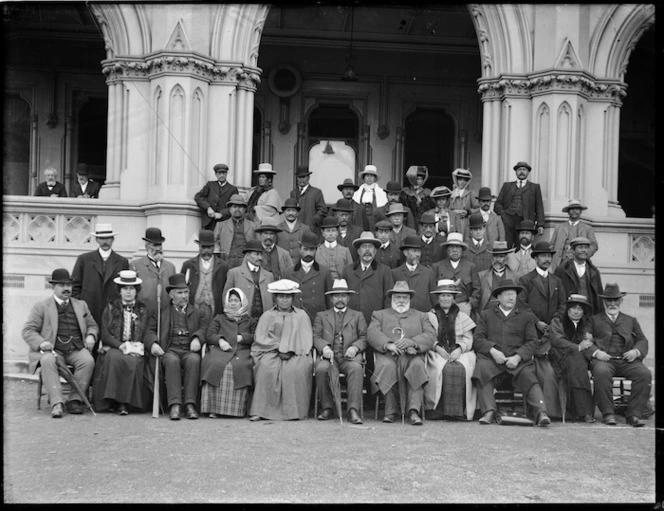
Government beekeeping was serious business by 1909! Isaac Hopkins, New Zealand's Government Apiarist, appears at the far left of the front row in this photograph of Wellington's Department of Agriculture staff. Alongside him are the officials helping to shape New Zealand's farming industries, including Prime Minister Sir Joseph Ward. Photo: Muir and Mackinlay. Otago Witness, 28 April 1909, via Papers Past, National Library of New Zealand.
Side quest 1: Who was Isaac Hopkins?
The man behind the 1914 report had quite a life. Isaac Hopkins (1837–1925) was born in London and came to New Zealand in the 1850s. He worked at sea and on the Thames goldfield before developing a keen interest in beekeeping. He began keeping bees in 1874, initially using a simple hive made from a gin case.
After studying modern beekeeping methods, he adopted moveable-frame hives, wrote practical manuals and helped establish commercial beekeeping operations. He worked with J. C. Firth at Matamata, bred queen bees, published beekeeping material and became an advocate for better management of bee diseases. In 1905 he was appointed Government Apiarist, helping develop New Zealand's beekeeping industry through education, research and regulation.
He was sometimes described as the father of New Zealand beekeeping. By the time he wrote the bumblebee report, he had decades of practical experience to draw upon. Your side quest: Find out what a moveable-frame hive is, and why it made life easier for beekeepers. Compare it with the sort of simple wooden box Hopkins used when he began.
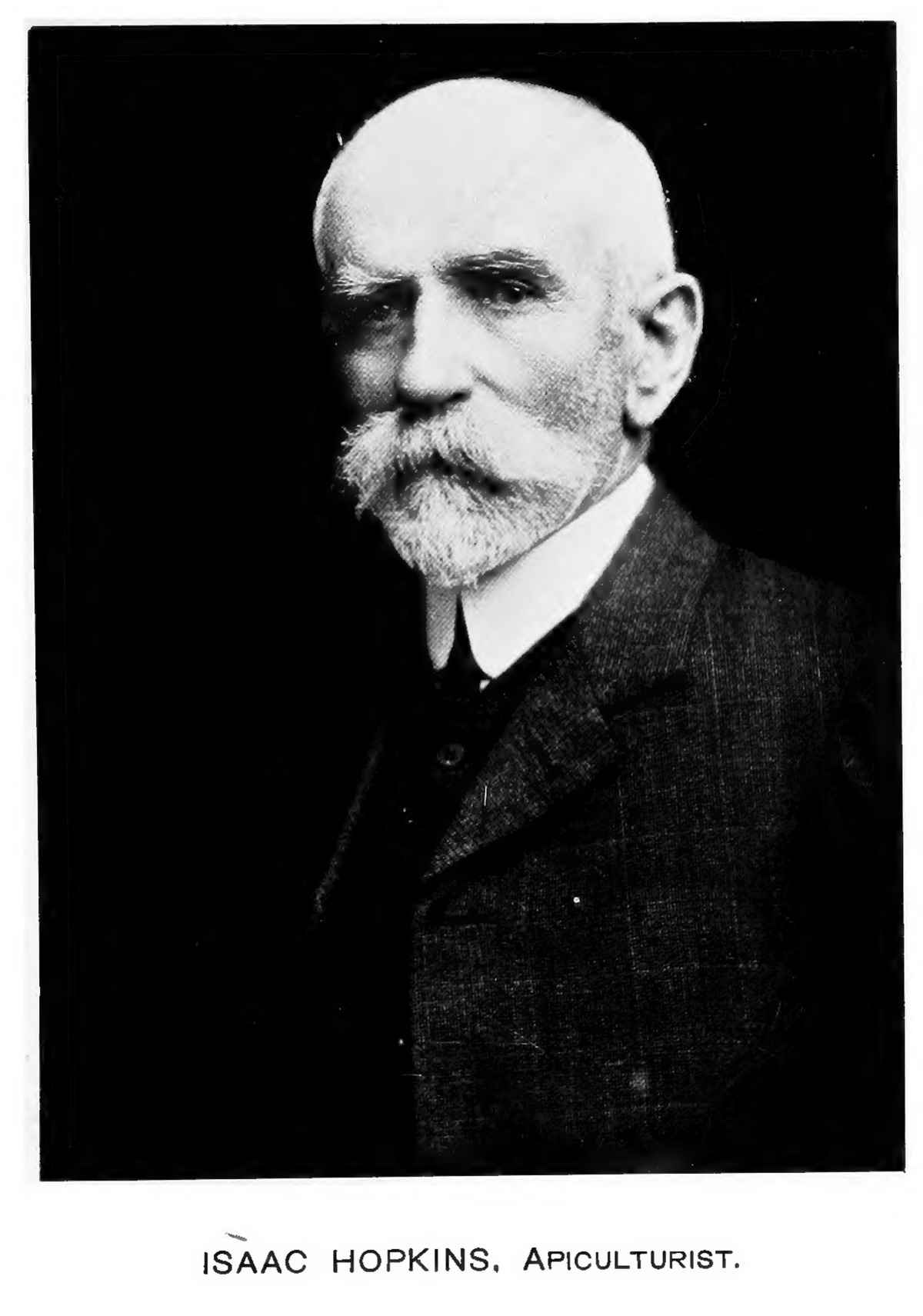
Isaac Hopkins (1837–1925), a pioneer of commercial beekeeping in New Zealand and the country's first Government Apiarist. Hopkins helped introduce modern beekeeping methods, encouraged better hive management and worked to improve the health and productivity of New Zealand's honey bee industry. Image credit: Portrait of Isaac Hopkins, published in Bee-culture by Isaac Hopkins, New Zealand Department of Agriculture, Bulletin No. 18, third edition, 1909. Frontispiece. Original held by Cornell University Library, digitised by the Internet Archive. Source: https://archive.org/details/cu31924003713652 Copyright: Public domain due to age. Photographer unidentified.
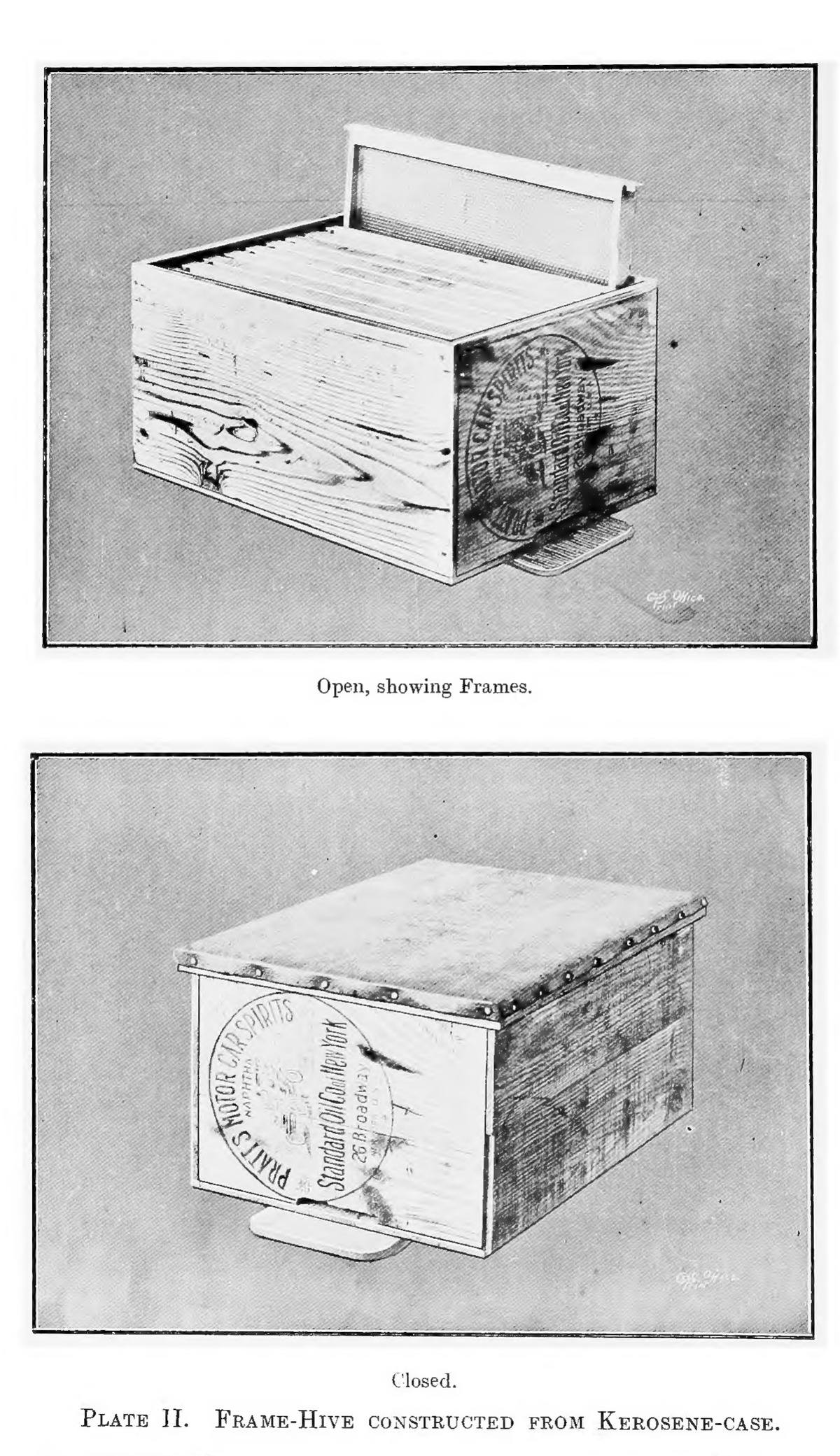
Beekeeping on a budget! In his 1909 guide, Isaac Hopkins explained how an ordinary wooden kerosene case could be converted into a modern movable-frame beehive. The top photograph shows the box open, with individual wooden frames that could be lifted out to inspect the honeycomb and check the colony's health. Below is the same hive with its lid closed. It offered settlers an inexpensive introduction to more practical beekeeping. Image credit: Frame-Hive Constructed from Kerosene-Case, Plate II, in Isaac Hopkins, Bee-culture, New Zealand Department of Agriculture, Bulletin No. 18, third edition, 1909. Original held by Cornell University Library, digitised by the Internet Archive. Source: https://archive.org/details/cu31924003713652 Copyright: Public domain due to age. Original image creator unidentified.
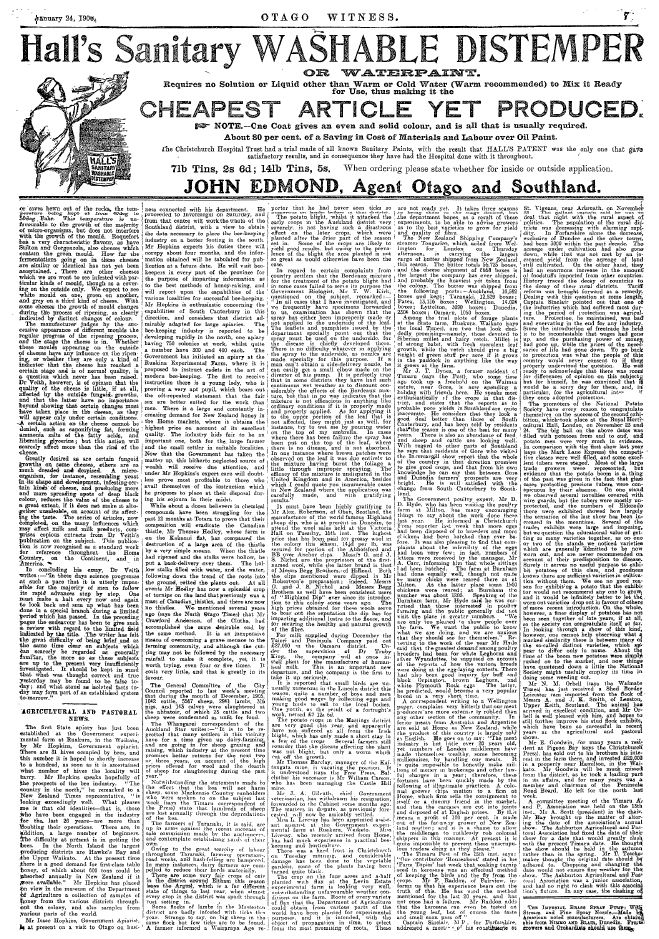
Otago Witness, 24 January 1906. The newspaper reported that Hopkins was enthusiastic about South Canterbury's prospects and considered the district well suited to large apiaries. He was travelling through the South Island, visiting beekeepers, examining local conditions and helping improve the industry. https://paperspast.natlib.govt.nz/newspapers/OW19060124.2.13.2
Side quest 2: From the beehive to Parliament
WuHoo! While researching Isaac Hopkins, I discovered that his work with bees had taken him right into the machinery of New Zealand's government.
In 1905, Hopkins was appointed Government Apiarist in the Department of Agriculture. This was a time when farming industries were expanding, and the government was investing in scientific knowledge, practical training and better regulation. He wasn't working inside Parliament itself, but his work was helping shape national agricultural policy. A photograph published in the Otago Witness on 28 April 1909 shows Hopkins at the far left of the front row among Wellington's Department of Agriculture staff. Also pictured is Prime Minister Sir Joseph Ward, who was Minister of Agriculture.
And here comes the South Canterbury connection! In January 1906, the Otago Witness reported that Hopkins was travelling through the South Island, visiting beekeepers, offering advice and assessing where the industry might flourish. The newspaper described him as enthusiastic about South Canterbury's prospects, considering the district "admirably adapted for large apiaries." So when we read Hopkins's publications today, we're looking at more than advice about keeping bees. We're discovering how practical knowledge, government support and local farming opportunities were helping develop an industry. And South Canterbury was already part of that conversation!
Photo caption: Wellington staff of the Department of Agriculture, published in 1909. Isaac Hopkins is seated at the far left of the front row. Prime Minister and Minister of Agriculture Sir Joseph Ward is also pictured. Photograph by Muir and Mackinlay. Otago Witness, 28 April 1909, via Papers Past, National Library of New Zealand.
Historical sources:
Otago Witness, 28 April 1909, Department of Agriculture staff photograph https://paperspast.natlib.govt.nz/newspapers/OW19090428.2.207.4.4
Otago Witness, 24 January 1906, Agricultural and Pastoral News, p. 5 https://paperspast.natlib.govt.nz/newspapers/OW19060124.2.13.2
Side quest: Why was the humble-bee report written?
This is one of my favourite parts of the history hunt in this document... In the preface, Hopkins explains that the early introduction attempts had largely been organised by private individuals and societies.
There weren't proper government records of who had imported the bees, where they were released or what happened afterwards. When people asked the Department of Agriculture about the history and results, officials struggled to provide accurate answers.
Hopkins had taken part in the experiments, so he was asked to gather the information before it disappeared. He consulted farmers, naturalists, agricultural organisations and seed merchants, compared accounts and assembled a record of what was known.
The result was Bulletin No. 46, published in March 1914, with 2,000 copies printed. It provided the Department and interested readers with an account of the introductions, their agricultural results and the risks of bringing in additional species. Hopkins even included advice about parasites and diseases that might accidentally accompany imported bees.
A side quest for you: Read Hopkins' preface. Who did he ask for help? How did he decide which information was reliable? And what did he admit he still didn't know?
This is how historical research works. Someone asks a question, searches for evidence and tries to account for the gaps... more than 110 years later, we can continue the investigation.
A little history to keep exploring
I'm rather pleased I found Hopkins' report.
I went looking for information about bumblebees and ended up reading about a Timaru woman, Victorian steamships, agricultural experiments and the development of our seed-growing industry. I'm still curious about Mrs Belfield and those two queens released in 1881. Perhaps someone has a family letter, an old newspaper clipping or another record that helps complete their story. Meanwhile, I'm going back to filming the bumblebees in our garden. There's always something new to see.
Do you have memories, photographs or family stories about beekeeping, clover-seed growing or the early farmers of South Canterbury? I'd love to hear from you.
Sources and further reading
- Isaac Hopkins, History of the Humble-Bee in New Zealand: Its Introduction and Results (1914), New Zealand Department of Agriculture, Bulletin No. 46. The original illustrations reproduced figures from F. W. L. Sladen's The Humble-bee and How to Domesticate It by permission of Macmillan & Co.
- New Zealand Times, 25 February 1881, reproducing the Timaru Herald account of Mrs Belfield's bumblebees.
- New Zealand Bumblebee Conservation Trust: Identification of bumblebees in NZ.
- Te Ara, Insects – overview: Introduced species, for the four established bumblebee species.
- Dictionary of New Zealand Biography: Isaac Hopkins.
- Te Papa: Bumble bees and pollen insights.
- WuHoo Timaru: Pollinators.